

Start by forming a separate legal entity, getting an EIN, and opening a business bank account. These three moves let you begin to build business credit right away, because every bureau, lender, and vendor uses them to verify that your business is a distinct entity from you personally.
Once that's done, move fast on the follow-up work:
- Register with Dun & Bradstreet for a free D‑U‑N‑S number, the identifier that anchors your business credit file.
- Open several vendor tradelines that report payment activity to a business bureau.
- Apply for a business credit card that reports to commercial business credit bureaus.
- Set every invoice to autopay or calendar reminders, since payment timing drives most of your early score.
Formosity Funding works well as a next step once these basics are in place, matching businesses with lenders that fit their stage and documentation.
Key Takeaways
Business credit is built through a specific sequence: legal entity formation, an EIN, a separate bank account, bureau registration, and reportable tradelines paid on time.
| Point | Details |
|---|---|
| Start with structure | Form an LLC or corporation and get an EIN before anything else can build a credit file. |
| Separate your accounts | A dedicated business bank account proves financial independence from your personal finances. |
| Confirm reporting | Ask vendors and card issuers directly whether they report to Dun & Bradstreet, Experian Business, or Equifax Business. |
| Pay on time or early | Payment history, measured through days beyond terms, is the primary driver of your PAYDEX score. |
| Use funding help strategically | Formosity Funding offers no-impact pre-qualification and lender matching once your basic documents are ready. |
Table of Contents
- What Does It Take to Build Business Credit From Scratch?
- How Long Does It Take to Build Business Credit?
- How Do You Monitor and Fix Errors on Your Business Credit Report?
- Common Mistakes That Slow Down Business Credit Building
- When Does It Make Sense to Get Funding Help?
- What Actually Moves the Needle on Business Credit
- Ready to Put Your Business Credit to Work?
- Where to Register and Get Official Guidance
- Frequently Asked Questions
- Sources
What Does It Take to Build Business Credit From Scratch?
Building business credit is really about creating a paper trail that proves your company pays its bills reliably, separate from your personal credit history. Lenders, suppliers, and bureaus can't score what they can't see, so the entire process is a sequence of making your business visible, then making it look trustworthy. Here's the order that actually works.
1. Form a separate legal entity. An LLC or corporation draws a legal line between you and your business. Forming one early is standard advice because it lets bureaus create a distinct business file instead of folding your business activity into your personal credit history. Confirm your state filing is complete and your entity is in good standing before moving to the next step.
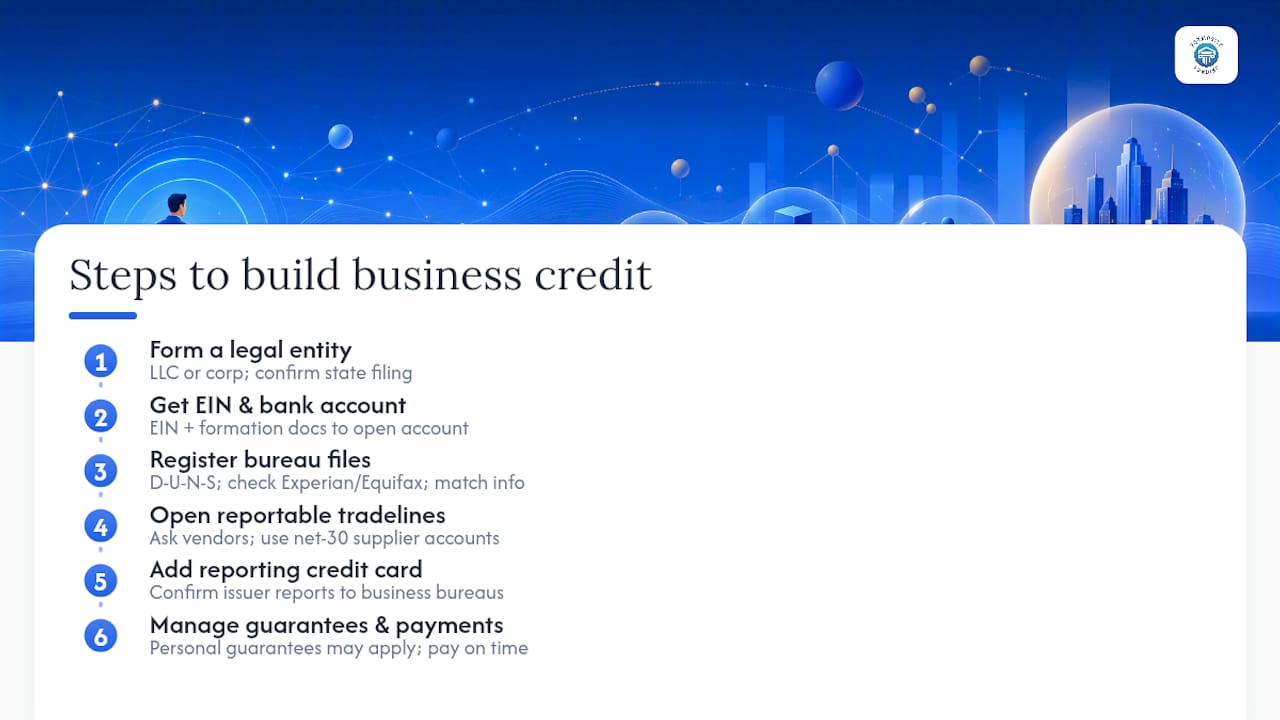
2. Get your EIN. The IRS issues Employer Identification Numbers for free, and most banks require one to open a business account. Think of the EIN as your business's Social Security number: bureaus and lenders use it to tie activity back to your company specifically.
3. Open a dedicated business bank account. Bring your EIN, formation documents, and ID to the bank. The FDIC notes that separating funds matters not just for bookkeeping but for proving your business operates independently, which lenders check before extending credit.
4. Register or confirm your bureau files. Get a free D‑U‑N‑S number from Dun & Bradstreet, and check whether you already have a file open at Experian Business or Equifax Business. Use identical business name, address, and phone number everywhere. A mismatch here is the single most common reason bureaus fail to link your activity into one clean file.
5. Open reportable tradelines. Most suppliers don't report payments to any bureau by default. Ask directly: "Does this account report to Dun & Bradstreet or Experian Business?" Net-30 vendor accounts (office supplies, shipping, inventory) are the fastest practical way to generate reportable payment history for a brand-new business.

6. Add a business credit card that reports. Not every card issuer reports to business bureaus, and some only report to personal ones. Confirm the reporting policy before applying.
7. Understand personal guarantees. Lenders often require a personal guarantee when your business has no credit history yet, and your personal credit can influence early approvals. As your business file matures with more tradelines and a track record, you can negotiate accounts without a personal guarantee attached.
8. Pay on time, or early. Payment history is the single biggest factor in your business credit score. Add tradelines gradually rather than all at once, and keep utilization low on any revolving accounts.
Pro Tip: Ask new vendors this exact question before opening an account: "Do you report payment history to Dun & Bradstreet, Experian, or Equifax?" A surprising number of net-30 suppliers only report on request, so asking is often the difference between a wasted account and a reportable one.
How Long Does It Take to Build Business Credit?
Expect a gradual buildup of your business credit profile. Starting with filing your entity, obtaining your EIN, and opening a bank account, you will gradually add vendor tradelines that report payment activity, which over time can lead to an established credit file and better financing terms.
Progress speeds up when you choose vendors known to report and slows down when your card issuer only reports to personal bureaus or when a supplier never submits your trade reference at all.
How Do You Monitor and Fix Errors on Your Business Credit Report?
Pull your file at Dun & Bradstreet, Experian Business, and Equifax Business at least twice a year, more often if you're actively applying for financing. Your PAYDEX score reflects days beyond terms (DBT), meaning how early or late you pay relative to invoice terms; a PAYDEX near 80 generally reflects on-time payment, while scores drop as DBT increases.
- Check that your D‑U‑N‑S number, legal name, and address match across all three bureaus.
- Flag any tradeline you don't recognize or any payment marked late that you paid on time.
- File a dispute directly with the bureau, attaching invoices or bank statements as proof.
- Recheck your file 30 to 45 days later to confirm the correction posted.
Pro Tip: Keep a simple folder, digital or physical, with every vendor invoice and payment confirmation. When you dispute an error, having documentation ready cuts resolution time significantly.
Common Mistakes That Slow Down Business Credit Building
- Don't use inconsistent business information. A different suite number or a shortened business name on one application can prevent bureaus from linking your accounts into a single file.
- Don't assume every vendor account reports. Many suppliers only report trade references if you specifically ask, so confirm before you count on an account to build history.
- Don't chase high credit limits. A low utilization ratio on a modest limit works better than a stretched limit on a big one.
- Don't mix personal and business spending. Keep every transaction inside the business account to preserve the separation you worked to establish.
- Do document every vendor relationship. Save the emails or account terms confirming that a supplier reports, so you have a record if a dispute ever comes up.
When Does It Make Sense to Get Funding Help?
Once your EIN, bank account, and a couple of reportable tradelines are in place, you're in a solid position to look at financing, whether that's working capital, a line of credit, or equipment financing. Formosity Funding matches businesses with a nationwide network of lenders and offers pre-qualification that doesn't affect your credit.
- Have your EIN, recent bank statements, and a few months of invoices ready before applying; this alone speeds up approval.
- A marketplace approach makes the most sense when you want multiple offers compared quickly instead of applying to lenders one by one.
- If you only need one specific product and already have a relationship with a lender, going direct might be simpler.
| Path | Best for |
|---|---|
| DIY lender applications | Businesses with an existing bank relationship and one clear financing need |
| Funding marketplace | Businesses wanting several offers compared side by side without separate applications |
Pro Tip: Even if you're not ready to borrow yet, running a no-impact pre-qualification tells you where your business credit profile stands in the eyes of actual lenders, not just a bureau score in isolation.
What Actually Moves the Needle on Business Credit
Most guides bury the real priority under a long checklist. The truth: one dependable, cleanly reporting tradeline beats five sloppy ones. Get your reporting right before you scale up the number of accounts.
Automate what you can, since a missed payment from human error costs you more than a low credit limit ever will. And when speed matters, or you want several lender offers instead of guessing which bank to approach, a funding marketplace is a legitimate shortcut worth using.
Ready to Put Your Business Credit to Work?
Building the profile is only half the job. The other half is turning it into actual financing when you need working capital, equipment, or room to grow. Formosity Funding connects your business with a nationwide network of lenders and shows you real offers, not just estimates, without a hard credit check to get started.
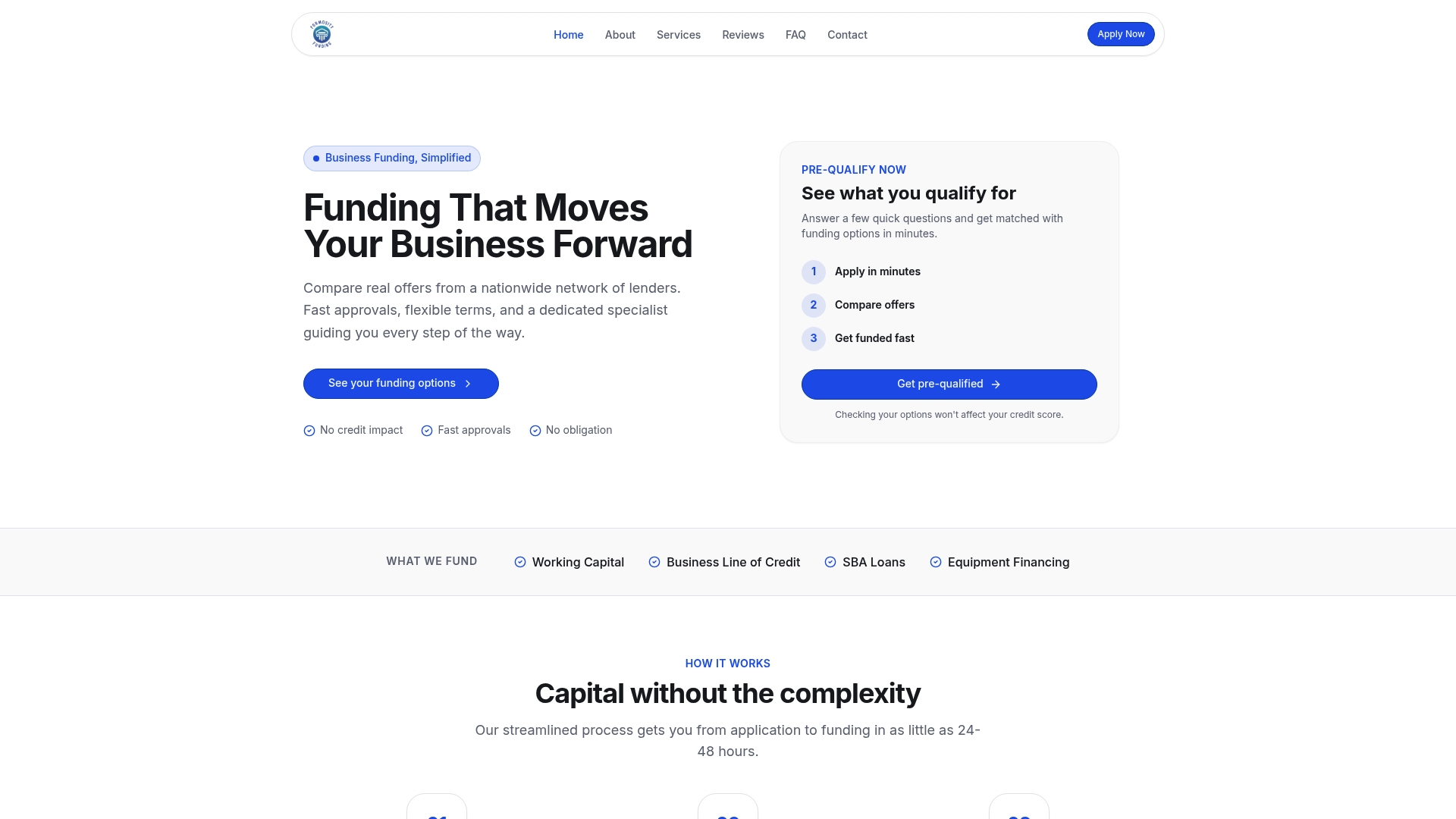
Once you've got your EIN, a few months of bank statements, and recent invoices in hand, you're ready to see what you qualify for. Head to Formosity Funding's services page to compare working capital, lines of credit, SBA loans, and equipment financing side by side, or start at the Formosity Funding homepage to get matched with a dedicated funding specialist who can walk you through next steps.
Where to Register and Get Official Guidance
- Apply for an EIN directly through the IRS at no cost.
- Register for a D‑U‑N‑S number with Dun & Bradstreet to start your business credit file.
- Find free counseling through your local Small Business Development Center for setup and planning support.
Frequently Asked Questions
What's the fastest way to build business credit? Open two or three net-30 vendor accounts that report to a business bureau, plus one business credit card with a reporting policy, and pay every bill early. That combination typically produces a scoreable file faster than any other approach.
What's the difference between business credit and personal credit? Personal credit tracks your individual borrowing history through your Social Security number. Business credit tracks your company's payment behavior through its EIN and D‑U‑N‑S number, and it's visible to lenders, suppliers, and sometimes business partners.
What is a good business credit score range? Dun & Bradstreet's PAYDEX score runs from 1 to 100, with scores around 80 generally reflecting on-time payment and higher scores reflecting early payment. Experian and Equifax use their own separate scoring ranges.
Do I need good personal credit to build business credit? Not indefinitely, but early on, many lenders require a personal guarantee and check your personal credit since your business has no track record yet. As your business file develops its own history, you can increasingly qualify for credit without a personal guarantee.
How often should I check my business credit report? At minimum twice a year, and more frequently if you're actively applying for financing or have recently disputed an error.
Sources
- Apply for an Employer ID Number (EIN) | IRS
- How to build business credit | Dun & Bradstreet
- How to build business credit in 10 steps | QuickBooks
- How to Build Business Credit for a Small Business | Wolters Kluwer
- Small Business Development Centers (SBDC) | SBA