

Yes, small businesses can consolidate debt, and it makes financial sense when the new loan's total cost (interest plus fees) is lower than the blended cost of what you're currently paying. Before you go further, do three things right now: total every balance and interest rate you're carrying, run a no-hard-pull prequalification through a lending marketplace, and pull together your last two years of business tax returns. The New York Fed's small business survey found that most small-business employer firms carry multiple debt instruments simultaneously, which means the math on consolidation is worth running for a large share of business owners. Two benchmarks to keep in mind from the start: your Debt Service Coverage Ratio (DSCR) needs to stay above 1.25 after the new payment, and the FTC recommends reviewing loan terms carefully before signing anything.
- Total all current balances, interest rates, and monthly payments
- Check prequalification (no hard credit pull) with a lending marketplace
- Collect two to three years of business tax returns and recent bank statements
Key Takeaways
Business debt consolidation saves money only when the new loan's total cost (interest plus fees) is lower than your current blended rate, and only when you close the accounts you pay off.
| Point | Details |
|---|---|
| Run the math first | Compare total cost of new loan vs. current debts over the same horizon before applying. |
| DSCR is the key threshold | Your Debt Service Coverage Ratio must stay at or above 1.25 after the new payment. |
| Soft-pull prequalification | Check offers from multiple lenders without a hard credit inquiry affecting your score. |
| Close paid-off accounts | Re-accumulating debt on cleared accounts is the most common reason consolidation fails. |
| Formosityfunding marketplace | Submit once to compare multiple real lender offers with no hard credit pull required. |
Table of Contents
- What is business debt consolidation, and how does it differ from refinancing?
- What consolidation options are available to U.S. small businesses?
- How does consolidation change your payments, and which costs actually matter?
- What do lenders look for, and what documents do you need?
- When is consolidation the wrong move?
- How to consolidate business debt: a step-by-step timeline
- What does a $50,000 consolidation loan actually cost?
- How do you pick the right lender and spot red flags?
- How Formosityfunding helps businesses consolidate debt
- When consolidation works and when it doesn't: a direct take
- Ready to compare real consolidation offers?
- Sources
What is business debt consolidation, and how does it differ from refinancing?
Business debt consolidation means replacing multiple outstanding debts with a single loan or credit facility that carries one monthly payment. The goal is usually a lower blended interest rate, simplified bookkeeping, or both. It is not the same as refinancing, and the distinction matters when you're choosing a strategy.
Xero's small business debt management guide draws a clean line between the three main approaches:
- Consolidation: Combines several debts (credit cards, merchant cash advances, short-term loans) into one new loan. The benefit is simplicity and, ideally, a lower rate. The risk is that clearing old accounts creates available credit you might re-use.
- Refinancing: Replaces a single existing loan with a new one, usually to extend the term, lower the rate, or change the lender. You're not combining multiple debts; you're restructuring one.
- Debt management: A broader strategy, sometimes involving a third-party plan, that renegotiates payment schedules with existing creditors without necessarily taking on new debt. More common for consumer debt but available to businesses through structured workouts.
One tax note worth flagging early: interest on a business loan used for business purposes is generally tax-deductible under IRS rules. Interest on a personal loan used for business may also be deductible, but only if the funds are clearly documented as going to the business. Sloppy documentation kills the deduction.
The behavior change requirement is the part most articles skip. Consolidation works mathematically only when the new loan's weighted cost is lower than your current blended rate, and when you actually close or freeze the accounts you just paid off. Leaving them open is how businesses end up with more total debt six months later.
What consolidation options are available to U.S. small businesses?
The product you choose depends on your credit profile, how fast you need funds, and how much documentation you can produce. Here is a quick map of the main options, followed by a comparison of key parameters.
- Bank term loans: Lower APRs, larger amounts, but slow underwriting (four to eight weeks) and strict documentation requirements. Best for established businesses with strong financials.
- SBA 7(a) loans: The SBA's flagship program allows refinancing of existing business debt under certain conditions. Rates are capped and terms can run up to 10 years for working capital. Processing takes longer than online lenders, and SBA guarantee fees apply.
- Online term lenders and marketplaces: Faster approvals (sometimes same-day), but APRs run higher. Good for businesses that need speed or have thinner credit files.
- Business lines of credit: Useful for consolidating revolving debt, but the variable rate and revolving structure can work against you if discipline is an issue.
- Personal loans used for business: Lower documentation burden, but smaller amounts and the tax-deductibility issue noted above. The SBDC's consolidation guide specifically flags the tradeoff between personal and business credit for this purpose.
- Equipment or asset-backed refinance: If the debt you're consolidating is tied to equipment, a secured refinance can lower the rate significantly by pledging the asset as collateral.
- Borrowing to pay off merchant cash advances (MCAs): MCAs are not loans; they are purchases of future receivables. Paying one off with a term loan converts a factor-rate obligation into an amortizing loan, which almost always reduces total cost. Lenders treat MCA payoffs carefully, though, and some won't touch them.
A few debt types lenders often won't consolidate or will treat as special cases, such as tax liens, court judgments, and certain government-backed loans with prepayment restrictions.
APR ranges reflect general market conditions and vary by lender, loan size, and borrower profile.
How does consolidation change your payments, and which costs actually matter?
The monthly payment is the number most business owners focus on, but total interest paid over the life of the loan is the number that determines whether consolidation saves money. A lower monthly payment achieved by stretching the term can cost significantly more in total interest.
APR vs. nominal rate vs. amortization: The nominal interest rate is what the lender advertises. APR (Annual Percentage Rate) adds origination fees and other costs into the effective rate, making it the right number for comparing offers. Amortization determines how much of each payment goes to interest vs. principal; early payments on a standard amortizing loan are mostly interest.
Common fees to factor into your total-cost calculation:
- Origination fee: Typically 1%–5% of the loan amount, deducted upfront or rolled into the principal
- SBA guarantee fee: Charged on the guaranteed portion of SBA loans; rate varies by loan size and term
- Prepayment penalty: Some lenders charge a percentage of remaining principal if you pay off early
- Closing fees: Title, legal, or administrative costs on secured loans
- Servicing fees: Ongoing monthly or annual fees on some products
Pro Tip: Run a break-even comparison before you commit. Add up the total remaining interest on all current debts over a fixed horizon (say, 36 months). Then calculate the total cost of the new loan over the same period, including origination fees. If the new total is lower, consolidation saves money over that window. If you're rolling the origination fee into the principal, include it in the financed amount when you run the amortization calculation.
Free amortization calculators from sources like the SBA's website or standard financial tools let you plug in principal, APR, and term to get monthly payment and total interest in seconds.
What do lenders look for, and what documents do you need?
Lenders underwriting a consolidation loan are essentially asking one question: can this business service the new debt without defaulting? The metrics they use to answer it are fairly consistent across lender types.
Core underwriting criteria:
- Time in business: Most banks and SBA lenders want two or more years. Online lenders often accept one year.
- Annual revenue: Minimums vary widely; $100,000 is a common floor for online lenders, $250,000+ for banks.
- Personal credit score: 650 is a rough floor for online lenders; 680+ for SBA and bank products.
- Business credit: Lenders check Dun & Bradstreet, Experian Business, and Equifax Business profiles.
- DSCR: Your Debt Service Coverage Ratio (net operating income divided by total annual debt payments) should be at or above 1.25 after the new loan payment is factored in. Below 1.0 means the business cannot cover its debt from operations.
- Collateral: Secured loans require pledged assets. Many SBA loans require a personal guarantee.
Standard document checklist:
- Two to three years of business tax returns
- Three to six months of business bank statements
- Profit and loss statement and balance sheet (current year-to-date)
- Complete list of existing debts: creditor name, balance, interest rate, monthly payment
- Personal financial statement (required for SBA and most bank loans)
- Business license and formation documents
Pro Tip: Most online lenders and marketplaces offer soft-pull prequalification, meaning they check your credit profile without a hard inquiry that affects your score. Use this to compare real offers from multiple lenders before you commit to a full application. The SBDC's consolidation guide recommends this approach specifically to avoid unnecessary credit-score impact.
Timeline expectations: online lenders can fund in one to five business days after a complete application. SBA loans typically take 30–90 days from application to funding. Traditional bank loans fall in between, usually four to eight weeks.
When is consolidation the wrong move?
Consolidation is not a universal fix. Several scenarios exist where it makes the situation worse, not better.
Principal risks:
- Longer amortization increases total interest: Stretching a 12-month obligation into a 60-month loan lowers the monthly payment but can double the total interest paid.
- Secured lending puts assets at risk: Converting unsecured debt into a secured loan means a default could cost you equipment, real estate, or other collateral.
- Re-accumulating debt: Paying off credit cards and lines of credit frees up available credit. Many businesses run those balances back up within a year, ending up with more total debt than before.
- Fees that negate savings: A 3%–5% origination fee on a large loan can wipe out months of interest savings, especially on shorter-term consolidations.
Alternatives when consolidation won't work:
- Debt settlement: Negotiating with creditors to accept less than the full balance. Damages credit significantly but can resolve unmanageable debt faster than a new loan.
- Structured workout/restructuring: Working directly with lenders to modify payment terms, extend maturities, or temporarily reduce payments. J.P. Morgan's business debt management guidance recommends proactive maturity extension as a standard capital-structure tool.
- Chapter 11 bankruptcy: Allows a business to reorganize debt under court supervision while continuing to operate. Expensive and complex, but preserves the business.
- Chapter 7 bankruptcy: Liquidates the business to pay creditors. The end of the road, not a restructuring tool.
SBA COVID-era loan caveats: If your business carries a COVID-era Economic Injury Disaster Loan (EIDL) or had a Paycheck Protection Program (PPP) loan, the rules around refinancing or consolidating those balances are specific. The SBA's COVID-era programs page outlines servicing options for EIDL borrowers and procedures lenders must follow when PPP proceeds were used to refinance EIDLs. Check that guidance before treating an EIDL balance as a standard consolidation target.
For complex situations involving secured debt, tax liens, SBA loans, or court judgments, consult a business attorney or a certified financial advisor before proceeding.
How to consolidate business debt: a step-by-step timeline
The process from decision to funded loan typically takes two to twelve weeks depending on the lender type. Here is the sequence.
- Inventory all debts (1–2 days): List every creditor, balance, interest rate, monthly payment, and remaining term. Calculate your current blended interest rate.
- Calculate DSCR and projected savings (1–2 days): Run your net operating income against projected new debt service. Confirm DSCR stays above 1.25. Compare total cost of new loan vs. current debts over a fixed horizon.
- Choose a product type (1 day): Based on your credit profile, revenue, and urgency, decide whether you're targeting a bank loan, SBA 7(a), or online lender.
- Get soft prequalifications (1–3 days): Submit to two or three lenders or a marketplace for no-hard-pull offers. Compare APR, term, fees, and prepayment terms.
- Prepare and submit a full application (3–7 days): Gather all documents from the checklist above and submit the complete package to your chosen lender.
- Review terms and request payoff letters (2–5 days): Once approved, review the loan agreement carefully. Request written payoff letters from every existing creditor showing the exact amount needed to close each account.
- Close the loan and confirm payoffs (1–3 days): At closing, confirm the lender will disburse funds directly to creditors or provide written confirmation of payoff. Keep copies of every payoff confirmation.
- Close or freeze old accounts (same day as payoff): Do not leave paid-off credit lines open. Close them or formally freeze them to prevent re-accumulation.
- Set up autopay on the new loan (day of funding): Missed payments on a consolidation loan can trigger default provisions that are worse than the original debt situation.
Pro Tip: Get payoff letters in writing before closing, not after. Some lenders will issue a verbal payoff amount that differs from the written figure by days of accrued interest. The SBDC's step-by-step guide specifically recommends confirming written payoff letters as a key step before funds are disbursed.
Estimated total timeline: online lenders, 5–10 business days; bank loans, 4–8 weeks; SBA 7(a), 6–12 weeks.
What does a $50,000 consolidation loan actually cost?
Three scenarios below show how term length and APR interact on a $50,000 consolidation loan.
A few things stand out. The 10-year loan has the lowest monthly payment by far ($661 vs. $1,966), but it costs nearly $8,500 more in total interest than the 3-year option. The origination fee in scenario four adds $2,704 to the total cost over five years, which is more than the $1,500 fee itself because you're paying interest on the rolled-in fee amount.
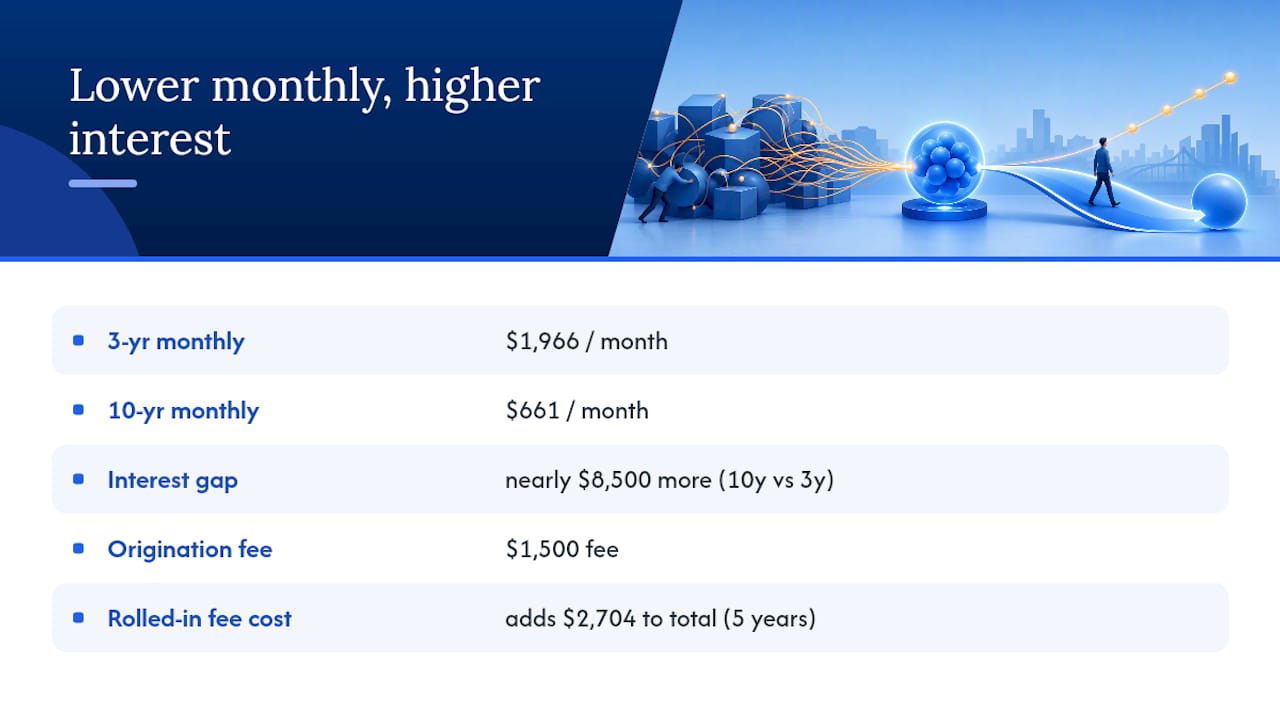
To run your own numbers, use any standard amortization calculator. For SBA loans, add the guarantee fee (which varies by loan size and term) to the financed amount the same way scenario four handles the origination fee. The SBA publishes current guarantee fee schedules on its website.
How do you pick the right lender and spot red flags?
APR is the starting point, not the finish line. Before you sign, work through these questions with every lender.
Questions to ask every lender:
- What is the total APR including all fees?
- Is there a prepayment penalty, and how is it calculated?
- Are there restrictions on how loan proceeds can be used?
- What collateral is required, and what happens to it if I refinance again later?
- Will you provide written payoff letters directly to my existing creditors at closing?
Red flags that should stop you cold:
- Pressure to sign within 24–48 hours with no time to review documents
- Fees that are described verbally but not itemized in writing
- Inconsistent answers about the payoff process for existing creditors
- Refusal to provide sample loan documents before application
- A lender who cannot explain how the APR was calculated
Trust signals to look for:
- NMLS registration: for mortgage-related products and many commercial lenders, verify the lender's registration at NMLS Consumer Access
- Clear, written loan documents provided before closing
- A documented underwriting timeline with written milestones
- Transparent fee schedule in the loan agreement, not just the term sheet
Negotiating room: Origination fees are often negotiable, especially for larger loan amounts or strong credit profiles. Push for no prepayment penalty if you think you might pay off early. On SBA loans, ask whether the guarantee fee can be rolled into the principal rather than paid upfront. The FTC's credit and loans guidance is a useful reference for understanding your rights as a borrower and identifying deceptive practices.
How Formosityfunding helps businesses consolidate debt
Formosityfunding operates as a lending marketplace, which means instead of applying to one lender and hoping for the best, you submit once and receive multiple real loan offers from a network of lenders. For a business evaluating consolidation, that difference matters because the spread between the best and worst offer on a $50,000 loan can be several percentage points of APR.

The platform's prequalification process uses a soft credit pull, so checking your options does not affect your credit score. From there, dedicated funding specialists help match your business to the right product: working capital loans, SBA loans, term loans, or lines of credit depending on what your debt profile and financials support.
Key features relevant to consolidation:
- No-hard-pull prequalification to compare real offers
- Access to multiple lender offers from a single application
- Support across product types including SBA loans and term loans
- Dedicated specialists who can walk through payoff coordination
Explore Formosityfunding's funding options to see which products fit your consolidation scenario.
When consolidation works and when it doesn't: a direct take
The businesses that benefit most from consolidation share a specific profile: steady monthly revenue, a DSCR that clears 1.25 after the new payment, and the discipline to close the accounts they just paid off. That last point is where most consolidation attempts fail, not in the math.
The business owner who does this successfully treats the cleared accounts as closed, not as available credit.
The failure pattern looks different: a business consolidates $80,000 in debt, frees up three credit lines, and runs them back up to $60,000 within 18 months. Now they have the consolidation loan and the new balances. J.P. Morgan's debt management research frames this as a capital-structure discipline problem, not a financing problem. The loan is a tool; the behavior is the outcome.
My rule of thumb: if you cannot honestly answer "yes" to both of these questions, consolidation is not ready to work for you. First, will the new loan's total cost be lower than your current blended cost over the same horizon? Second, will you close the accounts you pay off?
Ready to compare real consolidation offers?
Carrying multiple business debts at different rates is expensive and distracting. Formosityfunding gives you a faster path to real offers without the guesswork of applying to lenders one at a time. Submit once, get matched to multiple lenders, and compare APR, terms, and fees side by side with a dedicated specialist walking you through the process.
No hard credit pull to check your options. Prequalify now at Formosityfunding and see which consolidation products fit your business's profile today.
Sources
- COVID-era programs - Small Business Administration
- Small business debt management: strategies and tips | Xero US
- How to Consolidate Your Business Loans
- Consumer
- New York Fed small business report
This article is general information, not a substitute for advice from a qualified financial advisor. Consult a qualified financial professional about your own circumstances before acting on anything here.