

Typical U.S. Most new bank-originated lines fall in the mid-to-high single digits. The Small Business Lending Survey from the Kansas City Fed reported medians around 7% for new lines in recent quarters, with Q1 2026 data showing a substantial year-over-year increase in new credit lines at large and midsized banks. SBA-backed lines carry program-specific rate caps that generally keep them below what most online lenders charge, though they come with guarantee fees and longer processing times.
A few things consistently push the effective cost above the headline rate:
- Draw fees (typically 1%–2% per draw), charged each time you pull funds
- Annual or maintenance fees that apply whether you draw or not
- Factor or flat fees used by some online lenders instead of APR, which can translate to very high annualized rates if not converted properly
- Unused-availability fees charged on the portion of the credit line you haven't drawn
The rate you see advertised is rarely the rate you pay once fees are included. The sections below break down current market numbers, how pricing is structured, what lenders actually look at, and how to compare offers on equal footing.
Key Takeaways
| Point | Details |
|---|---|
| Headline rate range | Bank lines typically run 4%–12%; online/alternative lenders often charge 15%–60%+ APR. |
| Fees inflate effective cost | Draw fees (1%–2%), origination (0.5%–2%), and annual fees can push a 7.5% rate to 11.5% effective cost. |
| Biggest rate levers | Credit scores, revenue documentation, and collateral are the three factors that move your rate most. |
| Always normalize offers | Convert factor rates and fees to annualized cost using your expected draw pattern before comparing lenders. |
| Formosityfunding | Matches small businesses to real, personalized line of credit offers from multiple lenders with no hard credit pull during prequalification. |
Table of Contents
- What are current business line of credit rates in the U.S.?
- How is interest on a business line of credit actually structured?
- What fees push your borrowing cost above the headline rate?
- What do lenders look at when setting your rate?
- How do you qualify for the lowest rate available?
- When does a business line of credit make sense versus other options?
- U.S. tax and regulatory notes that affect your borrowing cost
- Questions to ask every lender before you accept an offer
- Where the numbers in this article come from
- An honest take on how to use this guide
- Formosityfunding connects you to competitive line of credit offers
- Sources
What are current business line of credit rates in the U.S.?
The most reliable benchmark for U.S. small business lending rates is the Kansas City Fed's quarterly Small Business Lending Survey, which collects actual transaction data on rates, spreads, and terms from banks across the country. That's a different animal from advertised APRs, which represent starting offers for the most qualified borrowers.
Bankrate reports that advertised APRs can vary widely, from low single digits for some lenders to much higher rates for certain online and alternative lenders. The survey medians, reflecting what banks are actually closing, tend to be in the mid-to-high single digits for new lines.
| Lender Type | Typical APR Range | Notes |
|---|---|---|
| Traditional banks / credit unions | Generally low to mid single digits | Best rates for secured, well-qualified borrowers |
| SBA-backed lines (CAPLines) | Moderate rates with program caps | Guarantee fees add to effective cost |
| Online / fintech lenders | Higher rates, sometimes with factor or flat fees | Faster approval; fee structures vary |
Q1 2026 data from the Kansas City Fed showed a notable 117-basis-point year-over-year decrease in variable-rate new lines of credit at rural banks, while urban bank rates moved in the opposite direction. Geography matters more than most borrowers realize. A rural community bank competing for local business relationships may offer meaningfully tighter spreads than a large national lender quoting the same borrower online.
The gap between advertised rates and survey medians also reflects the difference between what lenders publish and what they actually close. Many lenders don't publish firm rates at all, which means you need to prequalify to see real pricing. That opacity is one of the strongest arguments for comparing multiple offers before committing.
How is interest on a business line of credit actually structured?
Understanding the pricing mechanics is what lets you compare a bank offer against an online lender offer without being misled by the headline number.
Variable rates are the most common structure for business lines of credit. The lender sets a margin (also called a spread) above a benchmark rate, typically the prime rate or SOFR (Secured Overnight Financing Rate). When the benchmark moves, your rate moves with it. CapitalXO notes that well-qualified borrowers at traditional banks often see margins of prime plus 1%–3%.

Fixed rates on specific draws are less common but available at some banks. You lock a rate on a given draw for a defined repayment period, which removes benchmark risk but typically costs a bit more upfront than a variable quote at the same moment.
Factor or flat fees are a different structure entirely, common with short-term online lenders. Instead of an interest rate, the lender charges a multiplier on the amount drawn. A factor rate of 1.25 on a $20,000 draw means you repay $25,000 total, regardless of how quickly you pay it off. That $5,000 fee sounds manageable until you annualize it.
Here's a simple conversion:
- Calculate the total fee: $20,000 × 0.25 = $5,000
- Divide by the loan amount: $5,000 ÷ $20,000 = 25%
- Divide by the loan term in years: if the term is 6 months, 25% ÷ 0.5 = 50% annualized
That's the number to compare against a bank's APR. Factor-rate products are not inherently predatory, but they are frequently misunderstood.
Secured vs. unsecured pricing follows a predictable pattern. Xero confirms that secured lines generally carry lower rates than unsecured lines, because collateral reduces the lender's loss exposure. Pledging accounts receivable, inventory, or real estate can move your rate down by several percentage points.
Pro Tip: *When an online lender quotes a weekly or monthly fee instead of an APR, always convert it to an annualized figure before comparing.
What fees push your borrowing cost above the headline rate?
The headline rate is only part of what you pay. Fees can add several percentage points to your effective annual cost, and they're often buried in the fine print.
Common fees to identify and quantify before accepting any offer:
- Origination fee: A one-time charge at closing, typically 0.5%–2% of the credit limit. On a $100,000 line, that's $500–$2,000 upfront.
- Draw fee: Charged each time you pull funds, usually 1%–2% of the draw amount. If you draw frequently, this compounds fast.
- Annual or maintenance fee: A flat fee charged yearly (or monthly) to keep the line open. Traditional lenders often charge $0–$500 annually; some online lenders charge more.
- Unused-availability fee: Applied to the undrawn portion of your credit line, typically 0.1%–0.5% annually. This penalizes you for having a cushion you don't use.
- Prepayment penalty: Some lenders charge a fee if you pay off a draw early, which eliminates one of the main advantages of a line of credit.
- SBA guarantee fee: For SBA-backed lines, the guarantee fee is a program-specific cost that affects total effective cost and varies by loan size and term.
How to calculate first-year effective cost on a sample scenario:
- Assume a $100,000 line with a 7.5% variable rate, 1% origination fee, $250 annual fee, 1.5% draw fee, and you draw $50,000 once and hold it for the full year.
- Interest: $50,000 × 7.5% = $3,750
- Origination fee (on the limit): $100,000 × 1% = $1,000
- Draw fee: $50,000 × 1.5% = $750
- Annual fee: $250
- Total first-year cost: $5,750 on a $50,000 drawn balance = 11.5% effective rate
That gap is where borrowers get surprised.
Weekly or monthly fee structures, common with some online lenders, are the most aggressive version of this problem. If draws are frequent and balances roll, the effective cost climbs quickly.

Pro Tip: Ask every lender for the total dollar cost of borrowing under your expected draw pattern, not just the rate. A lender willing to model that scenario for you is showing you something about how they operate.
What do lenders look at when setting your rate?
Your rate isn't arbitrary. Lenders run a risk-pricing model, and knowing what goes into it tells you exactly which levers to pull before you apply.
Borrower-level factors:
- Personal credit score: Most bank lenders want 680 or higher for competitive pricing; some online lenders go lower but charge significantly more.
- Business credit score: Dun & Bradstreet PAYDEX, Experian Business, and Equifax Business scores all factor in. A strong business credit profile can reduce reliance on personal guarantees.
- Time in business: Two years is the common threshold for bank lines; some online lenders work with 6–12 months but price the added risk into the rate.
- Annual revenue and cash flow: Lenders want to see consistent revenue and positive cash flow. Debt-service coverage ratio (DSCR) of 1.25x or higher is a common minimum.
- Collateral: Pledging specific assets (A/R, inventory, equipment, real estate) moves you from unsecured to secured pricing, which typically means a lower rate.
- Existing banking relationship: Deposit accounts, payroll services, and other products at the same bank often translate to relationship pricing.
Lender-level and macro factors:
- Lender type: Banks and credit unions price more competitively than online lenders for qualified borrowers, but they take longer and have stricter documentation requirements.
- Benchmark rates: Prime and SOFR directly affect variable-rate pricing. When the Fed moves rates, your variable-rate line moves with it.
- Geography: The Kansas City Fed Q1 2026 survey showed a 117-basis-point year-over-year decrease in variable-rate new lines at rural banks, while some urban bank rates increased. Your local banking market matters.
- Market conditions: Loan demand trends affect lender appetite. The same Q1 2026 survey showed new credit lines up 31.1% year-over-year at large and midsized banks, signaling active competition for qualified borrowers.
For context on how commercial lending dynamics vary across bank sizes and regions, the commercial mortgage lending landscape offers useful background on how lender type and market position shape pricing across different credit products.
How do you qualify for the lowest rate available?
That gap is worth working for before you apply.
Three things that move the needle most:
- Credit scores: Pull your personal credit report from AnnualCreditReport.com and your business credit reports from Dun & Bradstreet, Experian Business, and Equifax Business. Dispute errors, pay down revolving balances, and avoid new hard inquiries in the 90 days before applying.
- Revenue documentation: Lenders want 2–3 years of business tax returns, recent profit-and-loss statements, and 3–6 months of bank statements. Clean, consistent revenue with positive trends is the single strongest pricing signal.
- Time in business: If you're approaching the two-year mark, waiting a few months before applying can move you into a lower-risk tier at many banks.
Additional actions that improve your offer:
- Pay down short-term debts to improve your DSCR before applying
- Add qualified collateral (A/R aging schedule, inventory list, equipment appraisal) to shift from unsecured to secured pricing
- Move operating accounts to the lender you're targeting, or document an existing relationship
- Gather a complete financial package before the first conversation: two years of tax returns, current P&L, balance sheet, A/R aging, and a brief business overview
Negotiation tactics that actually work:
- Competing offers are your strongest tool. A written offer from another lender at a lower rate gives you something concrete to show.
- Focus negotiation on the origination fee before the margin. Lenders have more flexibility on one-time fees than on the spread, which is often tied to internal pricing models.
- Ask specifically about relationship pricing: "What does my rate look like if I move my operating account here?"
Pro Tip: When presenting a competing offer, lead with the total first-year cost comparison, not just the rate. A lender who sees you've done the math is more likely to take the conversation seriously.
That's a favorable environment for borrowers who come prepared.
When does a business line of credit make sense versus other options?
A line of credit is the right tool for recurring, short-term cash flow needs. It's not always the right tool for everything else.
Alternatives and when they fit better:
- SBA-backed lines (CAPLines): Best for businesses that qualify and can tolerate a longer approval timeline (often 30–90 days). SBA programs carry rate caps and guarantee fees, but the effective rate is often lower than what most online lenders charge. The tradeoff is paperwork and time.
- Term loans: Better for a single, defined capital need (equipment purchase, renovation, acquisition). You get a lump sum at a fixed or variable rate with a set repayment schedule. Equipment loan rates and equipment financing rates are often lower than unsecured line rates because the asset itself serves as collateral.
- Equipment financing: When the purchase is a specific piece of equipment, equipment financing rates are typically more favorable than a general line of credit because the lender takes a security interest in the asset. Average equipment financing rates often run below general unsecured line rates for the same borrower.
- Business credit cards: Useful for small, recurring purchases under $10,000–$20,000 where you can pay the balance monthly. Rewards programs add value, but carrying a balance at 20%–29% APR is expensive.
- Merchant cash advances (MCAs): Fast and accessible, but factor rates translate to annualized costs that frequently exceed 50%–100%. For context on how private-money and alternative lenders price risk, private money lending dynamics in 2026 illustrates how speed-to-funding commands a significant price premium.
- Invoice financing / factoring: Useful when you have outstanding receivables and need cash now. The lender advances 70%–90% of invoice value and collects from your customers. Effective rates vary widely.
The core tradeoff across all alternatives:
| Product | Speed | Price | Flexibility |
|---|---|---|---|
| Bank line of credit | Slow (weeks) | Low to moderate | High |
| SBA-backed line | Slowest (30–90 days) | Lowest (with caps) | Moderate |
| Online line of credit | Fast (days) | High | High |
| Term loan | Moderate | Low to moderate | Low |
| Equipment financing | Moderate | Low (asset-secured) | Low |
| Business credit card | Immediate | High if carried | High |
| Merchant cash advance | Fastest | Highest | None |
The right product depends on what you need the money for, how quickly you need it, and what you can qualify for. A line of credit wins on flexibility; a term loan wins on price for a defined capital need; SBA wins on rate if you can wait.
U.S. tax and regulatory notes that affect your borrowing cost
This section is general information, not tax advice. Consult a qualified tax professional before making decisions based on deductibility.
The IRS generally allows businesses to deduct interest paid on business loans, including lines of credit, as a business expense. However, Xero notes that the Tax Cuts and Jobs Act introduced a limitation: business interest expense deductibility is generally capped at 30% of adjusted taxable income (ATI) for businesses above a certain revenue threshold. Smaller businesses may qualify for an exemption from this cap, but the rules depend on entity type and gross receipts.
A few additional regulatory points worth knowing:
- SBA rate caps: SBA-backed lines have program-specific maximum rates tied to benchmark rates plus a program spread. These caps protect borrowers from the highest end of alternative lender pricing.
- State usury laws: Some states cap interest rates on commercial loans, though many states have broad exemptions for business lending. Know your state's rules before accepting an offer from an out-of-state online lender.
- NMLS licensing: Online lenders operating in your state should be registered with the Nationwide Multistate Licensing System. You can verify a lender's registration at NMLS Consumer Access before accepting any offer.
Pro Tip: To substantiate a business interest deduction, the IRS and lenders commonly want to see: the loan agreement, bank statements showing interest payments, and documentation that the funds were used for a business purpose. Keep these in a dedicated file for each credit facility.
Questions to ask every lender before you accept an offer
Most borrowers compare headline rates. The ones who get the best deals compare total cost. Here's the exact list of questions to run through with every lender.
Rate and pricing:
- What is the benchmark rate (prime or SOFR) and your current spread/margin?
- Is there a rate floor or cap on the variable rate?
- Is this quoted as an APR, or is it a factor rate or flat fee? If factor or flat, what is the annualized equivalent?
- What is the all-in APR including all fees?
Fees:
- What is the origination fee, and is it charged on the limit or the drawn amount?
- Is there a draw fee, and what percentage?
- What is the annual or maintenance fee?
- Is there an unused-availability fee on the undrawn portion?
- Are there prepayment penalties on individual draws?
Terms and structure:
- What is the draw period, and what happens at the end of it?
- What is the repayment schedule on each draw (interest-only, amortizing, balloon)?
- What collateral is required, and how is it valued?
- Are there financial covenants (minimum revenue, DSCR requirements) that could trigger a rate change or acceleration?
Process:
- What is the expected timeline from application to funding?
- What happens at renewal: is the line re-underwritten, and can the rate change?
- Does unused credit trigger re-pricing or fees at renewal?
How to normalize offers for comparison:
Once you have answers, build a simple spreadsheet: enter your expected average outstanding balance, draw frequency, and hold period. Apply each lender's rate plus fees to that scenario. The output is a dollar-cost comparison that makes the choice obvious, regardless of how each lender framed their offer.
Where the numbers in this article come from
The rate ranges and market data cited throughout this article draw from a specific set of primary and secondary sources. Understanding what each one measures helps you interpret the numbers correctly.
Primary sources used:
- Kansas City Fed Small Business Lending Survey (Q1 2026): The quarterly survey collects actual transaction data on rates, spreads, maturities, and lending terms from banks across the country. The medians it reports reflect closed transactions, not advertised offers. This is the most reliable benchmark for what banks are actually charging.
- SBA program pages: Describe program mechanics, rate caps, and guarantee fees for SBA-backed lines. Used for the SBA alternatives section.
- Bankrate: Aggregates advertised APR ranges from lenders and references Small Business Lending Survey medians. Useful for illustrating the spread between advertised and actual rates.
- CapitalXO: Provides detailed explanations of pricing mechanics, fee structures, and annualization examples. Used for the fee calculation framework.
- Xero US: Explains secured vs. unsecured pricing and IRS interest deductibility rules.
What a survey median means vs. an advertised rate:
A survey median reflects the midpoint of actual closed transactions at reporting banks. Half of borrowers paid more, half paid less. An advertised rate is the best-case offer for the most qualified borrower. Your actual rate will land somewhere between those two points based on your credit profile, collateral, and the lender you choose.
The Q1 2026 Kansas City Fed data is the most current available at time of writing. Rate environments shift with Fed policy, so check the survey's latest quarterly release for updated medians before making a final decision.
Verify your lender: Before accepting any offer, confirm the lender's registration through NMLS Consumer Access and check their BBB profile for complaint history. Legitimate lenders are registered and transparent about their licensing.
An honest take on how to use this guide
Most articles about business line of credit rates give you a range and call it a day. The range is the easy part. What actually matters is whether you can convert any offer you receive into a number you can compare against alternatives, and whether you show up to that conversation with the documentation that earns you the low end of the range.
The Kansas City Fed data is genuinely useful here, not because it tells you what your rate will be, but because it tells you what the market is doing. That's leverage, and most small business owners don't use it.
The other thing worth saying plainly: a marketplace is most useful when you don't have an existing banking relationship that gives you a pricing advantage. If you've banked with the same institution for 10 years, moved your operating accounts there, and have a track record with them, go direct. If you're shopping cold, a marketplace that pulls multiple offers without triggering hard credit pulls saves you time and protects your score.
Formosityfunding connects you to competitive line of credit offers
Shopping for a business line of credit without a relationship at a specific bank means calling lenders one at a time, each of which may run a hard credit inquiry before showing you a real rate. That's a slow process that can ding your credit score along the way.
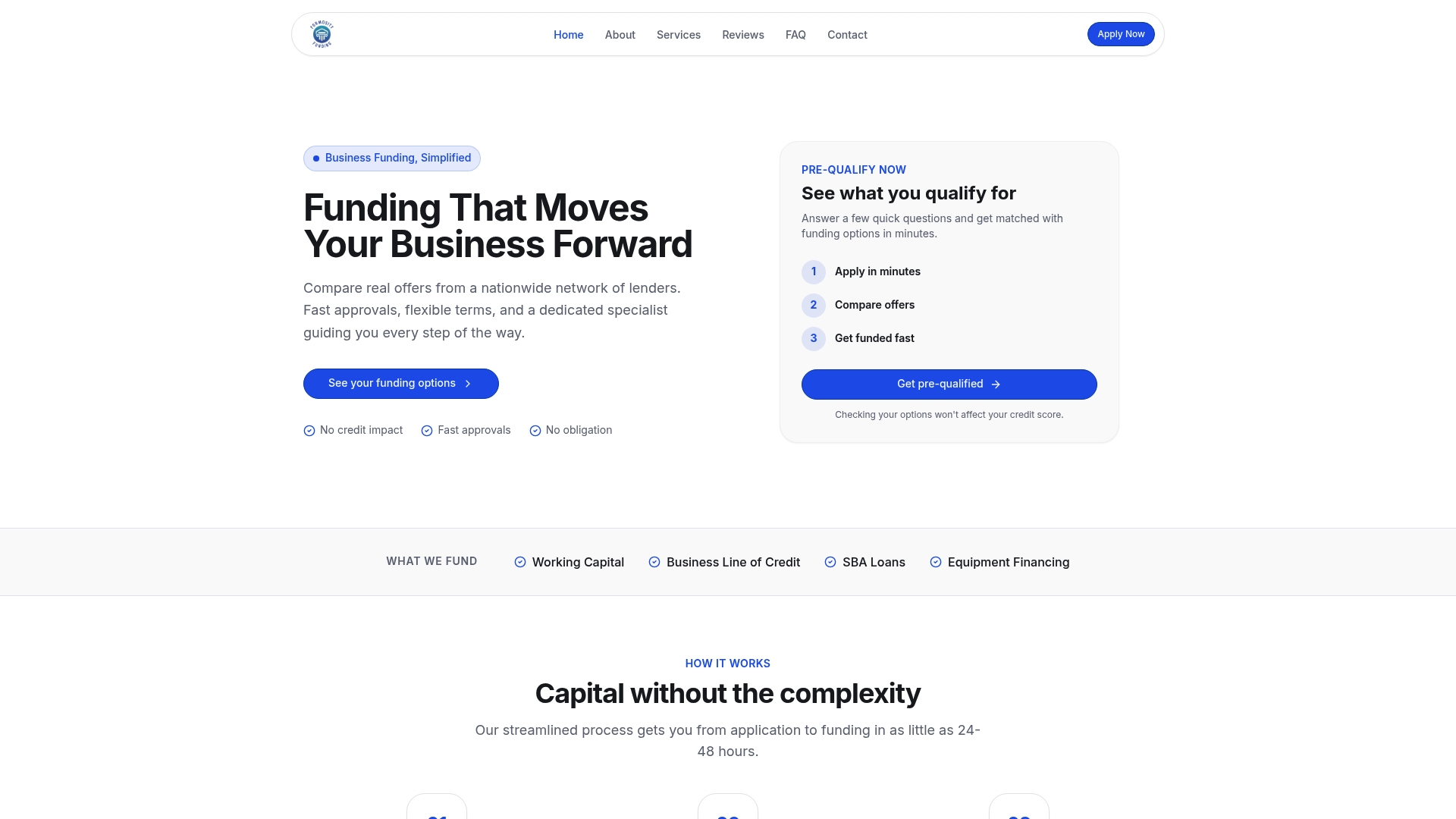
Formosityfunding works differently. As a business funding marketplace, it matches your business profile against a nationwide network of lenders and returns real, personalized offers, including lines of credit, SBA loans, and equipment financing, without a hard credit pull during prequalification. You see actual numbers from multiple lenders in one place, which is exactly the competing-offer leverage this guide recommends. Dedicated funding specialists walk you through the comparison so you're not decoding fee structures alone.
If you've read this far and you're ready to see what you actually qualify for, start your prequalification at Formosityfunding. No credit impact, no obligation, and you'll have real offers to compare rather than advertised ranges.
Sources
The figures and frameworks in this article come from a small set of primary sources. Each updates on a different schedule, and the date matters for rate data.
- Small Business Loan Demand Increases
- Average Business Line of Credit Interest Rates | Bankrate
- Sba
- Business Line of Credit Rates and Fees | CapitalXO
- Business line of credit: how it works and common uses | Xero US
Rate data ages quickly. The Kansas City Fed releases a new survey each quarter; check the release date on any source you use and treat figures older than two quarters as directional rather than current.
This article is general information, not a substitute for advice from a qualified financial advisor. Consult a qualified financial professional about your own circumstances before acting on anything here.