

Collateral is any business or personal asset you pledge to a lender to secure a loan. When you back a loan with collateral, the lender's risk drops, and that shift almost always translates into larger loan amounts, lower interest rates, and better repayment terms than you'd get unsecured. The trade-off is real: if you default, the lender can seize and sell that asset to recover what you owe.
Lenders favor assets that are liquid, marketable, and easy to value. A commercial building in a busy metro is far more attractive than a niche piece of manufacturing equipment with a thin resale market. Chamber of Commerce](https://www.uschamber.com/co/run/business-financing/a-guide-to-collateral). Collateral reduces lender risk and can lead to lower rates and higher loan amounts, but lenders still weigh cash flow and repayment ability heavily. Pledging collateral is not a substitute for a viable business; it's a risk-sharing tool.
The most common collateral types lenders accept:
- Commercial real estate (owned buildings, land, warehouses)
- Equipment and machinery
- Business vehicles
- Inventory
- Accounts receivable and invoices
- Cash, savings accounts, and certificates of deposit
- Investments and publicly traded securities
- Personal assets (home equity, personal savings)
- Intellectual property or contracts (conditionally, with strong documentation)
Key Takeaways
Strong collateral reduces lender risk, which typically produces larger loan amounts, lower rates, and longer terms, but lenders still prioritize cash flow and repayment ability above any single asset.
| Point | Details |
|---|---|
| What counts as collateral | Real estate, equipment, vehicles, inventory, receivables, cash, securities, and personal assets all qualify with clear title and documentation. |
| LTV expectations by asset | Cash and securities can reach 90% LTV; real estate 65%; equipment 50%; inventory as low as 20–50%. |
| SBA collateral rules | SBA lenders must follow SOP 50 10 and cannot decline loans solely for inadequate collateral in certain small-loan ranges. |
| Risks of pledging assets | UCC filings are public record; a default can trigger repossession, foreclosure, or a deficiency judgment for any shortfall. |
| When you lack collateral | Invoice financing, revenue-based financing, SBA Microloans, and unsecured loans are real options, though typically at higher cost. |
| Formosityfunding | Pre-qualify with no credit impact and get matched to lenders across collateral profiles and product types through the Formosityfunding marketplace. |
Table of Contents
- What specific assets can you use as business loan collateral?
- How lenders value collateral and what LTV ranges to expect
- How collateral changes your loan terms in concrete ways
- SBA collateral rules and what they mean for your application
- How to pledge and perfect collateral before closing
- Financing options when you don't have enough collateral
- What research actually says about collateral vs. cash flow in underwriting
- A practical perspective on preparing your collateral before you apply
- Formosityfunding matches your collateral profile to the right lenders
- Sources
What specific assets can you use as business loan collateral?
Lenders don't accept every asset equally. Each class carries its own documentation requirements, valuation method, and risk profile. Here's how the main categories break down in practice.
Commercial real estate is the gold standard. A building your business owns outright, or one with significant equity, gives a lender a hard, appreciating asset with a deep resale market. Lenders will require a formal appraisal, a title search, title insurance, and a recorded deed of trust or mortgage.
Equipment and machinery covers manufacturing rigs, construction equipment, medical devices, restaurant kitchen systems, and similar fixed assets. The lender will want proof of ownership (a bill of sale or title), recent maintenance records, and often an independent appraisal. Older equipment depreciates fast, so expect a lower loan-to-value ratio on a 10-year-old CNC machine versus a brand-new one.

Business vehicles work similarly to equipment. A fleet of delivery trucks or a company-owned semi can serve as collateral, provided the titles are clear and the vehicles are insured. Lenders typically place a lien on the title.
Inventory is trickier. A lender will discount it heavily because inventory is perishable, seasonal, or hard to liquidate quickly. Retail inventory in a slow-moving niche might get a very conservative advance rate. Perishable goods and leased equipment generally don't qualify, and lenders require clear title and documentation before accepting any asset as security.
Accounts receivable and invoices represent money your customers owe you. You can pledge them as collateral (invoice financing) or sell them outright (factoring). Collectability varies by customer creditworthiness and invoice age, so lenders price for that risk with conservative advance rates.

Cash, savings accounts, and CDs are the easiest collateral to value and liquidate. A lender will place a lien on the account or hold the funds. Because the risk is minimal, you'll often get the most favorable terms when cash is the collateral.
Investments and publicly traded securities work similarly. Stocks, bonds, and mutual funds can be pledged, though lenders will apply a haircut to account for market volatility.
Personal assets come into play when business assets fall short. Home equity is the most common personal collateral. This is where the risk becomes personal: a business default can put your home on the line.
Intellectual property and contracts are harder to value and rarely accepted as standalone collateral. A lender might consider a strong patent portfolio or a long-term government contract, but only when paired with other assets and when a credible valuation exists.
Lenders prefer collateral that can be converted to cash quickly in a default. Paper assets like cash, CDs, and publicly traded securities sit at the top of that preference hierarchy, followed by marketable equipment, real estate, receivables, and then inventory.
Pro Tip: If you're offering IP or a long-term customer contract as collateral, get a formal third-party valuation first. Lenders are far more likely to consider it when you walk in with a credible number rather than asking them to figure it out themselves.
Lenders will also ask for a personal guarantee when business assets don't fully cover the loan amount. A personal guarantee isn't collateral in the technical sense, but it gives the lender recourse against your personal assets if the business can't repay.
How lenders value collateral and what LTV ranges to expect
Lenders don't value collateral at what you paid for it or what it's worth on your balance sheet. They think in terms of what they could actually recover if they had to sell the asset quickly after a default. Three valuation concepts matter here.
Book value is the asset's recorded value on your financial statements, net of depreciation. Lenders rarely use this alone.
Appraised (market) value is what a qualified appraiser says the asset would sell for in an arm's-length transaction. This is the most common starting point for real estate and major equipment.
Liquidation value is the distressed-sale estimate: what the asset would fetch at auction or in a forced sale. Lenders often apply their LTV against liquidation value, not market value, which is why the math can feel conservative.
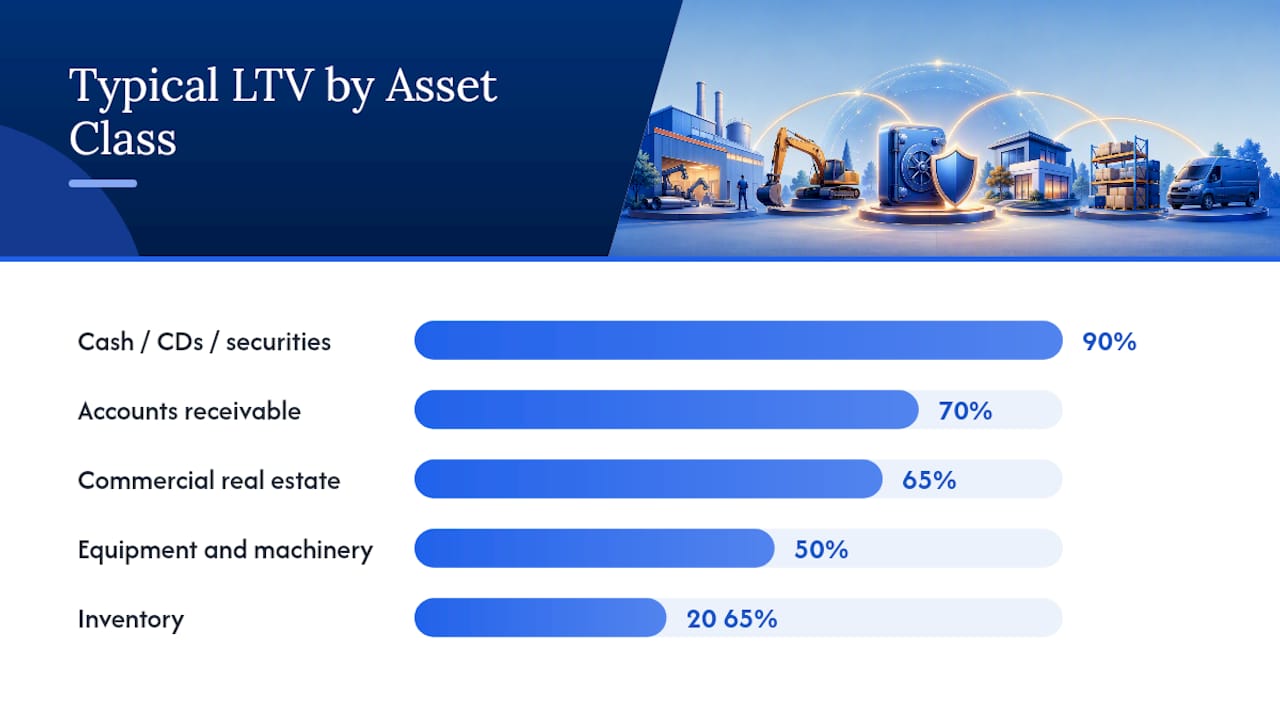
The loan-to-value ratio is the percentage of the collateral's value a lender will advance. Equipment and inventory typically carry lower LTVs than real estate because of depreciation and resale friction, while real estate supports higher LTVs due to longer marketability and deeper buyer pools.
| Asset Class | Typical LTV Range | Valuation Method |
|---|---|---|
| Commercial real estate | 65% | Licensed appraisal (market value) |
| Equipment and machinery | 50% | Appraisal or book value, adjusted for age |
| Business vehicles | 50% | NADA/Kelley Blue Book or appraisal |
| Inventory | 20%–50% | Cost or liquidation value |
| Accounts receivable | 70% | Face value, adjusted for age and collectability |
| Cash / CDs / securities | 90% | Face or market value |
Several factors move LTV up or down within those ranges:
- Age and condition: A five-year-old piece of equipment in excellent condition with maintenance records will get a better rate than an identical machine with no documentation.
- Lien encumbrances: Existing liens reduce a lender's effective claim. A building with a large first mortgage leaves little equity for a second lender.
- Marketability: Assets with thin secondary markets (specialized industrial equipment, niche inventory) get discounted more aggressively.
- Location: For real estate, a property in a high-demand market supports a higher LTV than one in a rural or economically distressed area.
- Industry seasonality: Retail inventory valued at peak season may be worth far less six months later.
Depreciation schedules matter especially for equipment. Bringing in an independent appraiser who can document real market value often recovers that gap.
How collateral changes your loan terms in concrete ways
Pledging strong collateral shifts where you sit on a lender's risk curve, and that shift shows up in four measurable ways.
Lower interest rates. A secured loan carries less risk for the lender, so the rate reflects that. The spread between secured and unsecured business loan rates can be meaningful, particularly for borrowers with average credit profiles.
Higher loan maximums. Without collateral, a lender caps the loan at what they believe your cash flow can service. With collateral, they can lend against the asset's value, often pushing the ceiling significantly higher.
Longer repayment terms. Secured loans, especially those backed by real estate or long-lived equipment, can carry terms of 10, 15, or even 25 years. Unsecured loans rarely exceed five years.
Improved approval odds for marginal credit. A borrower with a 620 credit score and a clear-titled commercial building has a realistic path to approval. The same borrower with no collateral may not.
Fewer or looser covenants. Lenders sometimes relax financial maintenance covenants (minimum cash balances, debt-service coverage ratios) when hard collateral backs the loan, because they have a secondary repayment source.
Here's a simple example of how LTV mechanics work. Say you own a commercial property appraised at $500,000 with no existing mortgage. If you only needed $200,000 for equipment, the property gives you room to borrow more later without adding new collateral.
Collateral reduces lender risk and frequently leads to better loan terms, but it is not the only underwriting factor. Lenders also weigh cash flow and repayment capacity. A borrower with strong collateral but no demonstrable ability to repay will still face rejection at most banks.
Cross-collateralization is worth understanding before you sign. Some lenders, particularly banks with existing relationships, will attach a blanket lien to multiple assets, meaning a default on one loan gives them a claim on assets that secured a different loan. Read every security agreement carefully before closing.
SBA collateral rules and what they mean for your application
The U.S. Small Business Administration doesn't lend directly in most programs; it guarantees loans made by approved lenders. Collateral rules flow from SBA guidance to those lenders, and the specifics vary by program.
The core principle: SBA lenders are required to take and perfect liens, follow SOP 50 10 closing procedures, and consider collateral when securing 7(a) and other SBA-backed loans. At the same time, SBA program guidance makes clear that lenders should not decline a loan solely because of inadequate collateral in certain small-loan ranges. Cash flow and creditworthiness still drive the decision.
| SBA Program | Loan Range | Collateral Requirement |
|---|---|---|
| 7(a) Standard | Up to $5 million | Required when available; lenders follow written collateral policies |
| 7(a) Small Loan | Up to $500,000 | Lenders' existing collateral policy applies |
| SBA Express | Up to $500,000 | Lender's discretion; SBA does not require collateral for small loans |
| CAPLines | Up to $5 million | Collateral required; often tied to receivables or inventory |
| 504 | Up to $5 million | Project assets (real estate/equipment) serve as primary collateral |
| Microloan | Up to $50,000 | Intermediary's requirements; personal guarantee typically required |
Key lender responsibilities under SBA rules:
- Maintain a written collateral policy and apply it consistently
- Take all available collateral when a loan exceeds $350,000 (including personal real estate if business assets are insufficient)
- Order appraisals on real property and equipment above program thresholds
- File UCC-1 financing statements and record deeds or titles to perfect liens
- Require borrowers to complete SBA Form 1919 (borrower information) as part of closing
Pro Tip: For SBA 7(a) loans above $350,000, lenders are expected to take a lien on personal real estate if business collateral doesn't fully cover the loan. If you want to protect your home, discuss this with your lender before applying, not after.
The 504 program is structurally different: the project asset (the building or equipment being purchased) serves as the primary collateral, and the SBA's certified development company (CDC) takes a second lien position. This makes 504 loans particularly useful for businesses buying real estate or major equipment without pledging unrelated assets.
How to pledge and perfect collateral before closing
Pledging collateral isn't just a handshake. It's a legal process with specific steps, and skipping one can delay closing or leave a lender's lien unenforceable.
- Inventory your assets. List every asset you own outright, its approximate value, and any existing liens or financing. This becomes your starting point for collateral discussions.
- Order appraisals or valuations. For real estate, hire a licensed appraiser. For equipment, use a certified equipment appraiser or a recognized valuation guide (NADA for vehicles, for example). For receivables, prepare an aging report.
- Run a UCC lien search. Before pledging any asset, search the Secretary of State's UCC database for your state to find existing financing statements. An undisclosed lien can block a new lender's claim or reduce their priority.
- File a UCC-1 financing statement. For personal property collateral (equipment, inventory, receivables), the lender files a UCC-1 with the Secretary of State to perfect their security interest. This is public record and will appear in future lien searches.
- Record deeds or titles. For real estate, the lender records a deed of trust or mortgage with the county recorder. For vehicles, the lender is noted on the title.
- Obtain and assign insurance. Lenders require that collateral assets be insured, with the lender named as loss payee. For real estate, this means property insurance; for equipment and vehicles, commercial coverage.
- Complete closing documentation. This includes the security agreement, any SBA-required forms (Form 1919 for SBA loans), and any title insurance policies the lender requires.
Typical costs and timeline to factor in:
- Commercial real estate appraisal: $2,000–$5,000, taking two to four weeks
- Equipment appraisal: $500–$2,000, depending on complexity
- UCC-1 filing fee: $20–$50 per filing, varies by state
- Title search and title insurance: $500–$2,500 for commercial property
- Total closing timeline with collateral: four to eight weeks for most secured commercial loans
Pro Tip: Run your UCC search before you apply, not during underwriting. Finding an old lien from a paid-off equipment loan that was never terminated gives you time to file a UCC-3 termination statement and clear the record before a lender sees it.
UCC filings appear on business credit reports and can affect future borrowing. If you default and the lender sells the collateral for less than the outstanding balance, you may face a deficiency judgment for the difference. That judgment can pursue personal assets if you signed a personal guarantee.
Financing options when you don't have enough collateral
Not every small business has a building or a fleet of trucks to pledge. That doesn't mean financing is off the table; it means the options shift, and so do the costs.
- Unsecured business loans: Based primarily on credit score, revenue, and time in business. Faster to close but carry higher rates and lower maximums than secured loans.
- Merchant cash advances (MCAs): An advance against future credit card or debit card sales, repaid as a percentage of daily receipts. Expensive and best used only for short-term gaps.
- Revenue-based financing: Repayment tied to a percentage of monthly revenue. Useful for businesses with consistent revenue but thin assets.
- Invoice financing and factoring: Pledge or sell outstanding invoices to get cash now. Rates depend on invoice age and customer creditworthiness. This is one of the most accessible options for service businesses with strong receivables.
- Business lines of credit: Often unsecured for smaller amounts, though larger lines may require a blanket lien. Useful for managing cash flow gaps.
- SBA Microloans: Up to $50,000 through SBA-approved intermediaries. Collateral requirements are set by the intermediary and are often more flexible than bank standards.
- SBA 7(a) accommodations: For loans below certain thresholds, SBA guidance discourages declining solely for inadequate collateral. A strong cash flow story can sometimes carry an application where hard assets are thin.
For businesses without significant fixed assets, alternative lenders and marketplaces can match borrowers to lenders who evaluate cash flow over hard collateral. The cost is usually higher, but the access is real.
| Option | Typical Cost | Speed | Collateral Needed |
|---|---|---|---|
| Unsecured business loan | Higher rates | Fast (days to weeks) | None specific; personal guarantee common |
| Invoice financing | Moderate fee | Very fast | Invoices/receivables |
| Revenue-based financing | Moderate to high | Fast | None; revenue-dependent |
| SBA Microloan | Lower rates | Weeks | Intermediary sets terms |
| Merchant cash advance | Highest cost | Very fast | None; future sales |
| Business line of credit | Variable | Moderate | None to blanket lien |
One thing most of these options share: a personal guarantee. Even when a lender doesn't require specific hard collateral, they'll often ask you to sign a personal guarantee, which gives them recourse against your personal assets if the business defaults. That's a meaningful risk to understand before signing.
If your collateral position is weak right now, the most productive moves are improving your cash flow metrics (higher revenue, lower expenses, faster collections), rebuilding credit, and finding a lender marketplace that can match you to lenders who work with your specific asset profile. You can explore business funding options across multiple product types to find what fits your situation.
What research actually says about collateral vs. cash flow in underwriting
The conventional wisdom is that collateral is the key to getting a loan. The reality is more nuanced, and understanding it changes how you prepare your application.
Collateral is primarily a risk-mitigation tool for lenders. Most experienced underwriters treat it as a secondary repayment source, not a substitute for a business that can actually service the debt. Cash flow comes first.
Consider two hypothetical applicants. The first has $800,000 in commercial real estate equity, a 640 credit score, and a business that has lost money for two of the last three years. Most bank underwriters will approve the second applicant and decline the first, or at minimum require significant restructuring of the first application.
Collateral matters most when it tips a borderline application. A borrower who is close on cash flow metrics but has strong, well-documented collateral often gets approved where a collateral-free version of the same borrower would not.
Pro Tip: Packaging collateral well raises its perceived value to an underwriter. A recent appraisal, photos, maintenance records, and a clear title summary tell a lender the asset is real, current, and ready to lien. An undocumented asset, even a valuable one, creates friction that can slow or kill a deal.
What underwriters actually look for when evaluating collateral:
- Clear, unencumbered title with no undisclosed liens
- Recent, credible appraisal from a qualified professional
- Adequate insurance with the lender named as loss payee
- Asset condition consistent with the appraised value
- Marketability: could this asset be sold within 90–180 days in a default scenario?
The businesses that get the best outcomes are the ones that treat collateral preparation the same way they treat their financial statements: organized, documented, and presented proactively.
A practical perspective on preparing your collateral before you apply
The biggest mistake small business owners make is treating collateral as an afterthought. They find a lender, get deep into underwriting, and then scramble to produce appraisals, title documents, and insurance certificates under deadline pressure. That scramble costs time, sometimes kills deals, and almost always weakens your negotiating position.
Here's the sequence that actually works:
- Inventory every asset you own outright. Include real estate, equipment, vehicles, receivables, and cash accounts. Note the approximate value and any existing financing.
- Order appraisals or valuations before you apply. A current appraisal in hand signals to a lender that you're organized and serious. It also gives you a realistic number to anchor your loan request.
- Run UCC and lien searches on every asset you plan to pledge. Surprises during underwriting are the single fastest way to delay or lose a deal.
- Pre-qualify with a lender marketplace that can match your asset profile to lenders who work with it. Not every lender values every asset type the same way, and a marketplace surfaces that variation quickly.
On the question of what to pledge: don't automatically offer your most valuable asset just because it's your most valuable asset. Think about what you'd lose if the business hit a rough patch and the lender called the loan. Pledging a building you need to operate is a different risk than pledging a piece of equipment you could replace. Protect the assets that are operationally irreplaceable; offer the ones that are fungible.
The goal is to walk into a lender conversation with a clear collateral package, a strong cash flow story, and a realistic loan request. That combination, more than any single asset, is what gets deals done.
Formosityfunding matches your collateral profile to the right lenders
Finding a lender who values your specific assets, whether that's a commercial building, a receivables portfolio, or a mix of equipment and inventory, is harder than it sounds. Different lenders have different appetites, and applying to the wrong one wastes time and can generate unnecessary credit inquiries.
Formosityfunding is a nationwide lending marketplace built for exactly this problem. You describe your business and your assets, and the platform matches you to lenders whose programs fit your collateral profile and funding need. Pre-qualification takes minutes and has no impact on your credit score.
Core benefits for businesses working through a collateral-based loan search:
- Quick pre-qualification with no credit impact, so you can see real offers before committing
- Access to lenders across product types: SBA loans, equipment financing, commercial real estate loans, invoice factoring, working capital, and lines of credit
- Dedicated funding specialists who help you package your collateral and present your application effectively
Whether you have strong hard assets or are working with a thinner collateral profile, the platform surfaces lenders who match your situation. Start your pre-qualification and see what you qualify for today.
Sources
These are the primary U.S. sources to consult when verifying program rules, lender obligations, or collateral guidance:
- SBA lenders - Small Business Administration
- What Is Collateral for Small Business Loans | CO- by US Chamber of Commerce
- Collateral business loans: What you need to know | Nav
- A Guide to Collateral and Business Loans | SoFi
For program-specific questions about SBA loan thresholds, lender responsibilities, or collateral requirements, the SBA's own program pages are the authoritative source. For bank-standard practices and regulatory context, the FDIC and OCC are the appropriate references.