

Direct and fintech lenders can approve and fund qualifying borrowers in as little as 24 hours, while a bank term loan usually takes 2 to 4 weeks. SBA 7(a) loans run 30 to 90 days, though Preferred Lender Program status often cuts that by two to three weeks. Whichever track you're on, a complete document package upfront is what actually moves your funding date closer.
TL;DR:
- Applying to fintech or direct lenders can result in funding within 24 hours if your financials are clean, while SBA loans often require 30 to 90 days.
- Preparing a complete document package upfront, including tax returns, financial statements, and ownership documents, can save several weeks during underwriting.
- Choosing a Preferred Lender Program lender can cut approval time by 2 to 3 weeks by eliminating the SBA review step.
- Responding to lender requests within 24 hours and ordering appraisals early can prevent common delays and shorten overall timelines.
- Matching your loan type to your urgency and understanding factors like deal complexity or missing documentation can help you avoid extra waiting time.
Table of Contents
- Business Loan Timeline by Type: What to Expect
- The Five Stages Every Business Loan Application Goes Through
- SBA Loan Timelines: 7(a), 504, Express, and PLP Explained
- What Actually Determines Whether Your Loan Takes 3 Weeks or 3 Months
- Documents to Have Ready Before You Apply
- How to Cut Weeks Off Your Funding Timeline
- Why the "Fastest Loan" Isn't Always the Right Loan
- Get Matched With a Lender Built for Your Timeline
- Sources
Business Loan Timeline by Type: What to Expect
The gap between "fast" and "slow" financing isn't small. It's the difference between having cash Thursday and having cash next quarter, and it depends almost entirely on which lender type you choose.
Here's how the main paths stack up in typical total time from application to funded account:
- Direct/fintech lenders: hours to a few days for qualifying applicants with clean financials
- Bank term loans: roughly 2 to 4 weeks, sometimes longer for first-time borrowers
- SBA 7(a), PLP lender: about 30 to 60 days
- SBA 7(a), non-PLP lender: about 45 to 90 days
- SBA 504: often longer than 7(a), frequently 90 days or more when real estate is involved
- SBA Express: faster decisioning than standard 7(a), though loan size caps at $500,000
Median 7(a) funding time runs roughly a couple of months from a complete application to disbursement, according to lender-side analysis from LenderHawk. That's the median, not the ceiling. Deals with real estate, multiple owners, or partnership structures routinely take longer.
Speed and cost move in opposite directions more often than not. A fintech lender that funds you by Friday is pricing that convenience into the rate. An SBA loan takes longer partly because the federal guarantee behind it demands more documentation and underwriting rigor, and that trade produces a lower rate and longer term in return.
Your own timeline will vary based on loan size, your industry, how clean your books are, and how fast you respond when the lender asks for something. Two businesses applying the same week for the same loan amount can close three weeks apart purely based on how quickly they turned around requested documents.
The Five Stages Every Business Loan Application Goes Through
Every loan, regardless of lender type, moves through the same basic sequence. What differs is how long each stage takes and how much control you have over it.
-
Pre-application prep. This is where most delay actually lives, and it's almost entirely within your control. Gathering tax returns, financial statements, and ownership documentation before you apply can take anywhere from a day (if your books are current) to several weeks (if you're chasing down a CPA or reconciling old statements).
-
Application submission. Filling out the lender's forms and uploading your document package. For a streamlined online lender this takes 15 to 30 minutes. For an SBA loan through a bank, expect to complete additional forms, including SBA Form 1919, which collects borrower and business ownership information the SBA requires.
-
Lender underwriting. This has three sub-steps: initial file review (confirming nothing's missing, usually 1 to 3 days), underwriting analysis (verifying income, collateral, and cash flow, often 1 to 3 weeks), and credit committee approval (a scheduled internal vote that can add days if your file lands between meeting dates). Committee cadence varies by lender. Some meet weekly, others biweekly, and that scheduling gap alone can add a week you never see coming.
-
SBA review, if applicable. Non-PLP lenders submit the approved file to an SBA loan processing center for a second review, which is where PLP status becomes valuable: PLP lenders have delegated authority to approve loans internally and skip this step entirely, typically saving 2 to 3 weeks.
-
Closing and funding. Legal document prep, signature collection, and wire transfer. Simple working capital loans close in a day or two after final approval. Real-estate-backed loans need title work and possibly an appraisal, which stretches closing to 2 to 4 additional weeks.
Pro Tip: Ask your loan officer directly how often their credit committee meets and where your file will land on that calendar. A two-day difference in submission timing can cost you a full week if you miss a committee date.
SBA Loan Timelines: 7(a), 504, Express, and PLP Explained
SBA loans get lumped together in conversation, but the three main programs behave very differently on the calendar. Knowing which one you're actually applying for changes what timeline you should expect.
- Standard 7(a), non-PLP lender: 45 to 90 days, sometimes longer for complex ownership structures
- 7(a) through a PLP lender: 30 to 60 days, since the lender approves in-house without waiting on an SBA center
- SBA 504: commonly runs 90 days or more, with a median closer to 95 days because it involves two lenders (a bank and a Certified Development Company) and a debenture pooling process
- SBA Express: faster turnaround on the decision itself, though the $500,000 cap means it's not a fit for larger acquisitions or major real estate purchases
PLP delegation is the single biggest lever inside the SBA system. PLP lenders average roughly 18 business days in underwriting-to-approval, compared to about 31 business days for non-PLP lenders. That 13-day gap comes almost entirely from skipping the SBA center's independent review, and PLP lenders also tend to request fewer rounds of clarification because they already know what the SBA will accept.
A few deal features reliably stretch any SBA timeline regardless of PLP status: commercial real estate transactions requiring appraisals, construction components tied to 504 financing, multi-owner LLCs or partnerships needing separate personal financial statements from each owner, and businesses in regulated industries that trigger additional SBA eligibility review. If your deal has any of these, budget extra weeks from the start rather than being surprised by them later.

What Actually Determines Whether Your Loan Takes 3 Weeks or 3 Months
Loan type sets the baseline. These five factors determine where you land inside that range, or whether you blow past it entirely.
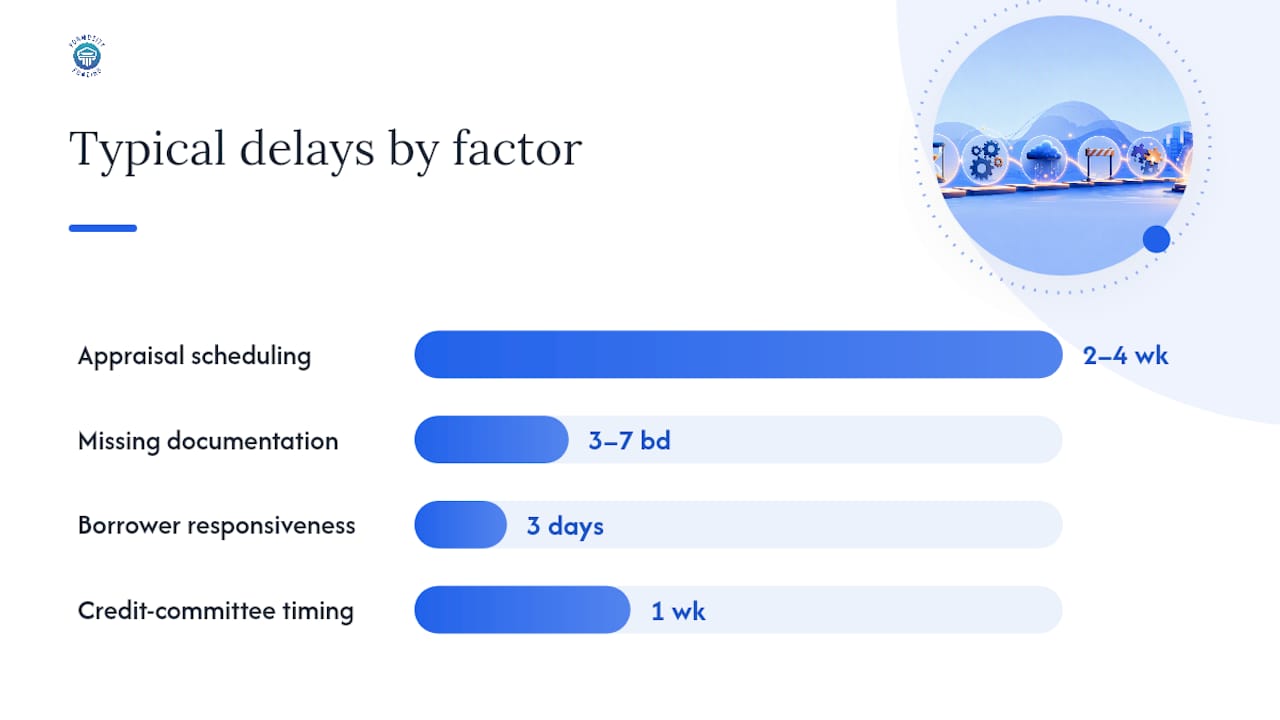
- Missing documentation. Each round of "we still need X from you" typically adds 3 to 7 business days, since it involves your response time plus the lender re-reviewing the file
- Appraisals. Required for most real-estate-backed loans, appraisals commonly take 2 to 4 weeks to schedule and complete, and you often can't close without one
- Borrower responsiveness. A lender who emails you Monday and hears back Thursday just lost three days that a same-day reply would have saved
- Credit committee scheduling. Weekly versus biweekly committees can shift your closing date by a week purely based on when your file happens to land
- Deal complexity. Multiple owners, recent ownership changes, or unusual entity structures (trusts, holding companies) require extra verification that a simple sole proprietorship never triggers
Lender-side capacity matters too. SBA processing centers handle a national volume of files, and backlogs during high-demand periods can add days to the review step even when your paperwork is flawless.
Pro Tip: If your deal involves commercial property, order the appraisal the same week you submit your formal application instead of waiting for the lender to request it. Appraisers book out, and this single move often saves two to three weeks off the back end.
Documents to Have Ready Before You Apply
A "complete" application isn't a formality. It's the highest-leverage move you can make, because it eliminates the back-and-forth cycles that cause most delays.
- Business and personal tax returns, typically the last two to three years
- Profit and loss statement and balance sheet, ideally current within 90 days
- Bank statements, usually the last three to six months
- SBA Form 1919, required for SBA loans and worth completing before you're asked
- Business debt schedule, listing existing loans and payment obligations
- Ownership and formation documents, including articles of incorporation and operating agreements
Conditional documents add real lead time when they apply. A commercial appraisal often takes 2 to 4 weeks to complete, an environmental assessment on commercial property can take similarly long, and a formal business valuation for larger acquisitions may take one to two weeks with a qualified provider.
Three shortcuts consistently save time: connect your business bank accounts electronically instead of uploading PDFs, request digital copies from your CPA the same week you decide to apply, and order any required appraisal or estoppel certificate review before the lender formally asks for it.
How to Cut Weeks Off Your Funding Timeline
Speed isn't about finding a secret lender. It's about matching your urgency to the right track and then executing cleanly.
- Match urgency to lender type first. If you need funds within a week, a direct or fintech lender is your only realistic option. If you have 4 to 8 weeks, a bank term loan or PLP-backed SBA loan gives you a better rate for a modest time cost.
- Assemble your document package before you apply, not after. Every day spent gathering statements after submission is a day added to your closing date.
- Order appraisals and valuations in week one of formal application, not when the underwriter finally requests them.
- Ask upfront whether your lender is a PLP. A PLP lender approving in-house can save you 2 to 3 weeks versus a non-PLP lender waiting on SBA review.
- Respond within 24 hours to any lender request. Slow responses are the single most common self-inflicted delay borrowers create.
Pro Tip: Call the lender before applying and ask two questions: "Are you a Preferred Lender Program participant?" and "How often does your credit committee meet?" Both answers tell you more about your real timeline than anything in the marketing material.
Why the "Fastest Loan" Isn't Always the Right Loan
Borrowers fixate on speed when the smarter question is fit. A same-day fintech loan solves a cash crunch, but it usually carries a rate that makes sense only for short-term needs, not a five-year equipment purchase or a real estate acquisition.
The mistake I see most often isn't picking a slow lender. It's picking the wrong track entirely, then getting frustrated when a document-heavy SBA process doesn't move like a fintech app. Those are two different products solving two different problems, and comparing their timelines is like comparing a rental car to buying a house. One track prices in speed. The other prices in a lower long-term cost, and asks for patience in exchange.
If there's a genuine blind spot in how people plan around business loan timing, it's this: most delay isn't the lender's fault. It's the borrower discovering, three weeks into underwriting, that they need a document they haven't started gathering. The PLP data alone makes the point. That gap between PLP and non-PLP processing largely comes down to fewer clarification requests, which means fewer moments where the file sits waiting on you.
Choose the track that matches your actual deal, not just your impatience, and have your paperwork ready before you need it.
— Alvin
Get Matched With a Lender Built for Your Timeline
Formosityfunding shortens the part of the process you actually control: figuring out which lender fits your deal and getting your file in front of them complete the first time. Instead of applying blind to one bank and waiting weeks to find out you don't qualify, you get matched against a nationwide network of lenders covering working capital, SBA loans, equipment financing, and commercial real estate financing, all through one pre-qualification that doesn't touch your credit.
If speed is your priority, tell your funding specialist that up front. They can point you toward lenders suited to fast turnaround rather than a slow-moving bank queue. If you're building toward an SBA loan, they'll help you assemble a complete package before submission, which is the single biggest lever for avoiding delay. Start with Formosityfunding's funding options to see which financing type matches your timeline, or visit the Formosityfunding homepage to see how the matching process works before you apply.
Sources
This article is general information, not a substitute for advice from a qualified financial advisor. Consult a qualified financial professional about your own circumstances before acting on anything here.