

Cash flow financing lets a lender advance money based on your business's expected future revenues rather than physical assets you pledge as collateral. If your company generates steady, predictable income but owns little in the way of equipment, real estate, or inventory, this is often the most practical path to working capital. The industry term you'll see in loan documents and lender conversations is "cash flow lending," which covers everything from term loans sized to your EBITDA to merchant cash advances repaid through daily card receipts.
You're likely a good candidate if any of these apply to your situation:
- Your revenue is recurring or contract-based (subscriptions, retainers, service agreements)
- Your balance sheet is light on hard assets but your bank statements show consistent deposits
- You need capital faster than a traditional bank's collateral appraisal process allows
Key takeaways
Cash flow financing is the right tool when your earnings are strong and predictable but your balance sheet holds few assets a traditional lender can collateralize.
| Point | Details |
|---|---|
| Best fit for cash flow lending | Service firms, SaaS companies, and subscription businesses with stable, recurring revenue. |
| Core underwriting metrics | Lenders size offers to EBITDA multiples and require a DSCR of at least 1.25x. |
| Cost comparison matters | Always convert factor rates and flat fees to an APR equivalent before comparing offers. |
| Covenant risk is real | Breaching a minimum EBITDA covenant can trigger accelerated repayment; review terms before signing. |
| Formosityfunding marketplace | Pre-qualify with no credit impact and compare multiple lender offers in one session at Formosityfunding. |
Table of Contents
- How cash flow financing works for borrowers and lenders
- The main types of cash flow financing products
- Cash flow financing vs. asset-based lending: how to choose
- What lenders actually look at: the underwriting checklist
- Benefits and risks: the honest picture
- What cash flow financing actually costs: rates, fees, and a worked example
- How to qualify and apply: a step-by-step timeline
- Where to find cash flow financing and how to choose a lender
- A practical perspective on when cash flow financing makes sense
- Formosityfunding connects you to multiple lenders in one step
- Sources
How cash flow financing works for borrowers and lenders
The core mechanic is straightforward: a lender reviews your historical revenue, projects what you'll earn going forward, and advances a sum you repay from those future receipts. According to BDC, a cash flow loan is typically a term loan granted on past and forecasted cash flow rather than business assets, with repayment structures that can include principal postponement and payments tied to actual cash flow.
What lenders underwrite:
- Historical bank deposits and receipts — usually 3–12 months of statements to establish a revenue run rate
- EBITDA (earnings before interest, taxes, depreciation, and amortization) — the primary sizing metric; lenders often advance a multiple of trailing EBITDA
- Debt Service Coverage Ratio (DSCR) — your net operating income divided by total debt service; most lenders want to see 1.25x or higher
- Credit profile — personal and business credit scores, especially for smaller loan sizes
- Customer concentration — if 60% of revenue comes from one client, that's a risk flag
Repayment structures vary by product:
- Fixed monthly amortization (most common in bank term loans)
- Daily or weekly deductions from a linked business bank account (common in online lending)
- Revenue-share arrangements where the percentage taken adjusts with your sales volume
How lenders protect themselves: Most cash flow facilities include financial covenants, such as minimum EBITDA thresholds or maximum leverage ratios, that you must maintain throughout the loan term. Some lenders also use cash sweeps, where excess cash above a defined balance is automatically applied to principal. In larger deals, intercreditor agreements govern how multiple lenders rank against each other for repayment priority.
The main types of cash flow financing products
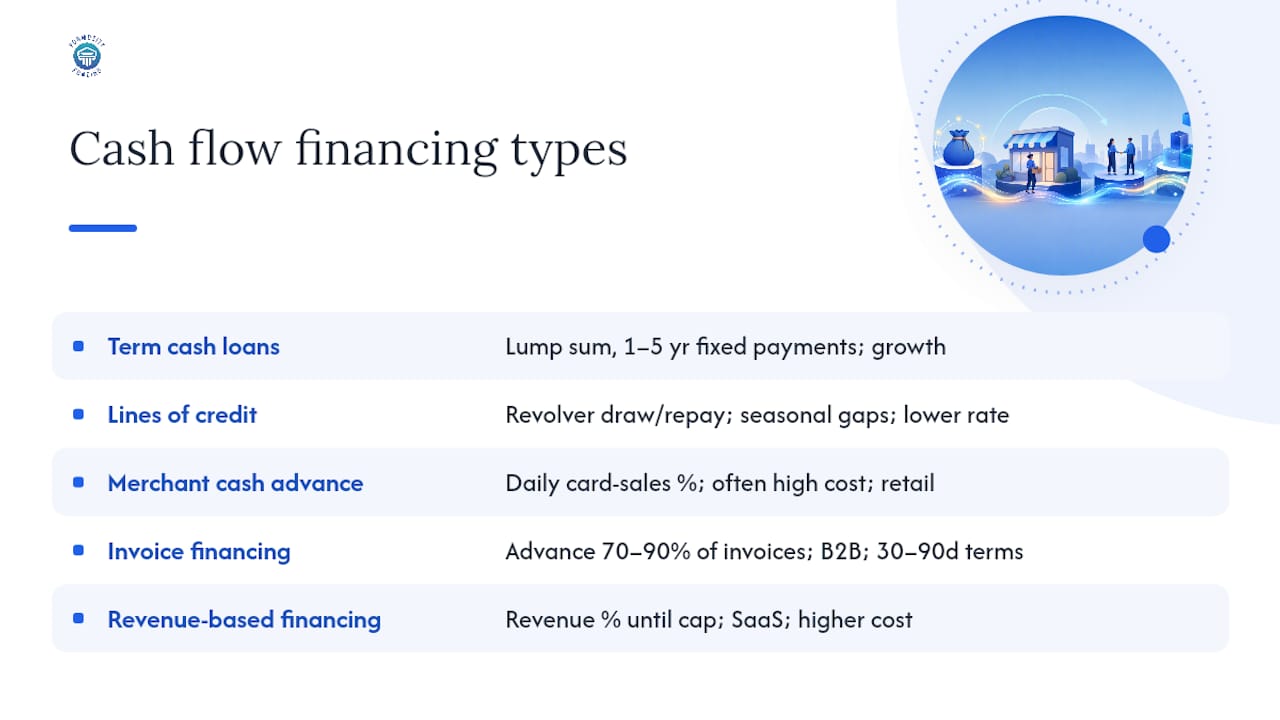
Stripe's guide to business cash flow loans identifies several distinct product structures, each suited to a different cash cycle and business need. Understanding the differences before you apply saves you from accepting a structure that fights your cash flow rather than supporting it.
Term cash flow loans are lump-sum advances repaid over a fixed schedule, typically 1–5 years. Banks and specialty lenders size these to a multiple of EBITDA. Best for: growth investments, acquisitions, or hiring where you need a defined capital injection and can service a predictable monthly payment.
Business lines of credit sized to revenue work like a credit card with a higher limit and lower rate. You draw what you need, repay it, and draw again. Best for: seasonal working capital gaps, bridging payroll between client payments, or managing inventory spikes without committing to a term loan.
Merchant cash advances (MCAs) provide a lump sum repaid as a fixed percentage of daily credit and debit card sales. Repayment is automatic and scales with revenue, which sounds appealing until you realize the effective annual cost is often far higher than a term loan. Best for: retail or restaurant businesses with high card volume and an urgent, short-term need.
Invoice financing (also called accounts receivable financing or factoring) advances a percentage of outstanding invoices, typically 70–90%, with the remainder released when your customer pays. The receivables themselves serve as the direct asset. Best for: B2B service firms with 30–90 day payment terms that create cash gaps between delivery and payment.

Revenue-based financing (RBF) is a newer structure where repayment is a fixed percentage of monthly revenue until a total repayment cap is reached. Unlike an MCA, RBF is usually tied to total revenue rather than card receipts alone. Best for: SaaS companies, subscription businesses, or any firm with predictable monthly recurring revenue.
Pro Tip: If your revenue is highly seasonal, a revenue-share structure (MCA or RBF) protects you during slow months because payments shrink with sales. A fixed-payment term loan, by contrast, demands the same amount in January as in July. The flexibility has a price, though — revenue-share products almost always carry a higher total cost.
Cash flow financing vs. asset-based lending: how to choose
The decision between cash flow lending and asset-based lending (ABL) comes down to one question: where does your business generate liquidity — from earnings or from assets?
Investopedia explains that cash flow lending underwrites projected future cash flows using EBITDA and credit multipliers, while ABL centers on balance-sheet collateral. Cash flow loans typically carry higher rates and tighter covenants because the lender has no hard asset to seize if things go wrong.
Choose cash flow lending when:
- You run a service business, SaaS company, or professional firm with strong margins but few tangible assets
- Your EBITDA is stable and growing, giving lenders confidence in future earnings
- Speed matters and you can't wait weeks for a collateral appraisal
Choose asset-based lending when:
- You hold significant accounts receivable, inventory, or equipment that can serve as a borrowing base
- Your earnings are volatile but your asset base is solid (manufacturing, distribution, retail)
- You want lower rates and are willing to accept borrowing-base reporting requirements
According to Don Clarke Enterprises, cash flow lending can offer higher leverage when earnings are stable, but it typically imposes tighter covenants, closer financial reporting, and pricing that reflects the earnings-based risk. ABL tends to be cheaper and more flexible in volatile environments.
One structure worth knowing: a hybrid facility pairs an ABL revolving line (sized to receivables and inventory) with a cash flow term loan sitting underneath it. The revolver handles day-to-day working capital while the term loan funds growth or acquisition. Intercreditor terms between the two facilities must be negotiated at the term-sheet stage, not after closing.
What lenders actually look at: the underwriting checklist
"Lenders look at cash flow" is technically true and practically useless. Here's what that actually means in a real underwriting review.
Key metrics and what they reveal:
| Metric | What lenders measure | Typical threshold |
|---|---|---|
| EBITDA | Earnings power available to service debt | Varies; used to size loan as a multiple |
| DSCR | Net operating income ÷ total annual debt service | 1.25x minimum is common |
| Revenue run rate | Trailing 3–6 month average monthly revenue | Establishes advance ceiling |
| Gross margin | Revenue minus cost of goods sold | Higher margins signal pricing power |
| Customer concentration | % of revenue from top 1–3 clients | Below 60% per client preferred |
Documents lenders typically request:
- 3–12 months of business bank statements (all accounts, no gaps)
- Profit and loss statement, year-to-date and prior two fiscal years
- Business tax returns, last 2 years
- Accounts receivable aging report
- Cash flow projections, 12 months forward
- Business debt schedule (all existing loans and leases)
- Personal tax returns and personal financial statement for owners with 20%+ equity
How to present your numbers well: Export bank statements directly from your bank's portal rather than printing PDFs of PDFs — lenders flag altered or low-resolution documents immediately. Reconcile your P&L against your bank statements before submitting; unexplained discrepancies slow underwriting more than a weak number does. For projections, use conservative assumptions and annotate them with the contracts or customer agreements that support the revenue line.
Pro Tip: If your bank statements show large, irregular transfers between accounts, include a brief written explanation. Lenders interpret unexplained cash movements as a red flag, even when the reason is entirely benign (e.g., sweeping cash to a savings account nightly).
Benefits and risks: the honest picture
Cash flow financing solves a real problem — it gets capital into the hands of businesses that generate strong earnings but can't pledge a warehouse or a fleet of trucks. The trade-offs are real, though, and worth understanding before you sign.
Primary benefits:
- Speed: Online lenders and marketplaces can fund in 24–72 hours; even bank-based cash flow loans close faster than collateral-dependent facilities
- No hard collateral required: Service firms, consultancies, and SaaS companies can access meaningful capital without pledging physical assets
- Revenue-aligned repayment: Revenue-share structures reduce payment pressure during slow periods
- Preserves equity: Debt financing doesn't dilute ownership the way venture capital does
Primary risks:
- Higher effective cost: Because lenders bear more risk without collateral, rates are higher than secured alternatives. Investopedia notes this pricing differential is a direct function of the earnings-based underwriting model
- Covenant triggers: Breach a minimum EBITDA covenant and the lender can accelerate repayment, restrict draws, or take control of cash flows
- Daily debit strain: Frequent automatic withdrawals can create their own liquidity problem if revenue dips unexpectedly
- Personal guarantees: Most small business cash flow loans require a personal guarantee from owners with 20%+ equity, putting personal assets at risk despite the "no collateral" framing
Red flags to watch for in any offer:
- Factor rates quoted without an equivalent APR or total repayment figure
- Daily debit amounts that exceed 15–20% of your average daily deposits
- Prepayment penalties that make early payoff more expensive than finishing the term
- Vague or missing language about default remedies and cure periods
Use NMLS Consumer Access to verify that any lender or loan originator you're considering is properly licensed in your state. It takes two minutes and eliminates a category of risk entirely.
What cash flow financing actually costs: rates, fees, and a worked example
Pricing varies widely by product type, lender, and borrower profile. Understanding the vocabulary is the first step to comparing offers honestly.
Common pricing structures:
- Factor rate: Expressed as a decimal multiplier (e.g., 1.35). Multiply your advance by the factor rate to get total repayment. A $50,000 advance at a 1.35 factor rate means you repay $67,500 total.
- Annual Percentage Rate (APR): The annualized cost of borrowing, including fees. Always ask for this figure.
- Origination fee: A one-time upfront charge, typically 1–5% of the loan amount, deducted from proceeds at funding.
- Daily or weekly debit: The fixed or percentage-based amount withdrawn from your account on each business day or week.
Worked example — merchant cash advance:
A retailer accepts a $50,000 MCA at a 1.35 factor rate, repaid as 12% of daily card sales. Average daily card revenue is $3,000, so the daily deduction is $360. Total repayment is $67,500. At that deduction rate, payoff takes roughly 188 business days (about 9 months). The effective APR on this structure can be very high, depending on how quickly sales move.
Compare that to a bank-originated cash flow term loan with a lower APR over a typical multi-year term on the same advance amount, resulting in significantly lower total interest cost than the MCA example.
Stripe's guide specifically warns that factor rates and flat fees must be translated into annualized figures to compare true cost across offers.
Fee checklist to request from every lender:
- Origination or underwriting fee
- Draw fees (for lines of credit)
- Prepayment penalty or discount for early payoff
- Monthly maintenance or servicing fee
- Wire or ACH transfer fees
- Renewal fees if you roll the balance
How to qualify and apply: a step-by-step timeline
The process from "I need capital" to "funds in my account" typically runs 1–3 weeks for bank-based cash flow loans and 24–72 hours for online lenders and marketplaces. Here's how to move through it efficiently.
Step 1: Assess your eligibility (Day 1) Pull your last 6 months of bank statements, your most recent P&L, and your current DSCR. If your DSCR is below 1.0x, address the underlying cash flow issue before applying — most lenders will decline, and multiple hard credit pulls will hurt your score.
Step 2: Prequalify with no credit impact (Day 1–2) Use a marketplace or lender that offers soft-pull prequalification. This surfaces realistic offer ranges without affecting your credit score. Gather your basic business information: legal entity name, EIN, time in business, and average monthly revenue.
Step 3: Prepare your document pack (Days 2–5) Compile the full document list from the underwriting section above. Organize files clearly — one PDF per document type, labeled with the period covered. A clean, complete submission cuts underwriting time significantly.
Step 4: Submit and respond to underwriting questions (Days 3–10) Underwriters will often ask for clarification on specific deposits, customer contracts, or balance sheet items. Respond within 24 hours. Delays on your end are the single most common reason funding timelines slip.
Step 5: Review the term sheet carefully (Days 7–14) Before signing, calculate the effective APR on any offer. Confirm the covenant package: what triggers a default, what the cure period is, and what reporting you'll owe monthly or quarterly.
Step 6: Close and fund (Days 10–21 for banks; 1–3 days for online lenders) Wire or ACH funding follows executed documents. Online lenders often fund same-day or next-day after signing.
Key questions to ask every lender before you commit:
- What is the effective APR, including all fees?
- What are the financial covenants and what triggers a default?
- What is the cure period if I breach a covenant?
- How often will you debit my account, and can the frequency change?
- What reporting do you require monthly or quarterly?
- Is there a prepayment discount if I pay off early?
Where to find cash flow financing and how to choose a lender
Small businesses have more sourcing options than most owners realize, and the right channel depends on how quickly you need capital and how much rate sensitivity you have.
Community banks and credit unions offer the lowest rates and longest terms but require stronger credit profiles, more documentation, and 2–4 weeks to close. Best for established businesses with clean financials and no urgency.
Specialty nonbank lenders (often called alternative lenders) close faster and accept a wider range of credit profiles, but charge higher rates. Many use revenue-share or daily debit repayment structures. According to BDC, community banks may offer longer terms with stricter credit windows while specialty lenders close faster with revenue-share structures but charge higher effective costs.
Invoice finance firms are the right channel if your cash gap is specifically caused by slow-paying B2B customers. They advance against specific invoices rather than overall revenue.
Online lending marketplaces let you submit one application and receive multiple competing offers from different lenders. The comparison happens in one place, which saves time and reduces the number of hard credit inquiries.
Selection criteria that matter most:
- Transparency on total cost (APR, not just rate or factor)
- Repayment method that matches your cash cycle (daily debits work for high-volume retail; monthly payments suit service firms with lumpy invoicing)
- Covenant structure you can realistically maintain
- Lender's responsiveness and willingness to explain terms clearly
- License verification via NMLS Consumer Access
Formosityfunding operates as a nationwide marketplace that matches small businesses with multiple lenders through a single prequalification process, with no credit impact at the initial stage. The platform covers working capital loans, lines of credit, SBA loans, invoice factoring, and equipment financing, so you can compare cash flow lending against other structures in the same session.
A practical perspective on when cash flow financing makes sense
The businesses that get the most out of cash flow lending share one trait: their revenue story is easy to tell and hard to dispute. A consulting firm with three-year client contracts, a SaaS company with 90% annual renewal rates, or a staffing agency with a predictable weekly payroll cycle — these are borrowers lenders compete for. The underwriting practically writes itself.
Where I see businesses struggle is when they apply for cash flow financing because they want it to work, not because their numbers actually support it. A business with erratic monthly deposits, high customer concentration, and a DSCR below 1.2x will either get declined or receive terms that make the capital more expensive than the problem it solves.
The marketplace model changes the calculus meaningfully. Submitting to multiple lenders simultaneously surfaces the actual market rate for your credit profile, which is almost always better than the first offer a single lender gives you. It also reveals which lenders are willing to compete on covenants, not just rate — and covenant flexibility often matters more over a 24-month term than a 50-basis-point rate difference.
If you're packaging an application, lead with your revenue story: recurring contracts, customer retention rates, and the specific use of proceeds tied to a revenue outcome. Lenders price risk, and a borrower who can explain exactly how the capital generates the cash flow to repay it gets better terms than one who submits numbers without context.
Formosityfunding connects you to multiple lenders in one step
Getting a single cash flow loan offer from one lender tells you almost nothing about whether you're getting a fair deal. The real advantage comes from seeing competing offers side by side — different rates, different covenant structures, different repayment methods — so you can choose the one that actually fits your cash cycle.
Formosityfunding's funding marketplace connects small businesses with a nationwide network of lenders through a single prequalification that doesn't affect your credit score. You get multiple real loan and credit offers matched to your business profile, not generic rate estimates. Dedicated funding specialists walk you through the comparison so you're evaluating effective APR and covenant terms, not just the headline number. Products available include working capital loans, business lines of credit, SBA loans, invoice factoring, and equipment financing. Once you've reviewed your matched offers, the next step is straightforward: select the structure that fits your cash cycle and complete the full application with your chosen lender through the platform.
Sources
The following sources were used to build this guide and are worth bookmarking for your own due diligence.
- Cash Flow Lending vs. Asset-Based Lending: What’s the Difference? | Investopedia
- Business Cash Flow Loans: A Guide | Stripe
- What is a cash flow loan? | BDC
- ABL vs. Cash Flow Lending: How to Choose the Right Structure | Don Clarke Enterprises
This article is general information, not a substitute for advice from a qualified financial advisor. Consult a qualified financial professional about your own circumstances before acting on anything here.