

Bank and CMBS execution typically lands a bit higher.
Three things matter right now:
- Fixed beats floating for most stabilized deals today. Spreads have narrowed enough that locking in a fixed coupon often makes more sense than betting on further cuts.
- Lender competition is heating up. More capital chasing fewer prime deals means better pricing if you shop it.
- If your loan matures in the next 12 months, don't wait. Refinancing windows are getting tighter for a specific reason explained below.
These are indicative figures pulled from Treasury yields, SOFR, and industry trackers including the Mortgage Bankers Association and CBRE, not commitments from any specific lender. Your actual quote depends on your credit profile, the property, and the lender you end up with.
Key Takeaways
Commercial mortgage rates today hinge on your capital source and your ability to shop competing quotes before benchmarks or maturities force your hand.
| Point | Details |
|---|---|
| Rate ranges vary by lender type | Agency and life-company debt price around 5.4% to 6.2%; bridge and private credit run 8% or higher. |
| Rate equals benchmark plus spread | Treasury, swap, or SOFR sets the base; your credit and deal quality determine the spread on top. |
| DSCR and LTV move your spread | Lowering leverage or raising debt service coverage typically earns a tighter quoted spread. |
| Maturities are bunching up in late 2026 | Nearly 39% of CMBS loans mature in Q4 2026, so refinancing early avoids a crowded market. |
| Formosityfunding speeds up quote shopping | The marketplace matches borrowers with multiple lenders at once, including SBA-eligible options. |
Where to Track Rates and Research Further
- MBA covers commercial and multifamily origination volumes.
- CBRE tracks lending spreads and market momentum.
- Trepp monitors CMBS maturities and distress.
- The Federal Reserve sets the monetary policy driving benchmark yields.
- SBA publishes program rules for 7(a) and 504 loans.
This article is general information, not a substitute for advice from a qualified financial advisor. Consult a qualified financial professional about your own circumstances before acting on anything here.
Table of Contents
- Current Commercial Mortgage Rates by Loan Program
- How Are Commercial Mortgage Rates Determined?
- What Factors Affect Your Commercial Mortgage Rate?
- When Should You Lock a Rate Before Your Loan Matures?
- How to Get a Real Commercial Mortgage Rate Quote
- What Does a Rate Change Actually Cost You in Payments?
- What Do Current Market Trends Mean for Your Rate?
- Get Competing Commercial Mortgage Quotes Fast
- Sources
Current Commercial Mortgage Rates by Loan Program
Pricing varies dramatically depending on who's writing the loan and what you're financing. A stabilized apartment complex financed through an agency lender is a completely different pricing conversation than a value-add retail center going through a bridge fund. Here's how the major categories stack up right now.
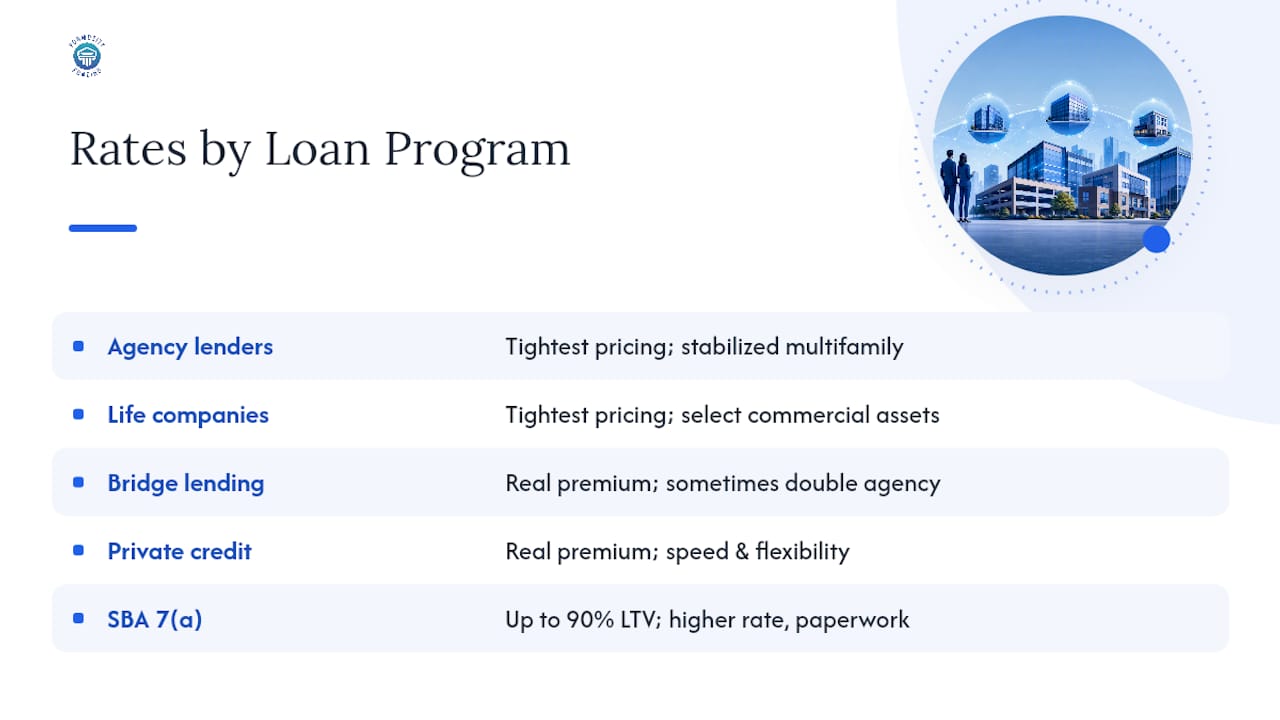
A few things jump out when you look at this side by side. Agency and life-company money still offers the tightest pricing available anywhere in the market, but only for stabilized, well-occupied multifamily and select commercial assets. Both are picky about property quality, so a mediocre asset won't get their best rate regardless of your credit.
Bridge lending and private credit sit at the opposite end. You're paying a real premium there, sometimes double the rate of agency debt, because you're buying speed and flexibility for a transitional or distressed property that traditional lenders won't touch yet.
SBA programs deserve a specific mention because they solve a different problem entirely. The SBA 7(a) program allows leverage up to 90% loan-to-value for eligible owner-occupied properties, which is far higher than a conventional commercial mortgage. You pay for that leverage with a higher rate and program-specific paperwork, but for a business owner without a large down payment, it can be the difference between buying and renting.
None of these ranges are offers. Your actual rate depends on your credit profile, the property's debt service coverage ratio, loan size, term, amortization schedule, and which type of lender you end up working with.
How Are Commercial Mortgage Rates Determined?
Every commercial mortgage rate breaks down into a simple equation: benchmark index plus lender spread, with an added cost for a rate cap or swap if you're financing a floating-rate deal. The benchmark is set by the broader market. The spread is where your specific deal, and your negotiating leverage, actually comes into play.
Different loan structures pull from different benchmarks:
- 10-Year Treasury or swap rate anchors most fixed-rate, longer-term commercial loans.
- SOFR (Secured Overnight Financing Rate) drives floating-rate loans and most bridge financing.
- Prime rate still shows up on some smaller bank lines and owner-occupied deals.
Federal Reserve policy and Treasury yield movements are the real engine behind these benchmarks, and shifts there ripple through to lender pricing within days, sometimes hours, of a Fed announcement.
On top of that benchmark, spreads typically range from 140 to 500+ basis points depending on your capital source. Agency lenders often add 150 to 225 basis points. Life companies run tighter, often 140 to 200 basis points, but they're choosy. Banks land around 200 to 300 basis points. CMBS conduits price in the 175 to 275 basis point range. Bridge and private credit lenders, taking on the most risk, routinely charge 300 to 500 basis points or more over benchmark, according to a breakdown of commercial mortgage pricing. That spread is largely where your deal quality and your shopping effort actually move the needle.

What Factors Affect Your Commercial Mortgage Rate?
The benchmark is out of your hands. The spread isn't, and that's where most of the real negotiating happens.
Borrower-level factors carry real weight:
- Personal and business credit history
- Sponsor track record with similar assets
- Whether the loan is recourse or non-recourse
- Liquidity and reserves after closing
Loan-level structure matters just as much:
- Term length and amortization schedule
- Fixed versus floating rate structure
- Prepayment penalties and lockout periods
- Loan size (smaller balances often carry wider spreads)
Property-level characteristics round it out:
- Asset class (multifamily generally prices tighter than office right now)
- Occupancy and lease rollover risk
- Location and market tier
- Debt service coverage ratio, with anything above 1.25x typically unlocking better terms
That's not guaranteed on every deal, but it's a consistent pattern across capital sources.
Pro Tip: The single most underused lever isn't your credit score, it's competition. Pull two or three term sheets from different capital sources, including at least one agency or life-company lender if your asset qualifies, and use the strongest offer to negotiate the others down. Lenders reprice fast when they know they're not the only option on the table.
When Should You Lock a Rate Before Your Loan Matures?
Rate locks typically run 30 to 60 days from commitment to closing, and the gap between your rate lock and your loan commitment matters more than most borrowers realize. Lock too early and you risk a rate that's stale by closing. Lock too late and you're exposed to a benchmark move you didn't plan for.
If your loan matures within the next 6 to 12 months, move now:
- Start the refinance process today, not 90 days before maturity.
- Solicit quotes from at least two distinct capital sources, ideally one agency or bank lender and one alternative source.
- Underwrite to today's all-in coupon, not a rate cut you're hoping the Fed delivers, according to current CRE debt market analysis.
- Ask your current lender about extension options and their real cost versus a full refinance.
A short-term bridge loan can buy you time if a permanent refinance isn't ready, but that flexibility comes at a meaningfully higher rate.
How to Get a Real Commercial Mortgage Rate Quote
Track the primary sources yourself before you ever call a lender: U.S. Treasury yields, current SOFR, the MBA's origination data, CBRE's lending momentum reports, and Trepp for anything CMBS-related.
When you're ready to request an actual quote, come prepared with:
- Rent roll and trailing 12-month operating statement
- Current loan statement, if refinancing
- Year-to-date profit and loss statement
- Target LTV, DSCR, term, and amortization
- Questions about fee structure and prepayment terms
Shop at least two different capital channels, agency, bank, or debt fund, rather than accepting the first term sheet that lands in your inbox.
What Does a Rate Change Actually Cost You in Payments?
Numbers on a rate sheet don't mean much until you translate them into monthly cash flow. Here's the math on a $500,000 loan using a standard amortizing formula.
- At 6% over a 25-year amortization, your monthly payment runs approximately $3,222, with total interest over the life of the loan landing around $466,600.
- Stretch that to a 30-year amortization at the same 6% rate, and the payment drops to roughly $2,998 monthly, but total interest climbs to about $579,300 because you're paying it off over more years.
- Move the rate up just 50 basis points to 6.5% on the 25-year schedule, and your payment rises to about $3,375 monthly, an extra $150-plus every month on the same loan amount.
Interest-only structures skip principal entirely during the IO period, which improves near-term cash flow but means you're not building equity through amortization, so weigh that trade-off against your hold period.
What Do Current Market Trends Mean for Your Rate?
Commercial and multifamily loan originations jumped 16% year-over-year in the second quarter of 2026, and climbed 12% from the first quarter, according to the MBA. That's real capital coming back into the market, not just talk.
At the same time, CBRE reports that commercial mortgage spreads narrowed 21 basis points year-over-year to an average of 204 bps, with multifamily spreads tightening even further to 162 bps. More lenders competing for deals is pushing pricing in the borrower's favor.
That said, a significant portion of CMBS loans have maturities concentrated in the fourth quarter of 2026, according to Trepp. If your loan falls into that bucket, expect a crowded refinance market later this year and start your process well ahead of the rush.
A publisher's note on using this snapshot
Treat these numbers as a starting point for your underwriting, then move fast to get real quotes. Formosityfunding connects borrowers to a network of lenders who can turn that snapshot into an actual term sheet.
Get Competing Commercial Mortgage Quotes Fast
Formosityfunding is the alternative to calling a dozen banks one by one. Instead of chasing individual lenders and waiting on separate underwriting timelines, you submit one application and get matched with a nationwide network of lenders competing for your commercial real estate deal.
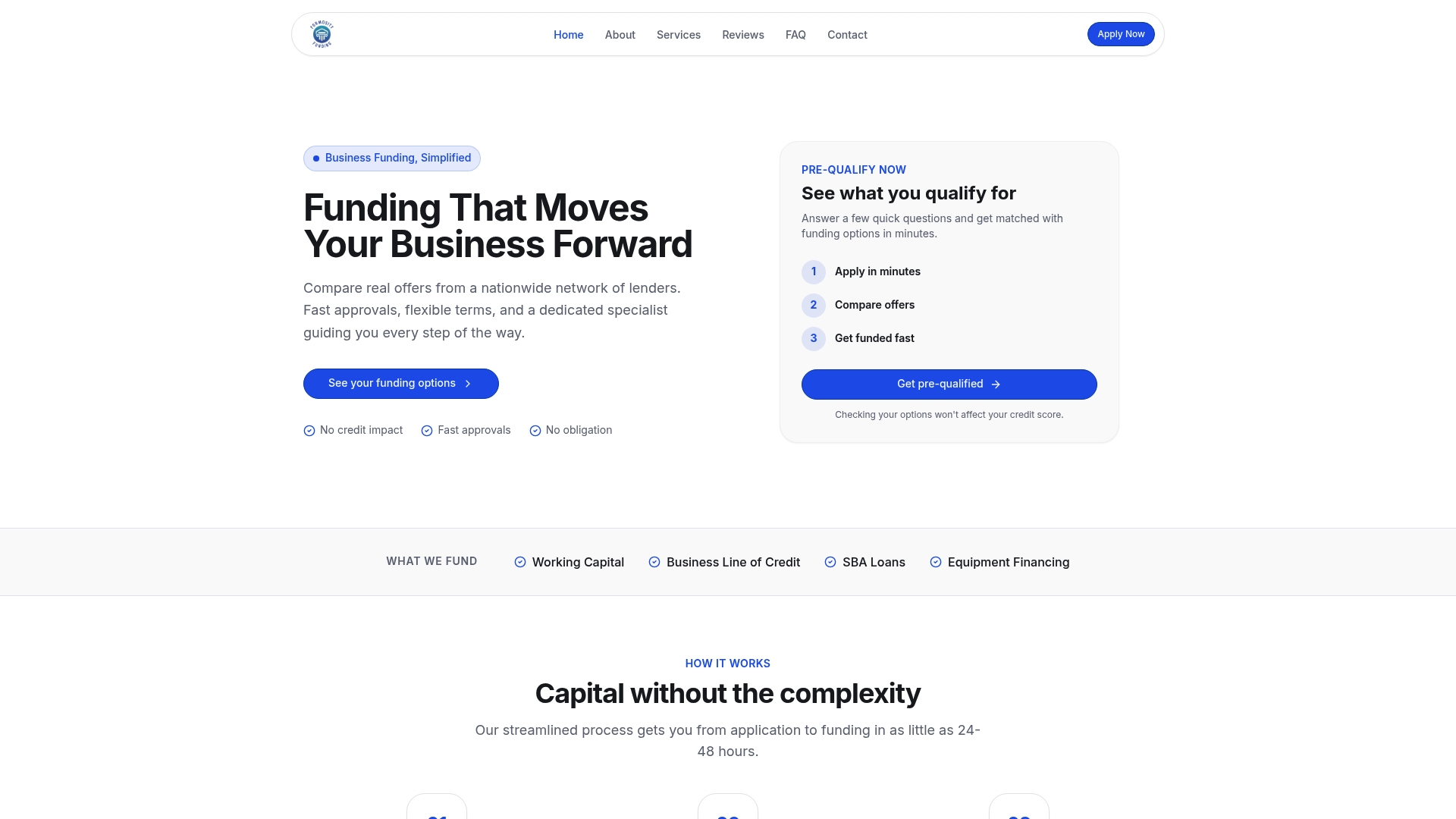
The platform is built around speed and choice, particularly useful given how fast spreads have been moving this year:
- Quick pre-qualification with no impact to your credit
- Access to SBA loan programs for eligible owner-occupied purchases
- Multiple real loan offers to compare side by side, not just one
- Dedicated funding specialists who walk you through terms and paperwork
If you're facing a maturity in the next year or just want to see what you'd actually qualify for, check your commercial real estate financing options with Formosityfunding and get quotes moving before the fourth-quarter refinance rush hits.
Sources
- Commercial/Multifamily Borrowing Increased 16 Percent in the Second Quarter of 2026 | MBA
- Commercial Real Estate Lending Fundamentals Remain Strong in Q2 2026: CBRE | CBRE
- Understanding Commercial Mortgage Interest Rates: Fixed, Floating & Spreads
- June 2026: CMBS hard maturities | TreppTalk