

Do those four things and you address the levers that determine most approval decisions.
Lenders weigh applications against a framework called the five C's of credit: Character, Capacity, Capital, Collateral, and Conditions. A debt-to-income ratio above 43% is a common line lenders use to flag an applicant as higher risk, so that number deserves your attention before you submit anything.
Here's where to start in the next three days:
- Pull your personal and business credit reports and dispute any errors immediately.
- Calculate your DTI and identify which debts you could pay down fastest.
- Gather two to three years of tax returns, recent bank statements, and your latest P&L.
- Consider applying for a smaller, secured amount first rather than the maximum you think you need.
Formosityfunding can prequalify you against a nationwide lender network without a hard credit pull, so you can see real offers before committing to a formal application.
Key Takeaways
| Point | Details |
|---|---|
| Fix credit before applying | Dispute report errors and lower utilization; disputes can take weeks, so start immediately. |
| Watch your DTI | Lenders often flag applicants above a 43% debt-to-income ratio as higher risk. |
| Organize your documents | Have tax returns, bank statements, P&L, and balance sheet ready and reconciled before applying. |
| Sequence your applications | Prequalify softly first, then submit one formal application to avoid stacking hard inquiries. |
| Prequalify through Formosityfunding | Compare real offers across a nationwide lender network without a credit-impact check. |
This article is general information, not a substitute for advice from a qualified financial advisor. Consult a qualified financial professional about your own circumstances before acting on anything here.
Table of Contents
- Your 24 to 72 Hour Loan Approval Checklist
- What Documents Do Lenders Actually Want?
- How Do Credit Scores and DTI Affect Approval?
- Building a Business Plan Lenders Actually Read
- Which Lenders Should You Approach First?
- What Happens After You Submit Your Application?
- The Checklist Beats the Credit Score
- Get Prequalified Through Formosity Funding
- Sources
Your 24 to 72 Hour Loan Approval Checklist
Treat the next three days as prep work, not paperwork. The goal is walking into any application with a complete, error-free package.
- Gather your documents. Locate your EIN, business formation paperwork, two to three years of tax returns, six months of bank statements, and your most recent profit-and-loss statement.
- Pull both credit reports. Check your personal credit and your business credit file, and dispute anything inaccurate right away, since disputes can take weeks to resolve.
- Make short-term credit moves. Pay down revolving balances to lower utilization, and avoid opening new credit lines or triggering hard inquiries until you've locked in your lender choice.
- Decide your loan size and structure. Figure out whether a smaller or secured request makes more sense than a larger unsecured one.
Pro Tip: Run your DTI calculation before you talk to a single lender. Knowing the number in advance lets you address it on your terms instead of reacting to a rejection letter.
What Documents Do Lenders Actually Want?
Lenders want proof you can repay, and they want it organized so an underwriter isn't hunting for context. Bankrate's rundown of required documentation lists tax returns, bank statements, profit-and-loss statements, and balance sheets as the core package almost every lender requests.
- Tax returns: Supply two to three years when you have them, plus a year-to-date summary if your most recent filing is older than six months.
- Bank statements: Highlight recurring deposits and attach a short note explaining any large one-time deposits, since unexplained inflows slow underwriting.
- P&L and balance sheet: Provide recent, reconciled statements, not a rough draft, along with a short narrative if revenue moved unexpectedly.
- Cash flow, shown as debt service coverage: Divide your net operating income by your total debt payments. A ratio above 1.25 tells a lender you have real cushion, not just enough to break even.
| Document | Why lenders ask for it |
|---|---|
| Tax returns (2 to 3 years) | Confirms income trend and consistency over time |
| Bank statements (recent months) | Verifies cash flow matches what your P&L claims |
| Profit and loss statement | Shows current profitability and expense structure |
| Balance sheet | Reveals assets, liabilities, and overall financial position |
How Do Credit Scores and DTI Affect Approval?
Younger businesses lean almost entirely on the owner's personal credit, since there's no track record yet to evaluate. Once a company has two or three years of financials, business credit starts carrying more weight, and lenders look at both scores side by side.
The DTI threshold matters more than most owners realize. A ratio above roughly 43% tells a lender that a large share of your income is already committed elsewhere, which raises the odds of default in their model. Bringing that number down is one of the most direct ways to improve your loan eligibility.
- Dispute credit report errors first. This is often the fastest fix and can move your score within weeks.
- Pay down the debt with the highest interest rate relative to its balance, not just the largest balance.
- Lower credit utilization below 30% on revolving accounts before applying.
- Hold off on new credit inquiries until after you've completed prequalification.
Expect disputes and utilization changes to show results in 30 to 60 days. Rebuilding a thin credit file, or recovering from a missed payment, usually takes six months to a year of consistent, on-time behavior.
Building a Business Plan Lenders Actually Read
A lender doesn't need forty pages. They need a one-page summary stating your loan amount, exactly how you'll use it, your repayment plan, and the key metrics that back it up.
Attach a simple three to twelve month cash flow projection, and say plainly what assumptions drive it: seasonal sales patterns, a new contract, or a planned hire. Show your break-even point and your debt service coverage ratio in plain numbers, since that's the fastest way to demonstrate you can actually make the payments. Lenders also expect two or more years of tax returns alongside a debt schedule when they're weighing capacity to repay.
- Executive summary: loan amount, use of funds, repayment source, and top three metrics.
- Cash flow table: three to twelve months, with assumptions stated in one line each.
- Break-even and DSCR: a short paragraph, not a spreadsheet dump, explaining what the numbers mean.
- Risk mitigations: a sentence on what happens if revenue dips below projection.
Pro Tip: If your revenue dipped last year for a reason you can explain, get an accountant to write a one-paragraph narrative around it. A CPA's framing of a temporary dip reads very differently to an underwriter than the raw number sitting alone on a P&L.
Which Lenders Should You Approach First?
Match the loan type to the lender before you match the lender to your comfort level. Equipment purchases fit equipment financing. Expansion projects usually call for a term loan or an SBA loan. Working capital gaps are better served by a line of credit or invoice financing.
- Start with soft prequalifications through a marketplace, since these typically don't touch your credit score.
- Narrow the results to your top one or two matches based on rate, term, and funding speed.
- Submit one formal application at a time rather than several simultaneous hard pulls, which can drag down your score right when you need it strongest.
- When you talk to a loan officer, bring a package that's already organized and be ready to explain your assumptions in one or two sentences, not a monologue.
- Traditional banks and credit unions tend to ask for more documentation but often offer better long-term rates.
- Online lenders move faster but still require the core financial package and frequently ask for a personal guarantee.
- Offering collateral, even partial, can offset a borderline credit profile without you having to raise your rate.
What Happens After You Submit Your Application?
Timelines vary a lot by product. A business credit card can approve in days, online term loans typically fund in 7 to 21 days, and SBA loans can stretch to 60 days or longer.
Most delays come from follow-up requests, not outright denial. Underwriters commonly ask for clarification on a large deposit, updated proof of collateral, or a more recent P&L than the one you submitted.
- Keep a folder ready with your most recent statements so you're not scrambling when a request lands.
- Respond within 24 hours whenever possible. Prompt, organized responses to document requests measurably speed up decisions.
- Designate one person on your team to handle lender communication so nothing falls through a gap between you and your bookkeeper.
The Checklist Beats the Credit Score
Most advice on this topic obsesses over credit scores like they're the whole game. They're not. A lender weighing the five C's will forgive a mediocre credit number if your cash flow story is airtight and your documents are clean. What actually sinks applications is disorganization: missing bank statements, an unexplained deposit, a P&L that doesn't match the tax return from the same period.
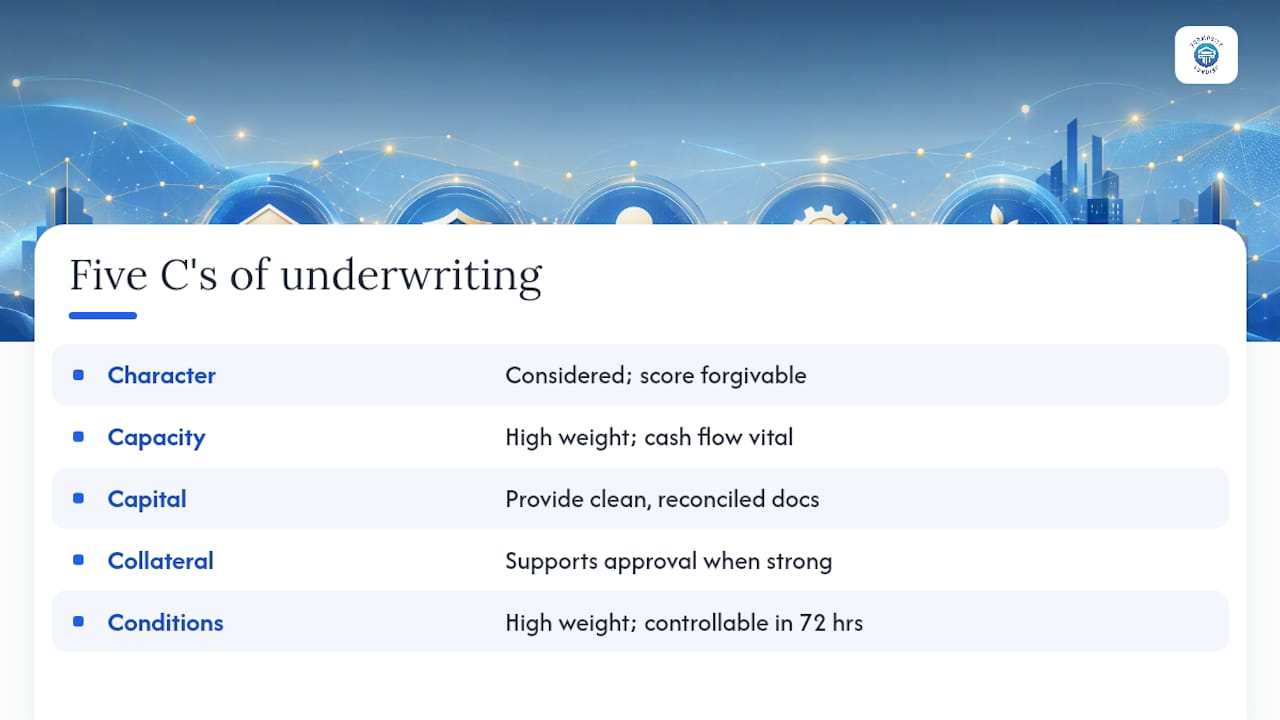
That's the part conventional advice underplays. Owners spend weeks trying to nudge a credit score up ten points when they'd get more mileage from spending one focused evening reconciling their financial statements and writing a one-page narrative around anything unusual. Capacity and Conditions carry as much weight as Character in most underwriting conversations, and those two are entirely within your control on a 72-hour timeline.
If I had to prioritize for a reader with limited time, I'd skip the elaborate business plan first and fix the DTI and document gaps before anything else. A polished projection means nothing if the underlying bank statements don't reconcile. Sequence your applications carefully, too. Firing off five loan requests in one week does more damage to your credit than a slightly slower, smarter approach ever will.
— Alvin
Get Prequalified Through Formosity Funding
Collecting offers one bank at a time wastes the exact week you need for prep work. Formosityfunding puts you in front of a nationwide network of lenders at once, so you can compare real offers side by side instead of applying blind to a single institution and hoping.
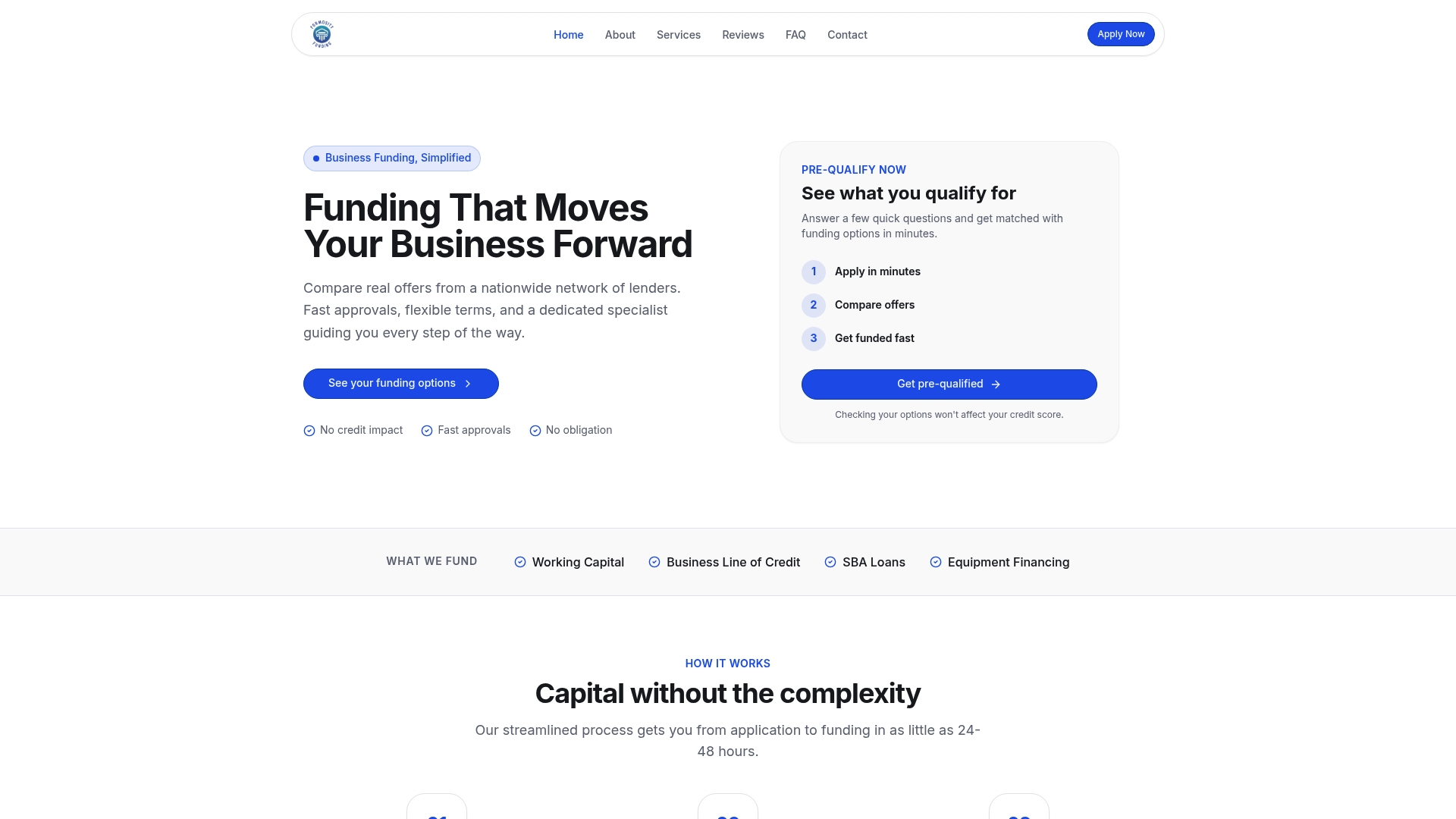
The prequalification step uses no-credit-impact checks, meaning you can see what you might get approved for without a hard pull touching your score while you're still gathering documents. From there, Formosityfunding matches your profile against working capital, SBA loans, equipment financing, lines of credit, invoice factoring, and more, and a dedicated funding specialist walks you through which options actually fit your situation rather than leaving you to guess. That combination, breadth of lenders plus a real person guiding the match, tends to surface options an owner searching alone would simply miss.
Start by checking your funding options to see which loan types you prequalify for, or visit Formosityfunding to see the full range of financing the platform matches you against.
Sources
- Small Business Loans: What You Need to Know to Secure Funding | US Chamber of Commerce
- What Documents Are Required For A Business Loan? | Bankrate
- Factors that impact loan decisions (and how to increase your approval odds) | Bank of America
- 12 Ways to Boost Loan Eligibility for Your Business | SoFi