

Pick a loan when you know exactly how much you need and you're buying something once, like a truck or a renovation. Pick a line of credit when your need is recurring, unpredictable, or you're smoothing out cash flow between invoices and payroll. The distinction underneath both, as Investopedia explains, comes down to installment credit versus revolving credit. A loan hands you a lump sum with a fixed repayment schedule. A line of credit gives you a pool of money you draw from and repay repeatedly, similar to a credit card, and organizations like the National Credit Union Administration publish plain-language guidance to help borrowers understand exactly how those structures differ before signing anything.
That's the short answer. The rest of this comes down to why it holds up, what it costs in real dollars, and how to know when your situation calls for one, the other, or both.
Key Takeaways
Choosing between a loan and a line of credit comes down to whether your need is a fixed, one-time cost or a recurring, unpredictable expense that benefits from paying interest only on what you draw.
| Point | Details |
|---|---|
| Match the product to the need | Choose a term loan for known, one-time costs and a line of credit for recurring or unpredictable cash needs. |
| Structure drives cost | Installment loans charge interest on the full balance immediately; lines of credit charge interest only on amounts drawn. |
| Fees hide beyond the rate | Ask every lender for an all-in typical month cost covering interest plus draw, maintenance, or origination fees. |
| Both products can coexist | Many growing businesses keep a term loan for capital projects and a line of credit for ongoing working capital. |
| Formosityfunding matches both | Formosityfunding's marketplace connects you with real loan and line-of-credit offers through no-impact pre-qualification and dedicated funding specialists. |
Where to verify these numbers yourself
Independent sources are worth checking before you sign any financing agreement. Investopedia's breakdown of installment versus revolving credit is a solid starting reference, and NerdWallet's comparison walks through lender types and rate expectations in more depth. Finder's guide covers term lengths and fee structures specific to business lines of credit, while FitSmallBusiness offers a practical look at when businesses combine both products. For consumer protections and unbiased educational material, the National Credit Union Administration publishes guidance that isn't tied to any single lender's product lineup, which makes it a useful gut check against anything a loan officer tells you.
FAQ
Is a line of credit better than a loan? Neither is universally better. A loan usually wins for one-time, known-cost needs because of its predictable payment and often lower fixed rate. A line of credit usually wins for recurring or unpredictable needs because you only pay interest on what you draw.
What's the biggest disadvantage of a line of credit? Variable rates and recurring fees (maintenance, inactivity, renewal) can add unexpected cost, and the revolving structure makes it easy to keep drawing rather than paying down the balance.
What's the biggest disadvantage of a term loan? You pay interest on the full amount from day one, even if you don't need all the funds immediately, and most fixed-term loans carry prepayment penalties if your circumstances change.
Is a mortgage a loan or a line of credit? A standard mortgage is an installment loan: a lump sum disbursed once with fixed monthly payments. A home equity line of credit (HELOC) is a separate revolving product secured against home equity.
Does using a line of credit affect my credit score differently than a loan? Yes. A line of credit's reported balance factors into your credit utilization ratio, so drawing close to your limit can lower your score even if you're paying on time. A term loan's fixed balance declines predictably each month, which tends to have a steadier effect on utilization-related scoring.
Are loans or lines of credit tax deductible? Interest on business loans and business lines of credit used for legitimate business purposes is generally tax deductible, while interest on personal loans typically is not. Deductibility rules can vary by structure and use of funds, so confirm specifics with a tax professional before filing.
How do rising interest rates affect each option? A fixed-rate loan's payment stays the same regardless of what rates do afterward. A variable-rate line of credit's payment can rise when the underlying benchmark rate increases, which is worth factoring in if you plan to carry a balance for an extended period.
This article provides general financial information and is not a substitute for personalized advice from a licensed lender or financial professional. Confirm current rates, terms, and eligibility requirements directly with lenders before making a borrowing decision.
Table of Contents
- Line of Credit vs Loan: A Side-by-Side Comparison
- How Loans and Lines of Credit Actually Work
- How to Compare the Real Cost of Each Option
- Who Qualifies, and What Lenders Ask For
- When Each Option Actually Makes Sense
- A Quick Checklist for Choosing Between Them
- A Worked Example: $10,000 Loan vs $10,000 Line of Credit
- Pros and Cons at a Glance
- Get Matched With the Right Financing Option
- Sources
Line of Credit vs Loan: A Side-by-Side Comparison
The two products solve different problems, and the table below shows where they diverge on the dimensions that actually affect your monthly budget.
| Dimension | Term Loan | Line of Credit |
|---|---|---|
| Best for | One-time, known-cost purchases | Recurring or unpredictable cash needs |
| Structure | Lump sum, disbursed once | Revolving pool, draw as needed |
| Repayment | Fixed installments over a set term | Pay down what you draw, funds become available again |
| Interest | Often fixed; accrues on full amount from day one | Often variable; charged only on the amount drawn |
| Typical limit | Can range from a few thousand to millions for SBA or commercial loans | Often smaller, frequently capped lower than a comparable term loan |
| Collateral | Depends on loan type; larger loans often secured | Can be secured or unsecured; personal guarantees common |
| Qualification | Credit score, time in business, revenue history | Similar factors, sometimes more flexible for established relationships |
| Common fees | Origination fee, prepayment penalty on some products | Draw fees, maintenance or inactivity fees, renewal fees |
| Example monthly cost on $10,000 | Fixed payment covering principal and interest on the full balance | Varies based on how much of the $10,000 you actually draw |
A few trade-offs matter more than the rest of the row-by-row detail:
- A loan gives you predictability: same payment, same date, every month, until it's paid off.
- A line of credit gives you flexibility, but that flexibility usually comes with more fee categories to track.
- You pay interest on the entire loan balance from the start, but only on what you've drawn from a line of credit, which is why usage pattern (not just the advertised rate) decides which one actually costs less.
How Loans and Lines of Credit Actually Work
A term loan is straightforward. You apply, get approved for a set amount, and the lender deposits the full sum into your account at once. From that moment, interest starts accruing on the whole balance, whether you spend it immediately or let it sit. Your payment schedule is fixed: same amount, same due date, for the life of the loan. Rates can be fixed or variable, but most small-business term loans and personal installment loans use fixed rates so the payment never surprises you.

A line of credit works differently. The lender approves you for a credit limit, say $25,000, but you don't receive that money upfront. You draw against it as needed, and interest is typically charged only on the amount drawn, not the full limit. Pay down what you've drawn, and that capacity becomes available again. It's a facility you can tap repeatedly rather than a single transaction.
Think of a loan like filling a bucket once. You get the full amount, and you're responsible for using it and paying it back on the schedule you agreed to. A line of credit works more like a tap connected to a reservoir: you turn it on when you need water, turn it off when you don't, and you're only billed for what flows through.
The core technical difference is installment credit versus revolving credit, and everything else, from how interest accrues to how repayment feels month to month, follows from that one structural choice.
Pro Tip: Before comparing rates, ask each lender to walk you through exactly when interest starts accruing on their product. That single detail changes the real cost more than the headline APR does.
How to Compare the Real Cost of Each Option
The advertised rate rarely tells the whole story. Business lines of credit often carry draw fees, maintenance or inactivity fees, and renewal fees that don't show up until you read the fine print. Term loans can carry origination fees upfront and prepayment penalties if you pay the balance off early. Neither of those costs is captured by the interest rate alone.
Here's the part that trips people up: a line of credit with a higher stated rate can still end up cheaper than a lower-rate term loan, simply because you're only paying interest on the portion you use. If you're approved for a $20,000 line but only draw $6,000 for two months to cover a slow season, you're paying interest on $6,000, not $20,000. A term loan for the same $6,000 need would have you paying interest on the full amount from day one, plus whatever origination fee the lender tacked on.
A quick way to run this comparison yourself:
- List every fee each lender charges, not just the interest rate.
- Estimate how much of the credit line you'd realistically draw in a typical month.
- Calculate interest on that drawn amount versus interest on the full loan principal for the same dollar need.
- Add fees to both totals and compare the real monthly cost side by side.
Pro Tip: Ask lenders directly for an "all-in typical month" cost, meaning interest plus fees for a sample draw amount or a typical usage pattern. That single number, not the advertised rate, is what actually predicts your bill.
Who Qualifies, and What Lenders Ask For
Loan and line-of-credit underwriting overlap more than most borrowers expect, but the emphasis shifts depending on the product.
Lenders evaluating a term loan typically look at:
- Personal and business credit scores, with many lenders wanting at least fair-to-good credit for competitive rates.
- Time in business, often two years or more for the strongest terms.
- Annual revenue and documented cash flow, usually verified through bank statements or tax returns.
- The specific use of funds, especially for larger loans tied to equipment or real estate.
Lines of credit look at similar factors, but banks tend to offer the lowest rates and are hardest to qualify for, while online lenders approve faster with looser eligibility standards at higher rates. That trade-off between speed and cost shows up constantly in the small-business lending market.
Collateral expectations vary by product size and lender type:
- Smaller unsecured lines of credit often rely on a personal guarantee rather than specific collateral.
- Larger secured lines or loans may involve a UCC lien against business assets, giving the lender a claim if you default.
- Commercial real estate loans and large equipment loans are almost always secured by the asset itself.
Term lengths differ too. Business lines of credit are generally shorter facilities, often 24 months or less, with more frequent repayment requirements, while business loans typically run longer with structured monthly installments that can stretch five, ten, or even twenty years for real estate.
When Each Option Actually Makes Sense
Numbers and definitions only get you so far. Here's where the choice plays out in real situations.
- Home repairs with a known price tag. You got three quotes for a new roof, and they landed within a few hundred dollars of each other. A personal loan makes sense here because the cost is fixed, you need the full amount at once, and a predictable payment fits a repair you won't repeat next year.
- Debt consolidation. Rolling several credit card balances into one fixed-rate loan gives you a clear payoff date, something revolving debt rarely offers.
- Equipment purchase for a small business. Buying a delivery van or a piece of manufacturing equipment is a one-time cost with a defined price. A term loan or equipment financing product matches that shape.
- Payroll during a slow season. A seasonal retailer or landscaping business that knows revenue dips every January doesn't need a lump sum sitting in an account earning interest charges. A line of credit lets them draw only what's needed to cover payroll gaps, then repay once revenue picks back up.
- Inventory purchases ahead of peak demand. Retailers restocking before a holiday rush face a need that's recurring but variable in size each year, which fits the flexibility of revolving credit better than a fixed loan.
It's also common practice, and FitSmallBusiness notes this pattern regularly, for growing businesses to carry both at once: a term loan funding a long-term capital project like a new location, and a standing line of credit handling the ordinary ebb and flow of working capital. Neither product has to do all the work alone.
Pro Tip: If your funding need splits into "a big one-time piece" and "an ongoing smaller piece," don't force one product to cover both. Layering a loan with a line of credit often costs less than stretching a single loan to also serve as your cash-flow cushion.
A Quick Checklist for Choosing Between Them
Before you fill out an application, answer these questions honestly:
- How certain am I about the exact dollar amount I need?
- Will I need the money once, or will the need recur over months or years?
- Do I want the certainty of a fixed monthly payment, or can I handle a payment that varies with what I've drawn?
- Am I comfortable managing a revolving balance without letting it creep upward?
- Do I need an open facility I can tap repeatedly without reapplying each time?
Match your answers to these signals:
- If the need is a one-time purchase and the amount is known, lean toward a term loan.
- If the need recurs, fluctuates, or you can't predict the exact amount, lean toward a line of credit.
- If you're managing both a big planned expense and ongoing cash-flow variability, consider both products working together rather than choosing one.
- If you're unsure how a variable rate might move, ask the lender to model a rate increase scenario before committing to a revolving product tied to a floating index.
Once you've got a direction, get pre-qualified, which typically doesn't touch your credit score, request that "all-in typical month" cost estimate from at least two lenders, and compare collateral requirements before you sign anything. Reading up on how repayment structure affects cash flow before you commit can also clarify which payment shape your business can actually absorb.
A Worked Example: $10,000 Loan vs $10,000 Line of Credit
Numbers make this concrete. Assume a $10,000 term loan at a fixed rate over a three-year term, compared against a $10,000 line of credit with a variable rate where you draw an average of $4,000 per month across the year.

| Scenario | Assumption | What it means for cost |
|---|---|---|
| Term loan | $10,000 disbursed in full, fixed monthly payment over 36 months | Interest accrues on the full $10,000 starting immediately |
| Line of credit, light use | Average draw of $4,000 of the $10,000 limit | Interest accrues only on the $4,000 actually drawn |
| Line of credit, heavy use | Average draw of $9,000 of the $10,000 limit | Interest accrues on nearly the full limit, closer to loan-level cost |
| Added fees, loan | Origination fee charged once at funding | One-time cost, spread invisibly into the effective rate |
| Added fees, LOC | Draw fees or maintenance fees charged periodically | Recurring cost that adds up over a year of use |
The assumptions you can tweak: how much of the line you actually draw, whether the lender charges a maintenance fee even during months you don't draw, and whether the loan's fixed rate is meaningfully lower than the line's variable rate. That last variable matters more than people expect. If the line of credit's rate runs several points higher than the loan's rate, light usage can still keep total interest lower than the loan. But if you consistently draw 80 to 90 percent of the limit, the gap closes fast, and the loan's lower rate on a fully utilized balance may win out.
The practical lesson: run your own numbers against your actual expected draw pattern, not the lender's advertised best-case scenario. A financing calculator that lets you plug in your own draw estimates and fee schedule will show you which product wins for your specific situation faster than comparing rate sheets alone.
Pros and Cons at a Glance
Term loans
- Predictable payment makes budgeting simple.
- Often lower interest rates than comparable lines of credit, especially through banks or SBA-backed programs.
- Interest accrues on the full balance immediately, even if you don't need all the money right away.
- Less flexible if your need turns out to be smaller, or larger, than expected.
Lines of credit
- Interest applies only to what you draw, which rewards disciplined usage.
- Reusable without reapplying, useful for recurring or seasonal needs.
- Additional fee categories (draw, maintenance, renewal) can add up if you're not tracking them.
- Variable rates mean your payment can rise if the underlying index climbs.
| Factor | Term Loan | Line of Credit |
|---|---|---|
| Predictability | High | Lower, payment varies with draw |
| Cost if fully used | Often lower rate | Can exceed loan cost at high utilization |
| Cost if lightly used | Fixed regardless of need | Often cheaper, interest only on draw |
| Risk of over-borrowing | Lower, amount fixed upfront | Higher, easy to keep drawing |
An editorial note on when this actually matters
Most guides treat this as a purely mathematical decision: compare the rates, pick the cheaper one. That misses the behavioral piece. A line of credit's biggest risk isn't the fee schedule, it's the temptation to keep drawing on it because the money is sitting there available. I've seen the same mistake play out in different forms: a business opens a line for a legitimate seasonal gap, then starts treating it as a permanent revenue supplement rather than a bridge. That's not a product failure, it's a discipline problem the product happens to make easy to fall into.
My rule of thumb is simpler than most calculators: if you can picture the exact invoice or purchase order this money is paying for, get a loan. If you're picturing a pattern of expenses over the next six to twelve months without a specific dollar figure attached to any single one, get a line of credit and treat the limit as a ceiling, not a target. Run through the checklist above before you talk to a lender. It won't replace their underwriting, but it will keep you from applying for the wrong product shape and wasting a hard credit pull.
Get Matched With the Right Financing Option
Comparing loan quotes against line-of-credit offers on your own means calling multiple banks, filling out separate applications, and hoping you're reading the fee disclosures correctly each time. Formosityfunding shortens that process by matching your business with a nationwide network of lenders in one application, so you see real loan and line-of-credit offers side by side instead of guessing which product fits based on rate sheets alone.
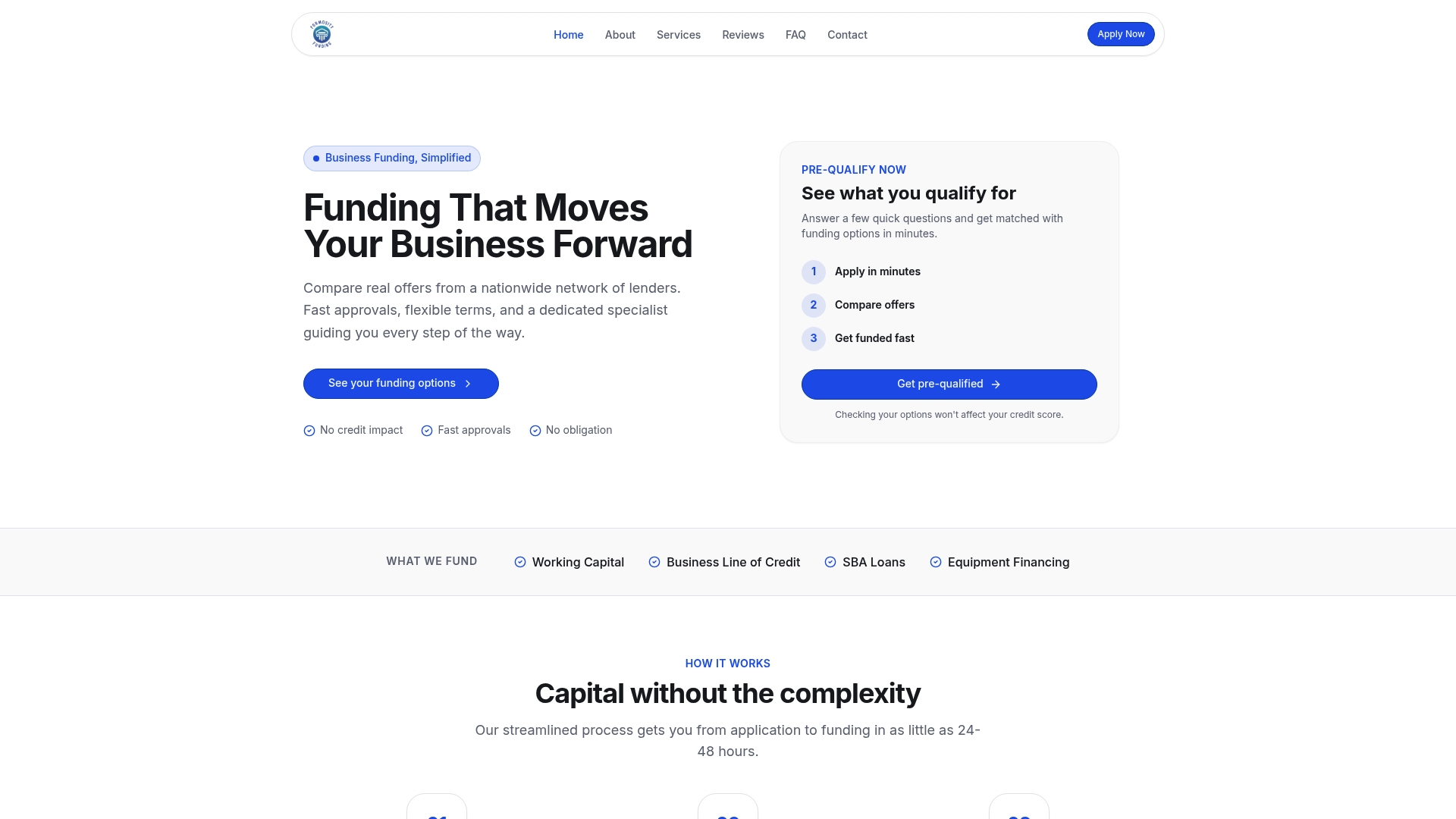
Formosityfunding's pre-qualification process doesn't affect your credit score, which means you can compare a term loan against a working capital line of credit before committing to either one. A dedicated funding specialist walks you through the terms, the fees, and the fine print that headline rates tend to hide, whether you're weighing SBA loans, equipment financing, or a revolving credit facility for seasonal cash flow. If you're ready to see what you actually qualify for, start your pre-qualification with Formosityfunding and get real offers instead of estimates.
Sources
- Business Line of Credit (LOC) vs. Loan: What's Best for You in 2026?
- Business Loan vs. Line of Credit: Which Is Right for You? - NerdWallet
- Loan vs. Line of Credit: Key Differences Explained - Investopedia
- Business Line of Credit vs Term Loan: Which One Fits Your Cash Gap - DripCapital