

If your business loan got denied, the most likely culprits are your credit score, weak collateral, inconsistent cash flow, limited time in business, or too much existing debt already on the books. In 2025, more than half of applicants were denied outright or only partially funded, according to the Federal Reserve Small Business Credit Survey. Before you do anything else: call the lender and ask for the specific denial reason or code, plus a copy of whatever underwriting checklist they used. You cannot fix what you cannot name.
The most common drivers, ranked by frequency:
- Credit score issues (personal or business)
- Insufficient collateral
- Insufficient cash flow or revenue
- Short time in business
- Too much existing debt
- Incomplete or inconsistent documentation
By the numbers: Credit problems were cited by 45% of denied or partially funded applicants, insufficient collateral by 36%, and weak cash flow by 33%, per the 2025 SBCS report.
Key Takeaways
Most business loan denials trace back to a handful of fixable gates, credit, collateral, cash flow, time in business, and debt load, that lenders measure with specific, knowable thresholds.
| Point | Details |
|---|---|
| Credit issues top the list | 45% of denied or partially funded applicants cited credit problems as a factor. |
| Documentation gaps are fastest to fix | Reconcile bank statements to your P&L before resubmitting; this alone resolves multiple gates. |
| DSCR is a hard SBA gate | SBA loans typically require a DSCR near 1.15x standard, or 1.10x for loans of $350,000 or less. |
| Timelines vary by fix type | Document corrections take days; credit repair and debt paydown take months; SBA processing runs 60 to 120 days. |
| A marketplace speeds lender matching | Formosity Funding offers soft prequalification and matches applicants to lenders across multiple funding products. |
Table of Contents
- Top Reasons Small Business Loans Get Denied
- How Lenders Evaluate Applications
- What To Do Immediately After A Denial
- Documentation Checklist Before You Reapply
- How A Loan-Matching Marketplace Fits In
- Get Matched With The Right Lender Faster
- Frequently Asked Questions
- Sources
Top Reasons Small Business Loans Get Denied
Lenders rarely deny an application for one isolated reason. Usually two or three factors stack up, and each one tells a different story about risk. Here's what each denial reason actually signals to an underwriter, and what usually fixes it.
- Credit score problems (45% of cases). Lenders read a low personal or business credit score as a proxy for repayment discipline, even when your business is otherwise healthy. Pull your report, dispute errors, and pay down revolving balances before you reapply.
- Insufficient collateral (36%). Equipment, real estate, or receivables that don't cover the loan amount signal higher risk if the business fails. Offering additional collateral or requesting a smaller loan amount often resolves this.
- Insufficient cash flow or revenue (33%). Lenders want proof you can service debt from operating income, not projections. A clean, forward-looking cash flow statement addresses this directly.
- Short time in business (26%). Fewer than two years of operating history makes it hard for underwriters to trust your trend line. A cosigner, larger down payment, or alternative product like invoice factoring can bridge the gap.
- Too much existing debt (22%). High debt service relative to income eats into your capacity to take on more. Consolidating or paying down existing obligations before applying often moves the needle.
- Documentation errors or gaps. Missing tax returns, mismatched bank statements, or an incomplete debt schedule stall applications before underwriting even begins.
- Industry risk. Certain sectors, restaurants, seasonal retail, are flagged automatically by some lenders regardless of your individual numbers.
Pro Tip: Fix documentation and lender communication issues first. They are the fastest to remediate, often within days, while credit repair and debt paydown can take months.
How Lenders Evaluate Applications
Underwriters lean on a handful of core metrics, and knowing them lets you gauge your own odds before you submit anything.
Debt Service Coverage Ratio (DSCR) measures whether your business generates enough cash flow to cover new debt payments. For SBA 7(a) loans, the typical minimum is around 1.15x for standard loans and 1.10x for Small Loans of $350,000 or less, according to SBA underwriting guidance. A DSCR of 1.15x means your net operating income covers your debt payments with 15% to spare.
Example: If your business generates $115,000 in annual net operating income and your proposed loan payment totals $100,000 a year, your DSCR is 1.15x. Drop that income to $105,000 and you're below the SBA's standard threshold.
Lenders also weigh:
- Personal credit score, often gated around 680 or higher for conventional products
- Business credit profile and payment history with vendors
- Time in business, tax returns, and bank statement patterns
- Collateral value relative to loan size
The SBA raised its SBSS minimum score to 165 for Small Loans effective June 1, 2025, tightening the gate for smaller SBA-backed requests.
Watch for red flags lenders specifically screen for: chronic overdrafts, unexplained large cash withdrawals, and seasonal revenue swings with no explanatory note attached.
What To Do Immediately After A Denial
- Get the denial reason in writing. Ask the lender for the exact reason and whether the file qualifies for reconsideration or appeal.
- Triage by impact and repair time. Documentation fixes take days. Credit corrections and debt paydown take months. Sort your issues accordingly.
- Match your timeline to the fix. Correcting a bank statement mismatch might take a week. Rebuilding a damaged credit score often takes three to six months. SBA reapplication and processing can run 60 to 120 days once you resubmit.
- Decide where to reapply. If the denial stemmed from a lender-specific policy (loan size, industry restriction), a different lender may approve the same file unchanged. If the denial stemmed from your numbers, fix them first, regardless of lender.
A significant portion of denials trace back to excessive existing debt, a factor that often takes months, not days, to resolve through consolidation or paydown.
Don't rush a reapplication before the underlying issue is actually fixed. A second denial on the same grounds makes the third attempt harder.
Documentation Checklist Before You Reapply
A stronger file starts with paperwork that reconciles cleanly. Gather:
- Two to three years of business and personal tax returns
- 12 to 24 months of business bank statements
- Current profit and loss statement and balance sheet
- A complete debt schedule listing every existing obligation
- Collateral list with recent appraisals
- Business licenses and incorporation documents
- A one-page use-of-proceeds memo explaining exactly how you'll spend the loan
Two fixes resolve problems fastest: reconcile your bank deposits against your P&L so the numbers match line for line, and correct any credit report errors before submission rather than explaining them after the fact. Clean, current bookkeeping often resolves two or three denial reasons at once because most underwriting gates trace back to the same source documents.
Pro Tip: *Recalculate your DSCR using your reconciled numbers before you submit.
How A Loan-Matching Marketplace Fits In
A marketplace won't override a lender's underwriting standards, but it changes how efficiently you find a lender whose standards you actually meet. Soft prequalification lets you see likely matches without a hard credit inquiry, and bundled documentation means you're not rebuilding your file from scratch for every lender you approach.
- Prequalification with no credit impact narrows your options fast
- One document package gets triaged across multiple lenders instead of one at a time
- Matching considers your strongest asset, whether that's collateral, cash flow, or credit
Marketplaces don't guarantee approval, and they tend to favor lenders already inside their network. Formosity Funding, for instance, works across a range of funding products rather than a single loan type, which matters if your strongest qualifying factor is collateral rather than cash flow.
Pro Tip: Use your prequalification results to target the product that plays to your strength, equipment financing if you have hard assets, a line of credit if cash flow is your best number.
Why Fixing The Right Metric Beats Reapplying Blind
The common mistake isn't lack of effort, it's reapplying without touching the metric that actually caused the denial. Fix the DSCR or the documentation gap first. Data on discouraged borrowers shows circumstances change, and so do outcomes.
Get Matched With The Right Lender Faster
Fixing your credit or rebuilding a debt schedule takes time, but finding a lender whose standards actually match your business shouldn't. Formosity Funding connects you with a nationwide network of lenders instead of one bank's single underwriting box, so a denial from one source doesn't have to be the final word.
Getting started takes a soft prequalification that won't touch your credit score, followed by a conversation with a funding specialist about which product fits your numbers, whether that's a line of credit, SBA loan, equipment financing, or invoice factoring. Expect a faster path to a decision than shopping lenders one at a time on your own.
What you can expect from the process:
- Faster decisions than approaching lenders individually
- Lender matches targeted to your strongest qualifying factor
- Clear next steps even if your first match isn't approval-ready
Start with a prequalification through Formosity Funding to see which lenders in the network fit your current numbers.
Frequently Asked Questions
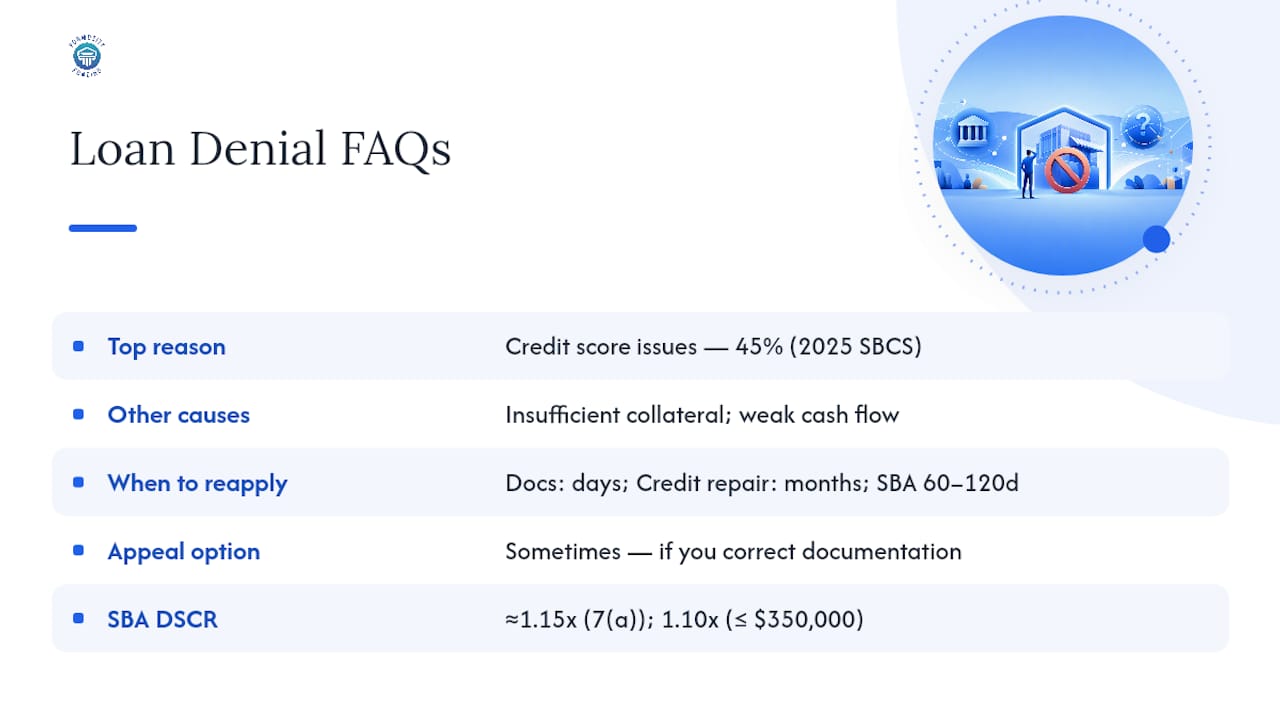
What is the most common reason a business loan gets denied? Credit score issues top the list, cited by 45% of denied or partially funded applicants in the 2025 SBCS report. Insufficient collateral and weak cash flow follow closely behind.
How long should I wait before reapplying after a denial? It depends on the fix. Documentation corrections can be resolved in days. Credit repair or debt paydown typically takes several months before it meaningfully moves your numbers. SBA applications can then take another 60 to 120 days to process once resubmitted.
Can I appeal a loan denial instead of reapplying from scratch? Some lenders allow reconsideration if you correct a specific documentation error or provide additional information, rather than requiring a full new application. Ask the lender directly whether your file qualifies for that path.
What DSCR do I need to qualify for an SBA loan? SBA underwriting typically looks for a DSCR of about 1.15x for standard 7(a) loans, or 1.10x for Small Loans of $350,000 or less. Below that threshold, expect denial regardless of how strong your other numbers look.
Does using a loan-matching marketplace guarantee approval? No. A marketplace like Formosity Funding improves your odds of finding a lender whose criteria match your profile, but it doesn't override any individual lender's underwriting standards.
This article is general information, not a substitute for advice from a qualified financial advisor. Consult a qualified financial professional about your own circumstances before acting on anything here.