

Recourse factoring keeps bad-debt risk with your business. Nonrecourse factoring shifts specified credit losses, usually just debtor insolvency, to the factor, in exchange for higher fees and tighter approval rules.
- Recourse: cheaper, easier to qualify for, but you buy back or replace any invoice your customer never pays.
- Nonrecourse: costlier, harder to qualify for, but the factor bears the loss if an approved customer goes insolvent.
- Quick verdict: stick with recourse if your customers are financially stable and you sell in volume. Lean nonrecourse if you're dealing with a concentrated, risky, or unfamiliar buyer base, like new export accounts.
Key Takeaways
Recourse factoring keeps unpaid-invoice risk with your business at lower cost, while nonrecourse factoring shifts insolvency risk to the factor for a higher fee and stricter approval.
| Point | Details |
|---|---|
| Recourse means you carry the loss | You buy back or replace any invoice unpaid past the recourse window, typically 60 to 120 days. |
| Nonrecourse only covers insolvency | Disputes, short-pays, fraud, and missing paperwork stay your responsibility even under nonrecourse. |
| Costs scale with risk transfer | Advance rates run roughly 80% to 95%, with nonrecourse fees commonly 3% to 7% per cycle. |
| Documentation determines approval speed | Proof of delivery and debtor credit info move underwriting faster than almost anything else. |
| Formosityfunding compares both options | The marketplace matches you to lenders offering recourse and nonrecourse programs so you can compare real offers side by side. |
Table of Contents
- How Does Recourse Factoring Work?
- What Does Nonrecourse Factoring Actually Cover?
- Recourse vs Nonrecourse Factoring Side by Side
- What Do Recourse and Nonrecourse Factoring Cost?
- What Paperwork Do You Need to Qualify?
- What Happens When a Customer Doesn't Pay?
- How Do You Choose Between the Two?
- How Can a Funding Marketplace Simplify This Decision?
- What Business Owners Consistently Get Wrong
- Compare Factoring Offers Without Calling a Dozen Lenders
- Frequently Asked Questions
- Sources
How Does Recourse Factoring Work?
Recourse factoring starts the same way most invoice factoring does: you sell an unpaid invoice to a factor, they advance you most of its value, and they hold the rest back as a reserve. The catch with recourse is what happens if your customer doesn't pay. You're on the hook.
Here's the mechanic that trips people up. If a customer misses payment past a set window, commonly 60 to 120 days, the factor issues a chargeback. You either repay the advanced amount, swap in a different receivable, or watch it get deducted from your reserve.
- Funding happens fast, often within a day or two of invoice submission.
- Advance rates and reserve terms get set upfront, before any dispute arises.
- The chargeback clock starts ticking the moment the invoice ages past the factor's recourse window.
Say a trucking company factors a $10,000 invoice, gets a $9,000 advance, and the customer stalls past 90 days. The factor charges back the $9,000, and the trucking company has to make it whole, either from its own cash or a replacement invoice.
Pro Tip: Track your recourse window on a calendar the day you factor an invoice, not the day it goes overdue. Missing that deadline is how chargebacks catch small businesses off guard.

What Does Nonrecourse Factoring Actually Cover?
Nonrecourse factoring sounds like it eliminates your risk. It doesn't. It transfers one specific kind of risk, usually debtor insolvency, to the factor for invoices they've pre-approved. Everything else stays your problem.
Coverage typically kicks in only when an approved customer files for bankruptcy or is otherwise formally unable to pay. It does not cover a customer who simply disputes the invoice, short-pays because they're unhappy with the work, or claims the goods arrived damaged. Fraud and missing paperwork are excluded almost everywhere, too.
- Covered: your approved customer goes insolvent within the coverage period.
- Excluded: disputes, short-pays, incomplete delivery documentation, and fraud.
- Excluded: any invoice tied to a debtor the factor never formally approved.
A furniture wholesaler factoring nonrecourse gets full protection when a retailer files Chapter 7. Nonrecourse coverage protects against one failure mode, not every reason a customer might not pay in full.
Recourse vs Nonrecourse Factoring Side by Side
The two structures diverge sharply once you line them up on the factors that actually shape your cash flow and your risk exposure.
| Dimension | Recourse Factoring | Nonrecourse Factoring |
|---|---|---|
| Who bears nonpayment risk | Your business | Factor (for approved, covered events only) |
| Typical fees / discount rate | Lower, generally under 3% per cycle | Higher, commonly 3% to 7% per cycle |
| Advance rate | Typically 80% to 95% | Often 80% to 90% |
| Reserve percentage | 5% to 20% | Often on the higher end of that range |
| Eligibility / debtor credit review | Moderate | Strict, per-debtor approval required |
| Covered events vs exclusions | None, you carry all nonpayment risk | Insolvency only, disputes/fraud/short-pays excluded |
| Funding speed / contract flexibility | Faster, more flexible | Slower underwriting, less flexible |
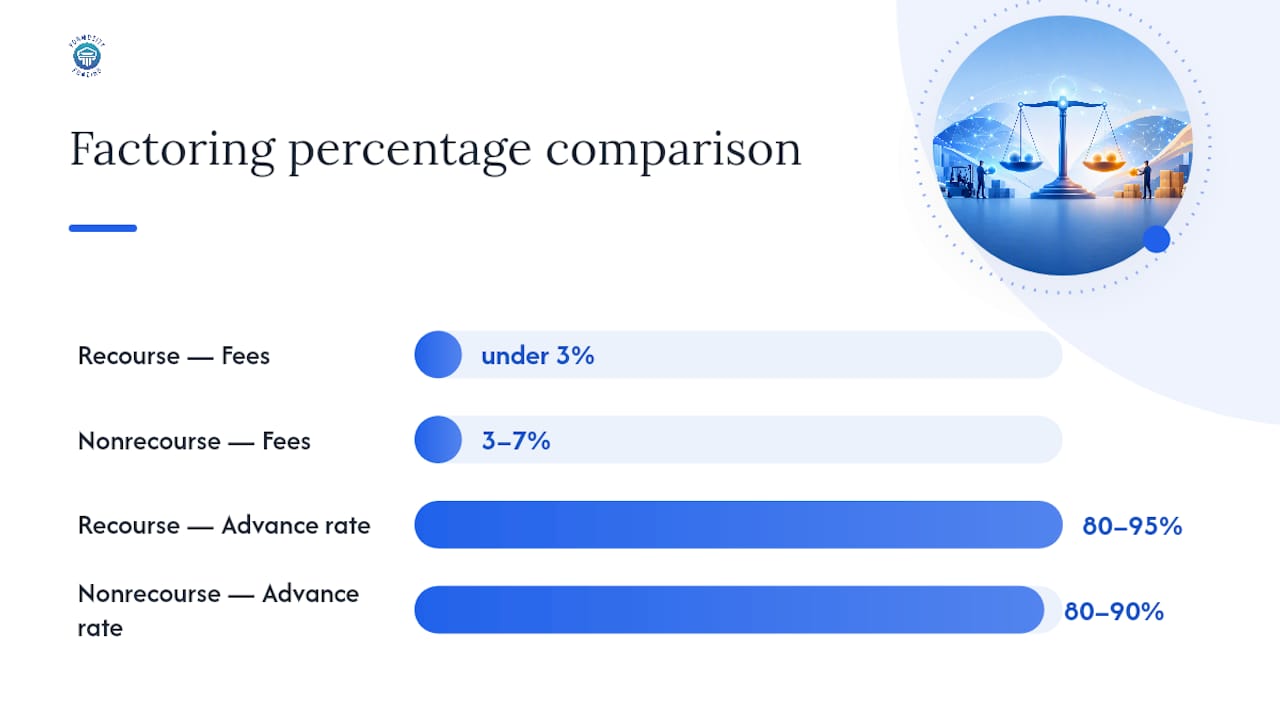
The practical takeaway: recourse gets you cheaper, faster money, but every unpaid invoice eventually comes back to you. Nonrecourse costs more and takes longer to set up, but it caps your exposure to one specific disaster, an approved customer collapsing entirely.
What Do Recourse and Nonrecourse Factoring Cost?
Pricing on both structures moves around based on your debtor's credit, your industry, and how clean your documentation is. A few benchmarks help you sanity-check any quote.
- Advance rates typically fall between 80% and 95%, with trucking and staffing companies often landing at the higher end when their paperwork is airtight.
- Reserve percentages usually run 5% to 20%. This is money the factor holds back until the invoice clears, and it's returned to you (minus fees) once payment lands.
- Discount fees for recourse programs tend to sit below nonrecourse pricing, while nonrecourse commonly runs 3% to 7% per cycle since the factor is absorbing insolvency risk.
Debtor credit quality and industry concentration move these numbers more than almost anything else. A factor evaluating a trucking receivable with strong proof-of-delivery paperwork will often advance more than one looking at a thin file with a shaky payer.
None of these ranges are fixed. Underwriting varies by provider, and the exact reserve or fee you get depends on the specific debtor being approved, not a flat industry rate.
What Paperwork Do You Need to Qualify?
Factors underwrite your customer, not just you, so the documentation you bring determines how fast you get approved and how much you can draw.
- Copies of the invoices themselves, matched to purchase orders where available.
- Proof of delivery or completed service, signed bills of lading, or delivery confirmations.
- The underlying contract or terms of sale with the debtor.
- Basic credit information on the customer you're factoring, especially if they're new to the factor.
Factors run credit checks on your debtors, look at payment history where it exists, and often cap how much of your book can come from one customer or industry. A staffing firm with three clients making up 80% of revenue will get more scrutiny than one with a spread-out roster.
Pro Tip: Ask during onboarding exactly which documents trigger delayed funding. Most holdups come from missing proof of delivery, not credit issues.
What Happens When a Customer Doesn't Pay?
The gap between recourse and nonrecourse becomes real the moment a customer stops paying. Three scenarios show how differently each structure plays out.
- Slow pay under recourse: past the recourse window, the factor charges back the advance, and you repay it or substitute another invoice.
- Buyer bankruptcy under nonrecourse: if that debtor was pre-approved and insolvency is a covered event, the factor absorbs the loss.
- Disputed quality or short-pay: under either structure, this is usually your problem. Nonrecourse protection almost never extends to disputes.
A chargeback or an unresolved dispute doesn't just cost you once. It can shrink your reserve, tighten future advance rates, and make the factor more conservative about your next batch of invoices.
Pro Tip: Resolve customer disputes fast and document every step in writing. A quality complaint that drags on for weeks looks, to a factor, exactly like a debtor who simply isn't going to pay.
How Do You Choose Between the Two?
Match the structure to your debtor risk and your cash-flow tolerance, not just the sticker price.
- List your top customers by revenue share and rate each on payment history and financial stability.
- Calculate what a single chargeback would do to your cash position if you went recourse and that customer defaulted.
- Compare a nonrecourse quote's fees against the cost of self-insuring that same risk.
- Decide whether speed or protection matters more for this specific batch of receivables.
Before signing anything, ask the factor these questions directly:
- What exact events trigger coverage under the nonrecourse program, and is that in writing?
- How long is the recourse window, and when does the chargeback clock start?
- What's the buy-back process if a chargeback happens, cash repayment or invoice substitution?
- Are advance rates and reserves fixed, or do they shift after the first few funding cycles?
Watch for vague recourse language, open-ended chargeback clauses with no clear timeline, no formal debtor approval process, or unusually low reserves that might be masking higher fees elsewhere in the contract.
How Can a Funding Marketplace Simplify This Decision?
Sourcing nonrecourse programs on your own takes time, since not every factor offers them and terms vary widely by provider. A marketplace approach to funding shortens that search by matching your business to multiple lenders at once instead of you calling each one individually.
The typical flow: quick prequalification with no credit impact, matching against a network of lenders, side-by-side offer comparison, then a funding specialist walking you through underwriting.
- Faster access to lenders who actually offer nonrecourse programs for your industry.
- Multiple real offers to compare on fees, advance rates, and reserve terms.
- Guidance spotting which contract language actually defines covered events.
Always get written confirmation of exactly what triggers nonrecourse coverage before signing. A verbal assurance from a sales rep isn't a contract term, and documentation gaps are also a common vector for invoice fraud that underwriters specifically screen for.
What Business Owners Consistently Get Wrong
The most common mistake we see is treating nonrecourse as blanket insurance against nonpayment. It isn't. It covers one failure mode, insolvency of an approved debtor, and businesses that assume broader protection get burned the first time a customer disputes an invoice instead of going bankrupt.
The second mistake is underestimating chargeback timing on recourse deals. Owners factor an invoice, mentally file it as "funded," and forget the clock is running until a customer misses payment and the chargeback notice arrives.
Prepare your debtor list before you talk to any factor. Prioritize proof-of-delivery documentation over almost everything else, and ask for sample contract language showing exactly which events trigger nonrecourse coverage. That single request separates a serious factor from one hoping you won't read the fine print.
Compare Factoring Offers Without Calling a Dozen Lenders
Formosityfunding gets you real, comparable offers on both recourse and nonrecourse factoring in one place, instead of you spending days contacting individual factors who each quote differently and disclose terms differently.
Prequalification carries no credit impact, and you're matched against a nationwide network of lenders rather than a single provider's take-it-or-leave-it terms. A funding specialist walks you through comparing advance rates, reserve percentages, and coverage language side by side, so you're not decoding contract fine print alone. If your business is ready to see what's actually available, start with Formosityfunding's funding options overview or visit the main site to begin prequalification.
Frequently Asked Questions
Is nonrecourse factoring always safer than recourse factoring? No. Nonrecourse only protects against a specific event, usually debtor insolvency. Disputes, short-pays, and fraud remain your liability under either structure.
Why does nonrecourse factoring cost more than recourse factoring? The factor is absorbing a defined slice of credit risk, so fees run higher to compensate, and underwriting is stricter since the factor has to approve each debtor individually.
Can a small business qualify for nonrecourse factoring? Yes, but approval depends heavily on your customers' credit strength. A factor evaluating nonrecourse coverage will scrutinize each debtor before extending protection, not just your own business financials.
What happens if I don't repay a recourse chargeback? The factor typically deducts it from your reserve first, then pursues repayment directly, which can affect your standing for future funding with that provider.
Should exporters consider nonrecourse factoring? Often, yes. Selling to unfamiliar or cross-border buyers carries more uncertainty, and nonrecourse programs are frequently used by exporters specifically for that reason.
This article is general information, not a substitute for advice from a qualified financial advisor. Consult a qualified financial professional about your own circumstances before acting on anything here.
Sources
- Recourse Factoring vs. Non-Recourse Factoring - NerdWallet
- Recourse and Non‑Recourse Factoring: The Difference | eCapital