

Revenue-based financing (RBF) gives you a lump-sum advance that you repay as a fixed percentage of your revenue until you hit a capped total, usually somewhere between 1.1 and 3 times what you borrowed. It's built for businesses with steady, predictable revenue that want growth capital without giving up equity or signing a rigid loan schedule.
RBF fits you best if:
- Your business generates consistent monthly revenue with healthy gross margins
- You want to avoid diluting ownership to raise growth capital
- You'd rather pay more in total dollars than give up equity or lock into fixed loan payments regardless of a slow month
The trade-off is real: RBF is non-dilutive, but it can cost more in total dollars than a bank loan, and the payments flex with your revenue instead of staying fixed.
Table of Contents
- What Is Revenue-Based Financing and How Does It Work?
- How Do You Convert a Repayment Cap Into a Real Cost?
- What Are the Advantages and Drawbacks of Revenue-Based Financing?
- Which Businesses Are the Best Fit for Revenue-Based Financing?
- How Does RBF Compare to Equity, Bank Loans, and Merchant Cash Advances?
- How Do You Evaluate an RBF Offer Before Signing?
- How Formosityfunding Helps You Compare Revenue-Based Financing Offers
- How Is Revenue-Based Financing Taxed and Accounted For?
- How Do You Prepare Your Business to Qualify for RBF?
- What Do Real Revenue-Based Financing Deals Look Like?
- What's the Practical Rule for Using Revenue-Based Financing Wisely?
- Should You Use Revenue-Based Financing for Growth Capital?
- Get Matched With Revenue-Based Financing Offers Through Formosityfunding
- Frequently Asked Questions About Revenue-Based Financing
- Sources
What Is Revenue-Based Financing and How Does It Work?
Revenue-based financing works on three moving parts: the advance, the remit rate, and the cap. Understanding how they interact tells you almost everything you need to know before signing an offer.
The advance is the lump sum you receive upfront. Lenders typically size it as a multiple of your monthly recurring revenue or a fraction of your annual recurring revenue, and they'll usually want direct access to your payment processor or bank account so they can track and automate collections. That access isn't just a formality. It's how the lender verifies your revenue claims and automates the remittance itself.
The remit rate is the percentage of your revenue the lender collects until the deal is paid off. Rates typically fall between about 1% and 15% of revenue, and collection frequency varies. Some lenders pull daily, others weekly or monthly.
The repayment cap (sometimes called a multiple) sets the ceiling on what you'll ultimately pay back. This is the mechanism that ends the obligation. Once you've remitted a total equal to your cap, the deal is closed, regardless of how long it took.
Here's the mechanic that trips people up:
- Revenue is unpredictable, so the timeline to hit your cap is not a fixed date. It's a moving target tied to your sales.
- A strong month means faster payoff. A slow month stretches the timeline and the total dollars collected stay the same, but they arrive later.
- Because the obligation is capped, not open-ended, you always know the maximum dollar amount you owe, even if you can't predict exactly when you'll finish paying it.
How Do You Convert a Repayment Cap Into a Real Cost?
A repayment cap and an annual percentage rate (APR) aren't the same kind of number, and comparing them directly is where most founders get pricing wrong. A cap tells you the total dollars owed. An APR tells you an annualized rate. Without knowing how long repayment will take, a cap alone tells you nothing about whether a deal is cheap or expensive.
The core formula is simple: total repayment = advance × cap. What varies is how fast you pay it and what that implies about the effective annualized cost.
Statistic Callout: Typical caps run from roughly 1.1x to 3.0x, and faster-payback profiles often land around 1.2x to 1.6x, while higher caps usually signal more perceived risk or a slower expected payback.
Two quick examples show why speed matters so much:
- Fast payback: $200,000 advance, 1.3x cap, repaid in 9 months. You're paying $60,000 in fees over three quarters, which annualizes to a steep effective rate even though the multiple looks modest on paper.
- Slow payback: Same $200,000 advance and 1.3x cap, but repaid over 30 months because revenue softened. The same $60,000 fee gets stretched across two and a half years, so the effective annualized cost drops substantially.
That's the counterintuitive part: the same cap can represent a cheap or expensive deal, purely as a function of how fast your revenue repays it. Pricing also moves with your revenue volatility, your industry's risk profile, and the size of the check. Volatile or thin-margin businesses generally see higher caps and remit rates than stable, high-margin ones.
What Are the Advantages and Drawbacks of Revenue-Based Financing?
The appeal of RBF is straightforward: you keep your cap table intact. Beyond that, the mechanics create a few real advantages and a few real risks worth weighing honestly.
Advantages:
- No equity given up. You keep 100% ownership and board control.
- Payments scale with revenue, so a slow month doesn't trigger the same stress as a fixed loan payment.
- Funding typically moves faster than a bank term loan, often in days rather than weeks.
- The lender's incentive lines up with yours: they get paid faster when you grow faster.
Drawbacks:
- Total cost can run higher than a bank loan once you convert the cap into an effective annualized rate.
- Ongoing revenue remittance is a permanent drag on cash flow until the cap is hit, which limits flexibility for reinvestment.
- Pre-revenue startups, deeply seasonal sellers, and razor-thin-margin businesses often don't qualify or get priced poorly.
Watch for a few traps: stacking multiple RBF-style facilities on top of each other without accounting for the combined revenue holdback can quietly strangle your cash flow, daily collection frequency hits harder than monthly, and vague cap language buried in a term sheet can obscure the real total cost.
Pro Tip: *Before signing, ask the lender to show you the exact dollar cap in writing, not just the multiple.
Which Businesses Are the Best Fit for Revenue-Based Financing?
RBF underwriting leans heavily on revenue consistency, so the businesses that qualify easily and price well tend to share a few traits.
Strong fits:
- SaaS and subscription companies with predictable monthly recurring revenue
- D2C and e-commerce brands with steady, repeatable sales patterns
- Service businesses with recurring client contracts or retainers
Poor fits:
- Pre-revenue startups with no track record to underwrite against
- Highly seasonal sellers whose revenue swings make repayment timing unpredictable
- Businesses running on razor-thin gross margins that can't absorb a revenue-share deduction
Underwriters commonly look for a minimum monthly revenue threshold, often in the low tens of thousands of dollars, though exact minimums vary widely by lender and industry. It's also worth noting that financing options tied to revenue history can exclude early-stage or underrepresented founders who haven't yet built a track record, which is a real access gap in this market.
How Does RBF Compare to Equity, Bank Loans, and Merchant Cash Advances?
Every funding source trades one thing for another. RBF trades higher potential cost for keeping your ownership intact, which puts it in a specific spot on the spectrum between debt and equity.
Versus equity: Venture capital dilutes your ownership permanently and often comes with board seats and strategic expectations. RBF is non-dilutive like debt but flexible like equity because payments move with revenue. The real comparison isn't the interest rate. It's the total cost of RBF against the long-term value of the ownership stake you'd otherwise give up.
Versus bank loans: Bank loans and SBA loans typically cost less if you qualify, but they usually demand collateral, a longer track record, and fixed monthly payments regardless of how your revenue performs that month. RBF trades that lower cost for faster approval and revenue-linked flexibility.
Versus merchant cash advances: MCAs and RBF look similar on the surface, but they're priced differently. MCAs typically take a cut of daily card sales specifically, while RBF usually draws from total revenue across all channels, and often at a lower effective frequency.
Combination strategies: Many founders use RBF as bridge capital between equity rounds or to fund predictable growth channels before later equity rounds once growth metrics justify a stronger valuation. Using RBF this way avoids raising a dilutive round too early, when your valuation is lowest and dilution hurts most.
How Do You Evaluate an RBF Offer Before Signing?
Comparing RBF offers means reading past the headline number. Here's the checklist worth running through before you sign anything.
- Confirm the exact cap in dollars, not just the multiple, so you know the true maximum repayment.
- Confirm the remit rate and whether it's calculated on gross or net revenue.
- Check remittance frequency. Monthly is far easier on cash flow than daily or weekly.
- Ask for two sample payback scenarios, one conservative and one optimistic, so you can see the effective cost range.
- Read for audit rights. Some lenders reserve the right to review your books beyond standard reporting.
- Ask about personal guarantees or covenants. Not all RBF deals require them, but some do, and the terms vary widely by lender.
- Confirm the termination event, meaning exactly what triggers the end of the obligation once the cap is met.
Have your recent revenue reports, payment processor statements, and bank statements ready before you apply. Most lenders will want at least three to six months of clean transaction history to underwrite quickly.
Red flags worth walking away from: daily remittance demands with no negotiation room, a cap that isn't stated as a hard dollar figure, collection channels you can't independently verify, and any lender who won't disclose whether they allow stacking with other facilities.
Pro Tip: Get every offer's cap, remit rate, and sample payback timeline in writing side by side. Reading two term sheets on the same page is the fastest way to spot which one is actually cheaper.
How Formosityfunding Helps You Compare Revenue-Based Financing Offers
Comparing RBF providers one by one eats time you don't have as a founder. A marketplace approach solves that by putting multiple real offers in front of you at once, so you're comparing actual terms instead of marketing pages.
Formosityfunding matches your business profile against a nationwide network of lenders, with pre-qualification that carries no credit impact and approvals that move fast. You get personalized guidance from a dedicated funding specialist who can help you read a cap and remit rate correctly, not just find you an offer.
- Instant pre-qualification with no hit to your credit
- Access to multiple real, comparable offers rather than a single quote
- Guidance from specialists who understand revenue-share terms
- A path to RBF alongside other funding products if RBF isn't the best fit
How Is Revenue-Based Financing Taxed and Accounted For?
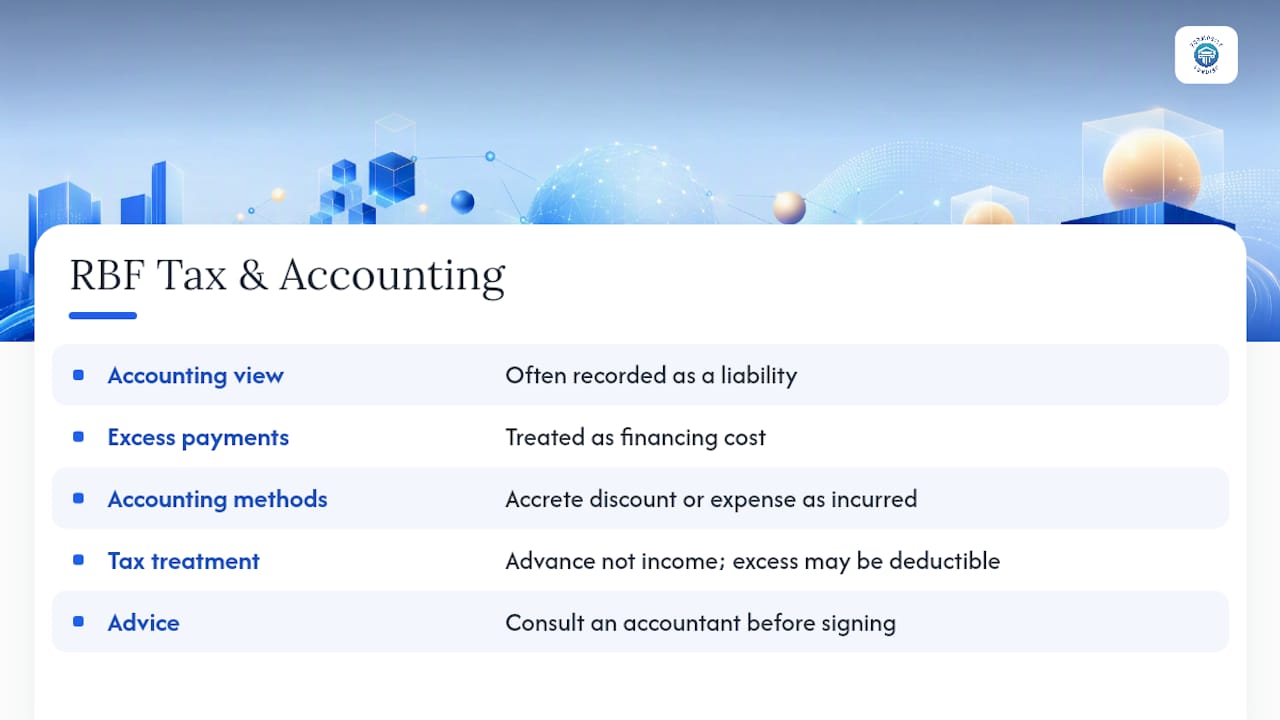
RBF sits in a gray zone for accounting purposes because it isn't quite a loan and isn't quite equity. Most businesses and their accountants treat the advance as a liability on the balance sheet, similar to debt, since it represents an obligation to remit future cash. The amount above the original advance, the extra dollars paid to reach the cap, is generally treated as a financing cost rather than revenue expense, though the exact classification depends on the specific structure of your agreement.
Because there's no fixed interest rate or amortization schedule the way there is with a term loan, RBF doesn't fit cleanly into standard debt accounting templates. Some businesses record the difference between the advance and the cap as a discount that gets accreted over the expected payback period, adjusting the estimate as actual revenue comes in. Others expense the repayment cost as it's incurred. Both approaches are used in practice, and the right one depends on your accounting method and the specific terms of your deal.
On the tax side, the advance itself typically isn't treated as taxable income since it's a financing obligation, not revenue. The portion you repay above the original advance may be deductible as a financing expense, similar to how loan interest is treated, but this varies by jurisdiction and specific facts.
Given the structural ambiguity here, this is one area where getting your accountant or a tax professional involved before you sign is worth the hour it costs. A misclassified RBF deal can distort your financials in ways that matter when you go to raise your next round or apply for a bank loan later.
How Do You Prepare Your Business to Qualify for RBF?
Lenders underwrite RBF deals primarily on the strength and predictability of your revenue, so the prep work is mostly about making that revenue easy to verify and easy to trust.
Start by cleaning up your financial reporting. Lenders want to see consistent monthly revenue reports, and gaps or wild swings in your numbers make underwriting harder and pricing worse. If you're running multiple sales channels, consolidate reporting so a lender can see total revenue clearly instead of piecing it together from several sources.
Connect your payment processor and bank accounts to reporting tools that can generate clean statements on demand. Most lenders will ask for direct or read-only access to verify revenue in real time rather than trusting self-reported numbers, and having that access ready speeds up approval considerably.
Build at least three to six months of stable transaction history before applying if you can. A single strong month means less to an underwriter than six consistent ones. Gross margin matters too: the healthier your margins, the more room you have to absorb a revenue-share deduction without straining operations.
Finally, know your own numbers before a lender asks. If you can walk into a conversation already knowing your monthly recurring revenue, your gross margin, and a realistic payback timeline, you'll negotiate from a stronger position and spot a bad offer faster.
What Do Real Revenue-Based Financing Deals Look Like?
The clearest way to understand RBF is to see how the mechanics play out in practice, even in general terms drawn from how these deals commonly structure.
A subscription software company generating consistent monthly recurring revenue is the textbook use case. It takes an advance sized against a multiple of its MRR, remits a modest percentage of revenue monthly, and pays off the cap within a year or two without ever touching its cap table. The predictability of subscription billing is exactly what makes RBF underwriting straightforward for this profile.

A direct-to-consumer brand facing a seasonal inventory crunch represents a different but equally common scenario. It uses an advance to buy inventory ahead of a peak season, knowing the sales spike that follows will accelerate repayment well before the slower months arrive. Timing the advance around a predictable demand curve is one of the more effective ways founders use RBF strategically rather than reactively.
A service business with recurring client contracts, an agency or a subscription-based consultancy, fits a similar pattern to SaaS. Its revenue is less spiky than e-commerce but still predictable enough for a lender to underwrite confidently, and the flexible payment structure means a client churn month doesn't create the same stress a fixed loan payment would.
Across all three profiles, the common thread is the same: predictable revenue is what makes RBF work, and businesses that lack it tend to either get declined or priced far less favorably.
What's the Practical Rule for Using Revenue-Based Financing Wisely?
The biggest mistake founders make with RBF isn't picking the wrong lender. It's signing based on the cap alone without modeling the timeline. Do model two scenarios before you sign: a conservative one where revenue stays flat, and an optimistic one where growth accelerates repayment. See how the effective cost changes between them. Don't stack multiple revenue-share facilities without checking the combined holdback against your actual cash flow. And when a term sheet's language on caps or covenants feels vague, get a funding specialist to read it before you sign, not after.
Should You Use Revenue-Based Financing for Growth Capital?
Predictable revenue is what makes revenue-based financing work, and the math only pencils out when you convert the cap into a real timeline before you sign.
| Point | Details |
|---|---|
| Cap defines your ceiling | Total repayment equals advance times cap, typically 1.1x to 3.0x, regardless of how long payoff takes. |
| Speed drives effective cost | The same cap can be cheap or expensive depending purely on how fast revenue repays it. |
| Best fit is recurring revenue | SaaS, subscription, and steady D2C or service businesses underwrite most easily and price best. |
| Compare against dilution, not just rate | RBF often costs more than a bank loan but less than the long-term value of equity given up. |
| Formosityfunding simplifies comparison | The marketplace surfaces multiple real RBF and funding offers with no-credit-impact pre-qualification and specialist guidance. |
Get Matched With Revenue-Based Financing Offers Through Formosityfunding
Shopping RBF providers one at a time means filling out the same application repeatedly and comparing term sheets that all describe caps and remit rates differently. Formosityfunding cuts that down to one pre-qualification that surfaces multiple real offers side by side, so you're comparing actual numbers instead of guessing at fine print.
Formosityfunding connects your business with a nationwide network of lenders covering revenue-based financing alongside working capital, lines of credit, SBA loans, and equipment financing, so if RBF isn't the right structure for your revenue profile, you're not stuck. Pre-qualification carries no credit impact, approvals move quickly, and a dedicated funding specialist walks you through reading the cap, the remit rate, and the payback math before you commit to anything.
If you've got steady monthly revenue and you're ready to see what a real offer looks like, start your pre-qualification with Formosityfunding and compare your options before you sign anything.
Frequently Asked Questions About Revenue-Based Financing
Is revenue-based financing the same as a merchant cash advance? No. RBF typically draws a percentage from total revenue across all channels, while a merchant cash advance usually pulls specifically from daily card sales, and the two often carry different collection frequencies and pricing structures.
Does revenue-based financing show up on my credit report? It depends on the lender and how the deal is structured, but many RBF providers focus underwriting on revenue history rather than personal credit, and pre-qualification through a marketplace like Formosityfunding typically carries no credit impact.
Can a new business qualify for revenue-based financing? Rarely without an established revenue history. Most lenders want several months of consistent monthly revenue before underwriting a deal, which is why pre-revenue startups usually look to other funding sources first.
What happens if my revenue drops sharply after I take RBF? Your remittance amount drops proportionally since it's a percentage of revenue, which stretches your payback timeline but doesn't increase your total dollar obligation beyond the agreed cap.
Is revenue-based financing cheaper than a bank loan? Usually not on a pure cost basis if you qualify for a bank loan, but RBF typically approves faster and doesn't require the collateral or lengthy track record that banks demand.