

The SBA guarantee fee for FY2026 (effective October 1, 2025) runs from 0.25% to 3.75% of the guaranteed portion of your 7(a) loan, not the full loan amount. Short-term loans maturing in 12 months or less get a flat 0.25% rate.
Here's what matters most for your budget:
- The fee applies to the guaranteed portion, which is 85% of loans up to $150,000 and 75% above that.
- Your lender pays this fee to the SBA first, then can legally pass the cost to you after your first disbursement.
- The SBA 7(a) Loan Guaranty Fee Calculator gives you an exact dollar figure in under a minute.
Key Takeaways
| Point | Details |
|---|---|
| Fee applies to guaranteed portion | Not the full loan amount; guaranty is 85% up to $150,000 and 75% above that. |
| Rates vary by loan size and term | FY2026 rates run 2% to 3.75%, with a flat 0.25% for loans maturing in 12 months or less. |
| Borrowers usually pay the fee | Lenders remit it to SBA first, then commonly pass the cost through after first disbursement. |
| Annual service fee stays with lender | This ongoing SBA fee can never be charged to the borrower. |
| Compare lenders before committing | Formosityfunding matches borrowers with multiple SBA lenders to compare fee structures and offers. |
Table of Contents
- SBA Guarantee Fee Schedule for FY2026
- How the SBA Guaranty Fee Is Calculated
- Estimating Your Cost With the SBA Calculator
- Who Pays the Fee and When
- Other Fees to Watch For
- Fee Waivers and FY2026 Policy Changes
- Questions to Ask Your Lender Before Closing
- Why Guaranty Fee Transparency Actually Matters
- Get Matched With SBA Lenders Through Formosityfunding
- Frequently Asked Questions
- Sources
SBA Guarantee Fee Schedule for FY2026
The fee schedule resets every October 1, and the current version, effective through September 30, 2026, is published in an official SBA Information Notice. Here's the full breakdown:
| Loan Size (Total Amount) | Fee Rate | Applies To |
|---|---|---|
| $150,000 or less | 2% | Guaranteed portion (85% of loan) |
| — | 3% | Guaranteed portion (75% of loan) |
| — | 3.75% on amount above $1 million | Guaranteed portion (75% of loan) |
| Any amount, maturity ≤12 months | 0.25% | Guaranteed portion |
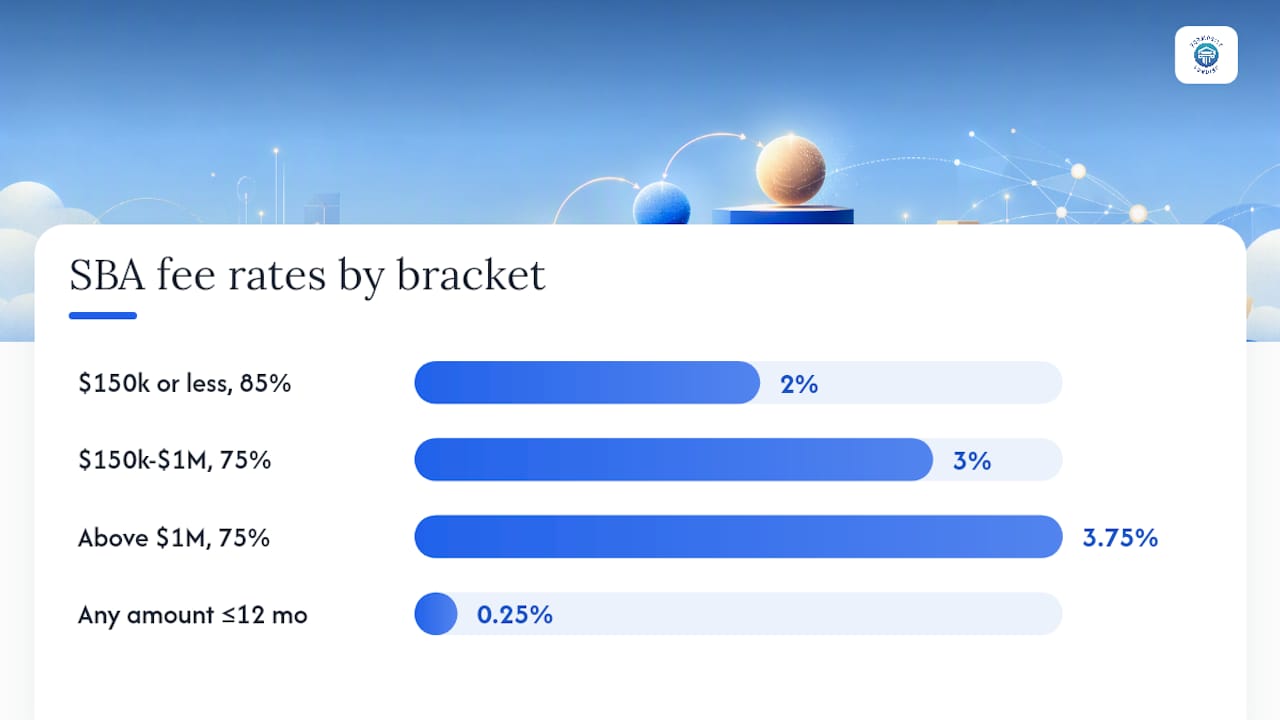
Two things trip people up here. First, the percentage tier is based on your total loan amount, but the fee itself is charged only against the guaranteed portion of that loan, which is smaller.
The SBA sets its guarantee percentages at 85% for loans of $150,000 or less and 75% for anything above that threshold, up to the program cap of $5,000,000.
How the SBA Guaranty Fee Is Calculated
Running the math yourself takes three steps, and it's worth doing before your lender hands you a number.
- Identify your guaranty percentage. Loans of $150,000 or less are guaranteed at 85%; everything above that is guaranteed at 75%.
- Calculate the guaranteed portion. Multiply your total loan amount by that percentage.
- Apply the FY2026 tier rate to the guaranteed portion, using the short-term 0.25% rate if your loan matures in 12 months or less.
Take a $500,000 loan with a maturity over 12 months.
A few practical notes worth flagging:
- The fee is a one-time upfront charge, distinct from any interest rate or ongoing servicing cost.
- Payment timing and refund conditions are governed by 13 CFR 120.220, which also sets rules for what happens if your loan never disburses.
Estimating Your Cost With the SBA Calculator
You don't have to run this math by hand. The SBA's official fee calculator does it automatically and accounts for FY2026 rates plus any recent loans you've taken within a 90-day window, which can affect how fees stack for repeat borrowers.
Here's how to use it:
- Enter your requested loan amount and select the loan maturity (12 months or less, or longer).
- Confirm whether you've received other SBA-guaranteed loans in the past 90 days, since the tool factors that into cumulative guaranteed exposure.
- Review the output, which shows the guaranteed portion, the applicable tier rate, and your final upfront fee.
Plug in that same $500,000, longer-term loan, and the calculator should return the same $11,250 figure from the manual calculation above. If your number differs from your lender's quote, that's your cue to ask for an itemized breakdown.
One thing to know before you sign anything: many lenders finance the guaranty fee directly into your loan balance rather than collecting it as cash upfront. That's convenient for cash flow at closing, but it increases your total loan balance and monthly payment, which nudges your debt service coverage ratio in the wrong direction. Ask your lender explicitly whether the fee gets financed or deducted from your disbursed proceeds, because the two approaches affect your numbers differently.

Who Pays the Fee and When
Federal rules require the lender to pay the guaranty fee to the SBA, but lenders are permitted to pass that cost on to you, the borrower, once your loan disburses. That's why you'll almost always see this fee reflected in your closing costs even though it technically starts as a lender obligation.
Timing depends on your loan's maturity. Under 13 CFR 120.220, lenders must remit the fee to the SBA within 10 business days for loans maturing in 12 months or less, and within 90 days for longer-term loans. Here's the practical sequence:
- Your loan gets approved and the guaranty fee amount is disclosed in your closing documents.
- The lender pays SBA within the applicable window, then collects the borrower-facing portion from you at or after first disbursement.
- If a loan never disburses and the lender formally requests cancellation, the SBA refunds the fee.
- For certain small loans, lenders may retain up to 25% of the fee rather than remitting the full amount, a detail worth asking about if you're closing a smaller 7(a) loan.
Other Fees to Watch For
The upfront guaranty fee isn't the only line item on your closing statement, and knowing the difference protects you from being overcharged. The Lender's Annual Service Fee is a separate, ongoing fee lenders pay to the SBA every year for the life of the loan, and it cannot legally be passed on to you as the borrower. You should never see this labeled as a borrower charge.
Beyond that, expect standard closing costs and possibly a packaging fee if a third party helped prepare your loan application, both of which are subject to SBA-imposed caps.
Pro Tip: Ask your lender for an itemized closing-cost schedule that separates the SBA guaranty fee from any bank administrative or packaging charges. If a lender can't clearly separate these line items, that's a red flag worth pushing on before you sign.
Fee Waivers and FY2026 Policy Changes
Not every borrower pays the standard schedule. In FY2026, the SBA waived upfront fees for certain small manufacturers as a targeted policy action, part of a broader pattern of industry-specific relief the agency uses to steer capital toward priority sectors.
These waivers are narrow by design:
- Eligibility is typically tied to industry classification, business size, or a specific SBA-defined program goal, not a general discount available to all borrowers.
- Waivers are announced through dedicated SBA Information Notices, separate from the standard annual fee schedule.
- You should ask your lender to cite the exact Information Notice number backing any waiver claim and get written confirmation before assuming a discount applies to your loan.
Given how fee schedules reset every October 1, don't rely on last year's numbers or a waiver you heard about secondhand. Confirm the current notice directly.
Questions to Ask Your Lender Before Closing
A short checklist saves you from surprises at the closing table:
- Can you provide an itemized closing-cost statement that separates the SBA guaranty fee from your own fees?
- Will the guaranty fee be financed into my loan balance or deducted from my disbursed proceeds?
- Which SBA Information Notice are you applying to calculate my fee?
- Am I eligible for any FY2026 fee waiver, and can you provide written confirmation?
- When will I actually be charged, relative to my first disbursement?
- Does my loan's guaranteed portion match 85% or 75%, and how did you calculate that?
Watch for red flags: a lender asking for the guaranty fee before your first disbursement, vague fee descriptions with no reference to an SBA notice, or an inability to explain how the guaranteed portion was calculated.
Why Guaranty Fee Transparency Actually Matters
Most borrowers focus on interest rates and skip past the guaranty fee, treating it as a fixed cost they can't influence. That's a mistake. The fee schedule, the guaranteed portion, and how your lender chooses to collect it all shift your real cost of capital, sometimes by thousands of dollars on identical loan amounts.
Formosity Funding helps borrowers compare fee structures across multiple lenders before committing to one.
Get Matched With SBA Lenders Through Formosityfunding
Comparing guaranty fees across lenders one phone call at a time eats up hours you don't have when you're trying to close on equipment, real estate, or working capital. Formosityfunding solves that by matching you with a nationwide network of lenders through one pre-qualification that doesn't touch your credit score, so you can see real loan offers side by side instead of chasing quotes individually.
Every 7(a) lender structures the guaranty fee pass-through and closing costs a little differently, and Formosityfunding's funding specialists walk you through those disclosures so you know exactly what you're being charged before you sign anything. Whether you need an SBA loan, equipment financing, or a working capital line, the platform matches your business profile to lenders actively working in your space. Start a free pre-qualification on Formosityfunding today and get real offers to compare before you commit to a lender.
Frequently Asked Questions
Is the SBA guarantee fee the same as the SBA guaranty fee? Yes. "Guarantee" and "guaranty" refer to the same upfront charge on 7(a) loans; the SBA's own documents use "guaranty" in official notices.
Can I avoid the SBA guarantee fee entirely? Only if you qualify for a targeted waiver, such as the FY2026 small-manufacturer exemption. Otherwise, the fee applies to nearly all 7(a) loans over $500 in loan amount.
Does the guarantee fee change if I refinance an existing SBA loan? Refinancing typically triggers a new upfront fee calculation based on the new loan's size and maturity, so ask your lender to recalculate rather than assuming your original fee carries over.
Is the SBA packaging fee the same as the guaranty fee? No. The packaging fee compensates a third party for preparing your loan application and is separate from the guaranty fee paid to the SBA; both are subject to regulatory caps.
What happens to the guaranty fee if my loan application is denied? If your loan never disburses, the fee is refundable to the lender under 13 CFR 120.220, and you shouldn't be charged for a loan that didn't close.
This article is general information, not a substitute for advice from a qualified financial advisor. Consult a qualified financial professional about your own circumstances before acting on anything here.
Sources
Bookmark these before you apply, since fee schedules reset every October 1:
- 7(a) Fees Effective October 1, 2025 for Fiscal Year 2026 | U.S. Small Business Administration
- SBA 7(a) Loan Guaranty Fee Calculator | U.S. Small Business Administration
- 13 CFR § 120.220 - Fees that Lender pays SBA. | Legal Information Institute