

Yes, most SBA loans over $50,000 require collateral, but a shortfall alone shouldn't sink your application. Here are the three rules that matter most before you apply:
- The $50,000 threshold: For SBA 7(a) loans of $50,000 or less, lenders aren't required to take collateral, with a few exceptions like International Trade Loans.
- Above $50,000, lenders use their own rulebook: For larger 7(a) loans, lenders must follow the same written collateral policies they'd apply to a similarly sized conventional commercial loan.
- A shortfall isn't an automatic decline: The SBA guaranty exists specifically to support borrowers who don't have enough hard assets to fully secure a loan on their own.
TL;DR:
- Lenders often count new equipment at only up to 75% of its value and used equipment at 50-80%, which can significantly reduce your available collateral.
- SBA loans over $50,000 require the same written collateral standards as conventional loans, but the guaranty minimizes the impact of thin or shortfall assets.
- Assets like furniture and fixtures are typically valued at around 10%, making them rarely sufficient to close collateral gaps on their own.
- Borrowers can offset collateral shortfalls by providing stronger cash flow documentation, additional guarantors, or supplemental equity.
- Pre-qualifying through platforms like Formosityfunding helps identify lenders whose collateral policies align with your assets, streamlining the application process.
Table of Contents
- SBA Loan Collateral Requirements Vary by Program
- How Lenders Calculate "Fully Secured" Collateral
- What Happens When Your Collateral Falls Short
- What Counts as Collateral for an SBA Loan
- When You'll Need an Appraisal or Insurance Policy
- The Collateral Documents Lenders Actually Want
- Getting Your Collateral Package Ready with Formosityfunding
- Where Borrowers Get Collateral Wrong
- Ready to Match with an SBA Lender?
- Key Takeaways
- Sources
SBA Loan Collateral Requirements Vary by Program
Not every SBA loan treats collateral the same way, and knowing which program you're applying for tells you a lot about what you'll be asked to pledge. A 504 loan, built for real estate and heavy equipment purchases, leans almost entirely on the asset being financed. A 7(a) loan, the SBA's general-purpose workhorse, spreads risk across business assets, personal guaranties, and sometimes real estate, depending on loan size and what's available.
The lender and the SBA play different roles here, and the split matters:
- The lender sets the policy. Banks and other approved lenders apply their own internal, written collateral standards for SBA loans over $50,000, the same standards they'd use on a comparable non-guaranteed loan.
- The SBA sets the guardrails. Program guidance on Sba spells out what counts, what's capped, and when exceptions apply.
- Neither party can reject you on collateral alone. A creditworthy business with thin collateral is exactly the scenario the SBA guaranty was designed to solve, not a reason to shut the door.
That last point trips up a lot of first-time applicants who assume "not enough collateral" means "no loan." It usually means a different structure, not a dead end.
How Lenders Calculate "Fully Secured" Collateral
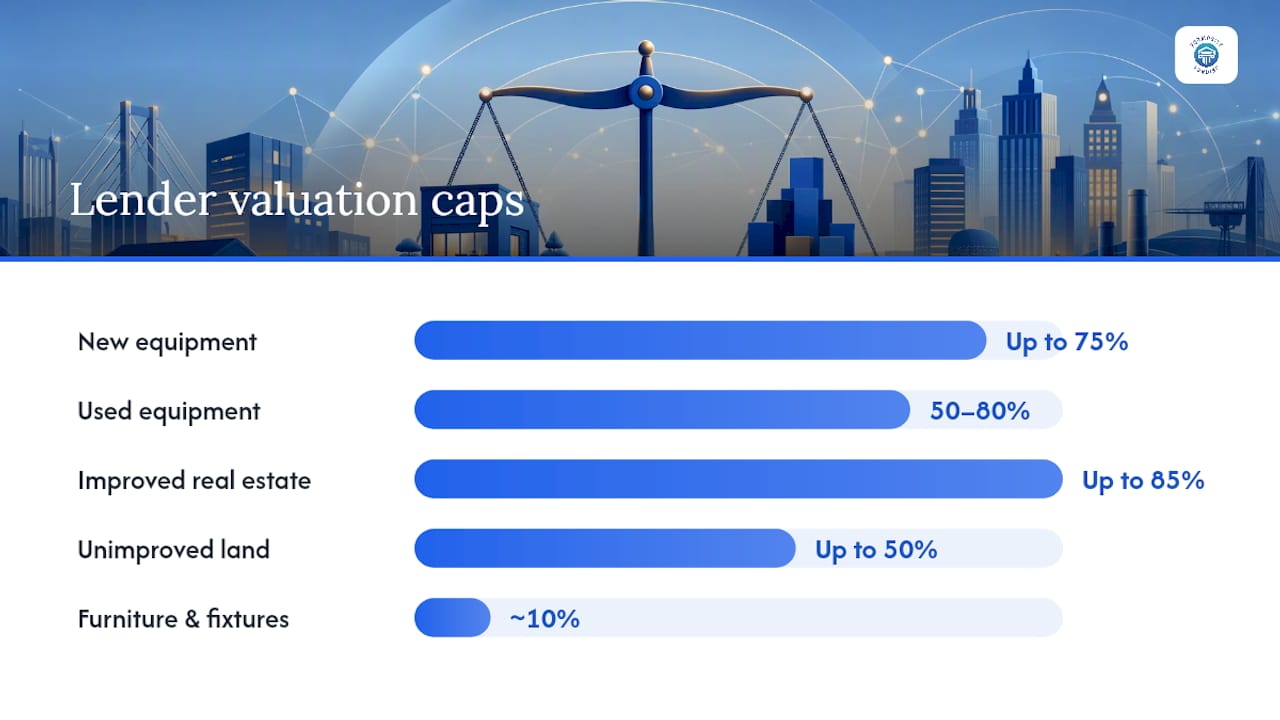
Here's the number that surprises most borrowers: lenders often count new equipment at only up to 75% of its price, and used equipment at just 50% of net book value (or up to 80% with an orderly liquidation appraisal), under SOP-based valuation guidance. Your $100,000 delivery van fleet doesn't show up as $100,000 on a lender's worksheet. It shows up as a fraction of that.
The same discounting applies across asset classes:
- Improved real estate: counted at up to 85% of value.
- Unimproved land: counted at up to just 50%.
- Furniture and fixtures: counted at roughly 10%, which is why office chairs and desks barely move the needle.
- Inventory and receivables (trading assets): typically discounted heavily unless supported by strong aging schedules and documentation.
Any prior liens against an asset get subtracted before the discount rate even applies, since lenders only count the equity you actually own. A collateral adequacy calculator can walk you through the math, but the shorthand version looks like this: a $500,000 piece of commercial real estate with a $200,000 mortgage balance leaves $300,000 in equity, and at an 85% cap that's roughly $255,000 in counted collateral, not the full $500,000 sticker value. Borrowers routinely overestimate how far their assets will stretch, which is exactly why running these numbers early avoids an awkward surprise at underwriting.
What Happens When Your Collateral Falls Short
Loans of $50,000 or less generally skip the collateral requirement entirely, aside from a few program exceptions like International Trade Loans.
That doesn't mean every owner's home gets a lien slapped on it automatically. If you're short on hard assets, you've got real options before you assume your house is on the line:
- Bring in a guarantor with additional pledgeable assets.
- Offer supplemental equity or a co-signer with stronger collateral.
- Strengthen your cash flow documentation, since strong debt service coverage can offset a thinner asset base in a lender's overall risk view.
Pro Tip: Ask your lender for their collateral shortfall worksheet before you submit a full application. Seeing exactly which assets they're crediting, and at what discount, lets you fix gaps in your documentation instead of finding out during underwriting.
What Counts as Collateral for an SBA Loan
Lenders draw from a fairly predictable list, and each type comes with its own catch.
- Commercial real estate is the strongest collateral type most lenders see, but it requires a formal appraisal and counts at only up to 85% of appraised value if improved.
- Equipment gets valued differently based on age. New equipment is discounted less than used equipment, and serial numbers matter. A vague description on your asset list slows everything down.
- Inventory and receivables count as trading assets and are usually discounted heavily unless you can back them with clean aging reports.
- Personal real estate and guaranties come into play mainly when business assets fall short, and any resulting liens are typically capped at the shortfall amount.
- Furniture and fixtures rarely move the needle, counted at around 10% of value, so don't count on your office buildout to close a collateral gap.
When You'll Need an Appraisal or Insurance Policy
Collateral review almost always triggers paperwork beyond the loan application itself, and timing it right saves weeks.
- Order a real estate appraisal early. Commercial real estate pledged as collateral typically requires a formal appraisal from a state-licensed or certified appraiser, and this step alone can take several weeks depending on your market.
- Check flood zone status immediately. If the property sits in a Special Flood Hazard Area, flood insurance through the NFIP or a private equivalent is mandatory, not optional, regardless of loan size.
- Line up hazard insurance before closing. Lenders generally require it on any real estate or major equipment pledged as collateral, and gaps here are a common closing delay.
Get a flood determination the same week you order your appraisal. Running them in parallel, rather than sequentially, is one of the easiest ways to shave time off your closing timeline.
The Collateral Documents Lenders Actually Want
Underwriters move faster when your paperwork is complete on the first pass. Assemble these before you apply, not after a lender asks:
- UCC-1 filing search results showing any existing liens against your business assets.
- A detailed equipment list with serial numbers, descriptions, purchase dates, and estimated current values, not a vague "misc. equipment" line item.
- Titles and deeds for any real estate or vehicles being pledged.
- Current insurance certificates, including hazard and, if applicable, flood coverage.
- A recent appraisal, or at minimum a realistic value estimate, for any real estate involved.
- Inventory aging and accounts receivable schedules, since these directly affect how much of your trading assets a lender will count.
The most common gap is an equipment list that's too generic to value accurately. A lender following SOP-based documentation standards needs specifics, and a thin list often gets sent back for revision, adding days to your timeline for no good reason.
Pro Tip: Photograph serial number plates on major equipment as you build your list. It sounds tedious, but it eliminates a common back-and-forth with underwriters who need to verify what they're valuing.

Getting Your Collateral Package Ready with Formosityfunding
Pulling together UCC searches, equipment lists, and appraisal paperwork on your own timeline is one thing. Doing it while also comparing lenders is another. Formosityfunding's funding platform connects small business owners to a nationwide network of SBA lenders, with no-impact pre-qualification that shows what you're likely to qualify for before you commit to a full application.
The process is straightforward: pre-qualify, upload your collateral documents (equipment lists, deeds, insurance certificates), and get matched with lenders whose collateral policies actually fit your asset profile. That matching step alone saves the back-and-forth of applying to a lender whose written policy doesn't align with what you can pledge.
Where Borrowers Get Collateral Wrong
Most articles on this topic treat collateral like a pass/fail test: either you have enough or you don't. That framing misses what actually happens inside underwriting. Lenders aren't looking for perfect collateral coverage; they're building a risk picture, and the SBA guaranty exists precisely to fill the gap when the collateral picture is incomplete but the business itself is sound.
The bigger mistake I see is borrowers waiting until they're deep in an application to figure out their actual numbers. If you don't know that your used equipment counts at half its book value, or that your office furniture is nearly worthless on a lender's worksheet, you'll misjudge your own position before you ever sit down with a loan officer.
Prioritize the math before the paperwork. Run your assets through the SOP discount rates first, identify the real gap, and then decide whether that gap needs a guarantor, more equity, or stronger cash flow documentation. Borrowers who show up already knowing their number move through underwriting faster, and they negotiate from a position of clarity instead of guesswork.
— Alvin
Ready to Match with an SBA Lender?
Formosityfunding gives you a way to skip the trial-and-error of applying to lenders whose collateral requirements don't fit your assets. Instead of guessing which bank will accept your equipment list or your real estate equity, you get matched with lenders in Formosityfunding's network whose written collateral policies already align with what you're bringing to the table.
Pre-qualification takes minutes, checks don't hit your credit, and you'll get a clearer sense of where your business stands before committing to a full SBA application. If you're weighing an SBA loan against equipment financing or a working capital line, Formosityfunding's funding options lay out every route side by side. Start your pre-qualification today and find out which lenders are actually a fit for your collateral profile.
Key Takeaways
SBA loans of $50,000 or less typically waive collateral, but larger loans depend on lender policy, SOP valuation caps, and whether a shortfall pushes review toward personal real estate.
| Point | Details |
|---|---|
| $50,000 threshold | Loans of $50,000 or less generally don't require collateral, aside from a few program exceptions. |
| Lender policy governs larger loans | Above $50,000, lenders apply the same written collateral standards used on comparable conventional loans. |
| Assets are heavily discounted | New equipment counts at up to 75% of price, used equipment at 50% to 80%, and furniture and fixtures at roughly 10%. |
| Shortfalls trigger personal real estate review | Owners with 20% or more stake may see personal real estate reviewed, though liens are typically capped at the shortfall amount. |
| Formosityfunding streamlines lender matching | No-impact pre-qualification connects borrowers to lenders whose collateral policies fit their actual asset profile. |