

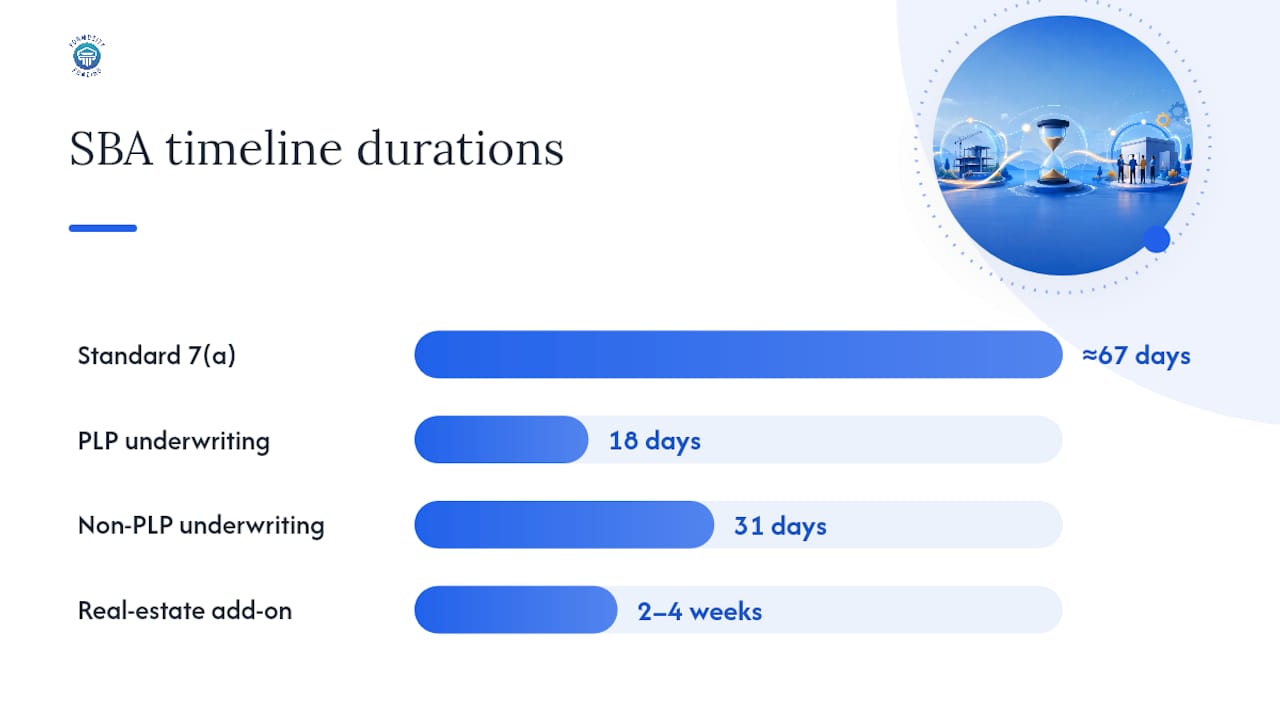
Most SBA 7(a) loans fund in about 60 to 90 days from a complete application, with the median landing near 67 days once a lender has every document in hand. Borrowers who go through a Preferred Lender Program (PLP) lender often close faster than those who do not, since those lenders skip sending files to the SBA for a separate sign-off. SBA Express can produce a decision in as little as 36 hours, though funding still takes longer. A 504/CDC loan usually takes longer, often several months, mainly because of appraisals and a second closing.
Real estate deals are the biggest wildcard. Appraisals and title work alone can tack on two to four weeks, regardless of how fast your lender moves internally.
Start now, before you have a lender picked out:
- Fill out SBA Form 1919 (Borrower Information Form)
- Complete SBA Form 413 (Personal Financial Statement)
- Pull two to three years of business tax returns and a current profit-and-loss statement
- Request pre-qualification from a lender or a matching service like Formosity Funding
Fast fact: Non-PLP lenders typically add 5 to 10 business days for SBA review after they've already approved the loan internally, a step PLP lenders bypass entirely.
Key Takeaways
A complete application, a PLP lender, and a single point of contact managing documents are what actually compress an SBA loan timeline, not luck.
| Point | Details |
|---|---|
| Standard 7(a) timeline | Expect 60 to 90 days from complete application to funding, with a median around 67 days. |
| PLP lenders save weeks | Delegated lenders skip SBA review, cutting underwriting to roughly 18 days versus 31 for non-PLP lenders. |
| Real estate adds time | Appraisals and title work on 504 or real-estate-backed 7(a) loans commonly add two to four weeks. |
| Documentation controls speed | Incomplete packages and slow responses are the most avoidable causes of delay at every phase. |
| Formosity Funding shortens pre-application | No-credit-impact pre-qualification and PLP-aware lender matching remove the guesswork from finding a fast lender. |
Where To Verify Program Details And Download Forms
Check the SBA's loan overview for program limits, 7(a) program details for caps, SBA Form 1919 and SBA Form 413 for required paperwork, and the SBA lenders directory to find participating institutions.
Table of Contents
- Phases Of The SBA Loan Process, Start To Finish
- How Timelines Change By SBA Loan Type
- What To Expect At Each Step (And How To Prepare)
- What Slows Down (Or Speeds Up) Your SBA Timeline
- Closing Day And What Happens After Funding
- How Formosity Funding Compresses The Timeline
- Frequently Asked Questions
- Sources
Phases Of The SBA Loan Process, Start To Finish
The SBA loan timeline breaks into five phases, and each one has a different owner. Knowing who's responsible for what keeps you from sitting around waiting on a step that's actually stalled because you haven't sent something over.
- Pre-application (you own this; 1 to 3 weeks). You gather tax returns, financial statements, a business plan, and ownership documentation before a lender even opens a file.
- Application and document assembly (shared: 3 to 10 days). The lender tells you what's missing, and you fill the gaps. This is the phase most borrowers underestimate.
- Lender underwriting (lender owns this: 2 to 6 weeks). Credit analysts verify cash flow, collateral, and repayment ability. PLP lenders average around 18 days here; non-PLP lenders average closer to 31, according to LenderHawk's analysis.
- SBA review, when required (SBA owns this: 5 to 10 business days). PLP lenders have delegated authority and skip this step entirely, which is the single biggest timeline lever in the whole process.
- Closing and disbursement (shared: 3 to 10 days). Loan documents get signed, equity injection gets verified, and funds move.
The SBA's own loan program pages lay out the official structure behind each program, but the practical sequence above is what actually determines your calendar. If your lender is delegated (PLP), you effectively delete phase four. That's the difference between a 55 day close and a 90 day one.
How Timelines Change By SBA Loan Type
Not every SBA loan moves at the same speed, and picking the right program for your situation matters as much as picking the right lender.
Standard 7(a) loans run through full underwriting and, for non-delegated lenders, a separate SBA review. Expect 60 to 90 days total, with a $5,000,000 maximum loan amount and collateral requirements that scale with loan size. These loans work for equipment, working capital, real estate, or business acquisition.
PLP (delegated) 7(a) loans cut the SBA review out entirely because the lender has independent approval authority. That alone saves two to three weeks, per LenderHawk's data, pushing total timelines to roughly 30 to 55 days for a clean file.
SBA Express loans cap out at a much lower loan amount than standard 7(a), but the SBA guarantees a faster decision, sometimes within 36 hours. Funding still depends on the lender's internal process, so treat "36 hours" as a decision speed, not a money-in-account speed.
504/CDC loans finance real estate and heavy equipment through a partnership between a bank and a Certified Development Company. Two closings, an appraisal, and CDC-side approval routinely stretch this to 90 to 120 days.
Microloans, typically under $50,000 and issued through nonprofit intermediaries, can close in as little as two to four weeks since they skip much of the collateral and appraisal complexity of bigger loans.
If speed is your top priority and your loan need is modest, Express or a microloan intermediary is your fastest realistic path. If you need real estate financing, budget for the longer 504 timeline and start the appraisal process immediately rather than waiting for underwriting to request it.
What To Expect At Each Step (And How To Prepare)
Here's what actually happens inside each phase, and what you should have ready before the clock starts.
-
Pre-application prep. Assemble two to three years of business and personal tax returns, a year-to-date profit-and-loss statement, a balance sheet, a debt schedule, and ownership documents (articles of incorporation, operating agreements). Most borrowers spend one to three weeks here, and the borrowers who spend less have simply kept clean books all year.
-
Application submission. A complete package moves faster through a lender's intake queue than a partial one. Lenders often bounce incomplete applications back for clarification, and every round trip adds three to five days. Submit SBA Form 1919 and SBA Form 413 with everything filled in, not just the sections that seemed obvious.
-
Underwriting. This is where a credit analyst verifies your debt service coverage ratio, checks collateral value, and confirms use of funds. Analysts commonly request bank statements, accounts receivable aging, or clarification on large deposits. PLP lenders average 18 days here versus 31 for non-PLP lenders, a gap LenderHawk attributes almost entirely to delegated authority.
-
SBA review. If your lender isn't delegated, your file goes to an SBA loan processing center. Expect 5 to 10 business days for a first pass. Files get kicked back for a second round most often because of missing beneficial-ownership documentation or incomplete use-of-proceeds statements, an issue that's gotten more scrutiny since 2026 rule updates tightened beneficial-owner citizenship requirements.
-
Closing and funding. You'll sign final loan documents, show proof of any required equity injection, and provide insurance certificates. For loans involving real estate, add appraisal and title timing, which commonly runs two to four weeks on its own.
Pro Tip: Order your appraisal the moment you submit your application, not after underwriting asks for it. Appraisals run on their own schedule and can't be rushed once you're already behind.
What Slows Down (Or Speeds Up) Your SBA Timeline
A handful of predictable problems account for most of the delay in a typical SBA loan timeline. Fix these and you're ahead of most applicants.
- Incomplete documentation is the single biggest time-waster, often adding a week or more per round trip between you and your lender.
- Appraisals and title work for real estate deals routinely add two to four weeks and can't be compressed no matter how fast underwriting moves.
- Slow borrower response times stall lenders who are otherwise ready to move; a two-day delay answering an underwriter's email becomes a two-day delay on your closing date.
- Non-PLP SBA review adds 5 to 10 business days that a delegated lender would skip entirely.
The fixes are just as concrete:
- Choose a PLP lender whenever your loan type qualifies, since delegated authority is the largest single timeline lever available to you.
- Build one master document packet upfront rather than sending files piecemeal as requests come in.
- Commit to 24 to 48 hour turnaround on every lender request, and say so upfront so your lender can plan around your responsiveness.
- Use a matching resource like Formosity Funding to get pre-qualified and routed toward PLP-capable lenders without shopping each one individually.
Pro Tip: Ask your lender directly whether they're a PLP lender before you apply. It's a fair question, and the answer tells you whether you're looking at a 45 day timeline or a 90 day one.
Closing Day And What Happens After Funding
Closing involves signing final loan documents, providing evidence of any required owner equity injection, and submitting insurance certificates covering collateral. For real estate or equipment-secured loans, your lender will also confirm clean title and lien positioning before releasing funds.
Once documents are signed, funds typically hit your account within one to three business days. Construction loans and 504 debentures move slower, since the debenture portion of a 504 loan doesn't fund until the CDC pools and sells it, sometimes adding several additional weeks beyond the bank's initial funding.
After funding, a few tasks keep you compliant and on schedule:
- Set up your loan payment through your lender's portal or ACH system.
- Retain closing documents, insurance certificates, and use-of-proceeds records for your files.
- Confirm any ongoing covenants (like maintaining insurance or minimum working capital) with your loan officer.
How Formosity Funding Compresses The Timeline
Formosity Funding's pre-qualification process runs on soft credit checks, so you find out where you stand without the back-and-forth that typically eats a week of the pre-application phase. That single step, matching you toward lenders that fit your loan size and industry from the start, removes a lot of the guesswork borrowers face when cold-applying to individual banks.
The bigger advantage is PLP awareness. Routing your file toward delegated lenders when your loan type qualifies means skipping the SBA review phase entirely, the same lever LenderHawk's data shows saves two to three weeks on average.
The fastest SBA closings share one trait: a single point of contact batching every document before underwriting asks for it, not after.
- No-credit-impact pre-qualification
- A nationwide network of lenders, including PLP-capable ones
- A dedicated funding specialist coordinating your document packet
Treat Your SBA Loan Like A Short Project
Set a weekly check-in with your lender from day one, and answer every document request within 48 hours. I've seen borrowers shave weeks off a timeline simply by acting as the project manager instead of waiting for someone else to chase them.
A Faster Path Through The SBA Process
Shopping individual banks one by one is the slow way to find a PLP lender, and most borrowers don't know which lenders even qualify until they've already lost a week asking. Formosity Funding is the alternative to that guesswork: one pre-qualification, no credit impact, matched against a nationwide network that includes delegated lenders capable of skipping SBA review entirely.
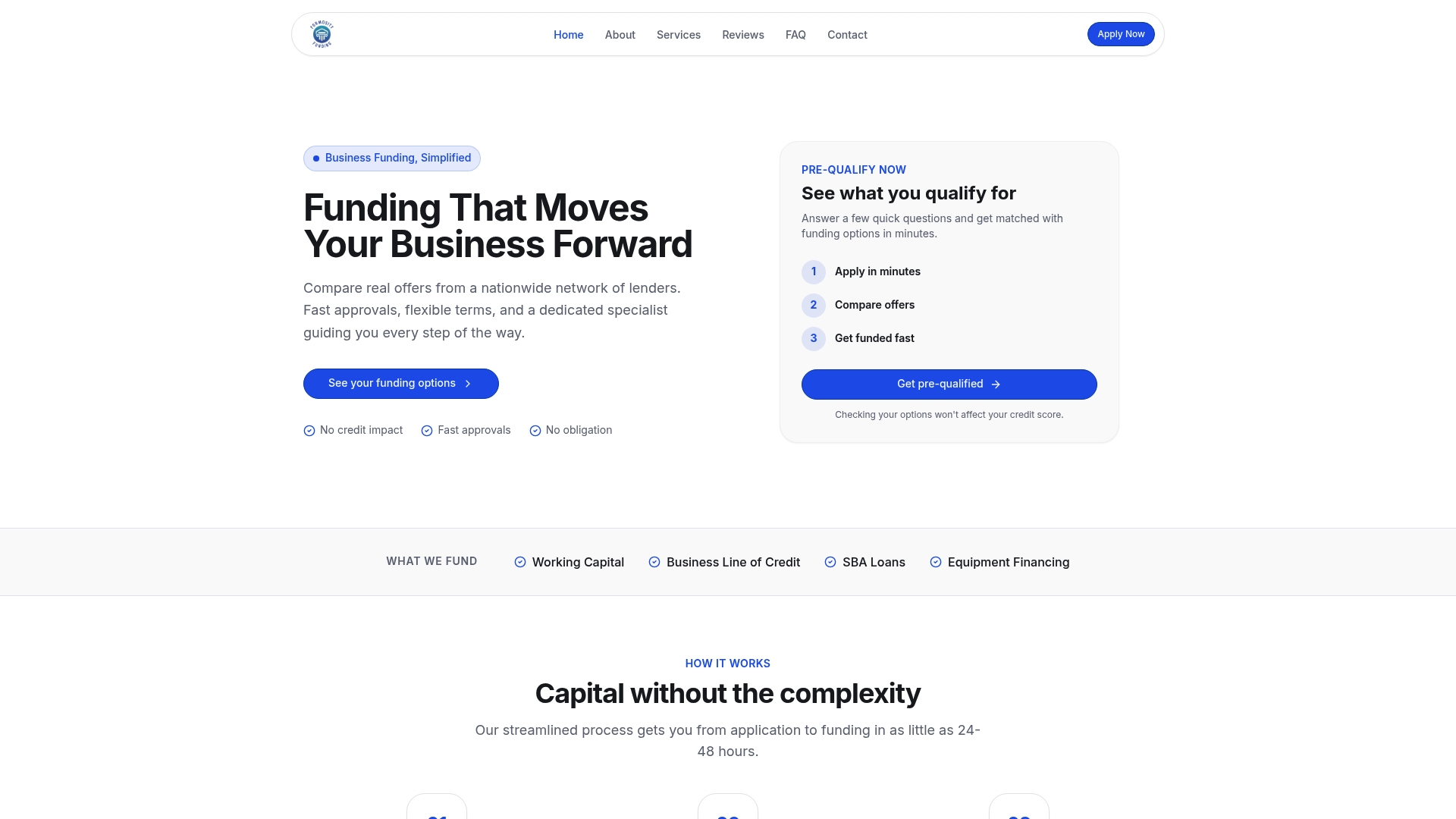
A dedicated funding specialist helps you batch your document packet upfront, the same practice that separates a 45 day close from a 90 day one. If you're ready to see what you qualify for, start with Formosity Funding's funding options and get matched with lenders suited to your loan size and timeline needs today.
Frequently Asked Questions
How long does SBA loan approval typically take after submission? Once your application is complete, expect 60 to 90 days for a standard 7(a) loan. PLP lenders often finish in 30 to 55 days since they skip the separate SBA review step.
What's a typical wait time for an initial lender response? Most lenders respond within three to ten business days of receiving a complete application, though incomplete submissions can push that response out by another week or more.
Does loan amount affect the SBA loan processing timeline? Larger loans often require more collateral documentation and sometimes a formal appraisal, both of which add time. Smaller loans, especially those under SBA Express thresholds, tend to move faster.
Can I speed up my SBA loan funding timeline? Choosing a PLP lender, submitting a complete document packet upfront, and responding to requests within 48 hours are the three moves that reliably shorten your timeline the most.
Is SBA Express really faster than a standard 7(a) loan? Express can deliver a decision in as little as 36 hours, but actual funding still depends on your lender's internal process, so treat that figure as decision speed rather than money-in-account speed.
Sources
- Loans - Small Business Administration
- How Long SBA Loans Actually Take | LenderHawk
- SBA 7(a) Loan Application: How to Apply in 4 Steps (2026 Guide)