

A secured loan requires you to pledge an asset, such as a house or car, that the lender can seize if you stop paying. An unsecured loan requires no collateral at all; the lender is betting on your credit history and income instead. Pick secured financing when you need a large amount at the lowest possible rate and can stomach the risk to your asset. Pick unsecured financing when speed and flexibility matter more than shaving a point or two off your rate, or when you simply have nothing to pledge.
That trade-off, cheaper money against real assets versus faster money against your promise to repay, drives almost every decision in the secured vs unsecured loan conversation. Everything else, the rates, the paperwork, the fallout if things go wrong, flows from that one fact.
Key Takeaways
Choosing between a secured and unsecured loan comes down to whether you value a lower rate more than you value protecting the asset you'd have to pledge to get it.
| Point | Details |
|---|---|
| Collateral defines the trade-off | Secured loans use assets like homes or cars to unlock lower rates; unsecured loans skip collateral but cost more. |
| Rates and amounts follow risk | Secured products typically offer lower rates and higher limits since lenders can recover losses through the collateral. |
| Default consequences differ sharply | Secured default risks repossession or foreclosure; unsecured default risks collections, lawsuits, and wage garnishment. |
| Time your applications | Cluster loan applications within a short window since hard inquiries stay on file for two years but rate-shopping windows limit cumulative score damage. |
| Compare offers before committing | Formosityfunding lets business owners prequalify with no credit impact and compare secured and unsecured funding options across its lender network. |
Table of Contents
- What Is a Secured Loan?
- What Is an Unsecured Loan?
- Secured vs Unsecured Loan Comparison at a Glance
- Pros and Cons of Secured and Unsecured Loans
- How Rates, Loan Amounts, and Qualifications Typically Differ
- What Happens if You Miss Payments or Default
- A Decision Checklist Before You Apply
- Applying: Documents, Timelines, and Where to Compare Offers
- The Shopping Tip Most Borrowers Never Hear About
- An Honest Take on Choosing Between Them
- Where Formosityfunding Fits Into This Decision
- Sources
What Is a Secured Loan?
A secured loan is any loan backed by collateral, an asset the lender can legally claim and sell if you default. That collateral is what makes the loan "secured": the lender's risk drops because there's something tangible to recover if you stop paying, and lenders reward that lower risk with better terms.
This is the mechanism behind some of the most common borrowing products in the U.S.:
- Mortgages — the home itself backs the loan, and HUD publishes extensive guidance on how home loans and equity products work.
- Auto loans — the vehicle serves as collateral until the loan is paid off.
- HELOCs (home equity lines of credit) — homeowners borrow against the equity they've built.
- Secured personal loans — often used by borrowers with thin credit files, backed by a car, savings account, or CD.
- Secured credit-builder loans and secured credit cards — a cash deposit acts as collateral, which is why they're easier to qualify for than most unsecured products.
The size of the loan usually tracks the value of what you're pledging. A lender won't hand you a $400,000 mortgage against a $250,000 house, and a savings-secured loan rarely exceeds the balance sitting in that account. Because the asset backstops the risk, approval odds tend to be higher even for borrowers with imperfect credit, which is exactly why credit-builder products lean on this structure in the first place.
What Is an Unsecured Loan?
An unsecured loan is money lent purely on your creditworthiness. No asset changes hands, no lien gets filed, and if you default, the lender can't just repossess something. Instead, underwriting leans almost entirely on your credit score, income, and existing debt load.
Personal loans, most credit cards, many student loans, and unsecured business lines of credit fall into this category. A lender looks at your credit score, your debt-to-income ratio, and your payment history, then decides how much to lend and at what rate based on how risky you look on paper. Someone with a 780 credit score and low debt-to-income ratio might land a $50,000 unsecured personal loan at a competitive rate. Someone with a 620 score and high existing debt might get approved for a fraction of that, at a considerably steeper rate, or not at all.
Because there's no collateral to fall back on, lenders price in that extra risk, and unsecured products, especially credit cards, tend to carry noticeably higher interest rates than secured alternatives like mortgages. FRED's consumer credit data tracks this rate gap over time, and it's persistent, not a temporary quirk of any one economic cycle.
Secured vs Unsecured Loan Comparison at a Glance
| Factor | Secured Loan | Unsecured Loan |
|---|---|---|
| Collateral required? | Yes (home, vehicle, savings, etc.) | No |
| Typical interest rates | Lower, since collateral reduces lender risk | Higher, to offset lack of collateral |
| Typical loan amounts | Higher, often tied to asset value | Generally lower, capped by creditworthiness |
| Credit-score requirements | More flexible; asset offsets weaker credit | Stricter; strong credit and income usually required |
| Approval speed / documentation | Slower; appraisals, title checks, valuations | Faster; income and ID verification only |
| Permitted uses | Sometimes restricted to the asset's purpose (mortgage, auto) | Often flexible, especially personal loans |
| Risk on default | Repossession, foreclosure, possible deficiency balance | Collections, lawsuits, credit damage, no asset loss |
The biggest trade-off in one line: secured loans buy you lower cost and higher borrowing power at the price of real risk to something you own, while unsecured loans buy you speed and flexibility at the price of higher rates and tighter credit standards.
Pros and Cons of Secured and Unsecured Loans
Every borrowing decision comes down to matching the loan's trade-offs to your actual situation, not just chasing the lowest advertised rate.
Secured loan pros:
- Lower interest rates because collateral reduces the lender's risk.
- Higher borrowing limits, often scaled to the value of the pledged asset.
- Easier approval for borrowers with limited or damaged credit history.
Secured loan con:
- You risk losing the pledged asset, whether that's your car, your home, or your savings, if you fall behind on payments.
Unsecured loan pros:
- No asset at risk if the loan goes unpaid.
- Faster funding since there's no appraisal or title search to slow things down.
- More flexible use of funds, particularly with personal loans and lines of credit.
Unsecured loan con:
- Higher rates and stricter credit and income requirements, since the lender has no fallback if you stop paying.
In practice, these trade-offs map onto specific scenarios. Buying a home or car almost always means a secured loan, since the asset itself is the collateral and the amounts involved are too large for most unsecured products to cover anyway. Debt consolidation splits both ways: a HELOC offers a lower rate if you own a home with equity, while an unsecured personal loan works for renters or anyone unwilling to put their house on the line for credit card debt. Emergency expenses tend to favor unsecured products purely for speed. Business working capital is where it gets interesting: a business line of credit or SBA loan might require collateral, while other working capital products are underwritten primarily on revenue and cash flow.
How Rates, Loan Amounts, and Qualifications Typically Differ
Interest rates in secured lending are lower largely because of what happens on the back end if you default: the lender recovers value by seizing and selling the collateral. That recovery path is what allows a lender to price a mortgage at a fraction of what a credit card charges, even though both are, at bottom, loans of money. FRED's 30-year mortgage rate series shows how much mortgage rates fluctuate over time with broader economic conditions, but even at cyclical highs, they've consistently undercut unsecured borrowing costs.
Loan amounts follow a similar logic but from a different angle. A secured loan's ceiling usually ties directly to the appraised value of the collateral. A HELOC, for instance, is capped by your home equity, not by your income alone. Unsecured loan amounts, by contrast, are capped by your credit profile: income, existing debt, and credit score determine how much a lender is willing to risk without anything to repossess.
Debt-to-income ratio matters more in unsecured underwriting because it's one of the few hard numbers a lender has to lean on. A borrower with a strong income but a high DTI, meaning too much of that income already goes toward debt payments, will often get turned down for unsecured credit even with a decent credit score. There are exceptions: some lenders extend high-balance unsecured personal loans, sometimes into the tens of thousands, to borrowers with excellent credit and low DTI, effectively treating a strong credit profile as its own form of collateral.
What Happens if You Miss Payments or Default
The consequences diverge sharply depending on which type of loan you're carrying, and understanding that gap before you sign anything matters more than almost any other part of this decision.

Default on a secured loan typically triggers repossession (for a car) or foreclosure (for a home). The lender sells the asset to recover what's owed. If the sale doesn't cover the full balance, some states allow the lender to pursue a deficiency judgment for the shortfall, meaning you can lose the asset and still owe money afterward. Either way, the default gets reported to credit bureaus and does serious damage to your score.
Default on an unsecured loan skips the repossession step but doesn't skip the pain. Lenders typically send the account to collections, may charge it off as a loss, and can sue you for the balance. A successful lawsuit can lead to wage garnishment or a bank levy, depending on your state's laws. Late payments and charge-offs both land on your credit report, and derogatory marks like these generally stay visible for around seven years.
Roughly two years is the window that matters most for your credit score in the short term. Hard inquiries from loan applications typically remain on your credit report for about two years, even though their scoring impact fades much sooner than that. That timeline shapes how you should shop for a loan, which is worth planning around before you start applying.
A Decision Checklist Before You Apply
Before submitting any application, run through a short list of questions that forces clarity on what you actually need and what you can afford to risk.
- What's the loan for, and does that purpose require or benefit from collateral? A home purchase requires a mortgage by definition; a $3,000 emergency repair probably doesn't need a secured loan at all.
- How much do you actually need, and does that amount exceed what unsecured lenders would typically approve for your credit profile?
- Can you realistically afford to lose the collateral if your income drops or an emergency hits? If the honest answer is no, that's a strong signal to lean unsecured, even at a higher rate.
- What's your timeline? Secured loans, especially mortgages and HELOCs, involve appraisals and title work that can stretch approval to weeks. Unsecured loans can often fund in days.
- Do you have a fallback plan if your income changes mid-loan? This matters far more for secured debt, where a missed payment threatens an asset, not just your credit score.
When you talk to a lender, ask directly about the annual percentage rate versus the advertised interest rate, all origination and prepayment fees, the exact repossession or deficiency-judgment policy in your state, and any restrictions on how you can use the funds. Walk away if a lender is vague about fees, pressures you to sign before you've reviewed terms, or offers repayment terms that shift between your first conversation and the final paperwork. Those are the classic warning signs of a predatory or poorly disclosed loan.
Applying: Documents, Timelines, and Where to Compare Offers
Unsecured loan applications generally ask for a government-issued ID, proof of income (pay stubs, tax returns, or bank statements), and authorization for a credit check. That's often the entire list, which is part of why approval can happen within a day or two.
Secured loans add another layer. On top of the standard identity and income documents, you'll need proof of ownership and a valuation of whatever you're pledging: a home appraisal for a mortgage or HELOC, a vehicle title and condition report for an auto loan, or account statements for a savings-secured loan. Discover's lending guidance notes that this valuation step is precisely what slows secured approvals down compared to unsecured ones, since appraisals and title searches take real time to complete.
You can shop for either loan type through banks, credit unions, or online marketplaces, and each has a different feel. Banks and credit unions often offer relationship pricing if you already do business with them. Online marketplaces let you compare multiple lenders' offers side by side, frequently through prequalification tools that use a soft credit pull, meaning you can see estimated rates and terms without affecting your credit score. Before finalizing anything with an unfamiliar lender, it's worth confirming their license status through NMLS Consumer Access, the public registry for mortgage and loan originators.
If you're weighing a secured home-improvement loan against an unsecured personal loan for the same project, this renovation financing comparison walks through how the math shifts depending on how much equity you have and how long you plan to stay in the home.
The Shopping Tip Most Borrowers Never Hear About
Here's something rarely mentioned in basic loan explainers: when you're comparing offers, the timing of your applications matters almost as much as the offers themselves.
Every hard credit inquiry stays on your report for about two years, but scoring models built for rate shopping, like those used for mortgages and auto loans, typically treat multiple inquiries within a short window as a single event rather than penalizing you for each one. Credit research from the University of Wisconsin-Madison Extension confirms this pattern: clustering applications limits the cumulative scoring damage compared to spacing them out over weeks or months.
Pro Tip: Prequalify with as many lenders as you can using their soft-pull tools first. Once you've narrowed it down to two or three serious offers, submit the actual applications within the same short window, ideally a few days to two weeks, so the resulting hard inquiries get grouped together rather than stacking up individually over time.
This approach works for mortgages and auto loans in particular, where rate-shopping windows are built into most scoring models. It's less reliable for unsecured personal loans and credit cards, where that grouping treatment doesn't always apply, so spread those applications out more conservatively.
An Honest Take on Choosing Between Them
Most guides treat this as a purely mathematical decision: compare the rates, pick the cheaper option, done. That undersells the risk side of the equation. A certified financial planner quoted by SmartAsset makes a point worth sitting with: secured loans make sense for large purchases like a mortgage, but they introduce real risk if payments become a struggle, and that risk deserves more weight than borrowers usually give it.
I'd push that further. The cheapest loan on paper isn't automatically the right loan for your circumstances. If your income is unstable, or you're the sole earner in your household, or you're already carrying debt close to your comfort limit, the lower rate on a secured product can be a trap disguised as a deal. You're not just borrowing money; you're putting a specific asset on the line for it.
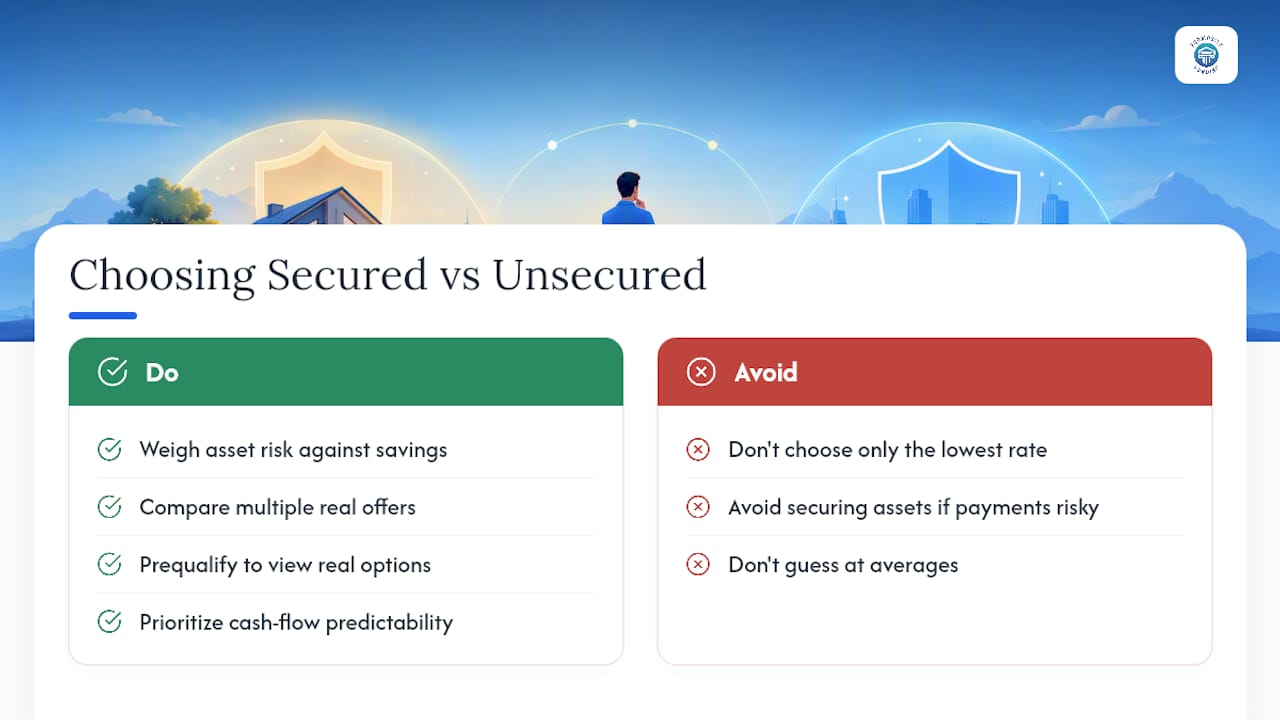
For business owners, this calculation gets more layered. A working capital loan, a line of credit, or SBA financing might come secured or unsecured depending on the lender and your business's revenue history, and the "right" answer often hinges on cash flow predictability more than the rate sheet. This is where comparing multiple real offers side by side, rather than guessing at averages, actually pays off. A marketplace model that surfaces offers from a range of lenders, and lets you prequalify without a credit hit, gives you the ability to see your real options before committing to either path.
Weigh the asset risk against the long-term savings honestly, not optimistically. If you can't picture yourself handling six months without income and still making payments, that's your answer regardless of what the rate comparison says.
Where Formosityfunding Fits Into This Decision
Once you know whether you're leaning secured or unsecured, the next question is where to actually find competitive offers without applying to a dozen lenders one at a time. That's the exact problem Formosityfunding was built to solve for small and medium-sized businesses.
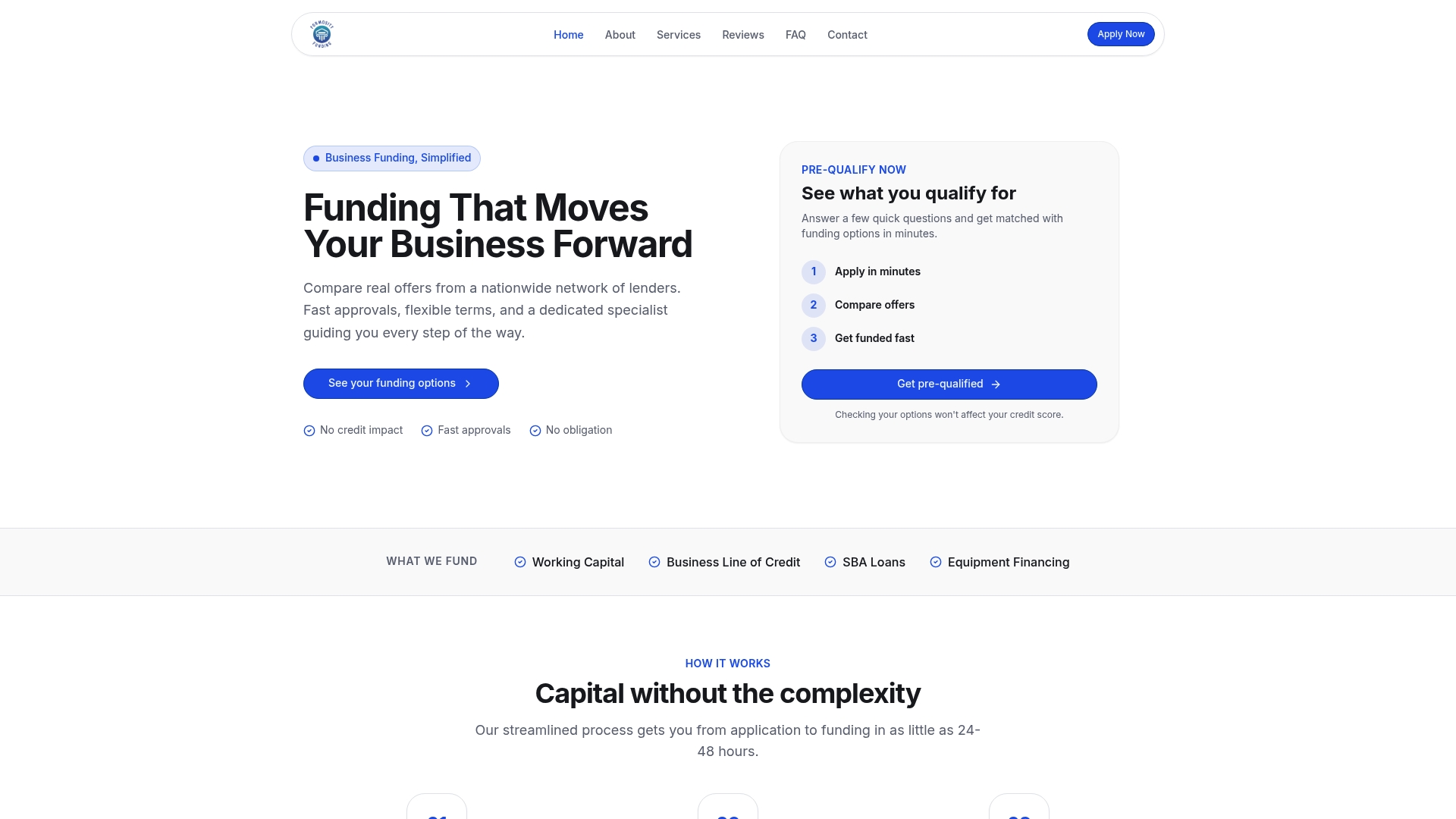
Formosityfunding connects business owners with a nationwide network of lenders offering working capital, business lines of credit, SBA loans, equipment financing, commercial real estate loans, and more, both secured and unsecured, matched to your specific situation. Instead of researching each lender independently, you get multiple real offers through one platform, with instant prequalification that doesn't touch your credit score. That matters directly for the timing strategy covered above: you can compare terms broadly through soft pulls, then move forward on final applications only once you've picked the strongest fit. Dedicated funding specialists guide you through documentation and next steps at every stage. If you're ready to see what you actually qualify for, explore Formosityfunding's business funding options and start comparing offers with no impact to your credit.
Sources
Verifying loan terms against primary sources beats relying on any single lender's marketing.
- Unsecured vs. Secured Loan: Understanding the Difference | TransUnion
- Credit inquiries advice | University of Wisconsin-Madison Extension
For business owners ready to move from research to real offers, Formosityfunding's marketplace connects you with lenders across both secured and unsecured funding categories in one place.
This article is general information, not a substitute for advice from a qualified financial advisor. Consult a qualified financial professional about your own circumstances before acting on anything here.