

Most U.S. small businesses that operate for profit, meet SBA size standards, and can demonstrate repayable cash flow qualify for common small business loans. Before you contact a single lender, pull together these six documents:
- Several years of business and personal tax returns
- Recent year-to-date profit and loss statement and balance sheet
- Several months of recent business bank statements
- A current debt schedule listing all outstanding obligations
- SBA Form 413 or an equivalent personal financial statement for every owner with 20% or more ownership
- Business formation documents: articles of incorporation, operating agreement, and ownership breakdown
These are the items that most often stall applications when they are missing or outdated. According to United Capital Source, missing or stale documents are the leading cause of underwriting delays. Get them current before you apply.
Pro Tip: Use SBA Lender Match at sba.gov or Formosityfunding's no-credit-impact pre-qualification to identify the right lender and program before you invest time assembling a full package.
Key Takeaways
Meeting small business loan requirements comes down to three things: clean financials, a DSCR above 1.25, and a complete, current document package submitted to the right lender for your situation.
| Point | Details |
|---|---|
| Core eligibility | For-profit, U.S.-based, SBA size standard, repayable cash flow, and current ownership/residency rules. |
| Documents to gather now | Tax returns (2–3 years), YTD financials, bank statements, debt schedule, and SBA Form 413. |
| Credit expectations | SBA 7(a) lenders typically want 680+ personal FICO; microloan intermediaries accept lower scores. |
| Top denial fix | Reconcile bank statements to tax returns and P&L before reapplying — gaps are the most common trigger. |
| Formosityfunding | Pre-qualifies businesses with 650+ FICO, no credit impact, and matches them to lenders across multiple programs. |
Table of Contents
- What are the small business loan requirements you must meet?
- Which SBA program fits your situation?
- What documents do lenders need for a business loan?
- What credit score and collateral do lenders typically expect?
- How do lenders actually decide whether to approve your loan?
- What timelines, loan amounts, and fees should you expect?
- How do you find a lender and submit a strong application?
- Why do small business loans get denied, and how do you fix it?
- What most applicants get wrong about the process
- Formosityfunding connects you to lenders who match your profile
- Sources
What are the small business loan requirements you must meet?
The SBA's loan overview lays out the baseline tests that apply to both SBA-backed and most conventional small business loans. Meeting all of them is the starting point, not the finish line.
Core eligibility anchors:
- For-profit and U.S.-based. The business must operate for profit and be physically located and operating in the United States or its territories.
- SBA size standard. The SBA measures size by industry using NAICS codes, either by number of employees or average annual revenue depending on the sector. A manufacturer with 500 employees may qualify; a retailer with $8 million in annual revenue may not. Check the SBA's size standards tool at sba.gov for your specific NAICS code.
- Ability to repay from cash flow. Lenders want to see that the business generates enough income to cover the proposed debt payment with room to spare. This is measured by the Debt Service Coverage Ratio (DSCR), typically calculated as net operating income divided by total annual debt payments. Most lenders want a DSCR above one, indicating sufficient cash flow to cover debt payments.
- Credit-elsewhere test. SBA loans are designed for businesses that cannot obtain comparable financing on reasonable terms from conventional sources. If a bank lends to you without an SBA guarantee, the SBA program may not apply.
- Ownership and residency rules. As of the March 1, 2026 SBA procedural notice, ownership, citizenship, and residency requirements for 7(a) and 504 loans were revised. Applicants with non-U.S. ownership should confirm current eligibility directly with their lender before proceeding.
- Ineligible business types. Certain businesses are excluded regardless of size or cash flow: passive investment companies, lending businesses, gambling operations, and businesses engaged in illegal activities under federal law, among others.
Which SBA program fits your situation?
The SBA runs three primary loan programs, and the differences matter more than most applicants realize. Choosing the wrong program adds weeks to your timeline and may result in a denial that a different program would have avoided.
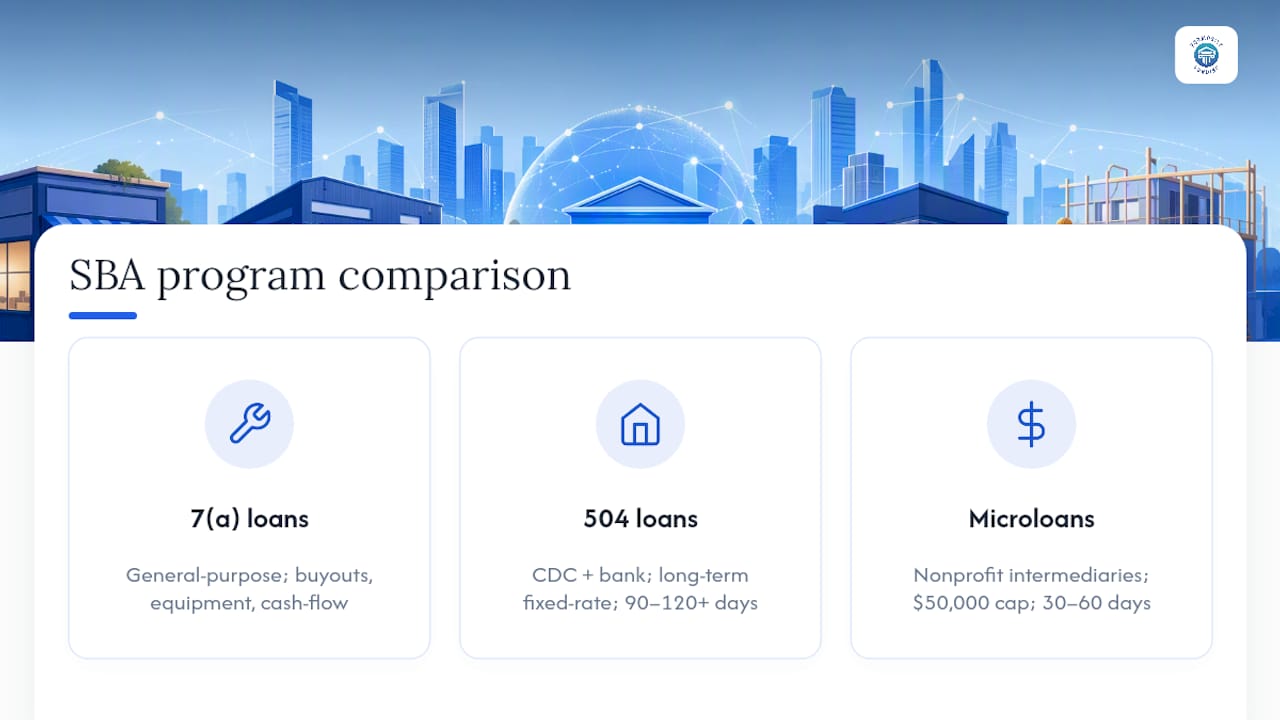
7(a) loans are the SBA's general-purpose workhorse. The program covers almost any legitimate business purpose, from buying out a partner to purchasing equipment to bridging a cash flow gap. Guarantee percentages and interest-rate caps vary by loan size, so review the program page for current figures.
504 loans are built for long-term, fixed-rate financing of owner-occupied commercial real estate and major equipment. A Certified Development Company (CDC) partners with a bank to fund the deal, which adds steps and extends the timeline to 90–120 days or more.
Microloans work through nonprofit intermediary lenders and are the most accessible entry point for very small businesses. Documentation requirements are lighter, underwriting is more flexible, and turnaround runs 30–60 days. The $50,000 cap makes them unsuitable for larger needs, but for a startup buying its first piece of equipment or building initial inventory, they are often the fastest path to capital.
What documents do lenders need for a business loan?

Lenders evaluate your application through what you hand them, not what you tell them. A well-organized package signals competence; a disorganized one signals risk. Here is what to gather, organized by category.
Business financial documents:
- Business tax returns for the past 2–3 years (all schedules included)
- Year-to-date profit and loss statement and balance sheet, prepared within the last 90–120 days
- Business bank statements for the most recent 3–6 months
- Accounts receivable and payable aging reports (required by most lenders for businesses with significant receivables)
- A complete debt schedule listing every outstanding loan, lease, or obligation with balance, payment, and maturity date
Personal financial documents:
- Personal tax returns for the past 2–3 years for all owners with 20% or more ownership
- SBA Form 413 (Personal Financial Statement) for each qualifying owner
- Authorization to pull personal credit reports
- Government-issued photo ID
Organizational and legal documents:
- Articles of incorporation or organization
- Operating agreement or partnership agreement
- Ownership breakdown showing percentage held by each owner
- Current business licenses and permits
- Purchase agreements or letters of intent (for acquisitions)
Program-specific additions:
- 504 loans: property appraisal, environmental Phase I report, construction plans if applicable
- Microloans: intermediary lender's own application materials, which vary by organization
Pro Tip: Name every PDF with a clear convention before you upload: "BusinessName_2024_TaxReturn.pdf" rather than "scan001.pdf." Lenders process dozens of packages simultaneously. A clearly labeled file gets reviewed faster and rarely gets lost in the queue.
What credit score and collateral do lenders typically expect?
Credit expectations vary more than most guides admit. The type of lender and the loan program both shift the floor significantly.
- SBA 7(a) lenders commonly look for a personal FICO score of 680 or above, though some SBA Preferred Lenders set their own floors higher. The SBA also uses the FICO Small Business Scoring Service (FICO SBSS) for pre-screening on loans up to $500,000, with a reported minimum score around 155 out of 300.
- Microloan intermediaries accept lower personal credit scores, sometimes in the 575–620 range, because they weigh character and business plan more heavily than a bank would.
- Business credit scores (FICO SBSS and Dun & Bradstreet PAYDEX) matter most for established businesses with a credit history. A PAYDEX score of 80 or above signals on-time payment and strengthens an application considerably.
On collateral: SBA policy does not automatically decline a loan for insufficient collateral, but lenders are required to take available collateral when it exists. For 7(a) loans above $50,000, lenders will typically lien business assets first, then look to personal real estate equity if a shortfall remains. Loans under $50,000 often require no collateral at all.
Signing a personal guarantee means the lender can pursue your personal assets if the business defaults. This is not negotiable on most SBA loans, and it applies even when the business has strong collateral.
The FTC's business credit guidance explains how business credit is reported and what steps businesses can take to dispute errors before applying.
How do lenders actually decide whether to approve your loan?
Most lenders, including SBA-participating banks like Bank of America and Wells Fargo, structure their underwriting around the 5 C's of credit: Character, Capacity, Capital, Collateral, and Conditions.
- Character is your credit history, both personal and business. Lenders look for consistent on-time payment, no unresolved judgments, and no open federal debt (a CAIVRS hit from a prior government-backed loan default will stop most SBA applications cold).
- Capacity is cash flow. The DSCR calculation is the core test. Most lenders want to see that your net operating income sufficiently covers proposed debt payments, with a comfortable margin indicating repayment ability.
- Capital is the owner's equity stake. A business where the owner has invested meaningfully signals commitment. For startups, this translates into an equity injection requirement, often 10–30% of the total project cost.
- Collateral is the secondary repayment source if cash flow fails. Business equipment, real estate, and receivables all count.
- Conditions cover the loan's purpose, the industry environment, and broader economic factors. A restaurant applying during a period of sector-wide distress faces harder conditions than a healthcare services firm in the same period.
Red flags that underwriters watch for: large unexplained deposits, frequent overdrafts, declining revenue across multiple periods, and tax returns that don't reconcile with bank deposits. Each of these triggers a request for explanation, which adds time.
Pro Tip: If your P&L shows a one-time expense that depressed net income in a prior year, prepare a one-paragraph addendum explaining it and attach it to your package. Underwriters appreciate the transparency and it prevents a follow-up request that could add two weeks to your timeline.
What timelines, loan amounts, and fees should you expect?
Timeline and cost expectations vary sharply by program and lender type.
- Microloans: 30–60 days from application to funding, lighter documentation, and lower fees. The $50,000 cap is the main constraint.
- 7(a) standard loans: 60–90 days is typical, though SBA Preferred Lenders with delegated authority can move faster. Complex deals or incomplete packages push past 90 days.
- 504 loans: 90–120 days or more, because the CDC review process adds a layer that bank-only deals skip.
On fees: SBA guaranty fees are charged as a percentage of the guaranteed portion of the loan and vary by loan size and term. Origination fees, appraisal costs, environmental reports, and closing costs are additional. For a 504 deal involving commercial real estate, total closing costs can run several percent of the loan amount. Check the current SBA fee schedule at sba.gov before budgeting, as fee structures are updated periodically.
This is an illustrative example only. Your actual rate, term, and payment will depend on the lender, the program, and your credit profile.
Banks like Bank of America and Wells Fargo publish business loan product pages with sample rates and eligibility expectations. These are useful benchmarks, but always verify current program rules at sba.gov.
How do you find a lender and submit a strong application?
Step 1: Pre-qualify and collect your documents. Run through the documentation checklist above before you contact anyone. Know your DSCR, your personal FICO, and your business credit score. Gaps in any of these are easier to address before you apply than after a lender flags them.

Step 2: Choose your lender type. Community banks and SBA-participating national banks (Bank of America, Wells Fargo) offer the most competitive rates but move slower and require complete packages. Online marketplaces move faster and often work with a broader credit range. CDCs are the right path for 504 deals. Microloan intermediaries are the entry point for very small needs or thin credit files.
Step 3: Use matching tools. SBA Lender Match at sba.gov connects you with participating lenders based on your location and loan type. Formosityfunding's pre-qualification is another option: it runs with no credit impact and matches you to lenders across its nationwide network based on your actual business profile.
Step 4: Respond to underwriting requests quickly. Conditional approvals are common. A lender may approve your loan subject to receiving an updated bank statement, a corrected tax return, or a property appraisal. The clock on your approval doesn't stop while you gather those items, so treat every underwriting request as urgent.
Pro Tip: For 504 deals involving real estate, order the Phase I environmental report and property appraisal before you submit your application. These items take 2–4 weeks to complete and are always required. Having them ready can cut your closing timeline by a month.
Why do small business loans get denied, and how do you fix it?
Denial is not permanent. Most rejections trace back to a handful of fixable problems.
Top denial reasons:
- Insufficient cash flow or DSCR below the lender's threshold
- Missing, outdated, or internally inconsistent financial documents
- Low personal credit score or unresolved judgments and collections
- Tax returns that don't match bank deposits (a reconciliation problem)
- Collateral shortfall with no personal assets to bridge the gap
- Ownership or residency documentation that doesn't satisfy current SBA rules
Remediation steps, in order of impact:
- Reconcile your bank statements to your tax returns and P&L. Unexplained gaps are the single most common reason underwriters ask for more information.
- Pull your personal credit report and dispute any errors through the credit bureau. The FTC's business credit resources explain the process.
- If your DSCR is the problem, look at whether reducing existing debt or increasing documented revenue changes the ratio before reapplying.
- Add a co-signer or document an equity injection to address a capital shortfall.
- For ownership documentation issues, confirm current SBA rules under the March 1, 2026 procedural notice with your lender before reapplying.
If an SBA loan is genuinely out of reach right now, consider a microloan, equipment financing, or invoice factoring as a bridge. These products have lighter requirements and can help you build the credit history and cash flow documentation that a larger SBA loan will eventually require.
30–90 day action plan: Pull credit reports in week one. Reconcile financials in weeks two and three. Dispute any errors and gather updated documents in weeks four through six. Reapply with a complete, reconciled package at the 90-day mark.
What most applicants get wrong about the process
The biggest mistake I see is treating the loan application as a document-collection exercise rather than a financial narrative. Lenders are not just checking boxes. They are trying to answer one question: will this business generate enough cash to repay this loan without my guarantee being called?
An established business with two years of strong, consistent cash flow and a clean credit file should apply directly to an SBA Preferred Lender and expect a 60–75 day process. A startup, by contrast, needs to walk in with a credible equity injection, a detailed business plan, and realistic financial projections. The documentation bar is higher, and the equity requirement is real. Expecting startup terms to match established-business terms is where most first-time applicants lose weeks.
The other pattern worth naming: applicants who wait until they need money urgently. At that point, the 60–90 day SBA timeline becomes a crisis. The businesses that get funded on the best terms are the ones that started the process three to six months before they actually needed the capital.
Formosityfunding connects you to lenders who match your profile
Getting matched to the right lender is often harder than meeting the requirements. Formosityfunding removes that friction. The platform connects small and medium-sized businesses to a nationwide network of lenders across working capital, SBA loans, equipment financing, lines of credit, commercial real estate, and invoice factoring.
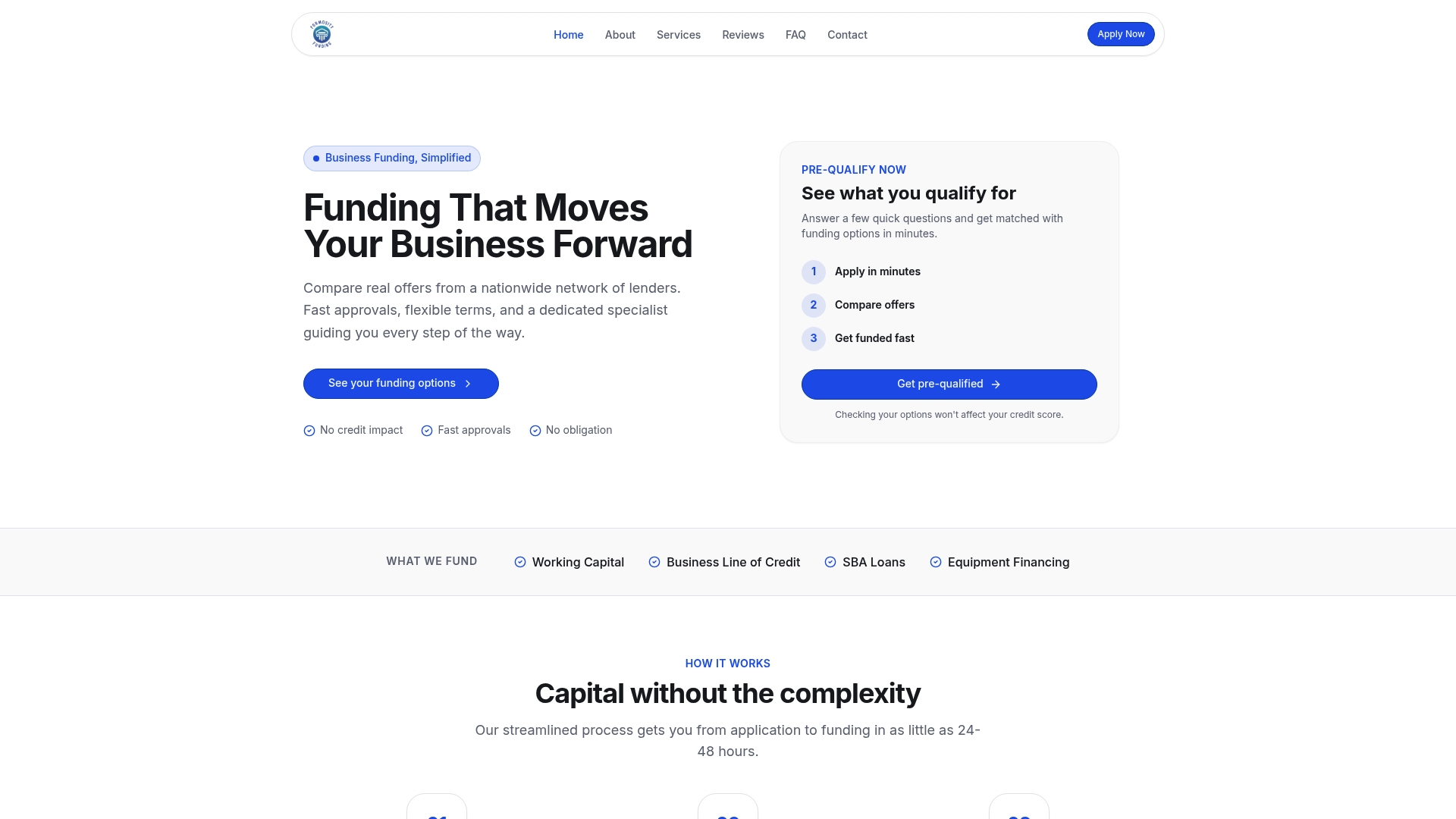
Formosityfunding works with established businesses and startups, including borrowers with credit scores as low as 650 FICO. Pre-qualification runs with no credit impact, so you can see real loan and credit offers before committing to a full application. Dedicated funding specialists guide you through document preparation and lender matching, which is particularly useful if your first application was denied and you need to understand why.
Check your business funding options at Formosityfunding to get pre-qualified and matched to participating lenders today.
Sources
These are the primary references for current rules, forms, and program details. Policies change, and the sources below reflect the most current official guidance.
- Loans | SBA
- Small Business Loans: What You Need to Know to Secure Funding | CO- by US Chamber of Commerce
- Getting business credit | FTC
This article is general information, not a substitute for advice from a qualified financial advisor. Consult a qualified financial professional about your own circumstances before acting on anything here.