

Most lenders want three things before they say yes: at least a few months to a year in business, revenue or deposit patterns strong enough to support repayment, and bank statements clean enough to prove it. Traditional banks push that history requirement toward the 12-month mark, while merchant-processor products can approve businesses with a shorter track record if processing volume is steady. The SBA's Working Capital Pilot program requires a full 12 months of operations. Formosityfunding's prequalification process helps you find out which lender type actually fits your file before you fill out a single application.
TL;DR:
- Businesses with less than 12 months of operation generally need to apply to revenue-based lenders that prioritize deposit consistency over credit history.
- Having four to six months of bank statements and a clear use-of-funds statement significantly speeds up approval, especially for short-term advances.
- The SBA Working Capital Pilot requires a full year of operations and can finance up to five million dollars, with strict documentation and rate caps.
- Matching your business profile to the appropriate lender type — revenue-first, credit-first, or asset-backed — can reduce application time from weeks to days.
- Prequalification tools help identify the best lender fit before applying, avoiding wasted efforts on incompatible options.
Table of Contents
- Working Capital Loan Requirements: The Priority Checklist
- Documents You Need Before You Apply
- SBA Working Capital Pilot: Rules That Don't Bend
- How Lender Type Changes What Gets Checked
- What to Expect: Size, Cost, and Timeline
- Improving Your Approval Odds Before You Apply
- How We Help Borrowers Get Through This Process
- The Gap Between "Qualified" and "Approved Fast"
- Get Prequalified Without the Guesswork
- Where to Verify These Rules Directly
- Sources
Working Capital Loan Requirements: The Priority Checklist
Lenders don't weigh every factor equally. Time in business, revenue consistency, and creditworthiness carry the most weight, and understanding the order matters because it tells you which lender type is worth your time.
Time in business is usually the first filter. Many online and revenue-based lenders will consider a business open for as little as three to six months, but banks and SBA-backed lenders typically want to see one to two years of operating history. A newer business isn't automatically shut out, but it narrows the field fast.
Revenue and deposits come next. Lenders want to see money moving through your accounts consistently, not just a big number on a tax return. Merchant-processor products, like the kind tied to card-processing history, sometimes qualify businesses with minimum annual processed sales thresholds after a few months of account history.
Creditworthiness matters, but it's rarely the single deciding factor for working capital financing the way it is for a mortgage. Lenders look at both business credit and the owner's personal credit score, and most want to see a personal score somewhere in the mid-600s or better, though revenue-first lenders will sometimes work around a lower score if deposits are strong.
Other eligibility criteria include your business being a legally registered U.S. entity with an active EIN, industry restrictions for certain sectors may apply. SBA size standards tied to the NAICS code determine eligibility, and collateral or personal guarantees might be requested or improve terms.
Pro Tip: If your time in business falls short for a bank loan, don't waste weeks applying anyway. Start with a revenue-based lender or Formosityfunding's lender network, where shorter operating histories are often workable.
Documents You Need Before You Apply
Gathering paperwork before you start an application, rather than scrambling after a lender asks, is the single biggest factor in a fast approval. Here's what to have ready, roughly in the order lenders ask for it.
- Bank statements. Four to six months is the standard ask. If your tax returns show a rough year, lead with your most recent months of statements. Revenue-first lenders often build their entire underwriting decision around four months of deposits, so this is the document that matters most for speed.
- Profit and loss statement, balance sheet, and cash flow statement. Lenders want both your most recent full-year numbers and year-to-date figures, so they can see where the business stands right now, not six months ago.
- Business and personal tax returns. Most lenders ask for one to three years, depending on loan size and lender type.
- Accounts receivable and payable aging reports, plus inventory reports when relevant. These matter more for larger facilities and asset-backed lines than for a small short-term advance.
- Legal documents. Articles of incorporation or organization, your EIN confirmation, operating agreement, and any required business licenses.
- Personal financial statement. Required for owners with significant equity stake, especially when a guarantee is part of the deal.
The full document set lenders typically request covers P&L, balance sheet, cash flow statements, two to three years of tax returns, three to six months of bank statements, AR/AP aging, and legal entity paperwork.
Pro Tip: Build one folder with every document named clearly (not "Scan001.pdf") before you apply anywhere. Lenders that see an organized file move faster, and it signals you run a tight operation.
SBA Working Capital Pilot: Rules That Don't Bend
The SBA's newer Working Capital Pilot (WCP) program operates under stricter rules than most commercial working capital products, and the biggest one is non-negotiable: your business needs a full 12 months of operational history. There's no shorter path in for a newer company, unlike some online lenders that will work with 90 days.
In exchange for that stricter bar, the ceiling is much higher. The WCP can finance up to $5,000,000, with guaranty percentages and interest-rate caps that shift depending on the size of the loan tranche.
- Maximum loan amount: $5 million.
- Minimum operating history: 12 full months, no exceptions.
- Documentation demands: timely financial statements, current AR/AP aging reports, and inventory reports, submitted on an ongoing basis, not just at application.
- Rate structure: caps tied to an SBA-approved base rate, with reported ranges from roughly base plus 3% up to base plus 6.5% depending on loan size.
One detail worth knowing: lenders with delegated SBA authority (called Preferred Lender Program status) can approve WCP loans without waiting on SBA review, which shortens the timeline considerably compared to lenders without that authority.
How Lender Type Changes What Gets Checked
The lender you apply to determine which document in your file actually decides the outcome. Match your profile to the right type before you apply, and you'll save weeks.
- Revenue-first lenders (merchant processors, most online working capital providers) build their decision around bank statements and deposit consistency. A business with imperfect credit but steady $30,000 monthly deposits often clears this bar faster than a business with excellent credit but choppy revenue.
- Credit-first lenders (traditional banks, credit unions) weigh established financials and credit history more heavily. They want years of tax returns and a credit profile that shows a track record, not just recent momentum.
- Asset-backed and receivables-backed lenders (asset-based lending shops, some SBA lines of credit) look past the income statement to what you own. Inventory, equipment, and outstanding invoices can secure financing even when cash flow alone wouldn't qualify.
The tradeoff runs in a predictable direction: revenue-first products fund fastest but often cost more; credit-first products cost less but demand more history and paperwork; asset-backed lines sit in between, trading collateral for better terms.
What to Expect: Size, Cost, and Timeline
Loan sizes for working capital financing range widely, from a few thousand dollars in short-term advances up to the SBA WCP's $5 million ceiling, with common maturities running anywhere from a few months to five years depending on the product.

Cost structures vary by lender type. Some quote a fixed fee, some use a factor rate, and traditional lenders quote an APR. SBA WCP loans cap rates using a base rate like Prime, the SBA's Optional Peg Rate, or SOFR, plus a set spread depending on loan size.
Timelines swing just as widely: revenue-based lenders can fund in a day or two once your file is complete, while bank and SBA products commonly take one to several weeks. The gap between those extremes usually comes down to one thing: how complete your document file is on day one.
Improving Your Approval Odds Before You Apply
A few deliberate moves before you submit an application can change both your odds and your terms.
- Submit a complete file the first time. If your tax returns show a weak year, lead with your most recent four months of bank statements instead of burying them behind older documents.
- Clean up credit issues you can control. Resolve small liens or disputes where practical; a single unresolved judgment can stall an otherwise strong file.
- Consider offering collateral or a limited personal guarantee. It won't be required everywhere, but it can unlock better rates at lenders on the fence.
- Use a broker or marketplace when your profile is mixed. A general business checklist can help you organize documents, but a marketplace does something a checklist can't: it routes your file to lenders that actually fit your numbers.
Pro Tip: Ask for a proof-of-funds or bank statement summary from your accountant before you apply anywhere. It's the same principle real estate investors use to verify available cash before making an offer, and it works just as well for loan applications.
How We Help Borrowers Get Through This Process
At Formosityfunding, we built prequalification specifically to skip the guesswork above. You share your basic numbers, we check them against our lender network without a hard credit pull, and we tell you which lender types are realistic for your file before you gather a single document.
That matters because most of the wasted time in this process comes from applying to the wrong lender first. Our funding options page lays out the range of products (working capital, lines of credit, SBA loans, equipment financing) we match against, and our specialists review your document set before it ever reaches a lender, catching gaps that would otherwise cause delays.
The Gap Between "Qualified" and "Approved Fast"
Here's what most guides on this topic get backwards: they treat eligibility as a pass/fail gate, when in practice it's a matching problem. A business with eight months of history and choppy revenue isn't unqualified. It's mismatched to a bank underwriter who wants two years of clean tax returns, and perfectly matched to a revenue-first lender who cares about last quarter's deposits.
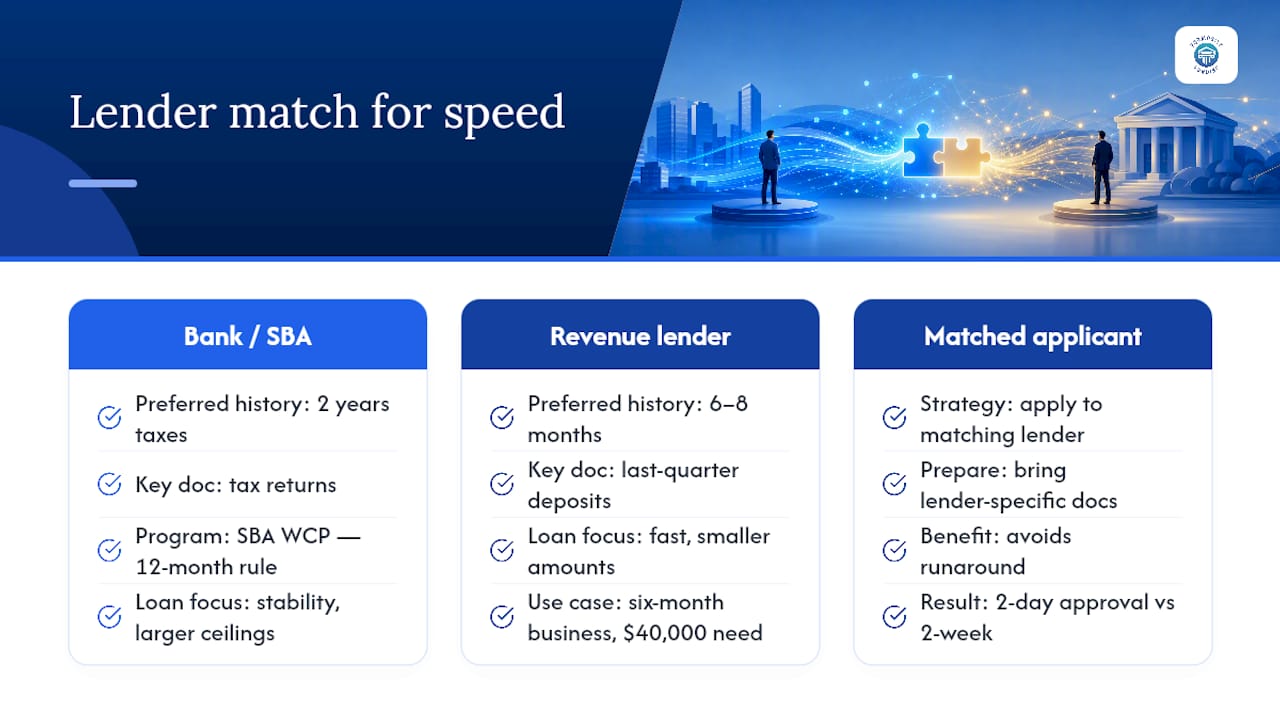
The businesses that get funded fastest aren't necessarily the strongest on paper. They're the ones that stopped applying to lenders built for a different profile than theirs. I'd argue the SBA WCP's strict 12-month requirement, paired with its far larger loan ceiling, actually makes this matching problem more visible, not less. It's a program built for stability and scale, not for the six-month-old business that needs $40,000 by Friday. Both businesses deserve financing. They just need different doors.
The document checklist in this article isn't busywork. Every item on it exists because a specific lender type asks a specific question, and showing up with the answer already prepared is the real difference between a two-day approval and a two-week runaround.
— Alvin
Get Prequalified Without the Guesswork
Instead of guessing which lender fits your file, or applying to three different banks and waiting weeks for each answer, you get one prequalification check that routes you to lenders actually built for your numbers. That's the real advantage of a marketplace over applying lender by lender: one no-credit-impact check surfaces multiple real offers instead of one slow maybe.
To get started, have your last four to six months of bank statements ready, along with a rough sense of your monthly deposits and time in business. Most applicants get prequalification results quickly, without a hard credit inquiry, and our specialists walk through your options once real offers come back. Visit Formosityfunding's funding options page to see the full range of products, from working capital advances to SBA loans, and start your prequalification today.
Where to Verify These Rules Directly
For official eligibility rules and caps, see the SBA's Working Capital Pilot program page. For a practical document checklist, see Cerebro Capital's application guide.
This article is general information, not a substitute for advice from a qualified financial advisor. Consult a qualified financial professional about your own circumstances before acting on anything here.
Sources
- Applying for a Working Capital Loan Online: Document Checklist
- SBA Working Capital Line of Credit: Rates, Terms and How To Apply - Nav