

Revolving credit is a reusable line, like a credit card, where your available balance refills as you pay it down. Installment credit is a fixed lump sum, like a car loan, repaid in equal payments until the account closes. Use revolving credit for short-term, flexible spending you can pay off quickly; use installment credit for large, predictable purchases where a fixed rate and schedule work in your favor.
TL;DR:
- Revolving credit is ideal for short-term, flexible spending and remains open indefinitely, while installment credit suits large, fixed-purchase financing with scheduled repayment terms.
- Carrying high revolving balances can significantly impact credit scores through increased utilization, which makes managing balances carefully crucial.
- Using installment loans to consolidate high-utilization revolving debt can lower interest costs and improve credit utilization with a fixed payment plan.
- Payment history affects both credit types equally, but revolving credit utilization accounts for about 30% of your score and requires keeping balances low.
- Matching the credit type to the expense's size and predictability ensures cost efficiency and better credit management.
Table of Contents
- What Is Installment Credit vs. Revolving Credit?
- Revolving vs. Installment Credit: Side-by-Side Comparison
- How Do Revolving and Installment Accounts Affect Your Credit Score?
- When Should You Use Revolving vs. Installment Credit?
- How to Manage Both Credit Types to Protect Your Score
- Pros and Cons of Revolving and Installment Credit
- How Formosity Funding Matches Financing to Your Credit Needs
- An Editor's Take on Getting This Right
- Get Matched With the Right Financing Type
- Sources
- FAQ
What Is Installment Credit vs. Revolving Credit?
Installment credit is a fixed amount borrowed once and repaid through scheduled payments until the balance hits zero. Mortgages, auto loans, student loans, and personal loans all follow this pattern: borrow, repay, done. Once you pay off an installment loan, the account closes and stays closed.
Revolving credit works differently. You get a credit limit, borrow against it as needed, and your available balance replenishes as you pay down what you owe. Credit cards, personal lines of credit, and home equity lines of credit (HELOCs) are the most common examples, and the account stays open indefinitely as long as you keep it in good standing.
The secured versus unsecured distinction matters most when things go wrong. A secured loan, like an auto loan or a HELOC, is backed by collateral the lender can seize if you default. Unsecured products, like most credit cards and personal loans, carry no collateral, which is one reason their interest rates tend to run higher.
- Installment credit: mortgage, auto loan, student loan, personal loan
- Revolving credit: credit card, personal line of credit, HELOC
- Key structural difference: installment accounts close at payoff; revolving accounts stay open and reusable
Revolving vs. Installment Credit: Side-by-Side Comparison
The core tradeoff comes down to structure. Revolving credit is reusable and charges interest only on carried balances, while installment loans deliver a fixed lump sum repaid on a set schedule and close once paid off. That single difference drives almost everything else, including cost.
| Attribute | Revolving credit | Installment credit |
|---|---|---|
| Repayment structure | Flexible minimum or full payoff each cycle | Fixed payment amount and schedule |
| Interest behavior | Charged on carried balance; compounds if unpaid | Amortized over the loan term at a set rate |
| Reusability | Reusable as you pay it down | One-time use; closes at payoff |
| Predictability | Variable, depends on spending | Highly predictable |
| Typical APR pattern | Often higher, especially on credit cards | Often lower, especially for secured loans |
| Credit report impact | Drives utilization (amounts owed) | Drives credit mix and payment history depth |
Carry a $5,000 balance on a credit card at a typical card APR and you could pay far more in interest over time than financing that same $5,000 expense through a personal installment loan at a lower fixed rate, simply because the installment loan amortizes toward zero on schedule while a revolving balance can linger indefinitely if you only pay the minimum.
Pro Tip: If you're carrying revolving balances across multiple cards just to keep up with minimums, an installment consolidation loan at a lower APR can cut your interest cost and drop your utilization ratio in one move, as long as you don't run the cards back up afterward.
How Do Revolving and Installment Accounts Affect Your Credit Score?
Payment history counts for about 35% of most credit scores, and it applies equally to both account types. A missed payment on a credit card hurts your score exactly the same way a missed installment payment does, so the "which type is better for my score" question really comes down to the other factors.
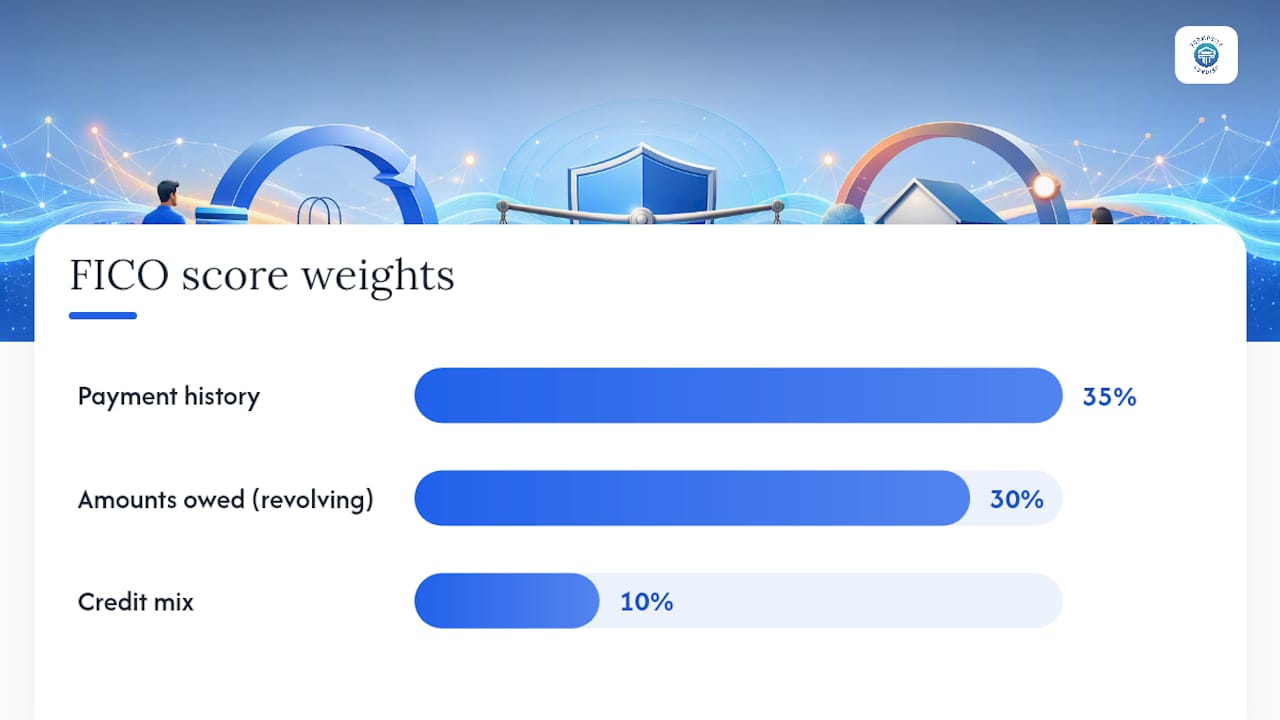
Revolving credit is where utilization lives. Amounts owed makes up roughly 30% of your FICO score, and experts recommend keeping revolving utilization well below 30%, ideally in the single digits, for the strongest results. Closing a revolving account can quietly push your utilization ratio up, because you lose available credit while your balances stay the same.
Installment loans feed into credit mix, which accounts for about 10% of your score. Having both a credit card and a car loan or mortgage on file signals to lenders that you can manage different kinds of debt. Here's the twist most people miss: paying off an installment loan doesn't guarantee a score bump. Removing an active, positive account can leave your credit file slightly thinner, and FICO notes that closing a paid installment loan can be neutral or even slightly negative for score depth.
- Payment history (35%): applies equally to revolving and installment accounts
- Amounts owed (30%): driven almost entirely by revolving utilization
- Credit mix (10%): rewarded by holding both account types
- Timing detail: many card issuers report your balance to the bureaus at statement close, not on your payment date, so paying down a card before that closing date can lower your reported utilization even if you were never late
About one third of your credit score comes from payment history alone. It's the one factor where revolving and installment accounts are judged by identical rules.
When Should You Use Revolving vs. Installment Credit?
Match the credit type to the shape of the expense, not just the interest rate. A one-time $20,000 kitchen remodel and a $200 grocery run call for very different tools, even if both technically fit on a credit card.
- Reach for revolving credit when the expense is short-term, variable, or you can pay the balance in full before interest accrues, such as everyday purchases or building rewards.
- Reach for installment credit when you're financing something large and one-time, like a car, education, or a home improvement project, and you want a fixed rate and a defined end date.
- Consider converting revolving debt to installment debt if your card balances are sitting near or above 30% utilization and you can qualify for a lower fixed rate, which can reduce interest and free up your utilization ratio in one step.
- Run the checklist before deciding: How large is the purchase? How predictable is your income over the repayment period? Can you realistically pay it off in one or two billing cycles? How does the installment APR compare to your card's APR?
How to Manage Both Credit Types to Protect Your Score
Managing revolving credit well means keeping balances low relative to your limits, not just avoiding late payments. Paying down your card balance before the statement closing date, rather than waiting for the due date, can lower what actually gets reported to the bureaus. Some cardholders even find that a small nonzero balance scores marginally better than $0 in certain scoring models, though paying in full remains the simplest way to dodge interest entirely.
For installment loans, understand your amortization schedule before you sign, and compare the full APR across lenders before refinancing anything, including a car loan or a personal loan. Closing a paid-off installment account can trim your credit history's depth, so weigh that against any benefit of paying it off early.
- Pay on time, every time, on both account types. This is 35% of your score for a reason.
- Keep old revolving accounts open even at a zero balance, since closing them shrinks your available credit and raises utilization.
- Get quotes from more than one lender before refinancing or consolidating; APR spreads between lenders can be wide.
Pro Tip: Asking your card issuer for a credit limit increase, without adding new spending, is one of the fastest ways to lower your utilization ratio overnight.
Pros and Cons of Revolving and Installment Credit
Installment credit gives you predictability. Fixed payments and often lower APRs, especially on secured loans, make budgeting straightforward. The downside: you can't reuse the credit once you draw it, and paying it off closes the account, which can trim your credit history's depth.
Revolving credit gives you flexibility and, often, rewards. You can borrow only what you need and reuse it as you repay. The downside: APRs tend to run higher, and undisciplined use can spike your utilization ratio fast, dragging your score down even without a single missed payment.
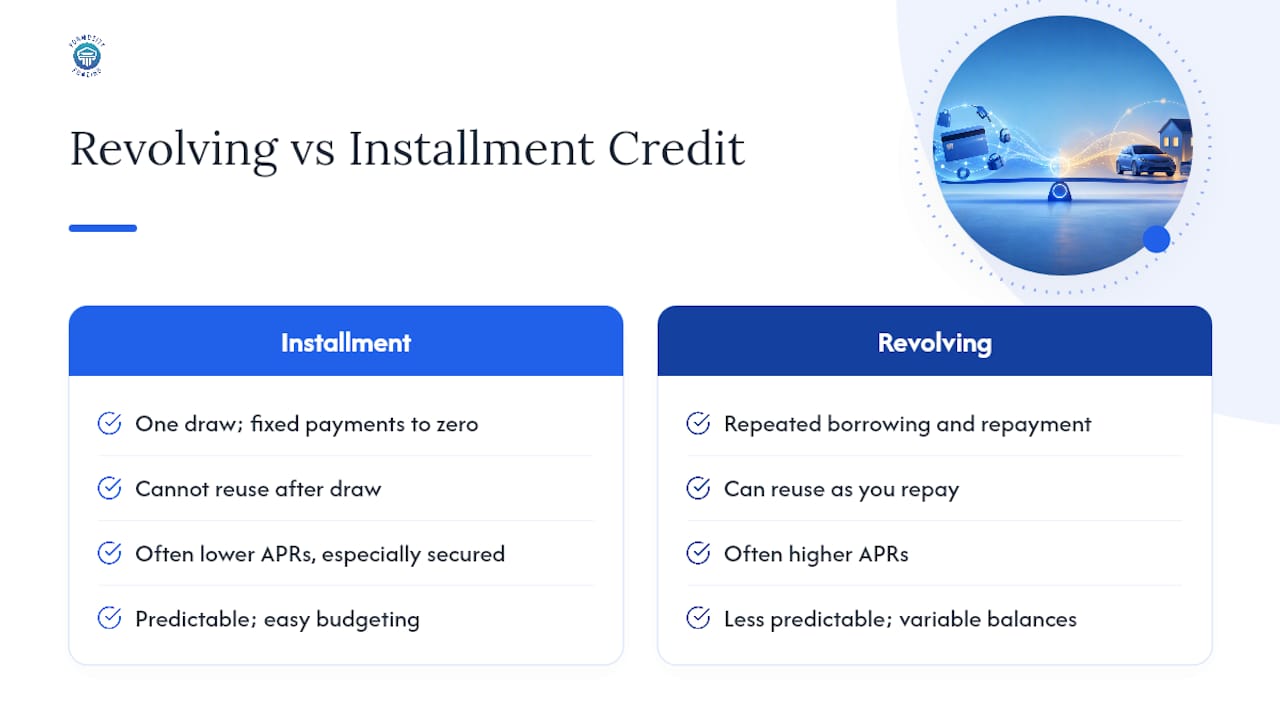
Most healthy credit profiles carry both. A car loan or mortgage paired with one or two well-managed credit cards demonstrates payment history, favorable utilization, and a solid credit mix all at once.
How Formosity Funding Matches Financing to Your Credit Needs
Business owners juggle both credit types constantly, and the right match matters as much for a company's credit profile as it does for a personal one. A business line of credit functions as revolving credit, giving you a reusable buffer for uneven cash flow. SBA loans and equipment financing behave like installment credit: a fixed amount, a set schedule, and a clear payoff date for a defined purchase like machinery or a real estate acquisition.
Formosityfunding's marketplace lets you pre-qualify without a credit impact and compare multiple real lender offers side by side, so you can weigh APRs and terms before committing to either type.
- Need ongoing working capital? A revolving line or business HELOC usually fits better than a lump-sum loan.
- Financing a specific, one-time purchase like equipment or property? An installment product with a fixed rate is typically the stronger match.
- Not sure which structure fits your situation? A dedicated funding specialist can walk through your options and connect you with the right lender.
An Editor's Take on Getting This Right
The mistake I see most often isn't picking the wrong credit type. It's treating utilization as an afterthought while obsessing over which loan has the lowest advertised rate. Payment history and utilization together account for roughly two-thirds of your score, so the boring stuff, paying on time and keeping balances low, does more work than any clever product choice.
I've seen businesses fix a cash-flow squeeze simply by rolling high-utilization card balances into a single fixed installment loan. Interest dropped, utilization dropped, and the monthly payment became predictable enough to actually budget around. Keep the math simple: pay on time, keep revolving balances low, and let installment credit handle the big, one-time bills.
— Alvin
Get Matched With the Right Financing Type
Formosityfunding is the alternative to guessing which lender fits your business: one marketplace, one pre-qualification, multiple real offers from a nationwide lender network, without touching your credit score to check.
If your business needs ongoing flexibility, a business line of credit or HELOC gives you a revolving cushion for payroll gaps and seasonal dips. If you're financing equipment, a buildout, or a real estate purchase, SBA loans and equipment financing offer the fixed-rate, fixed-schedule structure that installment credit is built for. A dedicated funding specialist reviews your situation and matches you to lenders suited to that specific need, rather than pushing one generic product. Businesses researching auto financing for a fleet purchase can also look at Clearwater Largo Automotive's financing guidance for consumer-side context on how installment auto loans work.
Start a free pre-qualification on Formosityfunding's services page to see real offers matched to your credit needs.
Sources
myCreditUnion.gov, myFICO, SmartAsset, FICO, and Experian cover the scoring mechanics referenced throughout this article.
- Mycreditunion
- Revolving vs. installment credit differences — myFICO
- Installment Loans vs. Revolving Credit — SmartAsset
- FAQs about FICO scores — FICO
FAQ
What Is the Difference Between Revolving and Installment Payments?
Revolving payments are flexible. You choose how much to pay above the minimum, and your available credit refills as you pay down the balance. Installment payments are fixed: the same amount, on the same schedule, until the loan is paid off and the account closes.
Is It Better to Pay Off Revolving Debt or Installment Debt First?
Prioritize whichever carries the higher interest rate, which is usually revolving credit card debt. Paying down high-utilization revolving balances first also tends to help your score faster, since amounts owed makes up roughly 30% of your score and revolving utilization drives most of that figure.
Is It Better to Have Revolving Credit?
Neither type is universally "better." Revolving credit offers flexibility and rewards but carries higher APR risk if you carry a balance. Installment credit offers predictability and often lower rates but less flexibility. A healthy credit profile typically includes both.
What Are the Disadvantages of Revolving Credit?
The main disadvantage is cost: interest accrues on any balance you carry, and rates on unsecured revolving credit tend to run higher than installment loan rates. High utilization can also drag down your score even if you never miss a payment.
Does Formosityfunding Offer Both Revolving and Installment Financing?
Yes. Formosityfunding's marketplace matches businesses with revolving products like business lines of credit and HELOCs, along with installment-style options like SBA loans and equipment financing, all through one pre-qualification that doesn't affect your credit.