

Most small business owners with straightforward credit and an existing bank relationship do better applying directly to a lender. Everyone else, especially those with complex deals, thin credit history, or no time to shop twenty lenders one by one, usually comes out ahead using a broker or marketplace. The right call hinges on how complicated your deal is, whether you already have a banker who knows your business, and how fast you need funds. Whichever path you choose, get the fee structure in writing before you sign anything.
TL;DR:
- Using a marketplace offers access to multiple lenders and product types with a single application, saving days in comparison to applying directly to each lender.
- Brokers and marketplaces usually get paid by lenders, which can influence recommendations; always ask for written fee disclosures before proceeding.
- Applying through a marketplace is recommended if your deal is complex, you lack existing lender relationships, or you need quick decisions for less-than-ideal credit profiles.
- Applying directly to a bank benefits borrowers with strong credit, no existing banking relationship, and standard loan requests, often resulting in better rates and faster funding.
- Preparing comprehensive documentation upfront and comparing net proceeds, not just rates, is crucial to avoid hidden costs and make informed borrowing decisions.
Table of Contents
- Business Loan Broker vs Lender: What Each One Actually Does
- How Do Brokers and Marketplaces Get Paid?
- When Should You Use a Broker or Marketplace?
- When Is a Direct Lender or Bank the Better Bet?
- What to Expect From Application to Funding
- How Do You Vet a Broker or Marketplace Before Committing?
- How to Decide Between a Broker and a Direct Lender in 5 Steps
- Where Formosity Funding Fits Into This Decision
- What Borrowers Get Wrong Most Often
- Ready to Compare Real Offers? Here's Where to Start
- Where to Verify the Details in This Guide
- Sources
Business Loan Broker vs Lender: What Each One Actually Does
A broker or marketplace is a matchmaker. You fill out one application, and that application gets shopped to a roster of lending partners who each decide independently whether to make an offer. A direct lender skips the middle step entirely: you apply to one institution, its underwriters review your file, and you either get a single offer or a decline.
That structural difference changes everything downstream. When you work with a business lending marketplace, you're trading a bit of pricing certainty for the ability to compare offers side by side without submitting five separate applications. A direct lender gives you one shot, but that shot often comes with more predictable underwriting standards because you're dealing with a single set of credit boxes.
Here's how the mechanics typically break down:
- Broker/marketplace: submits your profile to multiple lenders, returns several prequalified offers, and lets you compare terms before committing to one.
- Direct lender: underwrites and funds the loan itself, using its own criteria, with no third party in the pipeline.
- Network size: marketplaces often maintain dozens of lending partners spanning banks, online lenders, and specialty finance companies, while a direct lender only offers its own products.
- Product breadth: a marketplace can surface working capital, SBA loans, equipment financing, and lines of credit in one search; a direct lender's menu is limited to what that institution underwrites.
The tradeoff is speed of comparison versus depth of relationship. A marketplace widens your options fast. A direct lender, particularly one where you already bank, can move quickly precisely because there's no matching step to run through.
How Do Brokers and Marketplaces Get Paid?
Most business loan brokers get paid by the lender, not the borrower. That's the ideal setup, and it's how the majority of legitimate arrangements work, but broker compensation varies by product and lender, and some brokers do charge borrowers a separate success fee on top of the lender's commission.
Commission patterns aren't uniform. A broker placing a merchant cash advance might earn a percentage of the funded amount, while one placing an SBA loan could work under a flat referral fee capped by SBA rules. Industry breakdowns of broker pay show that marketplace platforms sometimes take a cut of the broker's commission too, which affects how aggressively a broker pushes one lender over another.
A few things worth knowing before you sign anything:
- Commissions can range from a small flat fee to several percentage points of the loan amount, depending on the product.
- Payout timing varies. Some brokers get paid at funding; others get paid in installments tied to your repayment.
- Clawback clauses exist. If you pay off or refinance a loan early, the lender may pull the commission back from the broker, which can create pressure to steer you toward loans with prepayment penalties.
Pro Tip: Ask every broker to put their compensation structure in writing before you apply, including whether they earn more from certain lenders. If they hesitate or get vague, that's your answer.
If you're pursuing an SBA-backed loan specifically, know that agent compensation on those deals is subject to formal disclosure rules that limit contingency arrangements. Ask any broker handling an SBA application to walk you through exactly what they're required to disclose on the SBA's own compensation form.
When Should You Use a Broker or Marketplace?
Certain borrower profiles and deal types consistently benefit more from going through an intermediary than applying cold to individual lenders.
- You have a complex or specialty deal. Commercial real estate transactions involving unusual property types, multiple stakeholders, or nonstandard structures often move faster and cheaper through a broker who knows which lenders actually want that kind of risk. Scenario comparisons on CRE financing show brokers can save real money on these deals precisely because they know which of dozens of lenders will compete for a specific asset class.
- You don't have existing lender relationships. If you've never borrowed commercially before, a marketplace hands you instant access to a network you'd otherwise spend weeks building from scratch.
- You're a startup or have a bruised credit profile. Marketplaces often partner with online lenders willing to work with borrowers a traditional bank would decline outright. Some partner lenders accept scores as low as roughly 500, and one referenced study found borrowers with scores of 659 or below made up 20% of approved applications through marketplace channels.
- You need to compare product types, not just rates. A single application through a marketplace can surface a line of credit, equipment financing, and a term loan simultaneously, letting you weigh structure, not just price.
- Speed and convenience matter more than shaving the last quarter point off your rate. Prequalification through a marketplace usually takes minutes, not days, which matters if you're facing a cash crunch now.
When Is a Direct Lender or Bank the Better Bet?
Strong credit and an existing relationship flip the math. If you've banked with the same institution for years and your financials are clean, applying direct often gets you a better rate than routing through a broker, simply because there's no commission built into the pricing.
Vanilla deals are the other case where direct wins. A standard refinance, a straightforward term loan on a large, well-documented balance sheet, or a big-ticket loan where several banks are actively competing for your business, these are situations where banks and direct lenders will often undercut a broker-arranged offer just to win the relationship.
Watch for these signals that direct is your move:
- Your business has two or more years of clean financials and a credit score comfortably above the low 700s.
- You already have a banking relationship with someone who knows your file.
- The loan is a standard product (term loan, business line of credit) rather than a specialty structure.
- You want to avoid exclusivity clauses that some brokers require, which can lock you out of shopping elsewhere for weeks while they work your file.
Going direct also sidesteps a layer of fees entirely. There's no commission built into your rate and no risk of a broker prioritizing a lender that pays them better over one that's actually cheaper for you.
What to Expect From Application to Funding
The mechanics of applying to differ enough between the two paths that your timeline expectations should differ too.
With a marketplace, you fill out one application and receive multiple prequalified offers, often within a day or two, based on a soft inquiry that doesn't touch your credit score. From there, whichever lender you choose still runs its own underwriting before final approval, so the marketplace step doesn't eliminate underwriting. It just eliminates redundant applications.
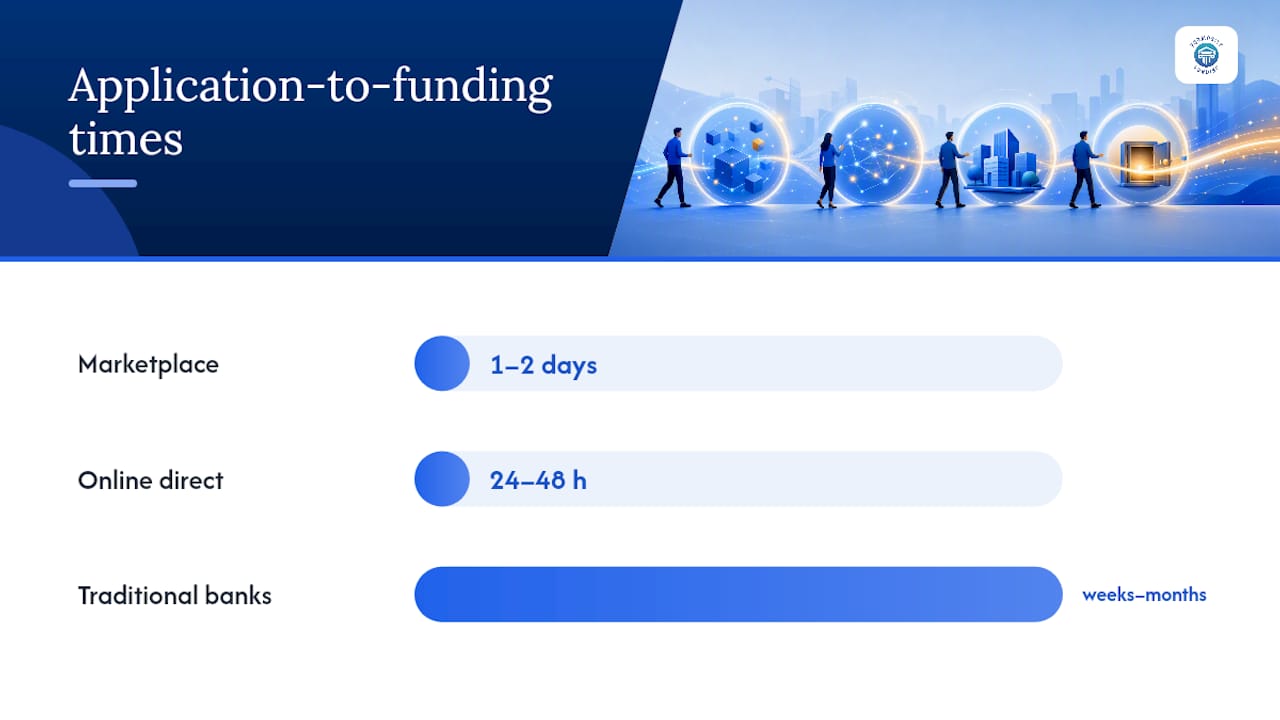
With a direct lender, you're in a single underwriting pipeline from day one. Online direct lenders can sometimes fund within 24 to 48 hours for smaller amounts. Traditional banks, especially for SBA-backed products, routinely take several weeks to a few months given the additional documentation and government-mandated review steps.
Documentation is where you can meaningfully speed things up regardless of path:
- Two to three years of business and personal tax returns.
- Three to six months of business bank statements.
- A current profit and loss statement and balance sheet.
- Collateral paperwork if you're pursuing equipment financing or a CRE loan.
Having these ready before you apply, whether through a marketplace or a direct lender, routinely shaves days off the process. Missing documentation is one of the most common reasons applications stall, and it's worth reviewing common loan denial triggers before you submit anything.
How Do You Vet a Broker or Marketplace Before Committing?
Certain warning signs should end a conversation immediately, no matter how good the pitch sounds.
- Upfront "processing" fees with no clear service attached. Legitimate brokers get paid at funding, not before you've even applied.
- Pressure to sign an exclusivity agreement fast. Reputable brokers explain their terms and let you take time to review them.
- Guarantees of approval. No legitimate broker or lender can promise approval before underwriting.
Beyond the red flags, run every intermediary through a short checklist: get a written fee disclosure, ask for a list of the lender partners they actually work with, confirm clawback terms in writing, check third-party reviews or Better Business Bureau ratings, and look them up on NMLS Consumer Access if the deal involves a mortgage-adjacent product requiring licensing.
Pro Tip: Never compare offers on headline APR alone. Calculate net proceeds, the amount you actually walk away with after every fee and commission, because two loans with identical rates can leave wildly different amounts in your account.
Transparency is the real test here. Brokers who disclose compensation clearly and name their lender partners without hesitation are the ones worth working with.
How to Decide Between a Broker and a Direct Lender in 5 Steps
- Define your priority. Decide upfront whether speed, lowest cost, certainty of approval, or product variety matters most for this specific loan.
- Check your existing lender relationships. If you already bank somewhere with strong standing, get a quote there before you do anything else.
- Standardize your questions. Ask every broker or lender the same set: How are you compensated? Which lenders do you work with? What's your typical timeline? Are there clawback terms?
- Compare net proceeds, not headline rates. Line up total fees, commissions, and the actual amount funded across every offer before deciding.
- When in doubt, run both paths at once. Apply directly to one bank while submitting through a marketplace in parallel, then compare real offers instead of guessing which route wins.
A simple scorecard helps here. Rate each option on speed, total cost, certainty of approval, and how well it fits the product you actually need, then weight those four factors by what matters most for this particular loan:
- Speed: how fast can you realistically get funded?
- Cost: what's the true net cost after every fee?
- Certainty: how likely is this path to actually result in approval?
- Fit: does this route offer the specific product structure your situation calls for?
Whichever scores highest for your specific deal is the path worth pursuing first, but nothing stops you from running two paths simultaneously if the clock isn't the deciding factor.
Where Formosity Funding Fits Into This Decision
This service works as a marketplace, matching your application against a network of lending partners rather than underwriting loans itself. That structure shortens the search phase significantly: instead of contacting lenders one by one, you complete a single prequalification and see what's actually available across working capital, business lines of credit, SBA loans, equipment financing, and commercial real estate loans.
Prequalification typically runs without a hard credit inquiry, so checking your options may not impact your credit file. From there, you can see multiple real offers rather than a single take it or leave it proposal, and a funding specialist often assists you in comparing them. That's the practical value of the marketplace model: it front loads the comparison shopping that would otherwise eat days or weeks of your time.
What Borrowers Get Wrong Most Often
The biggest mistake I see is fixating on the advertised rate and ignoring net proceeds. A loan with a lower headline number can still cost more once you factor in origination fees, broker commissions, and prepayment penalties buried in the fine print.
The second mistake is signing exclusivity agreements too early, before comparing anything. And the third is trusting anyone who guarantees approval before underwriting even starts. My advice: prep your documentation early, run a bank application and a marketplace search in parallel when you're unsure, and read every fee disclosure line before you sign. Combining approaches costs you nothing but a little time, and it consistently produces better outcomes than committing to one path on faith.
— Alvin
Ready to Compare Real Offers? Here's Where to Start
If you've read this far, you already know the fastest way to see whether a broker route beats going direct is to actually compare offers side by side, not guess. One marketplace application gives you access to a network of lenders across working capital, lines of credit, SBA loans, equipment financing, and commercial real estate financing, without the weeks of cold outreach to individual banks.
Prequalification typically runs on a soft credit check, so you can see what's realistically available before it affects your credit score. From there, a funding specialist may help you review the offers that come back and weigh them against what a direct lender might be offering. If preparation is holding you back, review what most lenders ask for so you're not scrambling once offers start coming in. When you're ready to see actual numbers instead of estimates, start prequalification through Formosity Funding's business funding options and compare what a real network of lenders is willing to offer your business today.
Where to Verify the Details in This Guide
For deeper reading on how marketplaces compare with direct lenders, NerdWallet's breakdowns of lending marketplaces and loan brokers cover the mechanics in detail, while FitSmallBusiness and Levr add industry context on compensation. Verify any broker's licensing directly through NMLS Consumer Access.