
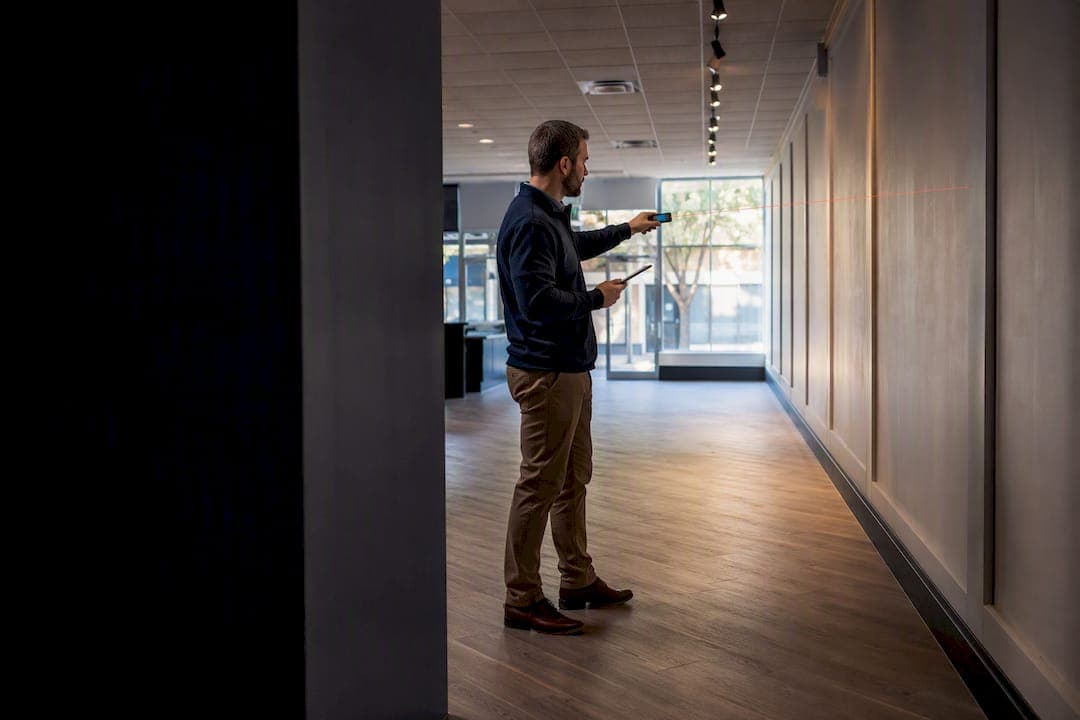
A commercial appraisal cost varies widely depending on property complexity and scope, typically spanning from a few thousand dollars to over twenty thousand. The biggest swing factor is property complexity, followed closely by report scope and how fast you need it done. Before you commit to a quote, get the intended use and turnaround time in writing from both the lender and the appraiser.
TL;DR:
- Appraisal fees for commercial properties typically range from $2,500 to over $25,000 depending on complexity, scope, and location, with high-end projects like hotels costing the most.
- The main factors influencing cost include property type, lease complexity, report format, data availability, inspection requirements, intended use, and appraiser credentials, especially for complex assets.
- Rush services that deliver in one to two weeks usually add 20% to 30% to the initial fee, with premiums reaching 50% for super-rush requests under a week.
- In most cases, the borrower pays the appraisal fee upfront for federally related loans, regardless of the report's depth or complexity, and should specify report type to avoid unnecessary costs.
- The lowest quote may compromise quality or compliance; a high-quality, USPAP-compliant report ensures a defendable valuation even if it costs more.
Table of Contents
- How Much Does a Commercial Property Appraisal Cost by Complexity?
- What Factors Affect Commercial Appraiser Rates?
- How Long Does a Commercial Appraisal Take, and What Does Rush Service Cost?
- Who Pays for a Commercial Appraisal, and Who Orders It?
- How Can You Reduce or Speed Up Your Appraisal Cost?
- Real-World Appraisal Cost Scenarios
- Why the Cheapest Quote Is Often the Riskiest One
- Financing the Deal While the Appraisal Runs Its Course
- Sources
- FAQ
How Much Does a Commercial Property Appraisal Cost by Complexity?
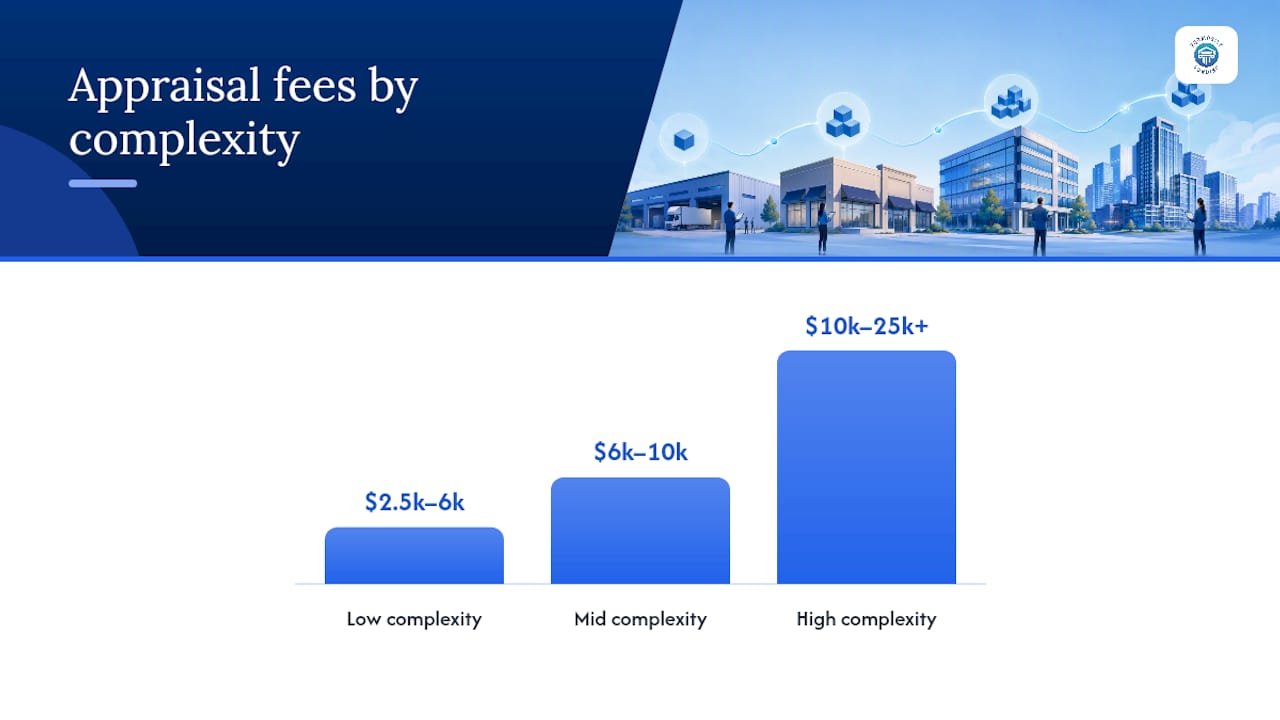
Price scales with how much analysis the property demands, not just its size. A small retail strip and a hotel might sit on similar acreage, but the hotel requires income modeling, market segmentation research, and often a specialized appraiser willing to travel.
Here's roughly how the market breaks down:
| Complexity level | Property examples | Typical fee range | Common timeline |
|---|---|---|---|
| Low complexity | Single-tenant retail, small office, simple land parcels | $2,500–$6,000 | 2–3 weeks |
| Mid-complexity | Small multifamily (10–50 units), mid-size retail centers, light industrial | $6,000–$10,000 | 3–4 weeks |
| High complexity | Hotels, development sites, large mixed-use, litigation work | $10,000–$25,000+ | 4–8+ weeks |
Notice the overlap between bands. A 12-unit apartment building in a thin rural market can cost more to appraise than a 40-unit building in a data-rich metro, simply because comparable sales are harder to find. Urban markets with high land values, such as coastal California or Manhattan, also tend to push fees toward the top of each band, partly because appraiser labor costs more there and partly because properties themselves carry more layered zoning and income considerations.
Special-purpose assets, think self-storage facilities, marinas, or golf courses, often get quoted separately from these bands entirely, since so few appraisers specialize in them.
What Factors Affect Commercial Appraiser Rates?
Fees are built line by line, not pulled from a flat schedule. A few line items explain most of the variation you'll see between quotes:
- Lease complexity: A property with 20 tenants on staggered, nonmarket leases requires far more abstraction work than a single-tenant net lease.
- Report format: A full narrative report with three valuation approaches (sales comparison, income, cost) costs more than a restricted-use report built for internal purposes only.
- Data availability: Thin comparable sales data for a niche asset type forces the appraiser to dig through broader market records or call brokers directly.
- Inspection and travel: Rural or multi-building properties add hours the appraiser has to bill somewhere.
- Intended use: A report headed for a loan committee, tax appeal board, or courtroom needs a defensibility standard that a routine refinance doesn't.
- Credentials: Appraisers holding the MAI designation, the industry's top credential for complex commercial work, typically charge more because lenders and courts weight their opinions more heavily.
Pro Tip: Ask upfront whether your assignment needs a full narrative report or a restricted one. Lenders sometimes accept the cheaper option for straightforward refinances, and nobody will volunteer that information unless you ask.
How Long Does a Commercial Appraisal Take, and What Does Rush Service Cost?
Standard lender-ready appraisals typically take 2 to 4 weeks from order to delivery. Complex assets, hotels, large portfolios, or anything requiring litigation-grade support, can stretch to 6 weeks or longer.
Need it faster? Expect to pay for it.
- Rush turnaround (roughly 1 to 2 weeks) commonly adds 20% to 30% to the base fee.
- Super-rush requests (under a week) can push the premium as high as 50%, depending on the appraiser's existing workload.
- Local appraiser supply matters too. Markets with few qualified commercial appraisers, especially for niche property types, see longer waits and steeper rush premiums regardless of how simple the assignment looks on paper.
If your closing date is flexible, ordering the appraisal the moment you sign a purchase agreement, rather than waiting for other underwriting steps, usually avoids rush fees entirely.
Who Pays for a Commercial Appraisal, and Who Orders It?
In federally related lending transactions, the lender orders the appraisal, not the borrower, and not the seller's agent. This isn't a courtesy. It's a regulatory requirement designed to protect appraiser independence, so the person paying for the loan doesn't get to hand-pick who values the collateral.
The borrower almost always pays the fee, usually collected upfront as a deposit before the appraiser even schedules an inspection, then rolled into total closing costs. Federal guidance also warns lenders against choosing appraisers based on lowest cost or fastest turnaround alone, since that undercuts the scope and competency a complex asset actually needs.
One more rule worth knowing: USPAP prohibits contingent fees tied to a property's final value. Any appraiser quoting a percentage-based fee instead of a flat scope-based one is violating professional ethics, full stop. If you're wondering whether the fee is deductible or capitalizable, appraisal costs tied to loan origination are generally treated as financing costs rather than added to the property's basis, though a tax professional should confirm how that applies to your specific deal.
How Can You Reduce or Speed Up Your Appraisal Cost?
You have more control over the final invoice than most borrowers realize.
- Hand over complete documentation at engagement. Leases, rent rolls, and three years of operating statements let the appraiser work efficiently instead of chasing you for follow-ups, which often adds days and sometimes a change-order fee.
- Lock down scope with the lender first. Confirm whether the loan committee needs a full narrative report or will accept something lighter before the appraiser starts.
- Ask about update options. If you had a recent appraisal on the same property, an update rather than a fresh valuation can save thousands.
- Bundle multiple properties. Investors valuing several similar assets, say four retail pads in one portfolio, can often negotiate a per-property discount versus ordering separately.
Pro Tip: Site plans, surveys, and environmental reports sitting in a folder you forgot about are exactly what shaves days off delivery. Send everything, even documents you think are irrelevant.
Real-World Appraisal Cost Scenarios
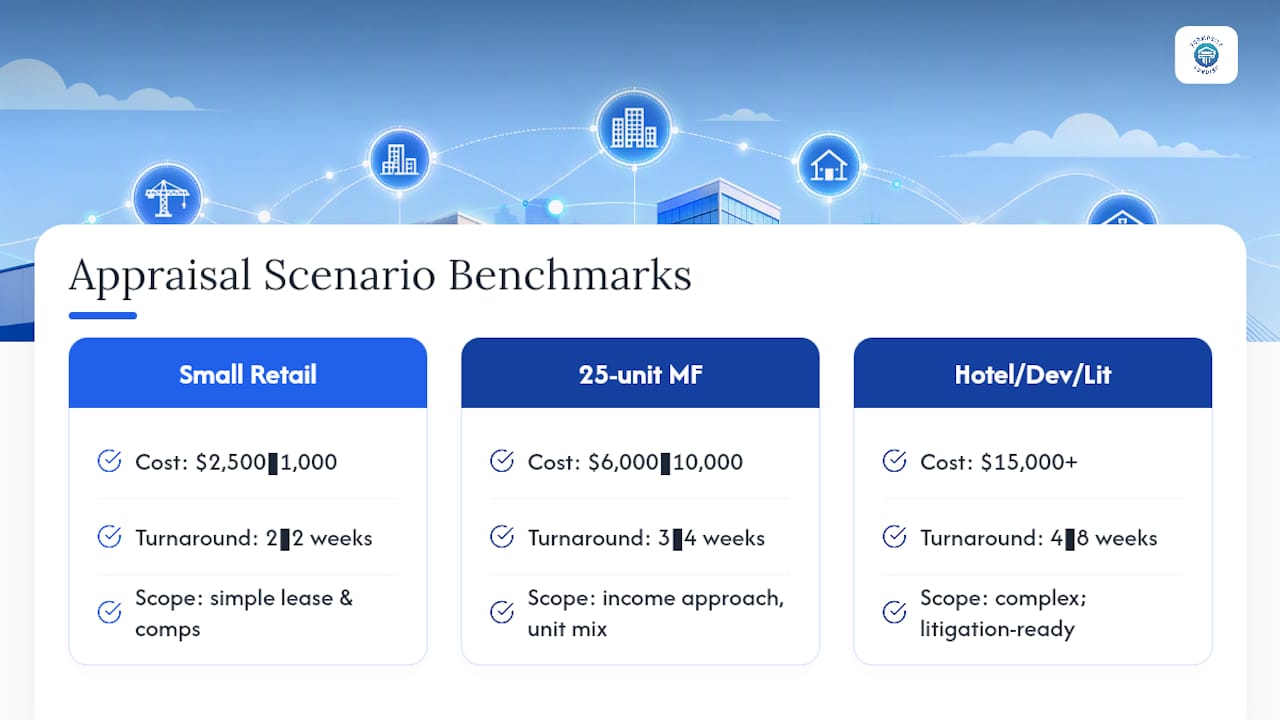
Scenario A: Small single-tenant retail refinance. A 3,000 square foot retail building with one long-term tenant typically lands between $2,500 and $6,000, delivered in 2 to 3 weeks. Simple lease, simple comps, simple report.
Scenario B: 25-unit multifamily purchase. Buying an apartment complex triggers income-approach analysis, unit mix review, and market rent comparisons. Expect $6,000 to $10,000 and a 3 to 4 week timeline.
Scenario C: Hotel, development site, or litigation assignment. These run $15,000 and up, often taking 4 to 8 weeks. Litigation work in particular demands workpapers detailed enough to survive cross-examination, which is exactly why it costs more than a routine lending appraisal.
Why the Cheapest Quote Is Often the Riskiest One
The instinct to shop for the lowest appraisal fee makes sense until you remember what's actually at stake: a loan decision, a purchase price, sometimes a legal outcome. A defensible, USPAP-compliant report earns its fee back the first time a lender's review committee questions a number.
Watch for a few warning signs. Any quote tied to a percentage of expected value is a violation of professional ethics, not a bargain. An unusually low bid for a complex asset, say a hotel appraisal quoted at half the going rate, usually means a rushed inspection or a thin comp set. And vague answers about report format or intended use almost always turn into expensive change orders later.
— Alvin
Financing the Deal While the Appraisal Runs Its Course
The platform understands that appraisal timelines and closing deadlines rarely align. Instead of leaving a deal stalled while you wait weeks for a report, it connects you with lenders across a nationwide network so you can pre-qualify for financing without impacting your credit score.
Whether you need working capital to cover the appraisal deposit and other due diligence costs, or you're structuring commercial real estate financing for the purchase itself, Formosityfunding's platform matches you with real loan offers instead of a single take-it-or-leave-it quote. A Business HELOC can also free up cash tied to existing property while you wait on the new valuation. Start your pre-qualification on the Formosityfunding site and get matched with lenders while the appraisal clock runs, not after.
This article is general information, not a substitute for advice from a qualified financial advisor. Consult a qualified financial professional about your own circumstances before acting on anything here.
Sources
- Frequently asked questions on the appraisal regulations and the interagency appraisal and evaluation guidelines — Board of Governors of the Federal Reserve System
- Interagency Appraisal and Evaluation Guidelines — OCC (excerpts)
- How Much Do Commercial Appraisals Cost? — Block Appraisals
FAQ
How much does a commercial real estate appraisal cost?
Most commercial appraisals cost between $2,500 and $25,000, with simple properties like small retail or office buildings on the low end and hotels or litigation assignments on the high end.
Who pays for the appraisal on a commercial property?
The lender orders the appraisal, but the borrower typically pays the fee upfront as part of closing costs in a standard commercial loan transaction.
Are commercial appraisers in high demand right now?
Demand for qualified commercial appraisers, especially those holding the MAI designation, remains strong in many markets, which is part of why niche or rural assignments can take longer and cost more.
How can I estimate the value of a commercial property myself?
You can get a rough sense using income capitalization (net operating income divided by a market cap rate) or by comparing recent sales of similar properties, but a formal valuation still requires a licensed appraiser for lending or legal purposes.
Does Formosityfunding offer commercial appraisal services?
No, Formosityfunding doesn't provide appraisals directly. It connects borrowers with lenders and financing options, including working capital and commercial real estate loans, that can help cover appraisal and closing costs while a deal moves forward.