

Consolidation helps when it swaps stacked merchant cash advances for real, lower-cost financing that actually shrinks total payback. It hurts when it's a reverse consolidation, a bigger MCA that pays off a slice of your old advances while stacking a new daily debit on top. Before you sign anything, pull your current MCA payoff quotes, your daily or weekly remittance totals, and run the math test covered below.
TL;DR:
- True consolidation replaces MCA debt with lower-cost financing like SBA loans or bank credit, usually reducing total payback and releasing UCC liens.
- Reverse consolidation often increases overall costs by stacking new advances on top of old MCAs and maintaining daily ACH debits, sometimes leading to higher total payback.
- Lenders for genuine consolidation typically require at least two years of business, a credit score above 650, and sufficient cash flow, with larger loans needing collateral or guarantees.
- Always compare total payback over the full term and ensure your new payments leave a manageable cash flow margin, especially when evaluating offers with lower daily debits.
- Beware of offers that lack clear total payback figures, refuse to release UCC filings, or set up ACH debits before old advances are fully paid, as they often worsen your financial position.
Table of Contents
- What Is MCA Consolidation, and How Does It Differ From Reverse Consolidation?
- What Are Your Real Consolidation Options in the US?
- How Do You Evaluate a Consolidation Offer?
- Who Actually Qualifies for True Consolidation?
- How Do You Apply for MCA Consolidation Step by Step?
- What Are the Warning Signs of a Bad Consolidation Deal?
- Formosity Funding's Take on Consolidation Offers
- Ready to Compare Real Consolidation Offers?
- Where to Verify This Guidance
- Sources
- FAQ
What Is MCA Consolidation, and How Does It Differ From Reverse Consolidation?
A merchant cash advance isn't technically a loan. A funder buys a slice of your future card or bank receipts at a factor rate, usually 1.2 to 1.5, meaning you repay $1.20 to $1.50 for every dollar advanced. Converting that into an annual percentage rate, a six-month advance at a 1.4 factor rate often lands between 60% and 100% APR, sometimes higher once you account for daily withdrawals compounding the effective cost.
True consolidation replaces that debt with lower-cost, underwritten financing, an SBA loan, bank term loan, or line of credit. You get one payment, a released UCC lien, and a new creditor relationship built on actual underwriting rather than daily receivables.
Reverse consolidation is different math wearing the same name. A funder issues a larger MCA, pays off a few of your existing advances directly, and hooks up a new daily ACH debit. Reverse consolidation typically layers a new MCA-like debt and often increases total payback rather than replacing it with something cheaper.
- True consolidation: new lender, lower rate, UCC released, fewer daily debits.
- Reverse consolidation: same lender type, bigger balance, new UCC filing, another daily debit stacked on the old ones.
A $50,000 reverse consolidation MCA at a 1.35 factor rate costs $17,500 in fees alone, often repaid in under a year. Same headline amount, wildly different burden.
What Are Your Real Consolidation Options in the US?
Not every business qualifies for every path, and picking the wrong one wastes weeks you don't have.
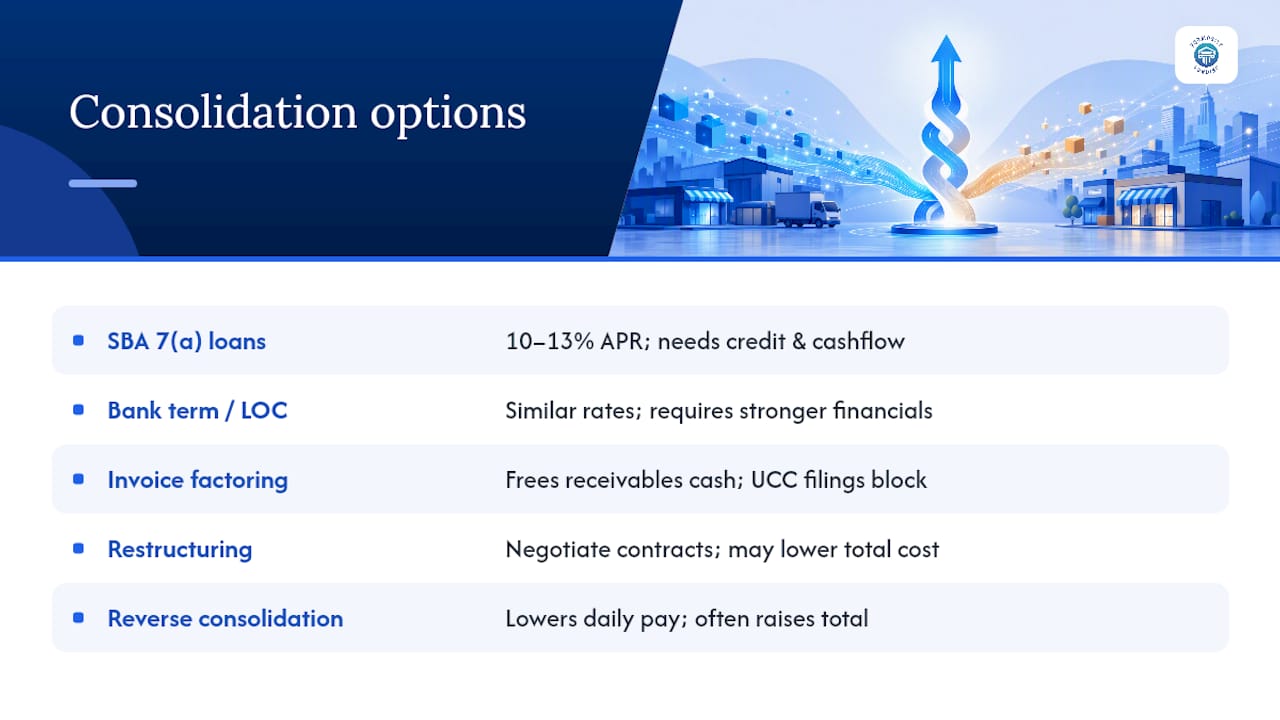
SBA 7(a) loans can refinance MCA debt when the deal produces a clear economic benefit to the borrower. Rates on SBA-backed financing commonly run in the low double digits in early 2026, often 10% to 13% effective APR for many borrowers, a fraction of typical MCA costs. The catch: SBA underwriting wants time in business, decent credit, and cash flow that supports the new payment, not just the old one.
Bank term loans and business lines of credit offer similar rate advantages but usually demand stronger financials than SBA programs and faster.
Invoice factoring can free up cash tied in receivables, but only if those receivables are unencumbered. Existing UCC filings from your MCA funders often block factoring outright, since the factor can't get a clean first position on the same receivables.
Restructuring or settlement means negotiating each MCA contract individually rather than refinancing the whole stack. This route skips new debt entirely and can beat reverse consolidation on total cost in many stacked-MCA situations, according to industry analysis on MCA relief options.
Reverse consolidation lowers your daily payment amount but frequently raises what you pay back overall, because the new advance still carries a factor rate instead of an amortizing interest rate.
Pro Tip: Ask any consolidator for the exact new total payback figure in dollars, not just the new daily payment. A smaller daily debit can hide a bigger bill.
How Do You Evaluate a Consolidation Offer?
Two math tests separate a genuine fix from a repackaged problem. Skip either one and you're guessing.
Test 1: Total payback comparison. Add up what you still owe across every existing MCA, using current payoff quotes, not original advance amounts. Compare that combined number to the total payback of the proposed new financing, principal plus interest or fees, over its full term.
Test 2: Daily or weekly holdback comparison. Add your current combined remittances across all MCAs. Compare that to the new proposed payment. The new payment should leave a real cash-flow margin. A common guideline is keeping any daily debit under a moderate percentage of average daily gross sales.
Here's a worked example. A restaurant owes $30,000 to one MCA funder and $25,000 to another, with combined daily remittances of $650. Total remaining payback: $61,000.
The bank loan wins both tests. The reverse consolidation feels better day to day but costs $13,000 more over the term.
Before accepting anything, request:
- Written payoff letters from every current MCA funder, dated within a few days of your decision.
- A UCC release plan showing exactly when and how existing liens get terminated.
- The new instrument's factor rate or APR, all fees, and the true total payback figure in writing.
Who Actually Qualifies for True Consolidation?
Lenders offering true consolidation, SBA loans and bank term loans especially, look for consistent signals: usually two or more years in business, a personal credit score generally above 650, and debt service coverage that shows your cash flow can absorb the new payment after covering existing obligations. Loans above roughly $50,000 often require collateral or a personal guarantee.
The biggest barrier isn't willingness, it's underwriting fit. Many businesses carrying multiple MCAs can't qualify for conventional refinancing because stacked daily debits and thin bank balances read as risk to a bank underwriter, even when the underlying business is healthy.
- Existing UCC filings and missed MCA payments shrink your options fast.
- Clean, recent bank statements matter more than a perfect credit score.
- Two years of tax returns and proof of sustained revenue speed up any application.
- If your numbers don't support new debt at all, restructuring or settling existing contracts is often more realistic than chasing a refinance you won't get approved for.
How Do You Apply for MCA Consolidation Step by Step?
Assemble your documents first. You'll need MCA contracts and payoff amounts, current UCC filings, three to six months of bank statements, two years of tax returns, and recent merchant processing statements if card volume matters to your revenue.
- Prequalify with prospective lenders where possible without a hard credit pull.
- Request formal payoff letters from every existing MCA funder, not verbal estimates.
- Run both math tests from the section above on every offer you receive.
- Ask each proposed lender directly: will this fully pay off my existing balances, and will UCCs actually be released?
- Compare final terms side by side before signing anything.
Timelines vary by path. Contract restructuring or settlement can resolve in days to a couple of weeks. Bank term loans typically take a few weeks. SBA loans commonly run four to eight weeks, sometimes longer depending on documentation. Reverse consolidation offers can close in days, which is exactly why they get pitched so aggressively.
What Are the Warning Signs of a Bad Consolidation Deal?
Some offers are designed to look like relief while quietly making things worse. Watch for these patterns before you sign.
- Vague or shifting answers about your exact new total payback amount.
- Refusal to commit in writing to releasing your existing UCC filings.
- A new ACH debit getting set up before your old advances are actually paid off in full.
- Factor rates that exceed what you're currently paying, dressed up as a "lower daily payment."
- Upfront fees deducted from the payoff proceeds before your old funders even get paid.
Before signing with any new funder, check their registration through NMLS Consumer Access and review their Better Business Bureau history. The FTC's consumer guidance on credit and loans walks through your rights and how to file a complaint if a lender misrepresents terms. When a deal feels rushed or the numbers won't hold still, pause and get a second opinion from an accountant or a vetted funding advisor before committing.
Formosity Funding's Take on Consolidation Offers
Formosity Funding operates as a marketplace, matching business owners with a nationwide network of lenders rather than pushing one product. That structure matters here: instead of one funder trying to sell you their own reverse consolidation, you can compare multiple funding options side by side and see how an SBA loan, term loan, or line of credit actually stacks up against staying put.
Prequalification runs without a hard credit pull, so checking your options doesn't cost you anything if the numbers don't work. Our guide to matching payment structures to revenue flow is worth reading before any consolidation conversation.
— Alvin
Ready to Compare Real Consolidation Offers?
A financial services marketplace connects business owners with a nationwide network of lenders offering working capital, SBA loans, business lines of credit, and term loans, the kind of true consolidation options that can actually lower your total payback instead of just rearranging it.
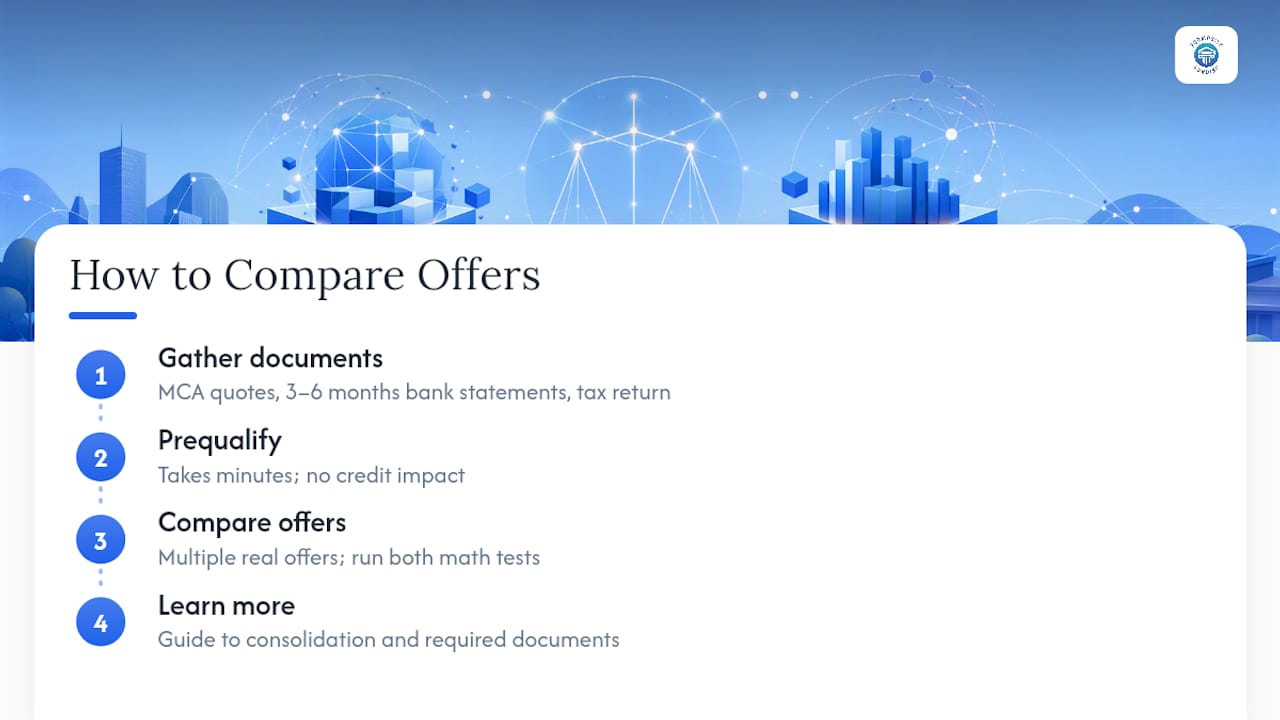
Before you start, gather your current MCA payoff quotes, three to six months of bank statements, and your most recent tax return. Prequalification takes minutes, runs without impacting your credit, and gives you multiple real offers to run through both math tests from this guide. If you want a deeper walkthrough first, our practical guide to business debt consolidation covers the trade-offs in more detail, and our breakdown of which documents lenders actually weigh helps you prepare before you apply.
Start a no-impact prequalification with Formosity Funding to see what a true consolidation offer looks like for your specific numbers.
Where to Verify This Guidance
For details straight from the source, these are worth bookmarking:
- SBA loan program pages for eligibility rules and refinancing guidance.
- FTC consumer credit and loan resources for borrower protections and complaint filing.
- The MCA Guide's consolidation breakdown for a deeper look at true versus reverse consolidation mechanics.
This article is general information, not a substitute for advice from a qualified financial advisor. Consult a qualified financial professional about your own circumstances before acting on anything here.
Sources
- MCA Debt Consolidation guide — The MCA Guide
- Should you consolidate your MCAs? A real-world look — Business Debt Insider
- Loans — U.S. Small Business Administration
- Credit and loans — FTC
FAQ
What Are the Best Merchant Cash Advance Companies in the USA?
There's no single "best" MCA company, since terms vary widely by industry, revenue, and time in business. A better approach is comparing multiple real offers through a marketplace like Formosity Funding rather than relying on one funder's pitch.
What Happens If You Can't Pay Back a Merchant Cash Advance?
Missing daily remittances typically triggers default clauses, additional fees, and sometimes a lawsuit tied to the personal guarantee most MCA contracts require. Contacting the funder early to negotiate a modified schedule usually produces better outcomes than missing payments silently.
How Are Merchant Cash Advances Treated in Accounting?
MCAs are generally recorded as a liability and the discount on receivables sold, not as a traditional loan with interest, since legally they're a sale of future receivables. A bookkeeper or CPA should classify the payback schedule correctly to avoid distorting your cash flow statements.
Is MCA Debt Consolidation Legit?
True consolidation, replacing MCA debt with an SBA loan, bank term loan, or line of credit, is a legitimate and common path. Reverse consolidation is legal but frequently increases your total payback, so running the total-payback and daily-payment tests before signing is what separates a real fix from a repackaged problem.