

A merchant cash advance makes sense when you need cash within a day or two and your credit card sales can absorb a steep daily payment; a traditional loan makes sense whenever you can wait two to eight weeks and want to know your exact interest cost. MCAs cost far more and carry legal ambiguity that traditional loans don't. For regulatory grounding, the SBA's loan programs and CFPB guidance are the two places to check before you sign anything.
TL;DR:
- Merchant cash advances are typically far more expensive than traditional loans, often carrying an effective APR between 40% and 350%, depending on repayment speed.
- MCAs approve quickly, often within a day, with minimal qualification requirements, but frequently impose fixed daily debits that can strain cash flow during slow months.
- Conventional business loans generally take longer to fund, but they offer lower interest rates, fixed payments, and longer repayment terms suited for capital investments.
- Refinancing an MCA into a lower-cost term loan is often the smartest move once revenue stabilizes, especially with options like SBA-backed loans that offer better interest rates.
- Before signing, owners should carefully review reconciliation clauses, repayment triggers, and recourse provisions, as these legal details significantly impact long-term costs and risks.
Table of Contents
- MCA vs. Loan: What a Merchant Cash Advance Actually Is
- MCA vs. Loan: How a Traditional Business Loan Works
- Comparing MCA vs. Loan Side by Side
- The Real Tradeoffs of a Merchant Cash Advance
- The Real Tradeoffs of a Traditional Loan
- When an MCA Makes Sense, and When a Loan Wins
- How to Compare MCA and Loan Offers Before You Sign
- Where Formosity Funding Fits Into This Decision
- An Editorial Take on Choosing Between MCA and Loan
- Get Multiple Funding Offers Without the Guesswork
- Sources
MCA vs. Loan: What a Merchant Cash Advance Actually Is
A merchant cash advance isn't a loan at all. It's a purchase of your future receivables, structured so a funder gives you a lump sum today in exchange for a slice of your daily card sales or bank deposits going forward. That legal distinction matters more than most owners realize, and it comes up again later.
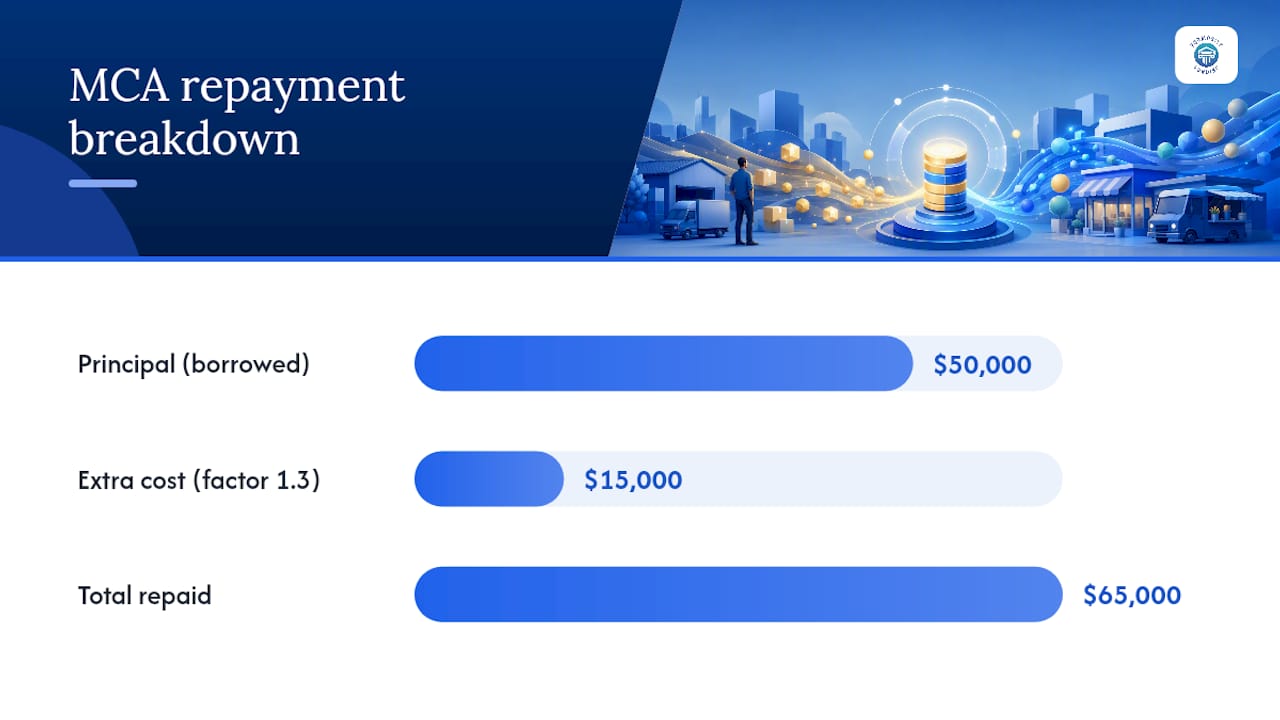
The pricing runs on a factor rate, not an interest rate. Borrow $50,000 at a factor rate of 1.3, and you owe $65,000 total, regardless of how fast you pay it back. If that $65,000 gets collected over six months through daily withdrawals, the effective APR often lands between 40% and 350%, depending on how quickly the holdback drains your account.
Repayment happens one of two ways: a percentage holdback that scales with your daily card batch, or a fixed daily ACH debit that stays the same whether you sold $200 or $2,000 that day. The first flexes with revenue. The second doesn't, and it's the version that strains cash flow the hardest during a slow stretch.
Qualification is light. Funders mostly want to see:
- Three to six months of bank or card processing statements
- Consistent monthly revenue, often $10,000 or more
- No requirement for strong personal credit or collateral
Funding speed is the real draw: funding often arrives within a few days, which is why MCAs dominate emergency-cash searches.
Statistic to remember: a $50,000 MCA at a 1.3 factor rate costs significantly more than the principal, no matter your repayment speed. Compare that to a term loan, where paying early actually saves you interest.
MCA vs. Loan: How a Traditional Business Loan Works
A term loan is straightforward by comparison. You borrow a fixed amount, repay principal plus interest on a set amortization schedule, and the APR you're quoted is the real cost of the money, not a factor rate in disguise.
SBA-backed loans sit at the reliable end of this category. The government guarantees a portion of the loan, which lets banks offer longer terms and lower rates than they'd extend on their own. In exchange, expect more paperwork: tax returns, financial statements, a business plan for larger requests, and sometimes collateral or a personal guarantee.
Online term lenders sit in between MCAs and banks. They move faster than a bank, often funding within one to two weeks, but their underwriting still looks at:
- Time in business (usually two years or more for the best rates)
- Personal credit score, typically 650 or higher
- Business revenue and existing debt load
- Collateral or a personal guarantee on larger amounts
SBA loans generally take the longest, often several weeks from application to funding, because the guarantee process adds a layer of federal underwriting. That timeline is the tradeoff for a lower rate and a longer repayment window, often five to ten years for working capital and up to 25 years for real estate.
Comparing MCA vs. Loan Side by Side
Here's where the numbers get uncomfortable if you've already signed an MCA agreement without doing this math first.
- Repayment structure. MCAs pull daily or weekly, tied to sales volume or a fixed ACH amount. Loans pull once a month, same amount every time, for the life of the term.
- Total cost. A $50,000 MCA at a 1.3 factor rate costs $65,000 total. A $50,000 term loan at 9% APR amortized over three years costs roughly $57,300 total, including interest. The MCA costs almost $8,000 more on the same principal, and that gap widens if the MCA repayment window is shorter than three years.
- Qualification and speed. MCAs approve on cash flow alone, often within a day. Loans require credit history, documentation, and weeks of underwriting.
- Legal risk. This is the one most owners never hear about until they're in trouble. Courts use a three-factor test to decide whether an MCA is genuinely a sale of receivables or a disguised loan wearing a factor-rate costume: whether there's a meaningful reconciliation provision, whether the term is finite rather than indefinite, and whether the funder has recourse if the business fails. Fail that test in bankruptcy court, and the advance can be recharacterized as a loan, sometimes voiding provisions the funder relied on.
Statistic to remember: the APR gap between a factor-rate MCA and a 9% term loan on identical principal can run into the thousands of dollars, even before you factor in how fixed daily debits behave during a slow month.
The Real Tradeoffs of a Merchant Cash Advance
MCAs solve a specific problem well and create a different one if you're not careful.
What works in your favor:
- Funding often arrives within a few days
- Approval doesn't hinge on strong personal credit
- Percentage-based holdback repayment scales down when sales slow
What works against you:
- Effective APR frequently exceeds anything a bank would ever quote
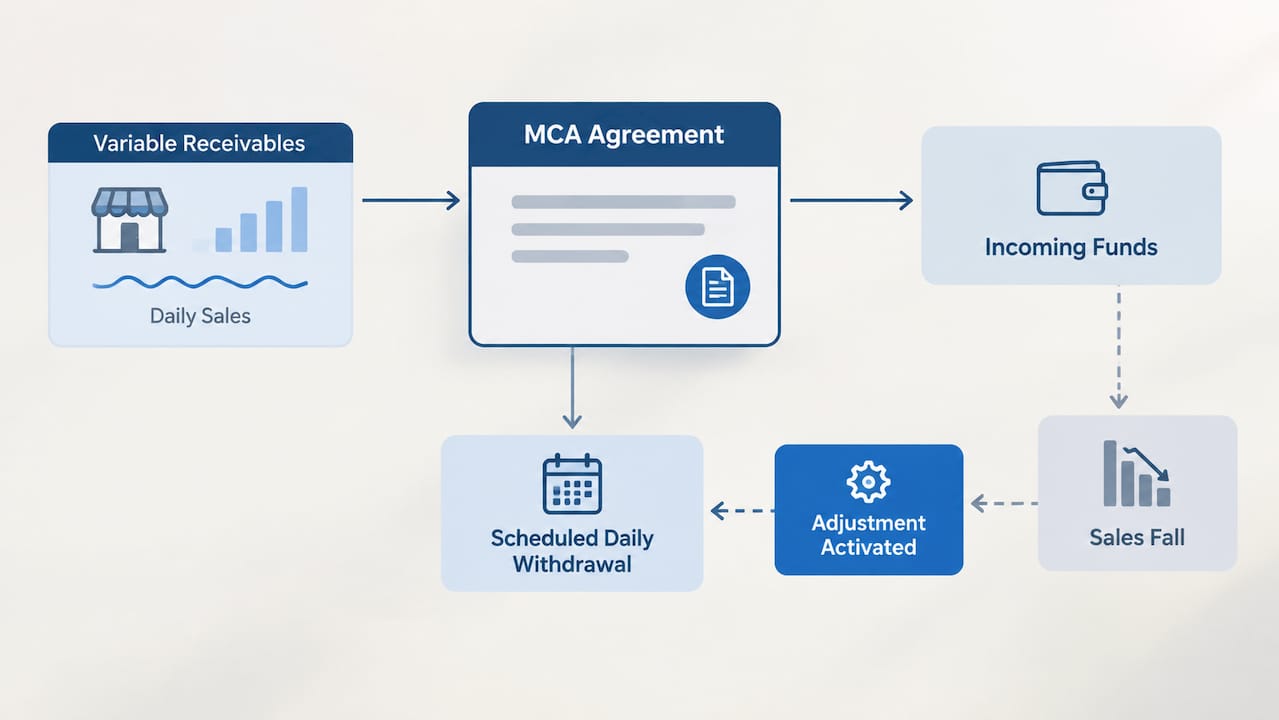
- Fixed daily ACH debits (as opposed to percentage holdbacks) don't flex, and that's often what triggers a cash crunch
- Contracts are dense, and early payoff rarely saves you meaningful money since the factor rate is fixed regardless of timing
Watch for three contract red flags specifically: a reconciliation clause that requires you to request adjustments rather than triggering them automatically, a fixed daily payment disguised as a "holdback," and personal guarantees or blanket security interests layered on top of what's supposed to be a receivables sale. Courts weigh those exact features when deciding whether an MCA is legally what it claims to be.
Pro Tip: Before signing, ask the funder to show you, in writing, exactly what document or event triggers a reconciliation adjustment. If the answer is vague or requires you to initiate every request, that's the clause that causes the most disputes later.
The Real Tradeoffs of a Traditional Loan
Loans are less exciting to talk about because they're just... reliable. That's the point.
What works in your favor:
- Interest rates are a fraction of a typical MCA's effective cost
- Fixed monthly payments make budgeting predictable
- Longer terms fit equipment purchases, real estate, and other capital investments that pay off over years, not weeks
What works against you:
- Funding takes one to eight weeks depending on the lender and loan type
- Underwriting demands solid credit, documentation, and time in business
- Larger loans often require collateral or a personal guarantee
One pattern shows up constantly among owners who took an MCA to solve an emergency: once revenue stabilizes, refinancing that advance into a term loan is often the single best financial move available, trading a factor rate for an amortized rate and stretching repayment over a schedule your cash flow can actually absorb.
When an MCA Makes Sense, and When a Loan Wins
Run through this before you apply anywhere:
- What does your sales pattern look like? Consistent card volume with seasonal dips favors a percentage-holdback MCA over a fixed daily debit. Steady, predictable revenue supports the fixed payments of a term loan.
- Can your cash flow absorb daily withdrawals? If your margins are thin, a fixed ACH sweep can do real damage during a slow month, even if the underlying business is healthy.
- Do you have other credit access? A business line of credit or existing bank relationship often beats an MCA on cost even when speed matters.
Picture a seasonal retailer that needs payroll covered this week before a holiday rush repays it within a month: an MCA fits, and the short holdback window limits total cost. Now picture a manufacturer buying a $200,000 CNC machine with a five-year useful life: that belongs on an SBA or equipment-financing term loan, not a factor-rate product designed for weeks, not years.
Pro Tip: Model your worst month, not your average month, before signing. Take your lowest sales month from the past year and run the MCA's daily withdrawal against it. If that month would have gone negative, the advance is riskier than the sales pitch suggested.
How to Compare MCA and Loan Offers Before You Sign
Get these numbers in writing from every funder or lender you're considering, and don't accept a verbal estimate.
- Factor rate and total repayment amount for an MCA, or APR and amortization schedule for a loan
- A sample daily or weekly payment schedule, so you can see the actual dollar amount hitting your account
- The reconciliation calendar: what triggers an adjustment, what documents you must submit, and how long the funder has to respond
- Whether the deal includes a personal guarantee, a blanket security interest, or other recourse if the business can't pay
Converting a factor rate to an effective APR requires the actual repayment timeline, not a rough guess. A 1.3 factor rate repaid over four months carries a dramatically higher APR than the same rate repaid over ten months, because APR accounts for time, and factor rates don't.
Statistic to remember: the difference between a 4-month and a 10-month repayment window on an identical $50,000 factor-rate advance can shift the effective APR by more than 100 percentage points.
Before signing anything, check the funder's standing through NMLS Consumer Access where registration applies, and read the default and recourse provisions twice. That's where the real risk usually hides.
Where Formosity Funding Fits Into This Decision
Comparing a factor-rate MCA against a term loan by hand is doable, but it's slow, and most owners only do it once, under pressure, after they've already signed something. Formosity Funding runs as a matching marketplace across a nationwide lender network, and pre-qualification carries no credit impact, so you can see real offers before committing to anything.
What the platform actually does for this specific decision:
- Surfaces multiple offer types side by side, including working capital, SBA loans, lines of credit, and equipment financing
- Connects you with a dedicated funding specialist to walk through reconciliation terms and total cost before you sign
- Supports refinancing an existing MCA into a lower-cost term loan once your revenue and documentation support it
| Decision factor | MCA fits when | Loan fits when |
|---|---|---|
| Timeline | Cash needed within days | You can wait 1 to 8 weeks |
| Cost tolerance | Short-term bridge, one-time need | Ongoing capital investment |
| Credit profile | Limited credit history | Established credit and revenue |
An Editorial Take on Choosing Between MCA and Loan
Most funding advice treats MCAs as universally bad and loans as universally responsible. That's lazy thinking, and it ignores why MCAs exist in the first place: sometimes the choice isn't "cheap money vs. expensive money," it's "expensive money now vs. no money at all before payroll bounces." The real failure isn't taking an MCA. It's taking one without reading the reconciliation clause, then discovering the fixed daily debit doesn't flex when a slow week hits.
Conventional advice also underrates the refinancing play. Owners treat the MCA as a permanent fixture instead of what it should be: a bridge. The moment your revenue stabilizes and your documentation catches up, refinancing into a term loan, ideally SBA backed, almost always beats riding out a factor-rate agreement to its natural end.
If you take one thing from this, take the three-factor test seriously before you sign, not after a court has to sort it out for you.
— Alvin
Get Multiple Funding Offers Without the Guesswork
There are platforms that exist to help you compare MCA quotes and loan quotes to figure out which one actually costs less for your situation. Some services allow you to pre-qualify once, with no credit impact, and see real offers from a network of lenders across various funding types including working capital, SBA loans, lines of credit, and equipment financing.
If you're already in an MCA and the daily withdrawals are squeezing you, some services provide guidance on what refinancing into a term loan could look like, compared side by side with your current payments. Start by checking your funding options and requesting offers to compare before your next payment cycle hits.
This article is general information, not a substitute for advice from a qualified financial advisor. Consult a qualified financial professional about your own circumstances before acting on anything here.