

SBA Form 1919 is the Borrower Information Form every applicant entity must submit for an SBA 7(a) loan. It lists your business details, loan purpose, and every owner with a 20% or greater stake, and it feeds directly into SBA background checks. Use the current SBA-hosted PDF, since procedural notices from 2025 and 2026 have quietly changed a few eligibility questions.
TL;DR:
- Accurate ownership disclosure, including holding companies and trusts owning 20% or more, prevents delays caused by missing or incorrect entity information.
- Using the most recent SBA-approved version of Form 1919, with current procedural notices, is essential to ensure eligibility questions are correctly answered.
- Signatures must come from authorized representatives, and each entity involved in a combined structure requires its own signed form to avoid processing issues.
- Gathering necessary documents such as tax returns, EIN letters, and ownership details before starting the form minimizes errors and reduces underwriting delays.
- Responding promptly and thoroughly to follow-up questions after submission helps keep the application timeline on track.
Table of Contents
- What Is SBA Form 1919 and Who Has to Complete It?
- Where to Get the Official Form and What Changed Recently
- How to Fill Out SBA Form 1919 Section by Section
- What to Gather Before You Start the Form
- Common Mistakes That Slow Down Underwriting
- What Happens After You Submit the Form
- Signing and Submitting Form 1919 the Right Way
- An Editorial Take on Getting Form 1919 Right the First Time
- Get Help Preparing Your SBA Paperwork the Right Way
- Sources
- FAQ
What Is SBA Form 1919 and Who Has to Complete It?
Form 1919 exists to give lenders and the SBA a single, standardized snapshot of who owns the business, why it wants the money, and whether anything in its history should slow down approval. The form's answers feed eligibility screens, affiliation analysis, and fraud checks under 15 U.S.C. 636(a)(1)(B), which is the statute governing 7(a) loan guarantees. Skip a field or fudge an answer, and you are not just annoying your loan officer. You are creating a mismatch that underwriting has to chase down before your file moves forward.
Every applicant business files its own Form 1919, and so does any operating company paired with an eligible passive company structure. The ownership section is where most applicants trip up, because the SBA does not just want the names on your cap table. It wants anyone, individual or entity, who owns 20% or more of the applicant, plus any parent entities that own a piece of those owners. That "look through" rule catches people off guard when a holding company or a spouse's trust owns a slice of the business.
A few structural rules to keep straight before you start filling anything in:
- Only an authorized representative, typically an owner, officer, or managing member with signing authority, can sign the form.
- Eligible passive companies (EPCs) and operating companies (OCs) in commercial real estate deals each need their own completed and signed Form 1919.
- Every owner at 20% or above gets listed, even if that owner is a corporation, an LLC, or a trust rather than a person.
- Beneficial ownership matters more than title. A silent partner with 25% equity outranks a listed "manager" with none.
Lenders use this form as a screening gate, not a formality. Get the ownership structure right the first time and you save yourself a round of follow-up questions that can stall your file for a week or more.
Where to Get the Official Form and What Changed Recently
Download Form 1919 only from the SBA's own document page or the SBA-hosted PDF. Third-party sites sometimes host outdated versions, and the SBA has revised this form more than once in the past few years to reflect rule changes.
Check three things before you assume your copy is current:
- The effective date printed in the form's footer, which should match the SBA's most recent revision.
- The OMB control number, which confirms the form is federally approved and current.
- Any linked SBA procedural notices that might have changed a specific question since the PDF was last printed.
Pro Tip: A printed or previously downloaded copy of Form 1919 can lag behind procedural notices. The SBA has updated how criminal-justice-related questions are reviewed, and citizenship and eligibility criteria have also shifted in recent notices. Always cross-check the question wording against the latest SBA guidance before you answer, not just against the form you happen to have saved on your desktop.
Borrowers most often miss updates tied to criminal history review standards and citizenship eligibility requirements. Both have shifted enough in recent SBA notices that an answer that was fine two years ago might need a different explanation attached today. When in doubt, read the notice, not just the form.
How to Fill Out SBA Form 1919 Section by Section
Form 1919 is organized into a handful of distinct blocks, and each one has its own logic. Walk through it in order rather than skipping around, because later sections often reference numbers you entered earlier.
-
Section I: business identification. Enter your legal business name, DBA if applicable, EIN, NAICS code, physical address (no P.O. boxes), and the exact loan amount requested. If your loan covers multiple purposes, such as working capital plus equipment, the dollar figures you list under "use of proceeds" need to add up to the total loan request on your application. A mismatch here is one of the fastest ways to trigger a lender callback.
-
Section II: ownership table. List every individual or entity owning 20% or more of the applicant, along with each owner's Tax Identification Number and ownership percentage. If any owner is itself a business entity, or if the applicant has an interest in other companies, you will likely need to attach Addendum A, which captures those additional entities and their TINs. This is the single most common source of underwriting delays, largely because applicants forget to list a holding company or a co-owner's spouse who technically crosses the 20% threshold through a trust.
-
Section III: eligibility questions. This is a series of yes or no questions covering things like prior government debt, current legal proceedings, citizenship status, and criminal history. A "yes" answer almost always requires an attached explanation, and a vague one will just generate a request for more detail. If you answer "yes" to a prior federal loan issue, for example, attach specific dates, amounts, and resolution status rather than a single sentence saying "resolved." The SBA and your lender want enough detail to close the question, not reopen it.
-
Signature block. The form must be signed by an authorized representative, and that signature carries legal weight. Signing certifies that the information is accurate and that you understand providing false statements on a federal loan application is a serious offense. If your deal involves an EPC and OC structure, or multiple co-applicant entities, expect to sign more than one Form 1919. Each entity's authorized signer certifies for their own business only.
Pro Tip: Before you sign anything, read every dollar figure on the form against your loan application and your financial statements one more time. Lenders key this data directly into E-Tran, the SBA's loan processing system, and a discrepancy between Form 1919 and your other paperwork is exactly the kind of thing that gets flagged during eligibility review.
What to Gather Before You Start the Form
Trying to fill out Form 1919 without your documents in front of you leads to guessed numbers and blank fields you circle back to fix later. Set aside an hour, pull the following together first, and the form itself takes a fraction of the time.
- Business identity documents: EIN confirmation letter, NAICS code, current lease or franchise agreement if applicable.
- Owner identity and tax information: Social Security Numbers or TINs and current addresses for every owner at 20% or above.
- SBA Form 413 (Personal Financial Statement) for each owner holding 20% or more, since lenders typically request it alongside Form 1919.
- Recent business tax returns and current financial statements, plus a schedule of existing business debt.
- A completed list of any other businesses you or your co-owners have an interest in, ready to drop into Addendum A.
- Written explanations, with dates and documentation, for any question you expect to answer "yes."
| What you need | Why it matters | Where it shows up on the form |
|---|---|---|
| EIN letter and NAICS code | Confirms legal business identity | Section I |
| Owner TINs and ownership percentages | Required for every 20%+ owner | Section II ownership table |
| List of affiliated businesses | Triggers Addendum A if applicable | Addendum A |
| Prior federal loan history | Checked against CAIVRS | Section III eligibility questions |
| Signed Form 413 for major owners | Supports underwriting and background review | Attached separately, referenced in review |
A CAIVRS check runs quietly in the background once your file moves forward, since it's the federal database lenders and the SBA use to spot prior defaults on government-backed loans. If you have ever defaulted on a federal loan, even one unrelated to your current business, disclose it up front rather than hoping it goes unnoticed.
Common Mistakes That Slow Down Underwriting
Most delays on Form 1919 trace back to a small handful of repeat offenders, and every one of them is fixable before you ever submit.
- Incomplete ownership disclosure. Forgetting a holding company, a silent partner, or a spouse's trust interest is the top cause of Addendum A callbacks. Fix it by auditing your full cap table, including any entity that owns a piece of an owner, before you write anything down.
- Numbers that don't match your tax returns or Form 413. If your reported revenue on Form 1919 doesn't line up with your most recent tax filing, expect a hold. Reconcile names, EINs, and dollar figures across every document before submission.
- Undisclosed criminal history or CAIVRS hits. Discovering a prior federal default or an undisclosed criminal matter mid-underwriting is far worse than disclosing it on day one. Attach court records or a written explanation, and talk to legal counsel if the situation is complicated.
- Outdated form versions, missing signatures, or P.O. box addresses. Each of these triggers an automatic bounce-back from the lender. Always pull the current PDF directly from the SBA's site, sign in the correct block, and list a physical street address.
Pro Tip: If you're unsure whether something counts as a "yes" on the eligibility questions, disclose it anyway with a clear explanation attached. Lenders and the SBA read an early, well-documented disclosure very differently from one that surfaces after underwriting is already underway.
What Happens After You Submit the Form
Once your Form 1919 is signed and handed over, it enters a fairly predictable pipeline, though the pace depends heavily on how clean your paperwork is.
- Your lender enters the data into E-Tran. This is the SBA's loan processing system, and it's how your application actually gets registered with the agency. The lender keeps the signed original on file for its own records.
- The SBA runs its eligibility and background screens. This includes affiliation analysis based on your ownership table, a fraud check, and a CAIVRS lookup for prior federal loan trouble.
- You get one of three outcomes. A delegated lender with SBA Preferred Lender Program status can approve straightforward files in house. A non-delegated file goes to the SBA for direct review, which takes longer. Either path can also generate a request for more documentation or, in some cases, a denial.
- Supplemental requests add time to your timeline. If underwriting flags something, expect a request for clarification, an amended addendum, or additional records. How fast you respond directly controls how fast your file moves again.
A clean file with a delegated lender can move in days. A file with ownership gaps, unexplained "yes" answers, or a CAIVRS flag can stretch into weeks while everyone tracks down the missing piece. Responding to lender questions within 24 to 48 hours, rather than letting them sit, is one of the simplest ways to keep your timeline intact.
Signing and Submitting Form 1919 the Right Way
Only an authorized representative of the applicant business can sign Form 1919, and that person's title needs to match what your lender has on file for signing authority. Co-applicant structures, such as separate EPC and OC entities in a real estate deal, each require their own signed form rather than one combined signature.
- Most lenders now accept a secure electronic signature through their own intake portal, which is faster than printing, signing, and scanning.
- Keep a dated copy of the signed form for your own records, even after the lender retains the original.
- Confirm your specific lender's preferred delivery method before you finish, since some still want documents uploaded through a dedicated portal while others accept a secure email attachment.
- If you're working with more than one lender to compare offers, expect to complete a separate signed Form 1919 for each one.
An Editorial Take on Getting Form 1919 Right the First Time
Most guides treat Form 1919 like a formality you rush through to get to the "real" underwriting. That's backwards. This form is the first real test of whether your paperwork holds together, and lenders read sloppiness here as a preview of how the rest of your file will go.
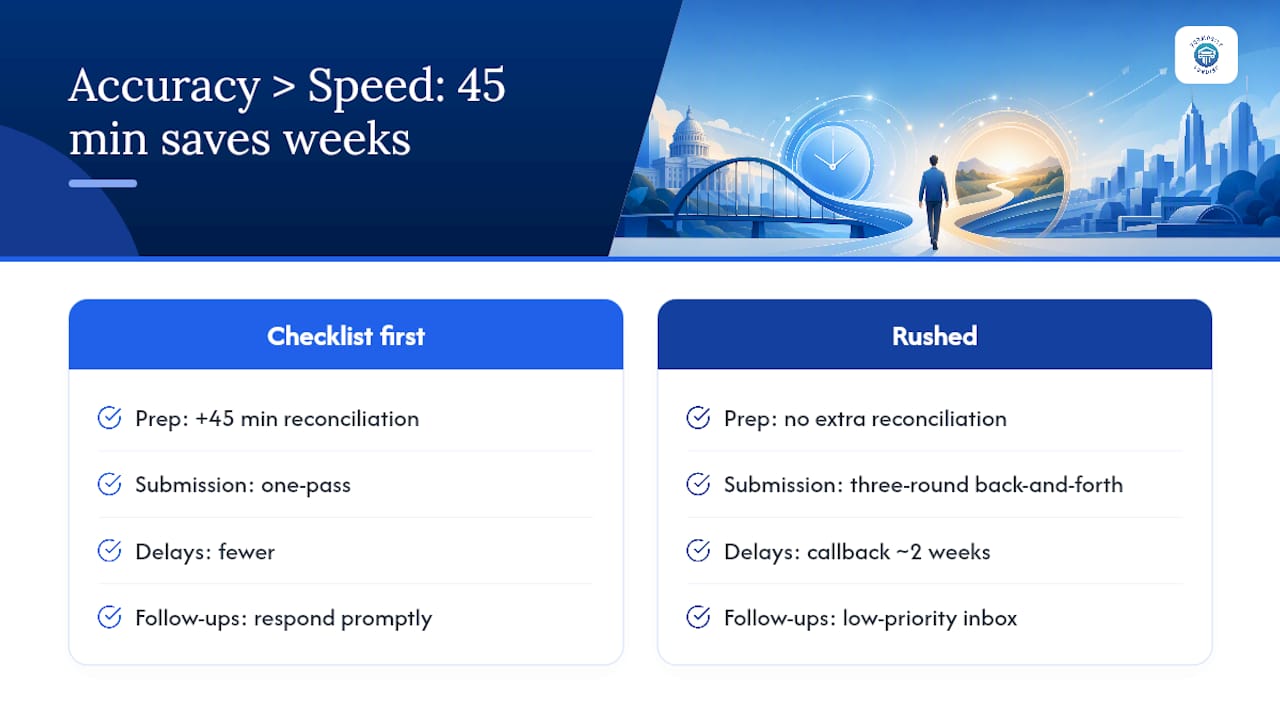
Speed is not the goal on this form. Accuracy is. A borrower who spends an extra 45 minutes reconciling ownership percentages against tax returns before signing will move through underwriting faster than one who rushes through and gets a callback two weeks later asking for the same information in a different format. The checklist approach, gather everything first, fill the form second, isn't bureaucratic overcaution. It's the difference between a one-pass submission and a three-round back-and-forth.
The other underrated factor is responsiveness after submission. Lender questions at this stage are usually routine, a missing TIN, a clarification on Addendum A, but they carry a time cost every day they sit unanswered. Treat those follow-up emails the way you'd treat a client deadline, not a low-priority inbox item, and your timeline stays intact.
— Alvin
Get Help Preparing Your SBA Paperwork the Right Way
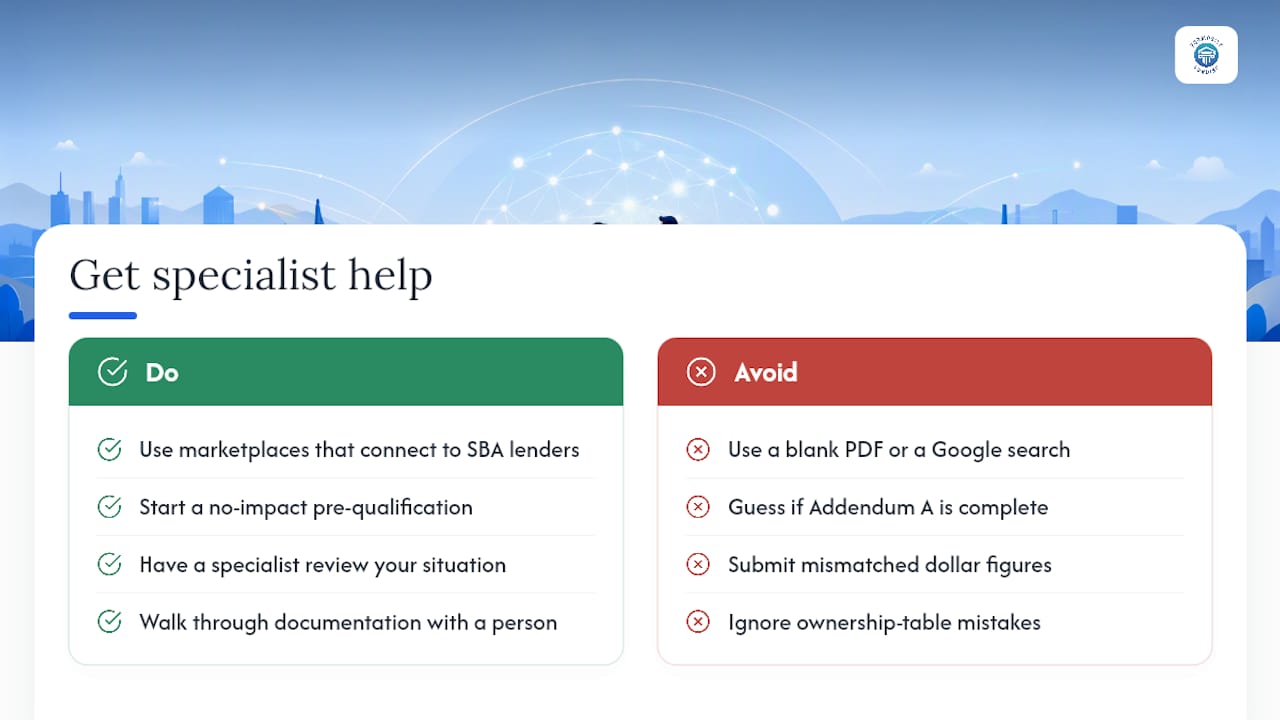
You can get more personalized assistance than just a blank PDF or a Google search, such as help from a funding specialist experienced with common ownership-table mistakes who can flag potential issues before lenders do.
Instead of guessing whether your Addendum A is complete or whether your loan-purpose figures actually add up, you get a person walking through your documentation alongside you before it ever reaches underwriting. There are marketplaces that connect businesses to a network of SBA-participating lenders, offering instant pre-qualification with no credit impact and dedicated funding specialists to guide applicants through the paperwork from application to funding. That kind of second set of eyes matters most on a form where one missing owner or one mismatched dollar figure can add weeks to your timeline.
If you're preparing to apply for an SBA 7(a) loan, working capital, or equipment financing, visit the Formosity Funding services page to see the full range of funding options and start a no-impact pre-qualification. A specialist will review your situation and help you line up the exact documents your lender will ask for.
Sources
The guidance above draws directly from primary SBA documentation and a small set of practical completion guides.
- Borrower Information Form | U.S. Small Business Administration
- SBA Form 1919 (PDF)
- How to Fill Out SBA Form 1919: A Field-by-Field Guide | StatementsReady
- SBA Form 1919: What It Is & How to Complete It | Fit Small Business
- SBA Form 1919 Update for Criminal Justice Reviews Final Rule
This article is general information, not a substitute for advice from a qualified financial advisor. Consult a qualified financial professional about your own circumstances before acting on anything here.
FAQ
How Do I Complete SBA Form 1919?
Download the current SBA-hosted PDF, fill in your business identification and loan-purpose figures in Section I, list every owner at 20% or above with their TIN in Section II, answer the eligibility questions in Section III with attachments for any "yes," and have an authorized representative sign. Gather your EIN letter, tax returns, and ownership documents before you start so you're not guessing at numbers mid-form.
What Are the New SBA Loan Requirements for 2026?
Recent SBA procedural notices have updated how criminal-justice-related eligibility questions are reviewed, along with citizenship and eligibility criteria referenced on Form 1919. Always check the latest SBA notices against your printed form before answering sensitive questions, since a form saved a year ago may not reflect the current standard.
What Documentation Is Required for an SBA Loan?
Formosity Funding's funding specialists can help you confirm exactly which documents your specific lender will request.
Do You Pay Back an SBA Loan?
Yes. An SBA loan is not a grant. It's a loan issued by a participating lender and partially guaranteed by the SBA, and you repay it with interest under the terms your lender sets. Form 1919 itself doesn't determine repayment terms, but the eligibility and ownership information it collects does factor into whether a lender approves your loan in the first place.