

The fastest practical route to buy an existing business is an SBA 7(a) loan stacked with a seller note and your own cash, and that structure covers most deals between $100,000 and $5 million. Before you write a letter of intent, confirm two numbers with a lender: your debt service coverage ratio and whether you can meet the 10% equity injection. Those two constraints, not the interest rate, decide whether your deal gets funded.
TL;DR:
- SBA 7(a) loans are suitable for deals under $5 million and require a minimum 10% equity injection, with lender focus on debt service coverage ratio and seller note standby terms.
- Conventional bank loans demand higher down payments of 20% to 30% and are faster but mostly fit asset-heavy businesses, whereas seller financing offers quick closure but involves ongoing relationships.
- Buyers should pre-qualify beforehand, assemble early documentation, model conservatively, and include financing contingencies in their letter of intent to avoid delays.
- Total deal funding typically includes 70-90% senior debt, with seller notes and buyer cash covering the remaining gap, emphasizing the importance of a cash buffer beyond the minimum equity.
- Pre-qualifying through a platform like Formosityfunding allows buyers to compare offers nationwide, reducing approval time and increasing negotiation leverage.
Table of Contents
- Business Acquisition Financing Options and Their Trade-Offs
- How Does SBA 7(a) Financing Work for Business Purchases?
- What Are the Alternatives to SBA Financing?
- How to Prepare and Apply for Acquisition Financing
- How Buyers Stack the Capital for an Acquisition
- Why Trust This Guide, and How Formosityfunding Helps
- Risks and Challenges Across Acquisition Financing Types
- Strategies for Negotiating Financing Terms and Conditions
- How Credit Score and Financial History Affect Your Options
- Managing Finances and Repayment After the Acquisition
- A Buyer's Perspective on Sequencing the Deal
- Formosityfunding: How We Help Buyers Find Acquisition Financing
- Sources
- FAQ
Business Acquisition Financing Options and Their Trade-Offs
Buyers usually pick from six paths, and each one trades speed against cost or control differently.
- SBA 7(a) loans dominate deals under $5 million because they need less cash up front and stretch repayment terms, though they come with guaranty fees and stricter documentation.
- Conventional bank loans close faster in many cases and skip the SBA paperwork, but they usually demand 20% to 30% down and favor asset-heavy businesses with real estate or equipment.
- Seller financing is often the quickest to arrange since it's a private negotiation, and it signals the seller's confidence in the business's future cash flow.
- ROBS (Rollovers as Business Startups) lets buyers use retirement funds as equity without early-withdrawal penalties, but the compliance rules are unforgiving and mistakes can trigger tax penalties.
- Mezzanine debt and asset-based lending (ABL) show up mostly in larger, asset-rich deals where senior lenders won't cover the full purchase price.
- Private equity financing brings in outside investors for scale but usually means giving up partial ownership and control.
The right pick depends on deal size, how much cash you have, and how fast the seller wants to close.
How Does SBA 7(a) Financing Work for Business Purchases?
The SBA doesn't lend money directly. It guarantees a portion of the loan a bank issues, which lets lenders extend more generous terms than they'd offer on their own. That guaranty is why SBA 7(a) has become the backbone of business purchase loans for deals under $5 million: lenders take on less risk, so they'll finance buyers who couldn't qualify for a conventional loan on the same terms.
That guaranty comes with strings attached. Lenders lean hard on three things when they underwrite an acquisition:
- Debt Service Coverage Ratio (DSCR). This measures whether the target business generates enough cash flow to cover the new loan payment plus existing obligations. Most lenders want a cushion above breakeven, and given the tighter underwriting standards taking effect in SBA's 2026 procedural updates, modeling a conservative, worst-case DSCR before you make an offer is no longer optional.
- Equity injection. SBA rules generally require a minimum 10% equity injection into the deal, calculated against total project cost, not just the sticker price.
- Seller note standby terms. A seller note can count toward that 10% only if it sits on full standby, meaning no payments to the seller until the SBA loan is paid off or a set period passes.
Equity injection and DSCR floors, guaranty fees, and 7(a) loan maximums are documented in current industry benchmarks, and buyers who skip this step often discover the shortfall after they've already signed an LOI, which is the worst time to find out. The SBA's benchmark data puts the standard 7(a) loan cap at $5 million, which is exactly why deals above that threshold often need a second layer of financing.
For deals above $3 million, expect lenders to require a quality of earnings (QoE) review on top of two to three years of tax returns and a business valuation. That review adds time and cost, but it also gives you independent evidence the cash flow projections hold up.
What Are the Alternatives to SBA Financing?
Not every buyer fits the SBA box, and sometimes another route makes more sense.
- Conventional bank loans close faster in many cases because they skip the SBA's layered approval process, but expect to put down 20% to 30% rather than the SBA's lower threshold. These work best for asset-heavy targets like manufacturing shops or trucking companies where the collateral itself reassures the bank.
- Seller financing often closes the fastest of any option since it's a negotiation between two parties rather than a bank approval. Sellers who believe in the business's staying power sometimes prefer carrying a note, both to smooth the sale and to keep a financial stake in its success.
- ROBS lets a buyer roll retirement savings into the new company as equity, tax and penalty free, but the compliance requirements around plan administration are strict enough that many buyers hire a specialist just to stay on the right side of IRS rules.
- Mezzanine financing and asset-based lending typically enter the picture on larger transactions, where a senior lender covers most of the purchase price and a mezzanine piece or an ABL facility fills the remaining gap against receivables, inventory, or equipment.
How to Prepare and Apply for Acquisition Financing
Buyers who move fastest through underwriting all do the same thing first: they talk to a lender before they talk to a seller's attorney.
- Pre-qualify before you make an offer. Build a financing thesis with a lender so you know your realistic loan size and rate range before you're negotiating against a deadline.
- Assemble your document package early. Lenders typically want two to three years of business tax returns, a profit and loss statement, a balance sheet, your personal financial statement, the draft purchase agreement, and a formal valuation. For deals over $3 million, add a QoE report.
- Model DSCR conservatively. Run the numbers assuming a bad year, not the seller's best year, and see if the loan still pencils out.
- Write financing contingencies into your LOI. SBA deals typically need 60 to 90 days to close, while conventional and seller-financed deals can move faster depending on documentation readiness. Give yourself realistic windows for each.
- Fix red flags before you submit. Thin cash flow, unclear seller books, or an incomplete document package are the top reasons lenders slow-walk a file. Clean these up before the LOI, not after.
How Buyers Stack the Capital for an Acquisition
A typical deal might break down into senior debt, seller note, and buyer cash components in proportions that balance risk and meet lender requirements. That combination works because it splits risk three ways: the bank takes the largest but most protected piece, the seller shares some of the future upside risk, and the buyer proves genuine skin in the game.
- Senior debt (SBA or conventional) typically covers 70% to 90% of total project cost.
- A seller note fills part of the gap, but only counts toward the required equity injection when it's fully on standby for the loan term.
- Buyer cash covers the rest, plus a working capital reserve.
Total project cost, the number lenders use to calculate your required equity injection, includes the purchase price plus working capital, closing costs, and lender fees. Buyers who size their injection against the sticker price alone routinely come up short.
Pro Tip: Model a cash buffer beyond the minimum equity injection. A DSCR that looks fine on paper can turn ugly fast if a key customer leaves in month four and you have nothing left to cover payroll.
Why Trust This Guide, and How Formosityfunding Helps
This guide was written by Alvin, who covers small-business financing markets with a focus on how SBA rule changes affect real buyer timelines and underwriting outcomes. The goal here has been practical accuracy: naming the constraints that actually stop deals from closing, not just listing loan types.
Formosityfunding exists for the moment after you've read a guide like this and need to act on it. Its platform connects buyers with a nationwide network of lenders across:
- SBA loans for acquisitions and expansions
- Conventional term loans and equipment financing
- Working capital and business lines of credit
- Commercial real estate financing
Buyers use the platform to pre-qualify without a credit impact, then compare multiple real offers side by side, with a funding specialist guiding the process instead of leaving buyers to chase separate bank relationships alone.
Risks and Challenges Across Acquisition Financing Types
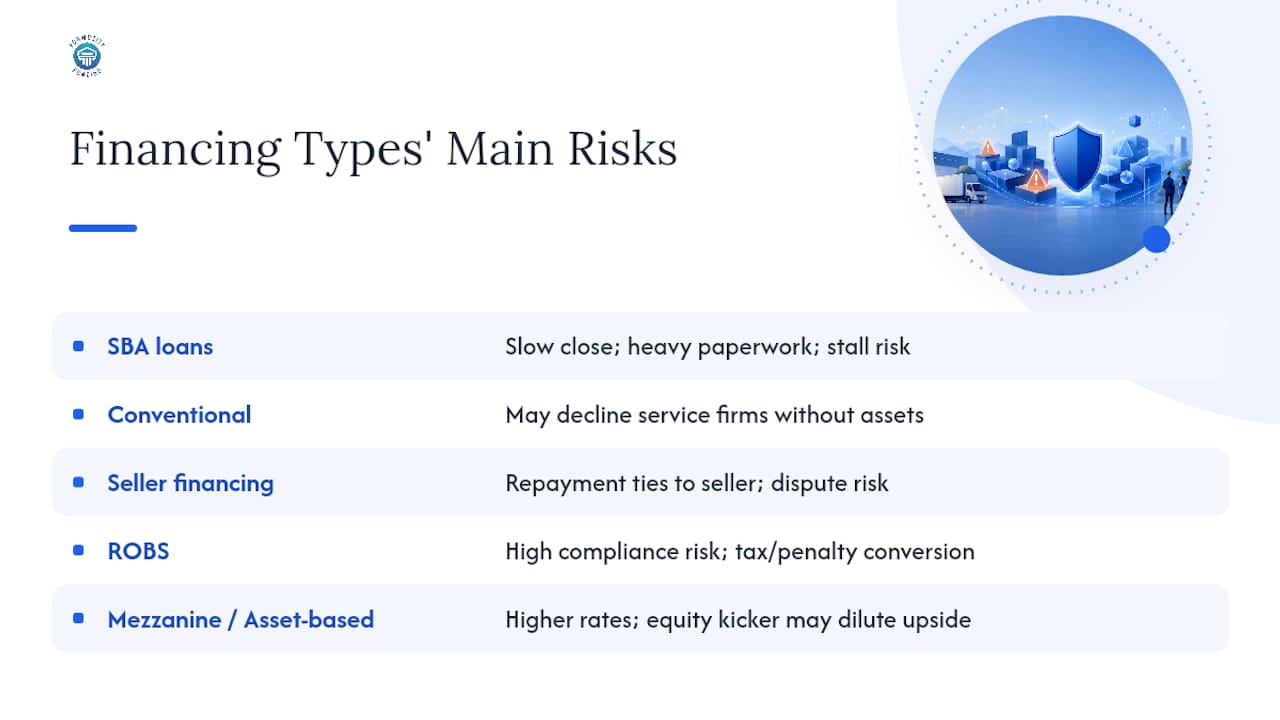
SBA loans carry the lowest down payment requirement, but they also have the slowest close and the heaviest paperwork burden. A deal that stalls in SBA underwriting for 90 days can lose momentum, and sellers sometimes walk if a faster buyer appears with cash or conventional financing in hand.
If the target business is service-based with few hard assets, a conventional lender may decline the deal outright regardless of cash flow strength.
Seller financing feels flexible, but it ties your relationship with the seller to your loan repayment for years. If the business underperforms and you fall behind on the note, that dispute plays out with someone who still knows the business, the customers, and possibly the landlord.
ROBS carries the sharpest compliance risk of any option. Structuring the rollover incorrectly, or failing to maintain the required plan documents afterward, can trigger a disqualification event that converts the entire rollover into taxable income plus penalties in a single year.
Mezzanine and asset-based lending bring higher rates and, in the case of mezzanine debt, sometimes an equity kicker for the lender, which dilutes your long-term upside even though it solves a short-term funding gap.
The common thread across every option is this: whichever structure lowers your cash requirement usually raises either your interest cost, your compliance risk, or your negotiating leverage with the seller. There's no version of acquisition financing that avoids trading one of those for another.
Strategies for Negotiating Financing Terms and Conditions
Lenders expect negotiation, and buyers who treat every term as fixed leave money and flexibility on the table. Interest rate is usually the least negotiable piece of an SBA deal since the SBA caps the spread lenders can charge over the base rate. Fees, prepayment terms, and the exact standby period on a seller note have far more room to move.
Push first on the seller note structure. A two-year standby period might satisfy the lender just as well as a five-year one, and shortening it gets the seller paid faster, which often makes them more willing to accept a lower rate or a slightly reduced price.
Ask your lender directly which parts of the term sheet are policy and which are lender discretion. Guaranty fees and SBA program minimums are fixed by rule, but closing timelines, some documentation requirements, and prepayment penalties often vary by bank even within the same SBA program.
If your DSCR modeling comes in tight, negotiate the purchase price down rather than trying to negotiate the loan terms up. Lenders will rarely stretch DSCR requirements for you, but a lower purchase price improves your ratio automatically and gives you a stronger position with every lender you approach afterward.
How Credit Score and Financial History Affect Your Options
Personal credit history matters more in acquisition financing than most first-time buyers expect, because SBA lenders and conventional banks alike are underwriting you, not just the business you're buying. A strong personal credit score doesn't guarantee approval, but a weak one narrows your options fast, often pushing you toward higher rates or a larger required equity injection to offset the lender's risk.
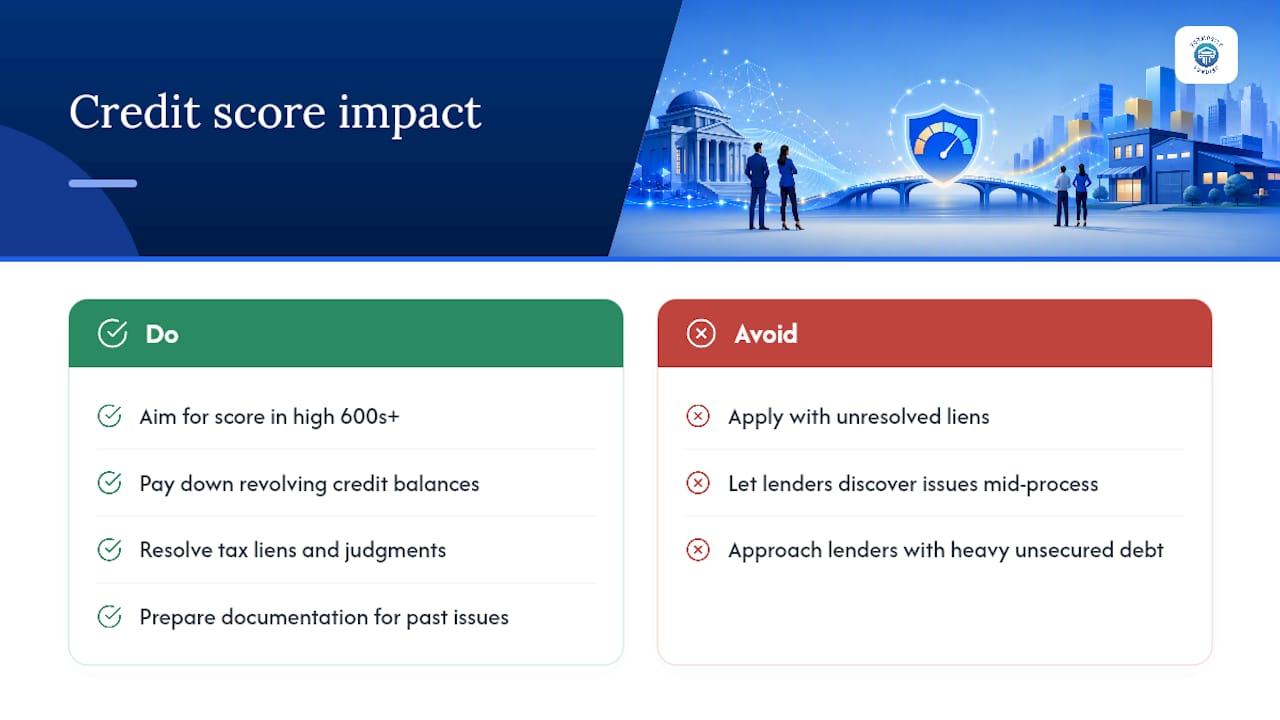
Lenders typically look for a credit score in the high 600s or above for SBA acquisition loans, though the exact cutoff varies by lender and deal size. Below that range, expect more scrutiny on every other part of your application, from cash reserves to industry experience.
Your financial history extends beyond the score itself. Lenders review recent bankruptcies, outstanding tax liens, and existing debt obligations, since all of it affects how much additional debt service you can realistically carry. A buyer with a clean score but heavy existing debt can look riskier on paper than a buyer with a slightly lower score and minimal other obligations.
If your credit history has rough patches, address them before you approach a lender rather than during underwriting. Pay down revolving balances, resolve any liens, and be ready to explain, with documentation, any past issues rather than letting a lender discover them mid-process.
Managing Finances and Repayment After the Acquisition
Closing the loan is the beginning of the real financial test, not the end of it. The DSCR you modeled during underwriting becomes the number you now have to hit every month, and the margin for error shrinks the moment payroll, inventory, and loan payments all draw from the same account.
Build a 90-day cash flow forecast the moment you take ownership, updated weekly rather than monthly, so you catch a shortfall while you still have time to react. Keep the working capital reserve you built into your equity injection untouched for at least the first two quarters. Buyers who raid that reserve to cover early surprises often find themselves without a cushion when a slower season or an unexpected repair bill hits.
Set up automatic tracking of your actual DSCR against your underwritten projection every month. If actual performance drifts below your conservative model for two consecutive months, that's the signal to renegotiate vendor terms, cut discretionary spending, or talk to your lender proactively rather than waiting for a missed payment to force the conversation.
Prioritize paying down the seller note on schedule even if the SBA loan has more favorable terms, since a strained relationship with a seller who's still owed money can complicate everything from transition support to non-compete enforcement.
A Buyer's Perspective on Sequencing the Deal
Get lender alignment locked in before you sign an LOI, not after. Treat seller financing as a tool for building trust with the seller, not a fix for a valuation gap you're not willing to admit exists. And keep a working capital buffer bigger than the minimum the math requires, because conservative DSCR models still get tested by real months.
— Alvin
Formosityfunding: How We Help Buyers Find Acquisition Financing
Every option covered here, SBA loans, conventional bank debt, equipment financing, working capital lines, runs through the same bottleneck: finding a lender who actually wants your deal and will move at the pace your seller expects. A platform is built to close that gap. Instead of applying to bank after bank and waiting weeks for each answer, you pre-qualify once, with no impact to your credit, and get matched against a nationwide network of lenders who compete for your business.
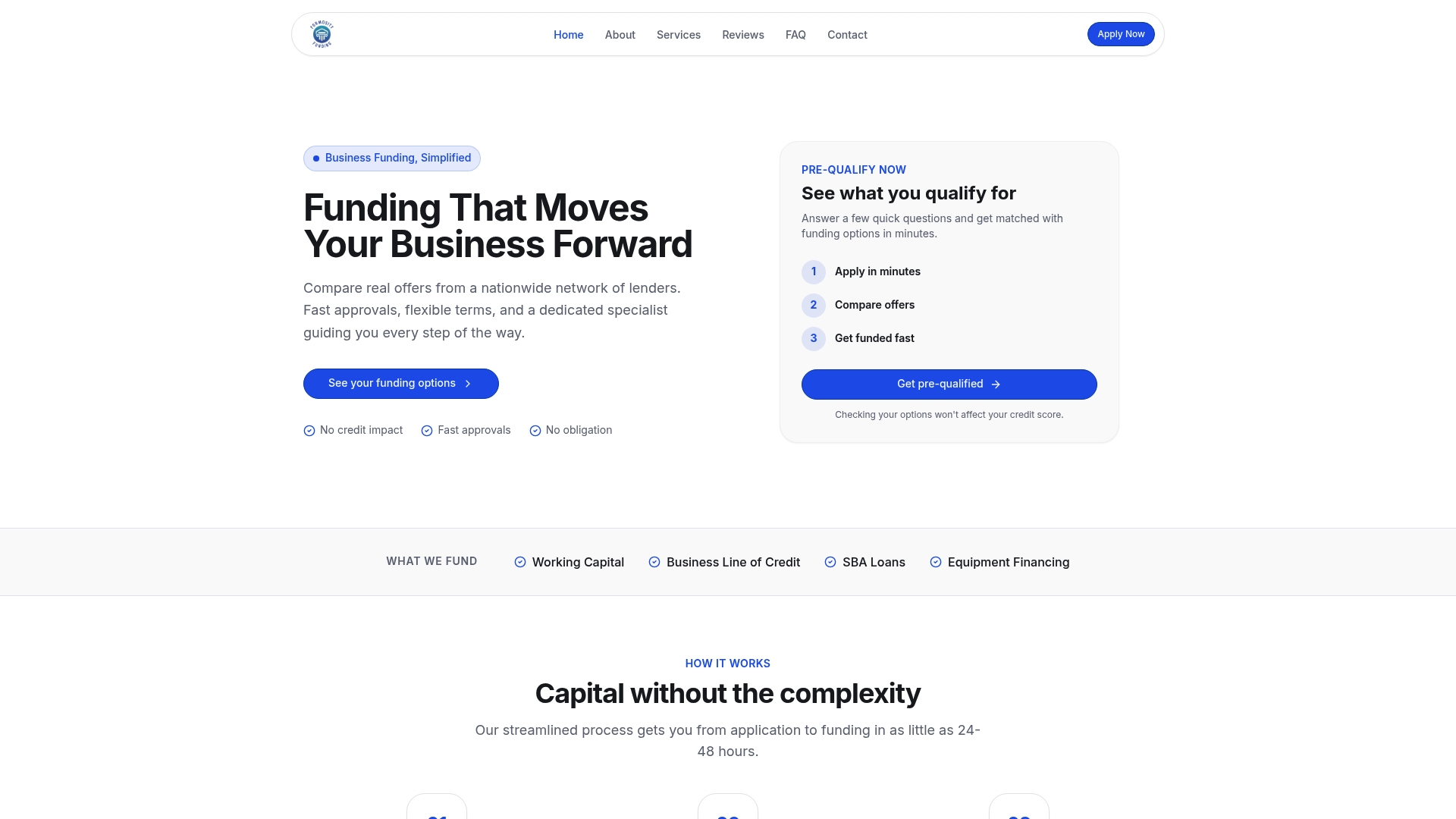
A dedicated funding specialist can guide you through which offers fit your deal size and DSCR profile, so you're comparing real terms rather than guessing which lender to approach next. If you're preparing an offer on a business right now, the practical next step is to start a pre-qualification and compare lender offers before you lock in your LOI timeline.
Sources
- SBA Business-Acquisition Financing Benchmarks (2026) - Hartwell Labs
- Business Acquisition Financing Options: Buyer's Guide (2026) - 1 800 Biz Broker
This article is general information, not a substitute for advice from a qualified financial advisor. Consult a qualified financial professional about your own circumstances before acting on anything here.
FAQ
Can I Get 100% Business Acquisition Financing?
Rarely, and not through SBA financing, since the program generally requires a minimum 10% equity injection from the buyer. Some deals get close to full financing when a seller note and a strong SBA loan combine, but buyer cash almost always plays some role.
How Hard Is It to Get a Business Acquisition Loan?
It depends heavily on your DSCR, credit history, and how complete your documentation is going into underwriting. Buyers who pre-qualify, model conservative cash flow, and bring clean financial histories typically move through approval far faster than those who apply cold.
What Is the Payment on a $1,000,000 Business Loan?
The exact payment depends on the interest rate, term length, and loan structure, which vary by lender and deal. An SBA 7(a) loan on a term of 10 years, a common length for acquisition financing, spreads that repayment over many monthly installments rather than a shorter conventional term.
How Does Acquisition Financing Work?
A lender extends senior debt against the target business's cash flow and assets, often with an SBA guaranty reducing the lender's risk, while the buyer supplies the required equity injection and sometimes a seller note fills any remaining gap. The combination is underwritten primarily against the business's ability to service that debt going forward, measured through DSCR.