

Business loan approval time ranges from 24 hours with select online lenders to 90 days or more for SBA and complex commercial loans, with traditional banks landing somewhere in between at one to six weeks. The single biggest factor controlling where you land in that range isn't your credit score or your industry. It's how complete and consistent your documentation is when you hit submit.
TL;DR:
- Completing and verifying consistent documentation can add up to several weeks to the loan approval timeline regardless of lender type or loan size.
- Online lenders typically approve funding within three days, while SBA loans often take between 30 and 90 days from application to funding.
- Larger loans and those requiring extensive collateral or approvals tend to extend the process, especially with multiple review levels involved.
- Borrowers can speed approval by preparing all documents in advance, using pre-qualification tools, and responding quickly to lender requests.
- Using a lending marketplace reduces research time and matches applicants with suitable lenders faster, but does not bypass actual underwriting requirements.
Table of Contents
- How Long Does Approval Take by Loan Type?
- What Factors Slow Down or Speed Up Approval?
- What Can Borrowers Do to Speed Up Approval?
- What Documents Do Lenders Require to Close?
- What Happens Between Approval and Getting Funded?
- How Does a Lending Marketplace Change the Timeline?
- What's the Real Lesson Here?
- Get Matched With a Lender Without Losing Weeks to the Search
- Sources
How Long Does Approval Take by Loan Type?
The speed gap between loan products is enormous, and it catches a lot of first-time borrowers off guard. A business owner who assumes every loan works like a credit card application will be in for a surprise once they start comparing quotes.
Online and alternative lenders move fastest because they lean on automated underwriting and bank-account data feeds instead of manual file review. Decisions often land within 24 to 72 hours, and funding can hit your account the same day or within three business days once you accept the offer. The tradeoff is usually cost. Speed comes at a premium in the form of higher rates or shorter repayment terms.
Traditional banks take longer because they still route files through relationship managers and credit committees. Expect one to six weeks from application to funding, with the timeline stretching if you're a new customer, borrowing a larger amount, or asking for something outside the bank's standard box. Community banks with fewer layers of approval can sometimes beat this range; large national banks with multiple sign-off levels tend to sit at the slower end.
SBA loans are the slowest mainstream option, and for good reason. Between the SBA's own review, the lender's underwriting, and additional paperwork like personal financial statements and business valuations, most SBA loans take 30 to 90 days from application to funding. Larger loans or those involving real estate frequently sit at the upper end of that window. If you want the full breakdown of what drives an SBA file long or short, this guide on SBA loan timelines walks through it in more detail.
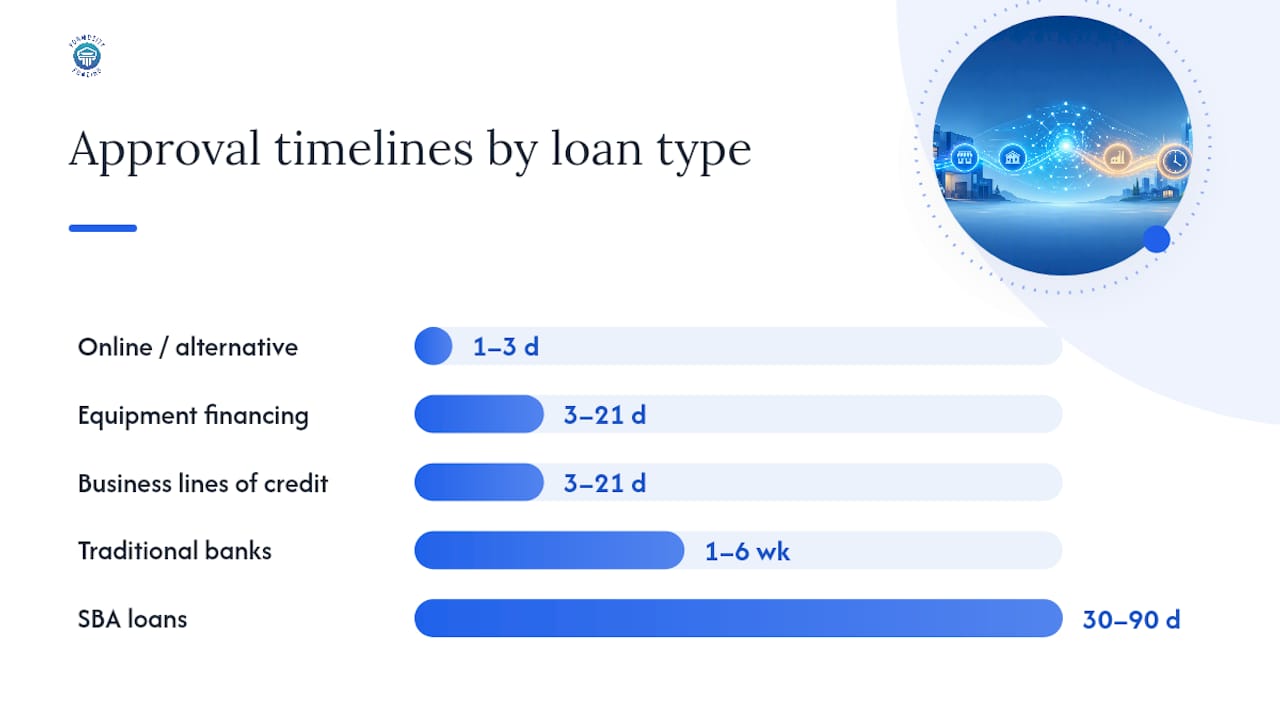
Equipment financing and business lines of credit occupy the middle ground. Because the collateral is often the equipment itself, or because a line of credit doesn't require a full disbursement plan, these products typically close in 3 to 21 days.
Across the board, approval and closing average around 45 days when you blend all loan types together, though that number hides a lot of variation depending on the lender and the borrower's file.
| Loan Type | Typical Timeline | What Widens the Range |
|---|---|---|
| Online/alternative lenders | 24 to 72 hours | Manual review triggers, bank connection issues |
| Traditional bank loans | 1 to several weeks | New customer status, loan size, underwriting depth |
| SBA loans | 30 to 90 days | Loan size, collateral, multiple approval levels |
| Equipment financing | 3 to 21 days | Appraisal needs, vendor coordination |
| Business lines of credit | 3 to 21 days | Credit review depth, existing banking relationship |
The pattern is consistent: the more parties who have to sign off, and the more collateral or government backing involved, the longer the clock runs.
What Factors Slow Down or Speed Up Approval?
Two applications for the same loan amount, at the same lender, can close weeks apart. The difference almost always traces back to a handful of controllable and uncontrollable variables.
Document completeness and consistency matter more than almost anything else. If your tax returns show one revenue figure, your profit and loss statement shows another, and your bank statements tell a third story, expect the underwriter to stop and ask questions. That single back-and-forth can add a week or more to the process.
Credit scores and verification delays play a real role, but not always the one people expect. A low score doesn't necessarily add time; it might just add a no. What actually slows things down is a credit file that needs clarification, like a dispute, a recent inquiry spike, or a mismatch between personal and business credit histories.
Loan size and underwriting escalation work against you the bigger the ask gets. The Small Business Lending Survey documentation shows lenders track multiple approval levels and report separate minimum, maximum, and typical business-day ranges depending on how many people need to sign off. A $25,000 line of credit might clear one desk. A $2 million SBA loan might need three.
Other factors that extend timelines:
- Collateral appraisals, title searches, and lien checks on real estate or heavy equipment
- Third-party verifications, including landlord confirmations or accounts receivable audits
- Lender staffing backlogs, especially around tax season and year-end holidays
- The gap between business days and calendar days, which borrowers often forget to account for
Pro Tip: Ask your loan officer early whether your file requires a second or third layer of approval. If it does, submit every document you can think of upfront. Escalated files that arrive complete move noticeably faster than ones that trickle in one request at a time.
What Can Borrowers Do to Speed Up Approval?
You control more of this timeline than most guides admit. Here's the order of operations that actually shortens the clock.
- Build a lender-ready packet before you apply. Gather tax returns, P&L statements, bank statements, and ownership documents, and check that the numbers on each one agree with each other. Missing documents and inconsistent figures are the most common reason files stall.
- Use soft pre-qualification to narrow your options first. Marketplace pre-qualification tools let you see real offers without a hard credit pull, so you're not burning days applying to lenders who were never going to say yes.
- Name one point of contact on your end. Whoever the lender emails should answer within hours, not days. A file that sits in someone's inbox over a long weekend adds real time to the process.
- Choose lenders that support e-signature and instant ACH verification. These tools cut out the mailing and manual bank-linking steps that used to add three or four days on their own.
- Weigh speed against total cost before you commit. The fastest lender isn't automatically the best deal. Compare the annual cost, the term length, and the lender's reliability, not just how quickly they can wire funds.
Pro Tip: Treat your application like a professional presentation of your business's financial health, not a form to fill out. Lenders move faster on files that read clean the first time through.
For a broader look at what raises your odds of a fast yes, this guide on increasing approval speed covers the credit and cash-flow side in more depth.
What Documents Do Lenders Require to Close?
Most delays trace back to a document that's missing, outdated, or inconsistent with something else in the file. Lenders commonly ask for:
- Personal and business tax returns, usually the last two to three years
- Profit and loss statements and a current balance sheet
- Six to twelve months of business bank statements
- Ownership and formation documents, including articles of incorporation or an operating agreement
- Business license and proof of commercial insurance
- Accounts receivable aging report, if your business invoices clients on terms
- SBA Form 1919 and related intake paperwork, required specifically for SBA loan applications
At closing, expect a second wave: signed loan agreements, ACH authorization for automatic payments, updated proof of insurance naming the lender as a certificate holder, UCC filings against business assets, and, for real estate or major equipment, an appraisal or title report.
Borrower guides consistently point to six to twelve months of bank statements alongside current tax returns and P&L statements as the baseline package most working capital lenders expect before they'll move a file forward.
Label every file clearly with the document type and date range before you send it. A folder named "Bank Statements Jan to Jun 2026" saves an underwriter a phone call, and every phone call adds a day.
What Happens Between Approval and Getting Funded?
Approval isn't the finish line. It's the start of a final sprint that still takes real time.
Once a lender approves your loan, the sequence usually runs: you sign the loan documents, the lender runs final verifications on your bank account and identity, any lien or UCC filings get recorded, ACH payment setup is confirmed, and funds get disbursed.
For most business loans, this stretch takes one to ten business days after approval. Online lenders often complete it in a day or two since e-signatures and instant ACH verification are already built into their process. Deals involving real estate or heavy equipment take longer, since appraisals and title work can't be rushed.
You can shave time off this final stretch by:
- Signing documents electronically the same day they arrive
- Setting up instant bank verification instead of waiting on manual account linking
- Submitting insurance and collateral paperwork before the lender even asks
How Does a Lending Marketplace Change the Timeline?
A marketplace model doesn't erase underwriting. It changes how much time you spend getting in front of the right lender in the first place.
Formosity Funding works by matching one application against a nationwide network of lenders instead of making you fill out separate forms for each one. That single-entry approach removes the days most borrowers lose researching lenders, submitting duplicate paperwork, and waiting to hear back one at a time. Marketplace matching narrows lender research down to a parallel process rather than a sequential one, and pre-qualification happens without a hard credit pull.
The fastest part of any loan process isn't the underwriting. It's the search for a lender who actually wants your deal. Cut that search down, and you cut the calendar significantly, even before a single document gets reviewed.
What a marketplace can't do is override your file. If your tax returns don't match your bank statements, or your deal needs an appraisal, that timing holds regardless of how you found the lender. What it does change is everything upstream of underwriting: the shopping, the duplicate applications, and the guesswork about which lender fits your business.
What's the Real Lesson Here?
Most advice on this topic treats "how long will my loan take" as a question with one universal answer. It isn't. The honest answer depends almost entirely on which loan product you're chasing, and readers who fixate on shaving days off an SBA loan while ignoring their own document gaps are optimizing the wrong variable.
Here's what the evidence actually supports: your paperwork is the lever you control, and it's the one most borrowers underinvest in. A clean, consistent file beats a fast lender every time, because a fast lender with a messy file still stalls. If you take one thing from this article, make it this: build your document packet before you shop for a lender, not after. That single habit closes more of the gap between the fast end of these ranges and the slow end than any lender choice ever will.
— Alvin
Get Matched With a Lender Without Losing Weeks to the Search
A lending marketplace exists for exactly the bottleneck this article keeps pointing to: the time lost shopping lenders one at a time instead of getting matched with the right ones up front. Instead of filling out separate applications and waiting on each one individually, you submit one profile and get connected to lenders across working capital, SBA loans, equipment financing, and commercial real estate financing who are actually positioned to say yes.
Pre-qualification can run without a hard credit pull, and some platforms provide support to help you understand which offers fit your timeline and your budget. If your business needs financing and you'd rather spend your time preparing documents than researching lenders, start your pre-qualification through Formosity Funding's services and see your real options before you commit to any one path.
Sources
Timeline figures draw on SBA Form 1919 requirements and the Small Business Lending Survey technical documentation, alongside industry timing data cited throughout.
This article is general information, not a substitute for advice from a qualified financial advisor. Consult a qualified financial professional about your own circumstances before acting on anything here.