

A loan matching platform is the right move when you want to compare real offers from multiple business lenders without filing separate applications or racking up hard credit inquiries. Submit one application, get matched with lenders across products like SBA loans, lines of credit, and equipment financing, and expect the fastest path to funding when you show up with your documents ready.
TL;DR:
- Loan matching platforms speed up comparisons by providing multiple offers based on a single soft credit pull, reducing the number of hard inquiries on your credit report.
- They often include a broader range of lenders, such as online fintechs and government-backed SBA lenders, which can accept newer or lower-credit applicants.
- The most common rejection reasons involve inconsistent revenue, short time in business, or high existing debt, which require better preparation and documentation before applying.
- Platforms vary in quality; prioritize ones that clearly disclose lender networks, explain offer ranking, and have responsive, specialist support.
- Complete and organized paperwork, including recent bank statements and tax returns, is key to faster funding, especially for online and working capital loans.
Table of Contents
- How Do Loan Matching Platforms Actually Work?
- Are the Benefits Worth the Trade-Offs?
- How Do You Choose a Trustworthy Loan Matching Platform?
- What Should You Prepare Before Applying?
- Customer Support and Dispute Resolution Features
- What Do Reviews Actually Tell You About a Marketplace?
- Why Do Applications Get Rejected?
- What Happens When You Actually Talk to a Funding Specialist?
- How Formosity Funding Gets You From Application to Offer
- Sources
How Do Loan Matching Platforms Actually Work?
A loan matching platform is not a lender. It's an intermediary that takes your business profile and routes it to lenders in its network who are likely to say yes. The lender, whether that's a bank, an SBA-approved institution, or an online specialty finance company, still makes the underwriting decision, sets the rate, and funds the loan. The platform's job is matching, not lending.
The process usually follows a predictable sequence. You fill out one application covering revenue, time in business, and industry. The platform runs a soft credit pull to generate matches without touching your credit score, then returns a set of potential offers. You review terms, pick the one that fits, and only then does the chosen lender run a hard credit inquiry and complete formal underwriting. That structure is why marketplaces get used more than direct-to-lender shopping: you narrow the field before your credit file takes any hits.
The lender mix behind that matching engine determines what you'll actually see. A strong network spans several categories:
- National and regional banks offering traditional term loans and lines of credit
- SBA-approved lenders processing 7(a) and other government-backed loan programs
- Online and fintech lenders specializing in fast working capital
- Equipment financing companies tied to specific asset classes
- Invoice factoring and merchant cash advance providers for revenue-based funding
A business lending marketplace connects one application to multiple lender types and loan products at once, which is the entire value proposition. Apply to five banks individually and you'll fill out five forms, trigger five separate credit pulls, and wait five times over for a response. Apply through a matching platform and you do it once.
Are the Benefits Worth the Trade-Offs?
The upside is real, but it comes with caveats worth knowing before you commit an afternoon to an application.
- Speed. Comparing multiple lenders in one sitting beats calling banks one by one, and marketplace-driven financing frequently funds faster than traditional bank timelines.
- Fewer hard inquiries. Soft-pull matching means you can see potential offers before any lender touches your credit report.
- Broader access. Marketplace networks often include online and specialty lenders that accept newer businesses or lower credit tiers that traditional banks routinely turn down.
- Competitive pricing. When several lenders bid for the same borrower, terms tend to sharpen rather than stay static.
The limitations are just as real. Some matched offers skew toward short-term, higher-cost products, especially if your file looks risky to conservative lenders. Certain banks simply don't participate in marketplace networks, so if you're chasing the lowest possible rate from a specific regional bank, going direct might still be your best bet. And not every platform ranks offers purely on fit. Some prioritize placements that pay them more.
Pro Tip: If you already have a strong relationship with a business bank and your credit profile is clean, call that banker first. Marketplaces shine brightest when you need breadth of options or your file doesn't fit a single lender's box neatly.
How Do You Choose a Trustworthy Loan Matching Platform?
Not every platform is built the same, and the differences show up fast once you start comparing offers.
Start with network composition. A platform worth your time will tell you, at least in general terms, what kinds of lenders sit in its network. Banks, SBA lenders, equipment financiers, and online specialty lenders each solve different problems, and a platform leaning entirely on one category limits your options before you've even applied.
Confirm the credit-pull policy in writing. You want a soft pull for initial matching, with a hard inquiry only after you select a specific offer. If a platform is vague about this, ask directly before submitting anything.
Ask how offers get ranked. A reputable marketplace will explain whether results are ordered by approval likelihood or by which lenders pay the platform more for placement. That single question separates platforms built for borrowers from ones built for referral revenue.
Check these before you apply:
- Does the platform disclose partner lenders or sample rate ranges upfront, or only after you submit an application?
- Is there a dedicated funding specialist you can talk to, or is it entirely self-service?
- What security measures protect your bank statements and tax documents once uploaded?
- How transparent is the platform about typical funding timelines by product type?
Watch for red flags: platforms that refuse to name any partner lenders, that follow up with aggressive daily calls before you've reviewed a single offer, or that keep requesting new documents without explaining why. Legitimate specialists explain the ask; pushy ones just repeat it.
Disclosure practices vary widely across the industry, and that variation is exactly why the questions above matter more than the platform's marketing copy.
What Should You Prepare Before Applying?
Funding speed depends less on the platform and more on whether your paperwork is complete the first time you upload it.
Gather these before you start:
- Bank statements for the last three to six months, unedited and fully legible
- One to three years of business tax returns, depending on lender requirements
- Recent merchant processing statements if you take card payments
- A government-issued driver's license or ID for the business owner
- Business formation documents (articles of incorporation, EIN confirmation)
- Profit and loss statements, ideally prepared or reviewed by an accountant
The details of that list can shift by loan type, and Formosity Funding's own breakdown of required documents is worth a look before you start uploading anything.
Pro Tip: Scan documents in full color at a readable resolution, name each file clearly ("BankStatement_March2026.pdf" beats "scan003.pdf"), and double check that your name and address match across every document. Blurry scans and mismatched details are among the most common, and most avoidable, causes of processing delays.
Timelines vary sharply by product. Online term loans and working capital advances can fund within days once your file is complete. SBA 7(a) loans and commercial real estate financing routinely take several weeks to a few months, partly due to government processing steps and more thorough underwriting. Funding speed differences between loan types are worth understanding upfront so you're not counting on SBA money to cover next week's payroll.
Customer Support and Dispute Resolution Features
Support quality is one of the clearest signs of a well-run platform, and it's also one of the easiest things to check before you commit. A platform that assigns you a dedicated funding specialist gives you a single point of contact who already knows your file, rather than a rotating cast of call-center agents who make you re-explain your business every time you call.
Ask how disputes get handled before you need to find out the hard way. If a matched lender's terms shift between the initial offer and final underwriting, does the platform intervene, or are you on your own once you've been handed off? A platform confident in its lender network will spell out exactly how it supports you if a deal goes sideways, whether that means escalation to a supervisor, a formal complaint channel, or simply a specialist who stays on the file through funding.
Response time matters more than most borrowers expect. A platform that takes three days to answer a basic question about your matched offers is going to be painful to work with if a real problem comes up during underwriting. Test this before you're deep into an application: send a question through whatever support channel exists and time the response. That single test tells you more about a platform's real support culture than any page of marketing copy.
What Do Reviews Actually Tell You About a Marketplace?
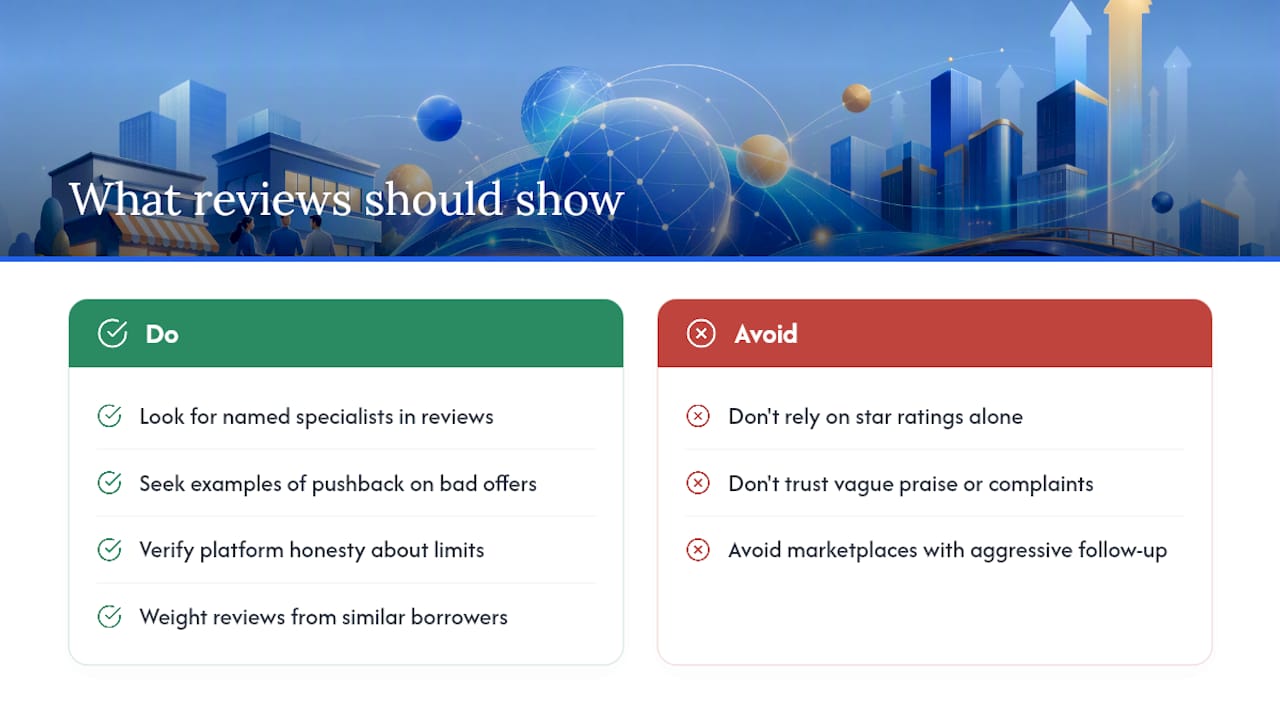
Reviews of loan matching platforms cluster around a few recurring themes: speed of matching, quality of offers received, and whether the specialist assigned to the file actually understood the business. Positive reviews tend to mention a specific person by name and describe a specialist who pushed back on a bad-fit offer rather than just forwarding whatever came through. That detail is worth more than a star rating.
Negative reviews tend to cluster around two complaints: aggressive follow-up calls after submitting basic information, and a mismatch between the advertised lender network and the offers actually received. Both are checkable before you apply, not after. Look for specific language in reviews rather than vague praise or complaints. "Got three offers within 48 hours and the specialist explained the fee differences clearly" tells you something. "Great service, highly recommend" tells you nothing.
Reputation also shows up in how a platform handles its own limitations publicly. A marketplace that's upfront about which loan types it covers well and which it doesn't tend to earn more durable trust than one that implies it can match anyone with anything. Businesses with unusual industries or thin credit files should weigh reviews from similarly situated borrowers more heavily than generic testimonials, since a platform that works well for an established retailer may perform very differently for a two-year-old startup.
Why Do Applications Get Rejected?
Eligibility requirements vary by lender, but a few thresholds show up consistently across the loan matching space. Most lenders in these networks want to see at least six months to two years in business, a minimum monthly or annual revenue figure, and a personal credit score that clears their internal floor, often somewhere in the 600s for online lenders and higher for SBA products.
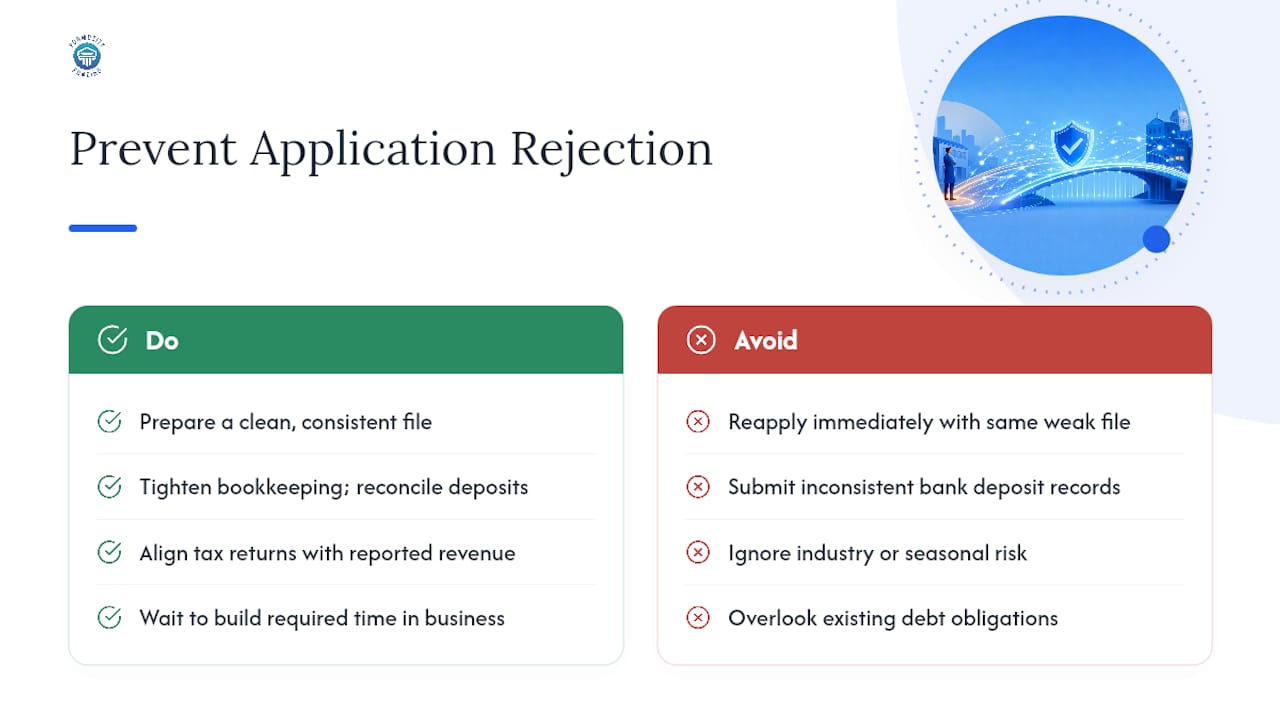
Rejections rarely come down to one dramatic problem. They usually stem from a handful of fixable issues: inconsistent revenue that doesn't match bank statement deposits, tax returns that don't align with the revenue claimed on the application, insufficient time in business for the specific product requested, or existing debt obligations that push the debt-to-income ratio too high for a given lender's appetite. Industry also plays a quiet role. Lenders sometimes flag certain sectors, cash-intensive businesses or ones with volatile seasonal revenue, as higher risk regardless of how clean the paperwork looks.
The fix for most of these issues is preparation, not a stronger sales pitch. Specific steps to raise your approval odds before you apply matter more than which platform you choose, since a clean, consistent file gets better offers from any reputable lender network. If a business owner gets rejected once, the smarter move is usually fixing the underlying issue, whether that's tightening bookkeeping or waiting a few more months to build revenue history, rather than immediately reapplying somewhere else with the same weak file.
What Happens When You Actually Talk to a Funding Specialist?
Intake starts with the basics: industry, time in business, monthly revenue, and credit tier. From there, a good specialist narrows the lender pool fast, ruling out banks that won't touch a two-year-old business and flagging SBA products that fit a company with steady cash flow but thin collateral.
The real value shows up once offers land. A specialist walks you through rate, term, fees, and funding speed side by side, pointing out the trade-off most borrowers miss on their own: the lowest rate isn't always the cheapest loan once fees and term length are factored in. Pairing a marketplace application with an actual specialist tends to produce sharper offers than automated matching alone, particularly for businesses in specialized industries where a generic algorithm might miss a niche lender that fits perfectly. Formosity Funding builds its process around exactly that model: one application, a nationwide lender network, and a person on the other end of the phone who can explain why one offer beats another for your specific situation.
— Alvin
How Formosity Funding Gets You From Application to Offer
A loan matching platform gives you one application and access to a network of lenders, so you're not filling out multiple forms to compare offers. Pre-qualification often runs on a soft credit pull, meaning you can see what's available without any hit to your credit score, and the platform covers various business funding products such as working capital, business lines of credit, SBA loans, equipment financing, and commercial real estate financing.
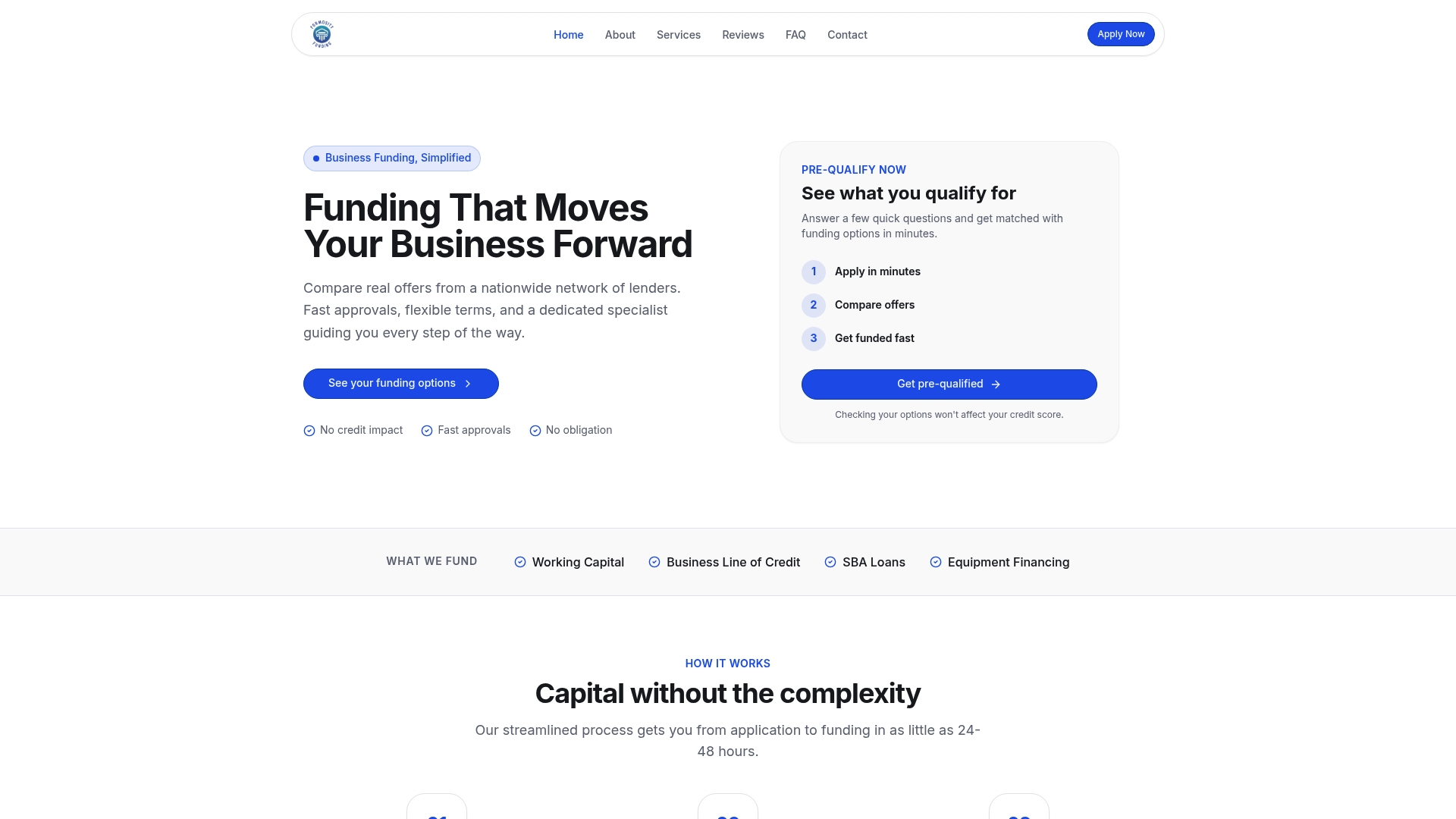
Here's how it plays out. Submit your application, and the platform matches you against lenders in its network based on your industry, revenue, and time in business. You'll get real offers to compare, and a dedicated funding specialist walks you through the trade-offs between rate, term, and funding speed before you commit to anything. Once you pick an offer, the chosen lender takes over underwriting and funding.
If you want to see what your business qualifies for, start by reviewing the full range of funding options Formosity Funding matches businesses to and submit an application when you're ready to see real offers.
Sources
- Best Business Loan Marketplaces: Compare Many Lenders (2026) — Finder
- What Is a Business Lending Marketplace? - NerdWallet
- Why You Should Use a Loan Marketplace for Your Next Business Loan — FitSmallBusiness (2026)