
Refinancing your equipment loan makes sense when you can lower your monthly payment, dodge a balloon payment coming due, pull cash out of equity you've built, or roll several loans into one. Before anything else, request a payout statement from your current lender and get a couple of rate quotes so you're comparing your actual balance against real market pricing. If cash-out or multiple offers matter to you, using a lending marketplace can speed up that comparison through no-impact pre-qualification.
TL;DR:
- Refinancing makes sense mainly when facing a balloon payment within 12 months, an improved credit score, or multiple loans creating cash flow issues.
- Extending a loan term may lower monthly payments but can also increase total interest paid, especially if the equipment's value has depreciated.
- Gathering complete documents such as payout statements, original contracts, photos, and bank statements can significantly speed up the refinancing process.
- Comparing total costs, including fees, term length, and cash-out options, is crucial before choosing a refinancing offer, not just the advertised interest rate.
- Using a lending marketplace can streamline shopping by pre-qualifying without credit impact and matching loans across multiple lenders.
Table of Contents
- When Does It Make Sense to Refinance an Equipment Loan?
- What Are the Real Tradeoffs of Refinancing Equipment?
- What Documents Do Lenders Need to Refinance Equipment?
- How Does the Equipment Refinance Process Work Step by Step?
- How Much Does It Cost to Refinance an Equipment Loan?
- What Disqualifies You From Refinancing Equipment?
- How a Lending Marketplace Speeds Up Equipment Refinancing
- A Practical Decision Framework for Refinancing
- Ready to Refinance? Here's Your Next Move
- Sources
- FAQ
When Does It Make Sense to Refinance an Equipment Loan?
Refinancing solves a specific problem. It's not a move you make just because rates ticked down a little. The businesses that come out ahead usually have one of these triggers pushing them: a balloon payment landing in the next few months, a credit score that's climbed since the original loan closed, equipment that's now worth more than what's owed on it, or three or four separate equipment notes eating into monthly cash flow with no consolidated view.
Rate drops matter too, but only when the math clears a real threshold, not a fraction of a point. Before applying anywhere, run through this checklist:
- Is a balloon payment due within the next 12 months?
- Has your business credit score improved by 40+ points since the original loan?
- Do you owe less than the equipment's current resale value?
- Are you juggling three or more equipment loans with different lenders and due dates?
- Would a lower payment free up cash for payroll, inventory, or growth this quarter?
Two or more "yes" answers usually mean refinancing is worth pursuing.
What Are the Real Tradeoffs of Refinancing Equipment?
Refinancing rarely comes free. The benefit is usually immediate: a lower monthly payment, one consolidated bill instead of several, breathing room before a balloon hits, or cash pulled from equity you already own. The cost shows up later, and it's easy to miss if you're only looking at the new monthly number.
Stretching a loan from 36 months to 60 months might cut your payment by a third, but it can also mean paying more total interest over the life of the loan, even at a lower rate. Fees eat into savings too, and if your equipment has depreciated faster than your balance has dropped, you could end up refinancing into negative equity.
- Gains: lower payment, one bill instead of several, balloon avoided, equity converted to working capital
- Costs: more lifetime interest on extended terms, origination and inspection fees, risk of owing more than the equipment is worth
Pro Tip: If your runway is tight this quarter, prioritize monthly savings even if total cost rises slightly. If cash flow is stable, prioritize the shortest term you can afford to minimize what you pay overall.
What Documents Do Lenders Need to Refinance Equipment?
Underwriters move fast when your file is complete and stall when it isn't. Missing paperwork is the single biggest reason refinance applications drag past a week. Pull these together before you apply:
- Payout statement from your current lender showing the exact balance and per diem interest.
- Original loan or lease contract so the new lender can verify terms and confirm there's no prepayment penalty ambush.
- Purchase invoice for the equipment, showing original cost and specs.
- Title or registration, if the equipment type requires one (trucks, trailers, titled machinery).
- Equipment photos: all four sides, the odometer or hour meter, and any recent major repairs. Lenders use these to confirm condition and remaining useful life.
- Bank statements, usually the last three to six months, to verify cash flow.
- Tax returns, typically the last two years, plus interim financials if your fiscal year-end isn't recent.
The most common gap is skipping the photos or the payout statement, both of which underwriters need before they'll issue a firm quote.
How Does the Equipment Refinance Process Work Step by Step?
The process runs in a predictable order once you know what each step actually requires.
- Request your payoff statement. Call or email your current lender and confirm the exact balance, not an estimate. This number anchors every quote you get afterward.
- Collect and compare quotes. Don't just compare rates. Line up total cost across rate, term length, fees, and whether cash-out is even available. Some lenders cap cash-out or don't offer it at all, so confirm what each lender actually provides before you get attached to a number.
- Submit your application and collateral package. Expect underwriting conditions: a request for one more bank statement, a clearer photo, or an updated appraisal. Respond fast to keep the timeline moving.
- Accept the offer and close. The new lender pays off your old loan directly. Confirm with your prior lender that the payoff posted and the lien released.
Small-ticket equipment loans (under roughly $100,000) often fund in a few business days to two weeks once the file is complete. Larger, specialized equipment can take three to six weeks, mostly because of appraisal scheduling and title work. The step-by-step approach outlined by Mehmi Group breaks down the cash-out math in more detail if you're weighing that option specifically.
How Much Does It Cost to Refinance an Equipment Loan?
Prepayment penalties on your existing loan are the wildcard. Some contracts charge a flat fee, others charge a percentage of the remaining balance, and a few charge nothing at all.
The breakeven math is simple: divide total refinance fees by your monthly savings to get the number of months before the refinance pays for itself.
- Example: $2,400 in total fees, $200 in monthly savings, breakeven at 12 months.
- If you plan to keep the equipment and the loan for longer than that breakeven point, refinancing wins.
- If you expect to sell or replace the equipment sooner, the fees may cancel out the benefit entirely.
Quick math check: A longer term almost always lowers your monthly payment, but it can raise what you pay in total interest over the life of the loan. Run both numbers before signing anything, not just the payment you'll see on your bank statement.
What Disqualifies You From Refinancing Equipment?
Lenders look at a handful of factors: the equipment's age and remaining useful life, its current market value relative to your loan balance, your business's cash flow, your credit profile, and whether there are any unresolved liens on the collateral.
A few situations kill applications outright. Equipment nearing the end of its useful life won't support a new term, since lenders won't finance an asset that may not outlast the loan. Owing more than the equipment is worth, unresolved liens from a prior lender, and recent operating losses on your financials all raise red flags too.
- Insufficient equity: wait until you've paid down more principal, or bring cash to close the gap.
- Equipment near end-of-life: consider a sale-leaseback instead of a refinance.
- Unresolved liens: clear the lien with your current lender before applying elsewhere.
- Recent losses: a business line of credit or short-term consolidation may fit better than a full refinance right now.
If refinancing isn't a fit, vendor financing, a sale-leaseback, or consolidating existing debt into one payment are all realistic alternate paths.
How a Lending Marketplace Speeds Up Equipment Refinancing
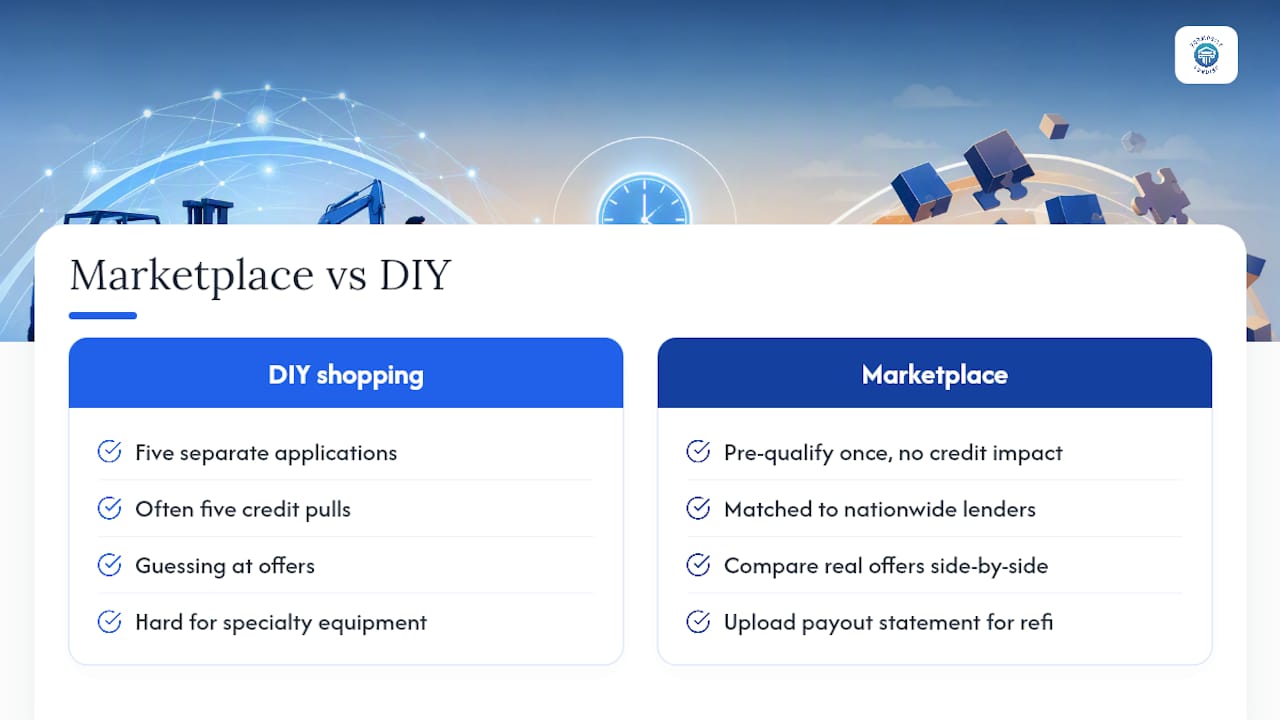
Shopping five lenders yourself means five separate applications and, often, five credit pulls. A marketplace flips that: you pre-qualify once with no impact to your credit, get matched against a nationwide lender network, and compare real offers side by side instead of guessing. This helps most with cash-out refinances, multi-loan consolidation, and specialty equipment where fewer lenders compete. Once you have your payout statement in hand, upload it and let the matching do the legwork.
A Practical Decision Framework for Refinancing
Strip away the spreadsheets and it comes down to three questions. Does this refinance serve a specific goal, not just a lower rate for its own sake? Does the new term roughly match the equipment's remaining useful life, so you're not paying on a machine that's already scrapped? And does the breakeven math clear inside a timeframe you're comfortable with, usually 12 to 18 months for most small equipment loans?
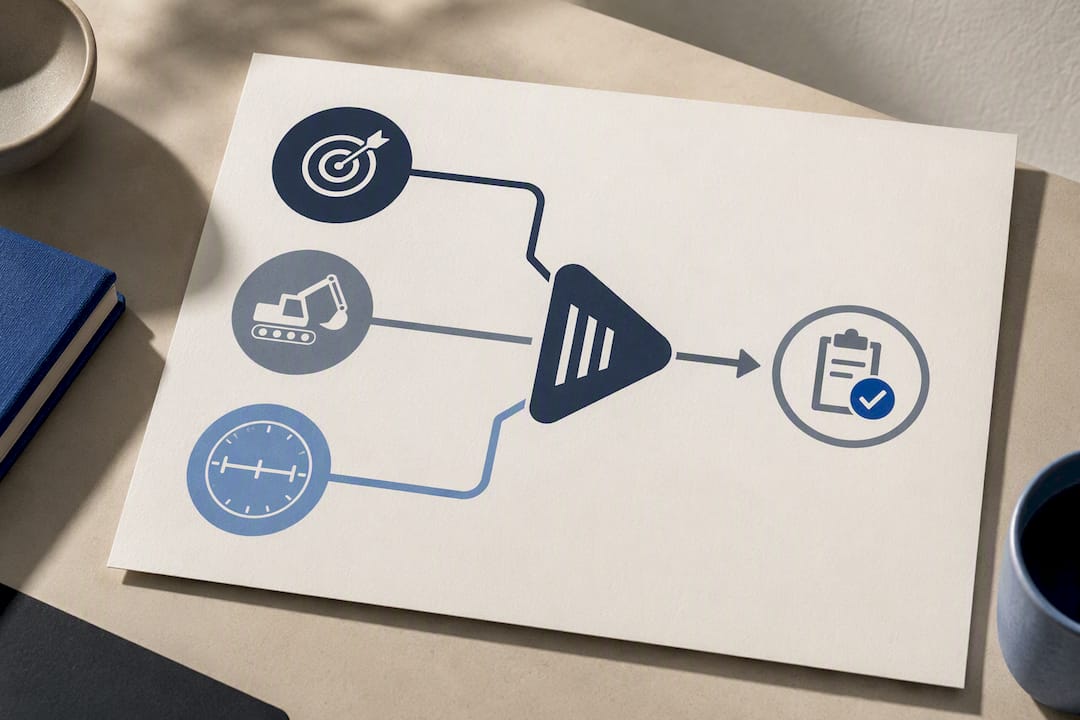
If all three check out, move forward. If even one doesn't, wait or explore an alternative structure instead.
Pro Tip: Package your collateral file before a lender asks for it. Photos, hour meter readings, and proof of recent repairs submitted upfront routinely shave days off underwriting compared to sending them piecemeal after a request.
— Alvin
Ready to Refinance? Here's Your Next Move
Some lending marketplaces provide access to real offers from a nationwide lender network without the five-application, five-credit-pull grind that shopping equipment refinancing on your own usually means. You pre-qualify once, with no credit impact, and often have a specialist assist through the process instead of managing underwriting conditions alone.
Two things move this forward today. Pre-qualify online to see what you're matched with, and upload your payout statement so the matching reflects your actual balance, not a guess. If cash-out is part of the goal, mention it upfront. Some lenders cap it or skip it entirely, and a specialist can route you to ones that don't. Start by reviewing Formosityfunding's equipment financing and other funding options and get matched with offers built around your numbers.
Sources
FAQ
What Is the 2% Rule for Refinancing?
It's a useful gut check, but it ignores fees, remaining term, and your actual breakeven math, so treat it as a starting filter, not a final answer.
How Much Does It Cost to Refinance a $300,000 Loan?
Divide total fees by your projected monthly savings to find your breakeven point before committing.
What Disqualifies You From Refinancing Equipment?
The most common disqualifiers are insufficient equity in the equipment, machinery nearing the end of its useful life, unresolved liens from a prior lender, and recent operating losses on your financials. Clearing the lien, waiting for more equity, or exploring a sale-leaseback can each address a different one of these.
What Is the Current Interest Rate on Equipment Loans?
Equipment loan rates move with broader market conditions, so check current rate and bond market data before assuming a specific number, since quotes shift week to week. Getting a couple of live quotes through a lender marketplace gives you a far more accurate picture than any published average.
How Do I Compare Refinance Offers From Different Lenders?
Compare total cost, not just the headline rate: factor in term length, origination and inspection fees, prepayment penalties on your current loan, and whether cash-out is available if you need it. A side-by-side comparison of leasing versus loan structures can also help if you're deciding between refinancing into a loan or restructuring as a lease.