

The SBA does not set a universal minimum credit score for SBA loans. Your lender decides that threshold, and many experienced lenders tend to look for personal scores generally considered acceptable, though community lenders may be more flexible for the right deal. What actually swings approval is your global debt-service coverage, collateral, time in business, and personal guarantee. Score matters less than it did before March 1, 2026, when SBA retired its FICO SBSS prescreen and pushed lenders toward broader, cash-flow-driven underwriting.
TL;DR:
- Credit score thresholds are set by individual lenders and generally favor scores in the mid-600s, but community lenders may be more flexible for weaker profiles.
- Lenders prioritize creditworthiness based on cash flow, collateral, and personal guarantees, with strict documentation procedures showing their work beyond just a credit score.
- After the SBSS prescreen's sunset, lenders rely on comprehensive, prudent credit analysis, making shopping around and pre-qualification more important than ever.
- Strong global debt-service coverage ratios around 1.25 times and solid collateral can offset lower personal credit scores in SBA loan approval chances.
- Poor recent credit events like bankruptcy or charge-offs do not automatically disqualify applicants but require clear explanations and strong supporting financials.
Table of Contents
- How SBA-Approved Lenders Evaluate Creditworthiness
- What Credit Score Do You Actually Need for an SBA Loan?
- Does Credit Evaluation Differ by SBA Loan Program?
- What Lenders Look At Beyond the Credit Score
- How to Strengthen Your Credit Profile Before Applying
- Can You Qualify With Low or Limited Credit History?
- Documents, Timeline, and Costs to Budget
- How Formosity Funding Helps You Prepare and Connect With Lenders
- Do Bankruptcies or Charge-Offs Automatically Sink Your Application?
- Which Credit Score Do Lenders Actually Pull?
- Common Misconceptions About SBA Credit Requirements
- Effect of COVID-19 Relief Programs on Credit Assessment
- What Underwriting Looks Like Now, and What You Should Actually Do
- Ready to See Where You Stand? Start With Formosity Funding
- Primary Sources Worth Bookmarking
- Sources
- FAQ
How SBA-Approved Lenders Evaluate Creditworthiness
The rule that actually governs SBA lending isn't a number. It's 13 CFR 120.150, which requires that applicants be creditworthy and that lenders apply prudent commercial credit analysis, the same kind they'd use for a similarly sized loan outside the SBA program. That single regulation explains why two lenders can look at the same borrower and reach opposite conclusions.
SBA's Standard Operating Procedures, specifically SOP 50 10, spell out what that analysis needs to cover: repayment ability, collateral, character, and management experience, all documented in a written credit memo. The eCFR reinforces that lenders may use internal scoring models if their regulator permits it, but they can't outsource judgment to a score alone.
In practice, this discretion shows up in a few consistent ways:
- Lenders build internal score bands (their own cutoffs, not SBA's) based on loan size and risk tolerance.
- Owners with 20% or more equity must sign personal guarantees and submit Form 413 personal financial statements, regardless of the entity's corporate structure.
- Every credit decision gets recorded in a loan file, including the reasoning behind approval or denial, which examiners can later review.
- Lenders document any scoring model result and the analysis behind it, per federal recordkeeping requirements.
That last point matters more than it sounds. It means a lender can't just print a score and stop. They have to show their work, and that written analysis is exactly where cash flow and collateral start outweighing the three-digit number on your credit report.
What Credit Score Do You Actually Need for an SBA Loan?
There's no SBA-mandated cutoff, but lending patterns have settled into rough bands over the years. While some lenders have historically used a personal FICO score in the mid-to-high 600s as a practical benchmark, this reflects industry habit rather than any official SBA requirement. Community lenders and mission-driven institutions have historically shown more flexibility with borrowers who fall short of that mark.
Here's how those bands tend to play out:
Credit score ranges often guide lender preferences roughly as follows, though these are not SBA rules and do not guarantee outcomes:
- Higher personal scores are often favored by larger banks and SBA lenders, especially for faster loans like 7(a) Small Loans and Express loans.
- Mid-range scores might be workable for many lenders when supported by strong cash flow and collateral.
- Lower scores can sometimes be acceptable to community lenders and CDFIs, especially with solid business history or additional collateral.
- Very low scores do not automatically disqualify applicants but may lead to increased scrutiny, higher costs, or consideration of microloan programs.
Thresholds shift depending on lender size, risk appetite, and how the loan is structured. A regional bank chasing a $2 million commercial real estate deal weighs credit differently than a CDFI underwriting a $50,000 microloan. Business credit history can also shift the weighting: a company with strong vendor trade lines and years of on-time payments can sometimes offset a personal score that isn't pristine. None of these bands are SBA rules. They're patterns lenders have settled into, and patterns can bend for the right deal.
Does Credit Evaluation Differ by SBA Loan Program?
Yes, and the differences got bigger after the SBSS sunset. Each program handles credit risk with its own mechanics.
- 7(a) Standard vs. 7(a) Small Loans. Before March 1, 2026, 7(a) Small Loans under $500,000 ran through SBA's FICO SBSS prescreen, a quick automated filter. That prescreen is now discontinued, and lenders apply the same prudent commercial credit analysis they'd use on any comparable loan, per SBA's procedural notice.
- SBA Express. Built for speed, Express loans still let lenders lean on their own internal scoring models, provided the analysis is documented. Turnaround stays fast, but the underwriting behind it looks a lot like standard commercial lending now.
- 504 and CDC loans. These loans lean heavily on project collateral and borrower equity injection rather than a personal score, since the asset being financed (often real estate or major equipment) secures much of the risk.
- Microloans and CDFI-backed programs. These tend to weigh relationship, mission fit, and cash flow more than a specific score, making them a realistic path for borrowers with thinner or bruised credit.
Loan size drives a lot of this. A $5 million 7(a) loan gets a deeper look than a $75,000 microloan, and each program's debt-service coverage expectations scale accordingly.
What Lenders Look At Beyond the Credit Score
Global debt-service coverage ratio, or global DSCR, is the number that decides more SBA applications than credit score ever did. It measures whether combined household and business income can cover all debt payments, not just the new loan. SBA guidance sets a floor around 1:1, but many lenders underwrite to roughly 1.25x coverage to build in a cushion against a slow season or an unexpected expense.
Statistic Callout: A global DSCR floor near 1:1 is the regulatory minimum, but lenders commonly want closer to 1.25x before they feel comfortable, which means your household budget and your business's cash flow both get scrutinized in the same spreadsheet.
Business credit matters here too. Vendor trade lines that report to Dun & Bradstreet or Experian Business build a track record independent of your personal FICO, and a business with two or three years of on-time trade payments can genuinely change how a lender reads the file. Our guide on building business credit walks through how to get those trade lines reporting in the first place.
Collateral and guarantees round out the picture. Lenders typically require:
- Personal guarantees from any owner holding 20% or more equity.
- Collateral appraisals on real estate, equipment, or other secured assets.
- Evidence of an equity injection, particularly on startup or acquisition loans.
- Recent bank statements, tax returns, and forward-looking financial projections that support the DSCR math.
Pro Tip: Run your own global DSCR calculation before you talk to a lender. Walking into a conversation with the math already in your favor changes how a loan officer treats the rest of your file.
Collateral requirements deserve their own deep dive, and our piece on whether SBA loans require collateral covers what counts and what doesn't.
How to Strengthen Your Credit Profile Before Applying
Fixing your credit isn't a single action. It's a short list of things done in the right order.
- Pull your reports and dispute errors. Get your personal reports from all three bureaus and your business report from Dun & Bradstreet or Experian Business, then challenge anything inaccurate. Errors are more common than most owners assume.
- Lower revolving utilization. Paying down credit cards below 30% utilization, ideally below 10%, moves your score faster than almost anything else you can do in 60 days.
- Bring every account current. A single 30-day-late mark on a business tradeline can outweigh months of clean payment history elsewhere.
- Get vendor trade lines reporting. Suppliers who report payment history to business credit bureaus build a file that lenders can verify independently of your personal score.
- Register for a DUNS number if you haven't, since some business credit products require it to build a file at all.
- Assemble clean financials. A profit and loss statement, balance sheet, tax returns, and a 12 month projection that shows a global DSCR at or above what your target lender expects.
Pro Tip: Consistent bank deposits matter more than people expect. Lenders read erratic deposit patterns as a red flag even when your credit score looks fine, because it signals unpredictable cash flow.
If your numbers still fall short after these steps, a co-signer, additional collateral, or a shift toward a microloan program can bridge the gap. Our rundown on increasing approval odds fast covers tactical moves for borrowers on a tighter timeline.
Can You Qualify With Low or Limited Credit History?
Yes, in specific situations. A thin credit file or a lower score isn't automatically disqualifying, especially now that underwriting leans harder on cash flow than it did before the SBSS sunset. A business with strong, well-documented revenue can sometimes succeed where it wouldn't have a few years ago, because lenders are required to run the full cash-flow analysis rather than filtering applicants out on a prescreen score.
Realistic paths for borrowers with limited or damaged credit include:
- Strong global DSCR and healthy collateral, which can offset a below-average personal score at many lenders.
- Community lenders and CDFIs, which often weigh mission and local relationships more heavily than large banks do.
- Microloan programs, which typically carry lower dollar amounts and more flexible underwriting.
Expect trade-offs: higher interest pricing, additional collateral requests, or a request for a co-signer. Before applying, ask yourself honestly whether six months of credit repair would move you into a materially better rate tier, or whether your cash flow story is strong enough to carry the file today.
Documents, Timeline, and Costs to Budget
Every SBA application runs through a similar document checklist, even though the depth of review varies by program:
- SBA Form 413 (personal financial statement) for each owner with 20% or more equity.
- Two to three years of business and personal tax returns.
- Recent bank statements, typically three to six months.
- Profit and loss statement and balance sheet.
- Business formation and ownership documents.
- Collateral appraisals, when the loan involves real estate or major equipment.
Timelines vary widely by program. SBA Express loans can move in a couple of weeks. Standard 7(a) and 504 loans commonly take 30 to 90 days, longer if appraisals or environmental reviews are involved. Our full breakdown of the SBA loan timeline covers what speeds the process up and what slows it down.
Costs include the SBA guarantee fee, which scales with loan size and term, plus lender closing costs, appraisal fees, and legal fees on larger deals. Check SBA's current fee tables directly, since guarantee fee percentages get updated periodically. A complete, well-organized document packet at submission is still the single biggest lever for cutting weeks off your approval timeline. For a broader checklist of what lenders expect, see our guide to small business loan requirements.
How Formosity Funding Helps You Prepare and Connect With Lenders
Some financial services platforms work as marketplaces, matching applicants with a nationwide network of SBA-capable lenders rather than underwriting loans directly. Pre-qualification with such platforms can carry no credit impact, allowing applicants to see realistic options before a hard inquiry affects their credit report.
Dedicated funding specialists may help review documentation, flag gaps before a lender sees them, and match applicants to SBA programs that fit their credit profile and loan size, whether 7(a), 504, or other funding paths. When credit is imperfect, such guidance can make a difference, especially under lender-specific underwriting systems. Educational content may support applicants between conversations. Typically, the referral relationship is straightforward: the platform connects applicants, and the lender ultimately handles the loan.
Do Bankruptcies or Charge-Offs Automatically Sink Your Application?
Not automatically, but they change the conversation. A recent bankruptcy or a string of charge-offs signals elevated risk, and most lenders will want a clear, documented explanation of what happened and what's changed since.
Time matters enormously here. A Chapter 7 discharged five years ago with a clean record since carries far less weight than one finalized eight months ago. Lenders typically want to see a stretch of rebuilt payment history, sometimes two years or more, before a bankruptcy stops dominating the underwriting conversation. Charge-offs work similarly: a single old charge-off on an otherwise clean file reads very differently than multiple recent ones.
What actually helps is context. If the bankruptcy followed a documented business downturn, a medical event, or a divorce, and your current financials show stability, lenders can and do work around it, particularly community lenders and CDFIs that build relationships case by case. What doesn't help is silence. Walking into an application without addressing a recent credit event on your report almost guarantees a harder conversation, because the lender will find it regardless and now has to wonder why you didn't bring it up first.
Some borrowers assume any bankruptcy is an automatic disqualifier. It isn't, but it does mean your global DSCR and collateral need to work harder to carry the file.
Which Credit Score Do Lenders Actually Pull?
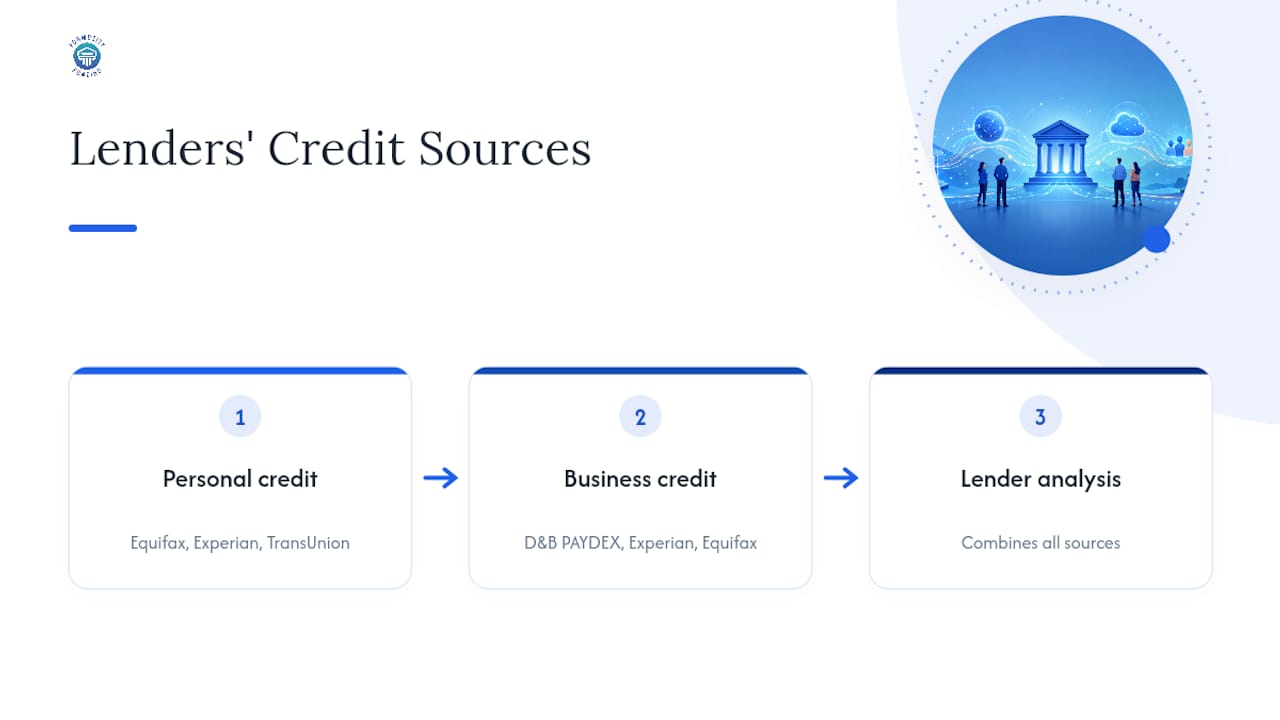
You have more than one credit score, and that surprises a lot of first-time applicants. Personal scores come from Equifax, Experian, and TransUnion, and the FICO calculation each bureau produces can differ by 20 points or more depending on what's reporting to that specific bureau. Business credit adds another layer entirely, with Dun & Bradstreet's PAYDEX score, Experian Business, and Equifax Business Credit Risk Score, all built on different data and different scales.
SBA lenders typically pull at least one personal score, often from whichever bureau their internal system defaults to, and increasingly review business credit reports as a separate data point rather than an afterthought. Since the SBSS sunset removed the single standardized prescreen score, there's no longer one universal number lenders are required to check. That shift places more weight on business credit files than before, since a lender building its own analysis has an incentive to look at every data source available, not just a personal FICO.
This is exactly why vendor trade lines and a registered business credit file matter more than they used to. A borrower who has ignored business credit and only tracks a personal score is leaving half the picture blank, right at the moment lenders are looking at more of the picture than ever.
Common Misconceptions About SBA Credit Requirements
The biggest misconception is the most persistent one: that the SBA has a published minimum credit score. It doesn't, and it never has. That number, whatever version of it circulates online, always originates from a lender's internal policy or a loan broker's rule of thumb, not from SBA regulation.
A second misconception, especially common now, is that the old SBSS score still functions as a gatekeeper for smaller loans. It was discontinued for 7(a) Small Loans as of March 1, 2026, and lenders now build their own credit analysis under the same prudent-lending standard used across all SBA programs.
A third misconception is that personal credit doesn't matter if the business has strong revenue. It does, particularly for owners holding 20% or more equity, since a personal guarantee and Form 413 are standard requirements regardless of how healthy the business financials look.
And a fourth: that one weak data point, whether a single late payment or a modest credit score, automatically disqualifies an applicant. In practice, lenders build a full picture from cash flow, collateral, guarantees, and credit history together, and a soft spot in one area routinely gets offset by strength in another.
Effect of COVID-19 Relief Programs on Credit Assessment
Pandemic-era relief programs, including PPP and EIDL, left a lasting mark on how some lenders read credit files, even years later. Deferred payments, forbearance agreements, and loan modifications from that period sometimes still appear on credit reports or in payment histories that lenders review during underwriting.
Most experienced lenders have learned to read those entries in context rather than penalizing them outright. A deferment tied specifically to 2020 or 2021 pandemic relief programs is generally treated differently than a deferment tied to ordinary financial distress, since it reflects a widely shared circumstance rather than a borrower-specific risk signal. That said, unresolved EIDL balances or missed payments on pandemic-era loans can still show up as active debt in a global DSCR calculation, which affects total coverage math regardless of when the loan originated.
The practical takeaway: if your file includes pandemic-related relief history, address it directly in your application narrative rather than hoping it goes unnoticed. Lenders reviewing files under the post-SBSS prudent-analysis standard are already digging deeper into documentation, and a clear explanation of a 2020 or 2021 deferment reads very differently than an unexplained gap in payment history.
What Underwriting Looks Like Now, and What You Should Actually Do
Underwriting got more lender-specific after the SBSS sunset, not less rigorous. That's the part a lot of borrowers misread. Without a standardized prescreen score, two lenders can reach different conclusions on the identical file, which means shopping around and having a real pre-qualification conversation matters more than it did two years ago.
If you're preparing to apply, run your own global DSCR calculation before a lender does. Pull your credit reports and fix errors now, not during underwriting. Build three to six months of clean, explainable bank statements. And resist the instinct to fixate on a single score. The lenders making the best decisions for borrowers right now are the ones reading the whole file, and you should prepare your application the same way.
— Alvin
Ready to See Where You Stand? Start With Formosity Funding
Chasing down individual banks and guessing which one might work with your credit profile wastes time you don't have. Formosityfunding is built to skip that guesswork: one application matches you against a nationwide network of lenders, and pre-qualification carries no credit impact, so you can see real options before committing to anything.
A dedicated funding specialist reviews your documentation, points out gaps before a lender does, and helps match you to the SBA program that actually fits your numbers, whether that's a 7(a), a 504, or something else entirely. If your credit history is less than perfect, that guidance is the difference between applying blind and applying strategically. Visit the Formosityfunding services page to see the full range of funding options, or start a pre-qualification today to find out where you actually stand with lenders ready to work with your business.
Primary Sources Worth Bookmarking
For direct confirmation of the rules covered here, review 13 CFR 120.150 on lending criteria, the SBA procedural notice on the SBSS sunset, and SBA's 7(a) program page for eligibility and lender responsibilities.
This article is general information, not a substitute for advice from a qualified financial advisor. Consult a qualified financial professional about your own circumstances before acting on anything here.
Sources
FAQ
Can I Get an SBA Loan With a 500 Credit Score?
It's difficult but not impossible, since the SBA itself sets no minimum score. A 500 score will steer most standard lenders toward a decline, but CDFIs and microloan lenders sometimes work with lower scores when cash flow and collateral are strong.
What Disqualifies You From an SBA Loan?
There's no single disqualifier, but unresolved federal debt, certain past defaults on government loans, and businesses in ineligible industries all create real obstacles. Weak global debt-service coverage, incomplete documentation, and an inability to demonstrate repayment ability sink far more applications than credit score alone.
Can I Get a $100,000 SBA Loan?
Yes, loans in the typical 7(a) and microloan ranges are common, and many lenders in the Formosityfunding network work with loans in those sizes regularly. Approval still comes down to your global DSCR, collateral, and documentation rather than the loan amount itself.
What Credit Score Does the SBA Need?
The SBA does not publish or require a minimum credit score under 13 CFR 120.150. Individual lenders set their own thresholds, and a personal score in the mid-600s or better is a common practical benchmark, though community lenders often accept less.