

Yes, SBA loans typically require an unlimited personal guarantee from anyone owning a significant ownership share of the business, usually documented on SBA Form 148. That guarantee makes you personally liable for the full loan balance, not just your ownership share. Key managers can be pulled in too, even below that threshold. A handful of exceptions exist, mainly around disaster loans and microloans, which we cover further down.
TL;DR:
- Owners with 20% or more ownership must sign an unconditional guarantee, which guarantees the full loan amount without any cap or limit.
- Guarantees can extend to direct ownership, attributed interests through trusts or family, and even community property states if applicable.
- Lenders can require guarantees from key managers or minority owners regardless of their ownership percentage, especially on larger loans.
- Borrowers can negotiate limited guarantees, carve-outs for personal assets, or insurance policies to reduce personal liability before signing.
- Guarantees only end upon full repayment, business sale with lender approval, or refinance, with lender consent being often overlooked by borrowers.
Table of Contents
- Who Has to Sign an SBA Personal Guarantee?
- Unlimited vs. Limited Guarantees: What You're Actually Signing
- How Lenders Enforce the Guarantee and Use Collateral
- Are There Exceptions to the Personal Guarantee Rule?
- How to Limit Your Exposure Before You Sign
- When Does an SBA Personal Guarantee Actually End?
- How Formosity Funding Helps You Navigate the Guarantee Question
- Get SBA Financing Support Without Guessing at the Fine Print
- Sources
Who Has to Sign an SBA Personal Guarantee?
The SBA's rule is blunt: anyone with 20% or more ownership, direct or attributed, has to sign an unconditional personal guarantee. Ownership attribution reaches through holding companies, trusts, and family relationships, so a 15% direct stake plus a 10% stake held by a trust you control usually adds up to a guarantee requirement, not an exemption.
Spouses get pulled in through community property rules in several states, particularly when combined marital interests reach the ownership threshold for guarantees. Even below the threshold, lenders retain discretion to require a guarantee from a general manager or minority owner they consider essential to repayment.
- Direct ownership above the SBA required threshold triggers a mandatory guarantee.
- Attributed ownership through trusts, holding entities, or family members counts toward the ownership requirement.
- Community property states can pull in a non-owner spouse.
- Lenders can require guarantees from key managers regardless of ownership percentage.
Under 7(a) loan program rules, lenders must obtain these guarantees to keep the loan eligible for the SBA's own guarantee to the bank, so there's little room for a lender to skip this step.
Unlimited vs. Limited Guarantees: What You're Actually Signing
An unconditional guarantee, signed on Form 148, covers the entire outstanding principal, accrued interest, late fees, and the lender's collection or legal costs if things go sideways. There's no cap. If three owners each hold 25% and sign guarantees, the lender can pursue any one of them for 100% of the debt under joint and several liability, then let that guarantor sort out reimbursement from the others separately.
Limited guarantees, filed on Form 148L, cap exposure by dollar amount, percentage of the loan, time period, or specific collateral. Lenders sometimes use 148L for minority owners or investors who wouldn't otherwise sign at all.
Quick reference:
- Form 148 (unconditional): Full balance, no dollar cap, joint and several among all signers.
- Form 148L (limited): Capped by amount, percentage, time, or asset, per SBA form instructions.
Pro Tip: Incorporating your business doesn't shield you here. The corporate liability shield stops at the guarantee, since you're signing as an individual, not as the company.
How Lenders Enforce the Guarantee and Use Collateral
Lenders don't have to liquidate business assets first. Once a loan defaults, the bank can go straight after a guarantor's personal bank accounts, wages, and property, then work out business collateral separately or in parallel.
Collateral still matters, though. On larger loans, expect UCC-1 filings against business equipment and inventory, plus a lien on commercial real estate if the loan financed a property purchase. Our breakdown of SBA loan collateral requirements walks through how that typically gets structured by loan size.
The realistic enforcement sequence looks like this:
- Default triggers a demand letter, then acceleration of the full balance.
- The lender liquidates business collateral through UCC or real-estate foreclosure.
- Any shortfall becomes a deficiency claim pursued against the personal guarantor.
- Bank levies, wage garnishment, or personal property liens follow if the deficiency remains unpaid.
Pro Tip: Ask your lender in writing whether they intend to pursue collateral and guarantor simultaneously or sequentially. That answer shapes your negotiating leverage before you ever sign.
Are There Exceptions to the Personal Guarantee Rule?
Disaster loans, including SBA's Economic Injury Disaster Loans, have historically used higher dollar thresholds before triggering a personal-guarantee requirement, unlike standard 7(a) loans where the 20% ownership rule applies almost universally. Microloan programs, run through nonprofit intermediaries rather than banks, often still ask for a guarantee even on loans of $50,000 or less, since the intermediary carries more direct risk than a bank would on a guaranteed 7(a) loan.
Outside those programs, exceptions are narrow:
- Disaster loan guarantee thresholds differ from standard 7(a) rules.
- Microloan intermediaries frequently require guarantees despite small loan sizes.
- Lenders retain discretion to require a guarantee from someone under 20% ownership if they're deemed critical to repayment, per plain-language SBA loan explainers.
How to Limit Your Exposure Before You Sign
You have more negotiating room than most borrowers assume, but only if you raise these points before closing, not after.
- Ask which form you're signing. Push for Form 148L with a stated cap if you're a minority owner, rather than defaulting to the unconditional Form 148.
- Negotiate carve-outs. Request exclusions for specific personal assets, like a primary residence, or a maximum liability percentage tied to your ownership share.
- Look into Personal Guarantee Insurance. PGI policies indemnify part of your out-of-pocket exposure if the loan defaults, though they carry their own limits and exclusions and don't erase the underlying guarantee.
- Talk to an estate or bankruptcy attorney before signing, not after. A guarantee can survive a bankruptcy filing depending on how it's structured, and it affects estate planning if something happens to you while the loan is outstanding.
- Keep your paperwork organized. Save signed copies of Form 148 or 148L, any release language, and every loan modification, since these documents are what a lawyer needs if a release dispute ever comes up.
Pro Tip: A collateral assignment life insurance policy is worth discussing with your insurance broker, since it can secure part of the loan without stacking more direct personal liability on top of your guarantee. Firms like E2W specialize in structuring these.
When Does an SBA Personal Guarantee Actually End?
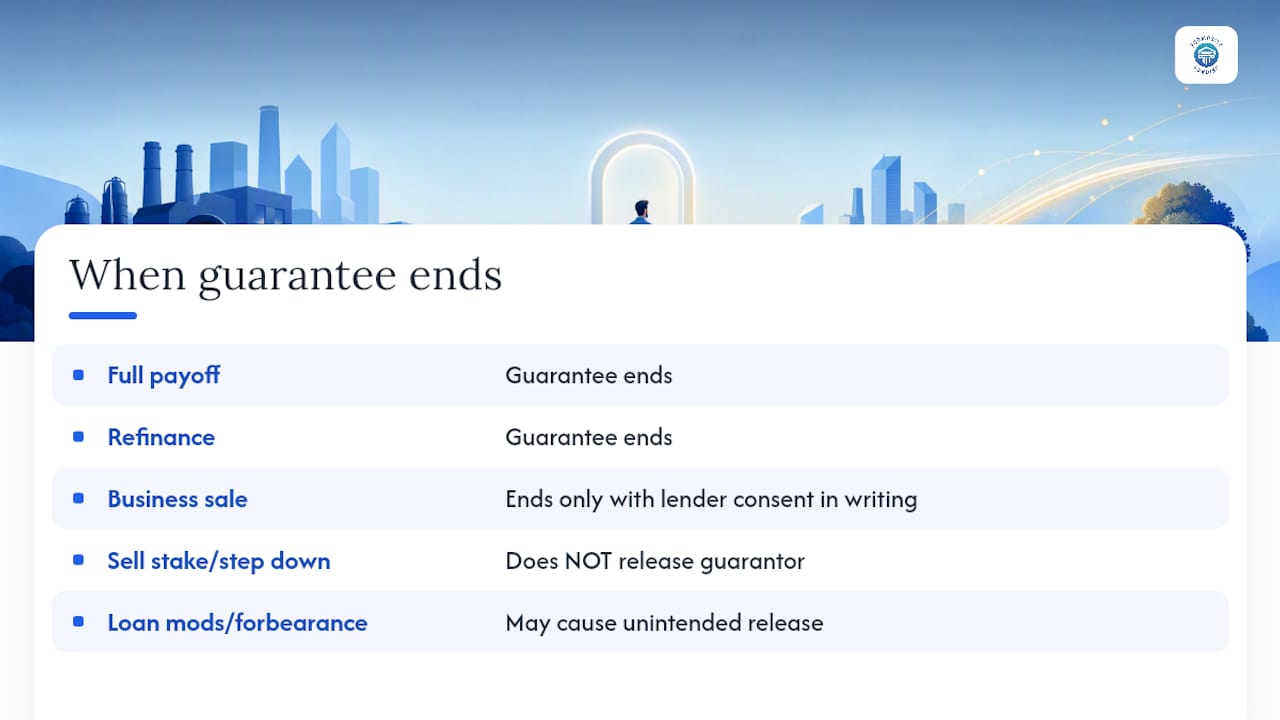
Guarantees end at full payoff, at refinance into a new loan, or when a business sale closes with the lender's written consent releasing you. That lender consent is the part borrowers underestimate. Selling your stake or stepping down as manager doesn't automatically release you. The lender has to agree in writing, and until they do, your name stays on the hook regardless of who now runs the company.
Loan modifications and forbearance agreements add another wrinkle. The SBA's own guidance warns that guarantors on Form 148L can sometimes get released unintentionally if a balance-reduction limitation kicks in while the loan is current, which can leave the lender holding more risk than they realized. Get any modification's effect on your guarantee spelled out in writing before you agree to it, and check our guide on the SBA loan timeline for how long these adjustments typically take to process.
How Formosity Funding Helps You Navigate the Guarantee Question
We work with a nationwide network of lenders every day, and the personal guarantee question comes up in nearly every SBA conversation we have with business owners. Our role at Formosity Funding is matching you with lenders whose terms and guarantee expectations actually fit your ownership structure, then walking you through what you're signing before you sign it. For deeper background on the fees and mechanics that pair with a guarantee, our piece on the SBA guarantee fee is worth a read. Guarantee terms are legal commitments, so pair this with advice from a qualified attorney before you commit.
— Alvin
Get SBA Financing Support Without Guessing at the Fine Print
Formosity Funding is the marketplace where you compare real SBA loan offers side by side. This way, you know exactly whose guarantee terms you're evaluating before you commit to one. We start with pre-qualification that has no credit impact, match you against our nationwide lender network, and assign a funding specialist who helps you prepare the documentation lenders actually ask for, including guarantee paperwork.
Expect a short application, a handful of real offers to compare, and a specialist who can flag whether a lender is offering a standard Form 148 or has room to negotiate a limited guarantee for your situation. If your business is preparing for its first SBA application, review the documents lenders expect first, then start your pre-qualification through our business funding services to see what offers you actually qualify for.
Sources
For the primary rules, go directly to the SBA's Form 148 guarantee page and the 7(a) loan program overview. For collateral specifics, see our guide on business loan collateral options.
This article is general information, not a substitute for advice from a qualified financial advisor. Consult a qualified financial professional about your own circumstances before acting on anything here.
- Unconditional Guarantee | U.S. Small Business Administration
- 7(a) loans | U.S. Small Business Administration