

Yes, a US small business can get funded without handing over tax returns, through options like bank-statement loans, invoice factoring, revenue-based financing, and merchant cash advances. Lenders substitute deposit history, receivables, or card sales for tax documentation. The trade-off is real: faster approval and looser paperwork usually mean higher rates and shorter terms, so the right choice depends on your revenue pattern and how much collateral you can offer.
TL;DR:
- No-doc and low-doc loans typically have higher interest rates and shorter terms compared to traditional bank loans due to increased lender risk.
- Revenue-based financing suits seasonal and steady businesses, while invoice factoring works well for B2B companies with strong clients and messy tax histories.
- Merchant cash advances offer fast funding but at high costs, making them suitable only if immediate cash is more important than repayment expense.
- Bank-statement commercial loans are preferable for real estate or heavier assets, usually providing better rates and larger amounts than unsecured short-term products.
- Preparing clear bank statements, collateral proof, and detailed explanations of unusual deposits significantly improves approval odds and terms.
Table of Contents
- Business Loan Without Tax Returns: How No-Doc and Low-Doc Lending Works
- Loan Options That Skip Tax Returns: Factoring, MCAs, Lines, and More
- Comparing No-Tax-Return Financing Options Side by Side
- Documents Lenders Accept Instead of Tax Returns
- The Real Cost of Skipping Tax Returns
- How to Apply for a Loan Without Tax Returns, Step by Step
- Why This Market Rewards Preparation, Not Just Speed
- Formosity Funding's Role in No-Tax-Return Business Financing
- Get Matched With a Lender That Skips the Tax-Return Runaround
- Sources
Business Loan Without Tax Returns: How No-Doc and Low-Doc Lending Works
A no-doc loan skips tax returns almost entirely and leans on other proof of revenue. A low-doc loan still asks for something, usually a handful of bank statements or a profit-and-loss sheet, but nowhere near the two years of returns a bank underwriter would want. A bank-statement loan sits in between: it uses 12 months (sometimes 24) of business deposits to calculate income instead of a tax filing, and it's especially common in owner-occupied commercial property financing.
Lenders that skip tax returns still need to answer the same question a tax return would answer: can this business actually pay the money back? They just get there differently. Many lenders offer no-doc or low-doc business loans that accept substitutes such as bank statements or merchant processing records in place of a full tax filing.
The signals underwriters lean on instead include:
- Average monthly deposits across your business bank account
- Merchant processing volume, if you take card payments
- Outstanding invoices and the credit quality of the businesses that owe you
- A basic profit-and-loss statement, even an unaudited one
- Personal credit score and time in business
- Collateral, whether that's equipment, receivables, or real estate
Pro Tip: Pull your own bank statements before a lender asks for them. If you spot a one-time deposit that inflates a slow month, be ready to explain it. Underwriters notice inconsistencies before you point them out.
Here's the catch: skipping tax returns doesn't mean skipping risk assessment; it means shifting where the risk assessment happens, and that shift almost always costs you something. No-doc and low-doc loans generally carry higher interest rates and shorter repayment terms than traditional bank loans, because the lender is taking on more uncertainty without a tax-verified income history.
None of this happens in a regulatory vacuum, either. Legitimate lenders and brokers operating in this space are registered and searchable through the NMLS Consumer Access database, and it's worth checking a lender there before you sign anything. If a broker is also arranging securities-based financing, FINRA is the relevant regulator to check.
Loan Options That Skip Tax Returns: Factoring, MCAs, Lines, and More
Not every no-tax-return product works the same way, and picking the wrong one for your business model is the most common mistake owners make. Here's how the main options actually function.
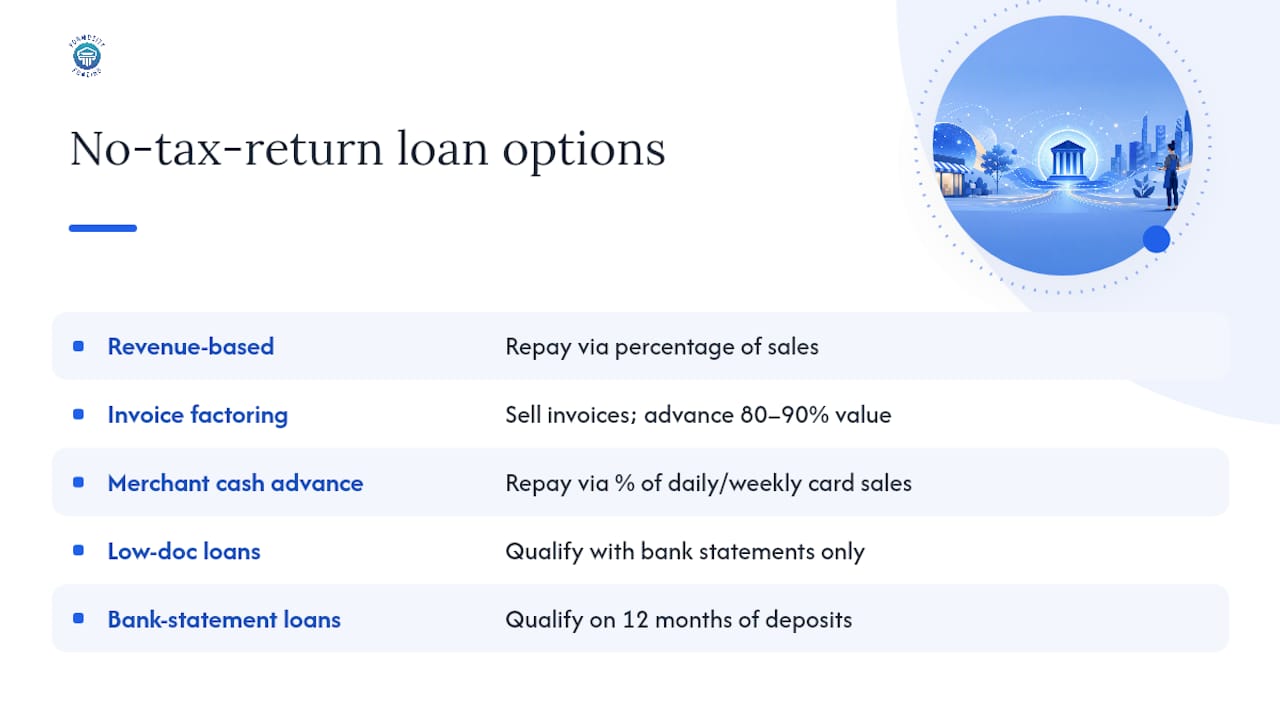
Revenue-based financing. You get a lump sum, and repayment is tied directly to a percentage of your sales. Slow month, smaller payment. Strong month, bigger one. This fits businesses with steady but seasonal revenue, like a landscaping company or a retail shop with predictable swings, better than it fits a business with flat, unpredictable income.
Invoice factoring. This isn't technically a loan at all. You sell your unpaid invoices to a factoring company at a discount, and they advance you most of the cash right away. Invoice factoring is structured as the purchase of accounts receivable and is assessed on the creditworthiness of your customers, not your own tax filings. That distinction is why factoring works so well for B2B companies with net-30 or net-60 terms and strong clients but a thin or messy tax history. Invoice finance arrangements can advance 80 to 90% of invoice value within 24 to 48 hours once approved, though that figure comes from an Australian lender and pricing structures vary by market.
Merchant cash advance (MCA). A lender gives you a lump sum against future card sales, then collects a fixed percentage of your daily or weekly card transactions until it's repaid. MCAs fund fast, sometimes within a day, but they're one of the more expensive ways to borrow money, and the daily withdrawal can strain cash flow for a business that's already tight. Retail shops and restaurants use these more than most, mostly because their card volume makes repayment easy to calculate.
Low-doc lines of credit and short-term online loans. These typically ask for a handful of recent bank statements, a driver's license, and basic business formation documents instead of tax returns. Non-bank lenders and online platforms commonly approve loans within 24 to 72 hours when applicants supply bank statements or invoice records instead of tax filings. A business line of credit gives you a revolving pool to draw from as needed, which suits businesses with recurring, smaller cash gaps better than a one-time term loan does.
Bank-statement commercial loans. These are mostly used for owner-occupied commercial real estate, where the lender qualifies you on 12 months of deposits rather than tax returns. Certain commercial loan programs use this exact structure, particularly for self-employed borrowers and business owners whose tax returns show heavy write-offs that understate actual cash flow.
Here's the pattern worth remembering: products backed by an asset or a receivable (factoring, bank-statement real estate loans) tend to offer better rates and larger amounts than unsecured, cash-flow-only products like MCAs and short-term loans, because the lender has something concrete to fall back on if you can't pay.
Comparing No-Tax-Return Financing Options Side by Side
| Financing type | Documentation required | Funding speed | Typical size | Cost profile | Repayment structure |
|---|---|---|---|---|---|
| Revenue-based financing | 3–6 months bank statements, sales history | 2–5 days | $10,000–$500,000 | Fixed fee, no interest rate in the traditional sense | Percentage of daily/weekly sales |
| Invoice factoring | Unpaid invoices, debtor credit info | 24–48 hours after setup | 80–90% of invoice value advanced | Discount rate per invoice (factor fee) | One-time advance, repaid when debtor pays |
| Merchant cash advance | 3–4 months card processing statements | Same day to 48 hours | $5,000–$250,000 | High factor rate, expressed as a multiple of the advance | Fixed daily/weekly holdback from card sales |
| Business line of credit | Bank statements, basic entity docs | 1–3 days | $10,000–$250,000 | Interest only on what you draw | Revolving, minimum payments plus interest |
| Short-term online term loan | Bank statements, ID, entity formation docs | 24–72 hours | $5,000–$500,000 | Fixed fee or APR, generally higher than bank loans | Fixed weekly or daily payments |
| Bank-statement commercial loan | 12–24 months business bank statements | 2–4 weeks | $150,000–$5 million+ | Rate premium over conventional mortgage, but below MCA pricing | Standard amortization, often 20–30 year terms |
Match the product to the actual problem, not the other way around:
- Need to cover payroll or a temporary cash gap: a line of credit or short-term loan usually gets there fastest.
- Waiting on unpaid B2B invoices: factoring converts that paper into cash without adding debt to your balance sheet.
- Buying or refinancing the building your business operates from: a bank-statement commercial loan is built for exactly that.
- Seasonal revenue with strong months and slow months: revenue-based financing flexes with your actual sales.
- Need cash today and have strong daily card volume: an MCA is fast, but understand you're paying the most for that speed.
Documents Lenders Accept Instead of Tax Returns
Skipping tax returns doesn't mean skipping paperwork. Most no-doc and low-doc lenders still want a real picture of your business, just built from different documents. Gather these before you apply:
- Three to twelve months of business bank statements. The exact window depends on the product; bank-statement commercial loans usually want a full 12 to 24 months, while short-term loans might only need three or four.
- Merchant processing statements, if a meaningful share of your revenue comes through card payments.
- A simple profit-and-loss statement, even if it's not audited or prepared by a CPA.
- Government-issued ID for every owner with 20% or more equity in the business.
- Entity formation documents, including your articles of organization or incorporation and your EIN letter.
- Outstanding invoices and accounts receivable aging, if you're pursuing factoring.
- Proof of collateral, such as equipment titles or a property deed, if the loan is secured.
- A voided business check for setting up automatic payments.
Your personal credit score still matters, even without tax returns in the mix. Most no-doc lenders want to see at least 550 to 600 for MCAs and short-term products, while bank-statement commercial loans typically expect 650 or higher. Time in business matters too. Six months is the rough floor for most online lenders; two years opens up better pricing across nearly every product category. Weak credit or a newer business often means a lender will ask for a personal guarantee or specific collateral to offset the risk.
Pro Tip: Annotate your bank statements before you submit them. If a $30,000 deposit was a one-time equipment sale rather than recurring revenue, write that on the statement or in a cover note. Presenting annotated bank statements alongside a concise summary that explains unusual deposits materially improves approval odds with bank-statement underwriters.
A short executive summary helps too, even one page. State how long you've been operating, what drives your revenue, and why any dip or spike in deposits happened. Underwriters read hundreds of statements a month; a document that answers their questions before they ask saves everyone time. For a broader look at what different lenders expect, small business loan requirements vary more by product type than most owners realize.
The Real Cost of Skipping Tax Returns
Faster approval and lighter paperwork come at a price, and it's worth knowing exactly what that price looks like before you sign. No-doc and low-doc loans generally carry higher interest rates and shorter repayment terms than a bank loan would, because the lender is pricing in the risk of not verifying income through tax documents.
Merchant cash advances use factor rates instead of APRs, typically ranging from 1.1 to 1.5 times the amount advanced. Short-term online loans often run 15% to 50% APR-equivalent, and bank-statement commercial loans usually have interest rates moderately above conventional mortgage rates.
Watch for these before you commit:
- Daily or weekly holdbacks that don't flex with a slow sales week, unlike true revenue-based products.
- Factor rates disguised as low "interest rates" that are actually much higher once annualized.
- Confessions of judgment buried in MCA contracts, which let a lender obtain a court judgment against you without a hearing if you default.
- Stacking, where a business takes on a second or third MCA to cover payments on the first, which spirals fast.
- Renewal or rollover fees that quietly extend a short-term loan into a much longer, more expensive obligation.
Before signing anything, ask the lender directly: what's the total dollar cost of this loan, not just the rate? Is there a prepayment penalty if I pay it off early? What happens if a payment bounces? A legitimate lender answers these without hesitation. One that gets vague or pressures you to sign same-day is a lender worth walking away from.
How to Apply for a Loan Without Tax Returns, Step by Step
- Get pre-qualified first. Most no-doc and low-doc lenders offer a soft-check pre-qualification that doesn't touch your credit score, giving you a realistic range before you commit to a full application.
- Assemble your document pack. Pull bank statements, merchant processing reports, and your P&L, then annotate anything unusual so the underwriter isn't guessing.
- Match the product to your need. A cash-flow gap calls for a line of credit; an equipment purchase might fit a term loan better; unpaid invoices point straight to factoring.
- Submit and expect a fast response. Online and non-bank lenders often respond within 24 to 72 hours for short-term products, while bank-statement commercial loans can take two to four weeks given the larger dollar amounts involved.
- Ask the hard questions before accepting. Total cost of capital, prepayment terms, personal guarantee requirements, and what happens on a missed payment should all be answered clearly, in writing.
- Compare more than one offer. A single quote tells you nothing about whether it's competitive; a second or third quote does.
Pro Tip: If a lender still requires collateral despite calling itself a "no-doc" product, ask exactly what qualifies. Business loan collateral can include equipment, inventory, or receivables, not just real estate, and knowing your options ahead of time speeds up negotiation.
Why This Market Rewards Preparation, Not Just Speed
The pitch behind no-tax-return lending is speed, but speed isn't the part that actually determines whether a business comes out ahead. What determines that is whether the owner understood the real cost before signing, and in my read of this space, most owners don't, not because they're careless, but because factor rates and daily holdbacks are deliberately harder to compare than a simple APR.
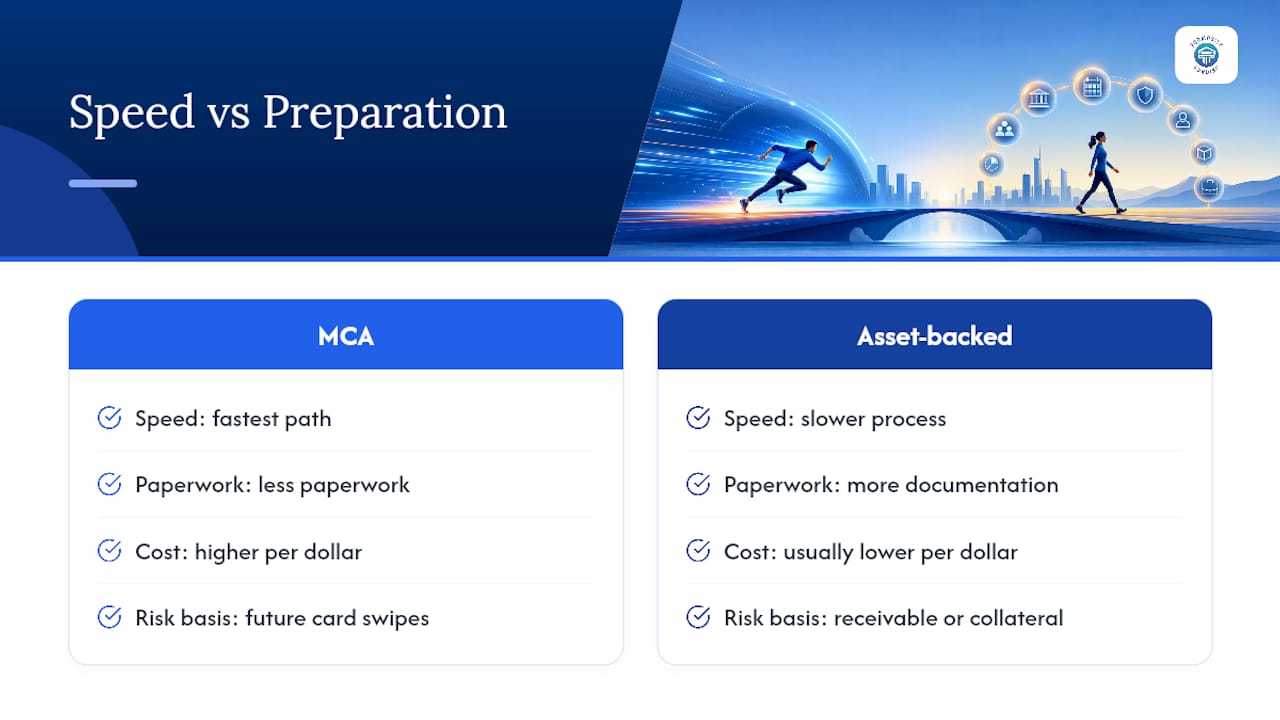
Here's what gets underweighted constantly: the asset-backed options, factoring and bank-statement real estate loans, are usually the better deal even though they take longer and ask for more paperwork than an MCA. An MCA feels like the fastest path out of a cash crunch, and sometimes it is the only path. But a business that qualifies for factoring instead of an MCA is almost always paying less for the same dollar of working capital, because the lender's risk is anchored to a receivable rather than a bet on future card swipes.
The other thing worth saying plainly: not having tax returns to show doesn't mean you have nothing to show. Solid bank deposits, strong customer credit, or real collateral can replace a tax return in an underwriter's eyes, sometimes more convincingly than the tax return would have. The businesses that get the best terms in this category aren't the ones that move fastest. They're the ones that show up with a clean deposit history and a one-page explanation of anything unusual before the underwriter has to ask for it.
— Alvin
Formosity Funding's Role in No-Tax-Return Business Financing
If you'd rather not shop each lender type individually, Formosity Funding works as a matchmaking layer across a nationwide network of lenders, many of whom offer the exact products covered here: bank-statement loans, lines of credit, revenue-based financing, and more. Pre-qualification runs as a soft check, so it won't touch your credit score before you see real offers.
This setup tends to help two kinds of owners most: those who don't have time to research a dozen lenders one by one, and those whose financials don't fit a standard bank template, whether that's a newer business, seasonal revenue, or a tax return that understates real cash flow. You submit your business and financial basics once, and the platform surfaces offers from lenders whose criteria actually match your profile instead of a generic template.
Get Matched With a Lender That Skips the Tax-Return Runaround
Here's the practical problem with shopping no-doc loans on your own: every product type covered above, from factoring to bank-statement loans to MCAs, has its own application, its own underwriting quirks, and its own way of pricing risk. Comparing them one by one eats the exact time you're trying to save by skipping tax returns in the first place.
Formosityfunding solves that by putting one application in front of a nationwide network of lenders instead of one lender at a time. Pre-qualification doesn't touch your credit score, and the funding options page covers a variety of funding options so you're not boxed into a single product before you've even seen your options. If your business is newer or your entity structure needs sorting out first, Bright Capital America's formation service can help get that squared away before you apply. Start a no-impact pre-qualification through Formosity Funding and see which lenders in the network are actually a fit for your numbers, not just your tax returns.
Sources
For readers who want to verify lender legitimacy or dig deeper into any of the products covered, the NMLS Consumer Access database lets you confirm a lender's licensing status directly. Explainers from SoFi, Forbes Advisor, and Lendio cover no-doc mechanics in more detail, and Formosity Funding's services page outlines current funding products available through its lender network.
- No-Doc Business Loans: How To Qualify | SoFi
- No-Doc Business Loans | Forbes Advisor
- What is invoice factoring | ResolutAI