

Commercial loan LTV is the loan amount divided by the property's appraised value, expressed as a percentage. It sets a hard cap on how much a lender will advance, and it drives your interest rate, covenants, and deal structure. Lenders never look at LTV alone; they run it against debt service coverage and debt yield, then bind your loan to whichever test produces the lowest number.
TL;DR:
- The maximum loan size depends on the lowest outcome among LTV, DSCR, and debt yield calculations, often favoring the most conservative limit.
- Appraisal timing and accuracy significantly impact the actual LTV and proceeds, especially if appraisals are outdated or undervalue current property worth.
- Borrowers in the lower leverage range (50-60%) typically enjoy tighter interest spreads and fewer covenants, whereas higher leverage triggers guarantees and stricter conditions.
- Adjusting your leverage before applying through equity, improving NOI, or enhancing tenant credit can meaningfully raise your LTV and borrowing capacity.
- Refinancing with cash-out options usually caps LTV at lower levels (around 75%) and requires seasoning, strong NOI, and thorough documentation to succeed.
Table of Contents
- What Is Commercial Loan LTV and How Do You Calculate It
- How Lenders Size Your Loan: LTV, DSCR, and Debt Yield
- Typical LTV Benchmarks by Property Type and Market Conditions
- How LTV Shapes Your Rate, Covenants, and Loan Structure
- How to Lower or Manage Your LTV Before You Apply
- Refinance and Cash-Out LTV: What to Expect
- What Lenders Actually Ask For, and Why It Trips Borrowers Up
- Get Matched With Lenders Who Fit Your LTV Profile
- Sources
What Is Commercial Loan LTV and How Do You Calculate It
The formula is simple: loan amount ÷ appraised value × 100. Borrow $6.5 million against a property appraised at $10 million, and your LTV is 65%. That single number tells a lender how much cushion exists if they had to foreclose and resell.
Appraisals matter as much as the math. Most institutional lenders require a full-narrative MAI appraisal from a certified general appraiser, not a restricted-use or drive-by report. When a property carries more than one loan, lenders calculate combined loan-to-value (CLTV), adding every lien against the property before dividing by value. A $6 million first mortgage plus a $1 million mezzanine loan against a $10 million property produces a 70% CLTV, even though the first mortgage alone sits at 60%.
A few things to keep straight before you run your own numbers:
- LTV uses appraised value, not purchase price, on refinances and often on acquisitions when the appraisal comes in below contract.
- CLTV counts every recorded lien, including seller financing and preferred equity structured as debt.
- Appraisal timing matters: a stale appraisal can understate current value and unnecessarily shrink your proceeds.
How Lenders Size Your Loan: LTV, DSCR, and Debt Yield
Here's what trips up a lot of borrowers who've done their LTV math and assume they're set: a lender's stated maximum LTV is a ceiling, not a promise. Lenders run three tests and lend against whichever one produces the smallest number.
Debt service coverage ratio (DSCR) divides net operating income by annual debt service. A DSCR of 1.25x means the property generates 25% more income than it needs to cover the loan payment.
Debt yield divides net operating income by loan amount.
Here's how underwriting typically plays out:
- The lender calculates the maximum loan under a stated LTV cap, say 65% of a $10 million appraisal, or $6.5 million.
- The lender calculates the maximum loan under its DSCR requirement, using the property's NOI and current rate.
- The lender calculates the maximum loan under its debt yield floor.
- Whichever test produces the lowest loan amount becomes the actual offer.
A property with soft in-place income can hit its DSCR ceiling well before it reaches 65% LTV, capping proceeds at $5.8 million even though the LTV math suggested more room. This is standard loan-sizing methodology across commercial lending, and it's the single most common reason borrowers get surprised by a lower offer than they expected.
Typical LTV Benchmarks by Property Type and Market Conditions
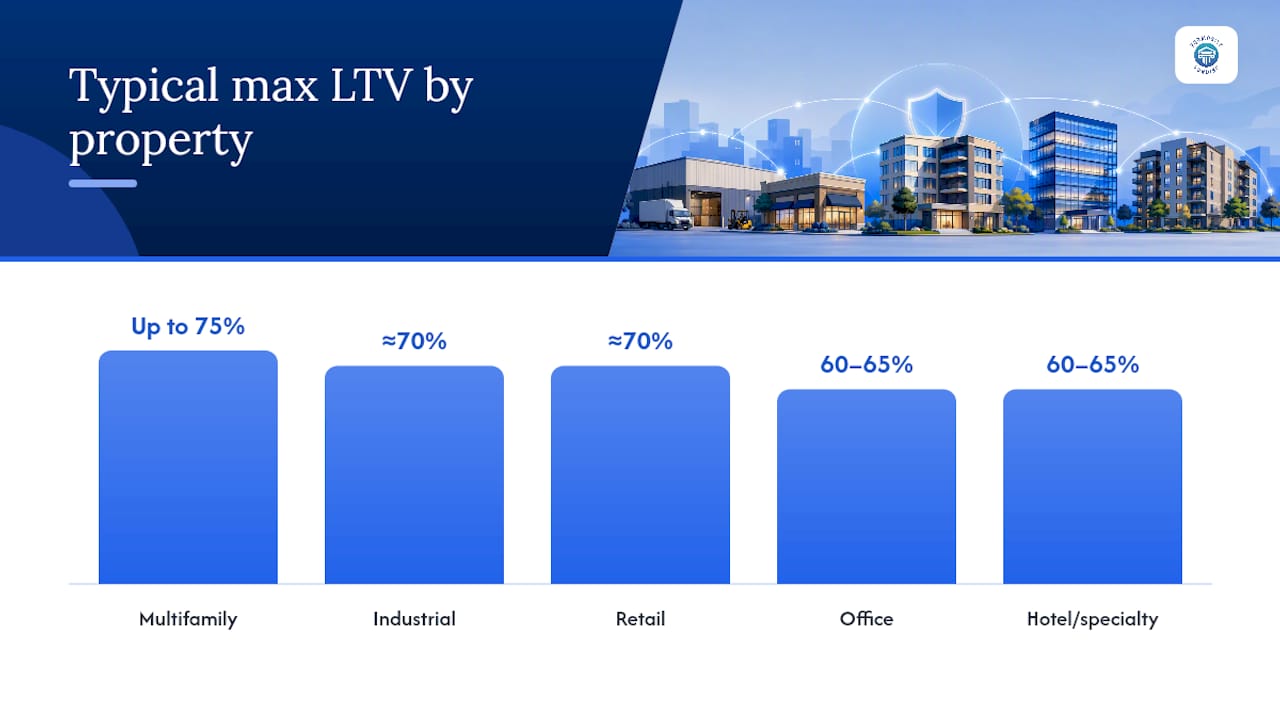
Leverage appetite moves with the economy, and it's moved a lot recently. CBRE reported that average commercial LTV climbed to 61.5% in the first quarter of 2026, with multifamily LTV rising to 67.2%. That marks a real shift from the tighter underwriting of the prior few years, though leverage still sits well below the roughly 80% averages common in 2021, according to NNN Triple Net's underwriting data.
Property type still drives most of the variation:
| Property Type | Typical Max LTV | Active Lender Types |
|---|---|---|
| Multifamily | Up to 75% | Agency lenders, banks, life companies |
| Industrial | Around 70% | Banks, CMBS, credit unions |
| Retail (self-storage included) | Around 70% | Banks, life companies |
| Office | 60–65% | Balance-sheet banks, select CMBS |
| Hotel/specialty | 60–65% or lower | Bridge lenders, private capital |
These figures come from PeerSense's institutional benchmarks. Tenant credit quality shifts these bands too. A single-tenant retail property leased to an investment-grade credit on a 15-year term can often justify higher leverage than an identical building with a rotating cast of local tenants on short leases.
How LTV Shapes Your Rate, Covenants, and Loan Structure
Every point of leverage you add costs you something on the back end. Lower LTV borrowers, generally in the 50–60% range, tend to see spreads roughly 25 basis points tighter than those borrowing in the mid-60s, according to LoopNet's commercial financing guidance. That gap compounds fast on a $10 million loan over a 10-year hold.
Higher leverage also changes what the lender asks for beyond rate:
- Personal or corporate guarantees become standard once LTV climbs past the mid-60s, whereas lower-leverage deals can often qualify for non-recourse terms.
- Reserve requirements (tax, insurance, capital expenditure) grow larger and more restrictive at higher LTV.
- Amortization schedules shorten, and interest-only periods shrink or disappear.
- Financial covenants, like minimum DSCR triggers, get tighter and more frequently tested.
Pro Tip: *If you're near a leverage threshold, ask your lender what the terms look like five points lower.
Rate movements tied to leverage compound with broader commercial mortgage rate trends, so timing your leverage decision against the rate environment matters as much as the LTV number itself.
How to Lower or Manage Your LTV Before You Apply
You have more control over your LTV than most borrowers realize, and the fixes usually fall into three buckets: equity, value, and paperwork.
- Add equity. A larger down payment, a co-investing partner, or seller concessions applied toward the purchase price all shrink the loan amount relative to value.
- Improve NOI before closing. Signing lease extensions, filling vacancies, or completing light capital improvements that boost rent can raise appraised value enough to move you into a better LTV band.
- Strengthen tenant credit. Replacing a weak tenant or extending a strong tenant's lease term ahead of your application often shifts the lender's risk view meaningfully.
- Prepare your appraisal package early. Build a clean NOI schedule, rent roll, and expense history, and engage a lender-approved MAI appraiser rather than assuming any licensed appraiser will do.
Documentation gaps are a common source of loan approval delays, and they're entirely preventable with a few weeks of lead time.
Pro Tip: If you're refinancing, check your lender's seasoning requirement before you start. Closing six months early can force you into a worse LTV band than waiting for the standard 12 to 24 month seasoning window to pass.
Refinance and Cash-Out LTV: What to Expect
Cash-out refinances almost always face tighter LTV caps than rate-and-term refinances. Many institutional and CMBS channels cap cash-out at 75% or lower, even when the same lender allows higher leverage on a straight rate-and-term deal, based on PeerSense's refinance guidance.
To estimate your maximum cash-out proceeds, use this formula:
- (New appraised value × target LTV) − existing loan balance − closing costs = maximum cash-out
Most lenders expect 12 to 24 months of seasoning since acquisition or the last refinance, along with a DSCR that holds up under the new loan amount. If your NOI hasn't grown enough to clear both the LTV cap and the DSCR test, waiting a few quarters for rents to season is usually smarter than refinancing into a smaller, more expensive loan today.
What Lenders Actually Ask For, and Why It Trips Borrowers Up
The gap between a borrower's LTV math and a lender's actual offer almost always comes down to documentation, not leverage tolerance. Borrowers show up with a solid appraisal but no clean NOI trend, or strong income but a tenant roster the lender can't underwrite with confidence.
Before applying, get your appraisal package, trailing 12-month NOI schedule, tenant credit summaries, and reserve accounts in order. A loan denial is usually a documentation failure wearing an LTV costume. Matching with lenders whose appetite fits your actual leverage need, rather than applying broadly and hoping, saves months.
— Alvin
Get Matched With Lenders Who Fit Your LTV Profile
Running LTV, DSCR, and debt yield math on your own tells you what's possible. Getting the actual offer that matches your numbers is a different problem, and it's the one Formosityfunding solves. Instead of applying to lenders one at a time and hoping their appetite lines up with your property type and leverage target, Formosityfunding matches you against a nationwide network of lenders in one pass, with pre-qualification that doesn't touch your credit.

A dedicated funding specialist reviews your appraisal and NOI documentation alongside your application, so you're not guessing which lenders can actually clear your numbers. Visit Formosity Funding's business funding options to start pre-qualification and see real offers from lenders suited to your commercial real estate deal.
This article is general information, not a substitute for advice from a qualified financial advisor. Consult a qualified financial professional about your own circumstances before acting on anything here.
Sources
- Commercial real estate lending activity reaches five-year high, CBRE
- Commercial Real Estate Loan Sizing: LTV, DSCR and Debt Yield | Insignia Financial Services
- LTV Trends & Underwriting Standards | NNN Triple Net
- What Is LTV (Loan-to-Value)? Commercial Real Estate Definition | PeerSense