

Revolving business credit is a reusable line of financing that lets you draw funds, repay them, and draw again without reapplying, and it exists primarily to smooth short-term cash flow gaps like payroll timing or seasonal inventory buys. You pay interest only on what you actually draw, not the full line. Costs and available credit vary by lender, and most facilities face an annual review that can shrink your limit if your financials weaken.
TL;DR:
- Revolving credit depends on short-term cash flow needs and typically faces annual reviews that can limit or cancel the line based on recent financial performance.
- Secured revolvers offer larger limits and lower rates because they use assets like receivables, inventory, or equipment as collateral, while unsecured lines come at higher costs and smaller limits.
- Interest rates vary widely, with bank and community bank lines in the high single digits to low double digits, while fintech unsecured lines usually start in the mid-teens and can rise higher.
- Proper management involves setting utilization limits, monitoring covenants, paying down balances quickly, and planning renewals at least 60 days in advance to prevent limit reductions or conversions.
- Using a platform like Formosity Funding simplifies pre-qualification, compares offers, and boosts negotiation leverage without impacting credit scores.
Table of Contents
- What Revolving Business Credit Actually Is and How It Works
- Secured Vs. Unsecured Lines: Collateral, Borrowing Base, and Liens
- What a Revolving Line Actually Costs You
- Who Qualifies and What to Have Ready Before You Apply
- When a Revolver Is the Right Tool (And When It Isn't)
- Keeping a Revolving Line Healthy: Policies That Prevent Surprises
- How Formosity Funding Helps You Find a Line of Credit
- How Credit Utilization Affects Your Business Credit Score
- Managing a Revolving Line Without Letting It Manage You
- Potential Risks and Common Pitfalls With a Revolver
- How to Negotiate Better Terms With Your Lender
- Tax Treatment of Revolving Business Credit
- A Few Rules of Thumb Worth Following
- Get Matched With Real Line of Credit Offers
- Sources
- FAQ
What Revolving Business Credit Actually Is and How It Works
A revolving line of credit works like a reusable pool of money with a ceiling. You draw what you need, pay it back on your own schedule (subject to a minimum), and the available balance refills automatically. Interest accrues daily only on the amount you've drawn, not on the full approved limit, which is the single biggest difference between a revolver and a traditional term loan.
Two repayment structures show up most often. Some lenders require you to pay down each draw on a set schedule, similar to a mini installment loan layered inside the larger facility. Others let you carry a continuous revolving balance, where you make a minimum payment each cycle and the rest keeps accruing interest, closer to how a credit card behaves. Investopedia's explanation of revolving loan facilities notes that rates on these facilities are typically variable, tied to a benchmark like the prime rate, so your cost moves when the broader rate environment moves.
Every revolver also has a draw period, the window during which you can pull funds, and a facility expiry date when the line either renews or closes. Lenders build in annual reviews where they re-check your revenue, credit, and cash flow before deciding whether to renew, shrink, or cancel the line.
Key contract terms worth knowing before you sign:
- Draw period: the active window for pulling funds, often 12 months before renewal.
- Commitment fee: a charge for keeping the line available, whether you use it or not.
- Facility expiry: the date the line closes unless the lender renews it.
- Borrowing base: for secured lines, the formula that caps how much you can draw against eligible collateral.
Compared to a term loan, which hands you a lump sum with fixed payments, a revolver is built for repeated, unpredictable draws. Compared to a business credit card, a revolver usually carries a lower rate and a much higher limit, though Bankrate's overview of business lines of credit points out that cards are faster to open and don't require the same underwriting depth.
Secured Vs. Unsecured Lines: Collateral, Borrowing Base, and Liens
Whether your line is secured or unsecured changes almost everything about pricing and size. Secured revolvers use business assets as collateral, which lets banks offer larger limits and lower rates because they have something to seize if you default. Unsecured lines skip the collateral requirement but charge more for that flexibility.
Lenders typically accept these as collateral for a secured revolver:
- Accounts receivable (unpaid invoices from customers)
- Inventory sitting in your warehouse or on your sales floor
- Equipment and machinery with resale value
- Cash and marketable securities in some cases
Banks that lend against receivables and inventory usually calculate a borrowing base, a formula that ties your available credit to the current value of eligible collateral, as explained in this guide to credit control risks. If your receivables age past 90 days or your inventory turns slower than expected, your available credit can shrink mid-month even if your approved limit hasn't changed. This is one of the more misunderstood mechanics of secured revolvers, and it's why SmallBizFinanceGuide's rundown of revolving credit facilities treats borrowing-base math as a monthly moving target, not a fixed number.
Statistic to note: according to Bill, 37% of small businesses sought a line of credit in 2024, making it one of the most commonly pursued financing products for working capital.
Secured facilities also often come with a blanket lien, a UCC filing that gives the lender a claim across most or all of your business assets, not just the specific collateral pledged. That's a meaningful trade-off: it can limit your ability to pledge the same assets to another lender later. Fintech unsecured lines skip the lien and the borrowing-base paperwork entirely, trading lower documentation and faster approval for higher rates and smaller limits.
What a Revolving Line Actually Costs You
Rates on revolving business credit swing widely depending on who's lending. Community banks and traditional banks tend to offer the lowest rates because they underwrite conservatively and often require collateral. Fintech lenders move faster but price in the risk of lighter documentation.
- Bank revolvers: often in the high single digits to low double digits, but require strong financials and usually collateral.
- Community bank lines: similar territory, with more relationship-based underwriting.
- Fintech unsecured lines: SmallBizFinanceGuide notes APRs starting in the mid-teens and climbing higher, with approval in 24 to 72 hours rather than weeks.
Beyond the headline rate, three fees change the real cost of a line:
- Unused/commitment fee: charged annually on the undrawn portion of your limit, sometimes overlooked when comparing offers.
- Draw fee: a flat charge or small percentage each time you pull funds.
- Daily interest accrual: interest compounds on the outstanding drawn balance each day, not monthly, so paying down principal early actually saves money.
Statistic to note: commitment fees on unused credit can quietly erase the value of keeping a line open "just in case," which is why it pays to model unused fees as an annual holding cost](https://smallbizfinanceguide.com/revolving-credit-facility/) rather than treating the line as free optionality.
Here's the math on a $50,000 draw held for 45 days. Check current business line of credit rate ranges before assuming either number applies to your situation, since pricing shifts with the broader rate environment.
Who Qualifies and What to Have Ready Before You Apply
Lenders underwrite revolving credit around three pillars: how much revenue you generate, how long you've been operating, and how clean your credit history looks, both business and personal. Most banks want at least two years in business and consistent monthly revenue; fintech lenders will sometimes work with six months to a year of operating history if your cash flow looks strong.
Documents lenders commonly request:
- Business and personal tax returns for the last two years
- Year-to-date profit and loss statement and balance sheet
- Three to six months of business bank statements
- Accounts receivable aging report, especially for secured lines
- A list of existing debts and monthly obligations
Personal credit still matters even for a business-only line, since most lenders check the owner's personal score alongside the business's credit profile. Paying down revolving personal balances and correcting any errors on your business credit report before applying can move you into a better pricing tier. For a fuller breakdown of what to gather, Formosity Funding's guide to loan requirements walks through the paperwork lenders expect across most financing types.
Pro Tip: Pull your business credit report at least a month before applying. Errors take time to dispute, and a clean report can be the difference between a mid-tier rate and a top-tier one.
When a Revolver Is the Right Tool (And When It Isn't)
A revolving line earns its place when the need is short, recurring, and somewhat unpredictable. Think seasonal inventory buys ahead of a busy quarter, bridging payroll during a slow receivables month, or funding a short marketing push you expect to pay back within weeks.
- Seasonal inventory ramps where you need cash for 60 to 90 days before sales catch up
- Payroll timing gaps caused by slow-paying customers
- Short, defined campaigns with a clear expected return
Term loans or equipment financing make more sense when you know the exact amount you need and want fixed, predictable payments, say, for a new delivery van or a build-out. SBA-backed products, including revolving CAPLines, can offer better long-term pricing but come with longer underwriting timelines and heavier documentation than a standard bank or fintech revolver. A closer look at lines of credit versus term loans can help you match the structure to the actual need rather than defaulting to whichever product you've heard of.
The most common misuse pattern: using a revolver to cover a permanent shortfall rather than a temporary one, then never fully paying it down. That turns a flexible short-term tool into expensive, indefinite debt.
Three quick decision criteria: Will this need repeat within the next 12 months? Can you realistically repay the draw within one or two cycles? Is the cost of waiting for slower, cheaper financing higher than the rate difference?
Keeping a Revolving Line Healthy: Policies That Prevent Surprises
Treat your revolver like a tool with rules, not a safety net you dip into by default.
- Set a maximum utilization threshold and track it monthly against your actual balance.
- Review any covenants tied to your facility (minimum cash balance, debt service ratios) quarterly, not just at renewal.
- Start conversations about renewing, replacing, or restructuring the line at least 60 days before the annual review, not after you get the renewal notice.
- Close lines you're not using if the commitment fees outweigh the value of keeping them open.
Investopedia notes that lenders can reduce a line or convert an outstanding balance into a term loan during annual review if your financials have weakened, so staying ahead of that review matters more than most borrowers assume.
Pro Tip: Model your unused/commitment fee as an annual dollar cost, not a percentage.
How Formosity Funding Helps You Find a Line of Credit
Formosity Funding operates as a marketplace connecting small businesses with a nationwide network of lenders offering working capital, business lines of credit, SBA loans, equipment financing, and more. Instead of applying separately to a dozen banks and fintech lenders, you complete one pre-qualification that doesn't affect your credit, then get matched with real offers from lenders suited to your revenue, time in business, and collateral profile.
Dedicated funding specialists walk you through which documents matter for your specific situation and help you compare offers side by side, including rate structure and fees. The practical sequence: pre-qualify, gather your bank statements and receivables aging, then compare the offers that come back before committing to one.
**
**
How Credit Utilization Affects Your Business Credit Score
Business credit bureaus weigh how much of your available credit you're actually using, and running a revolver near its limit month after month signals risk even if you're never late on a payment. High utilization on a revolving line can lower your business credit score in a way that outstanding balances on a term loan don't, because term loan balances shrink on a fixed, predictable schedule while revolver balances can sit maxed out indefinitely.
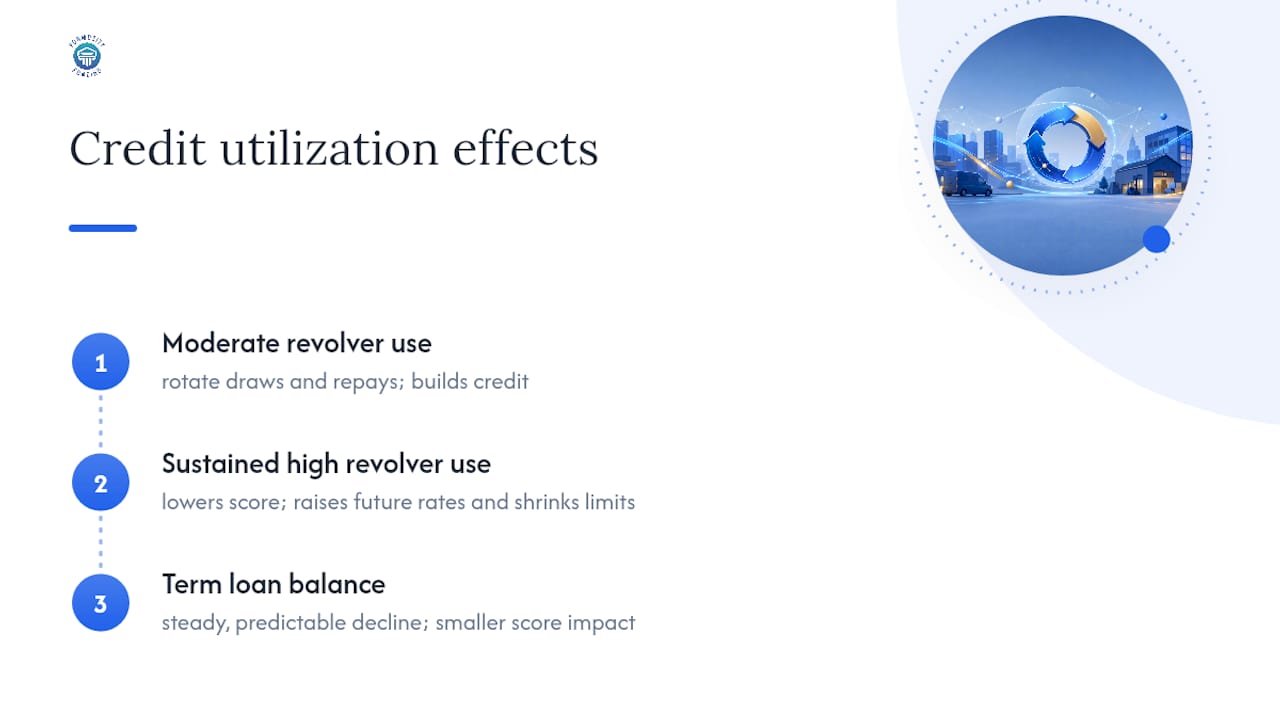
That score matters beyond the line itself. A lower business credit score raises the rate you'll pay on your next financing request and can shrink the limit a lender is willing to offer on future products, including equipment financing or a second line. Lenders reviewing your file during an annual review often look at utilization trends over the prior 12 months, not just the balance on the day of review, so a pattern of maxing out and slowly paying down looks worse than moderate, steady use.
Businesses that treat a revolver as a rotating tool, drawing, repaying quickly, and drawing again, tend to build stronger credit profiles than those that draw once and let the balance sit. That distinction shows up directly in the rates you're offered the next time you apply for financing.
Managing a Revolving Line Without Letting It Manage You
The businesses that get the most value from a revolver treat it as an active tool, checked weekly, not something they open once and forget about. Start by matching draws to a specific, named need, a known invoice gap, a specific inventory order, rather than pulling funds because the line is sitting there unused.
Pay down draws faster than the minimum whenever cash allows, since interest accrues daily on the outstanding balance. Track your balance against revenue weekly rather than monthly; a revolver that looked comfortable at $200,000 in monthly revenue can look dangerous fast if a slow season cuts revenue by a third.
Separate the line's purpose from your general operating account mentally, even if the funds land in the same place. A revolver used for smoothing cash flow around predictable timing gaps, like the 30 to 45 days between delivering a service and getting paid, behaves very differently from a revolver used to plug a structural loss month after month. The first is exactly what the product is built for. The second is a warning sign that needs a different fix than more credit.
Finally, revisit your utilization cap every time your revenue changes meaningfully. A cap that made sense last year might be too loose or too tight for where your business sits today.
Potential Risks and Common Pitfalls With a Revolver
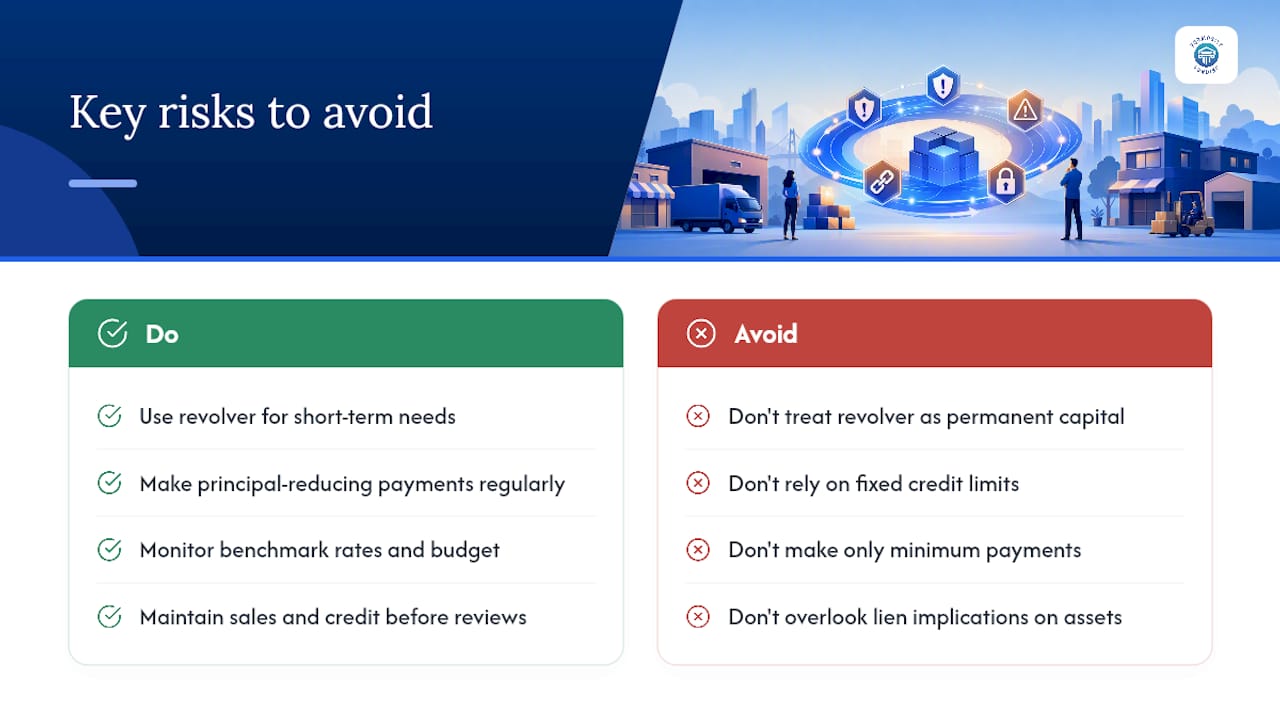
The single biggest risk with revolving business credit is treating a flexible short-term tool as permanent working capital. Because the line refills as you repay it, it's easy to fall into a pattern of drawing, making minimum payments, and drawing again without ever reducing the principal, which is functionally the same as carrying permanent debt at a variable rate.
Variable rates create a second, quieter risk. Since most revolvers are priced off a benchmark rate, a rising-rate environment can meaningfully increase what you owe on an unchanged balance, catching borrowers who budgeted around last year's rate off guard.
Annual reviews carry their own risk. A softer sales quarter or a dip in your credit score can trigger a limit reduction, or in some cases a conversion of your outstanding balance into a term loan, right when you need flexibility most. Borrowers who assume their limit is fixed for the life of the relationship are often surprised here.
Secured lines carry an additional exposure: the blanket lien attached to most bank revolvers can limit your ability to pledge the same assets for other financing later, which matters if you're planning to add equipment financing or a second facility down the road.
Finally, watch for confusion between a genuine revolving facility and a merchant cash advance, which buys future receivables at a discount rather than extending underwritten, revolving credit. The two products look superficially similar on a term sheet but carry very different effective costs, and MCAs usually come out significantly more expensive per dollar borrowed.
How to Negotiate Better Terms With Your Lender
Lenders have more room to negotiate than most borrowers assume, particularly if you're a strong applicant shopping multiple offers rather than accepting the first one. Getting pre-qualified with several lenders simultaneously, without a hard credit pull, gives you leverage you simply don't have when negotiating with a single bank in isolation.
Ask directly about reducing or waiving the unused/commitment fee, especially if you can show you'll draw the line regularly rather than holding it idle. Lenders would rather earn interest on active draws than collect a small annual fee on a line that never gets used, so this is often more negotiable than borrowers expect.
Push on the borrowing-base formula if you're taking a secured line. Some lenders will include a broader set of eligible receivables or extend the aging window from 60 to 90 days if you can demonstrate a strong collection history, and that directly increases your available credit without changing your limit.
Time your renegotiation conversation before the annual review, not during it. Walking in with updated financials, an improved credit profile, or a competing offer in hand gives you a stronger position than waiting for the lender to initiate the renewal conversation on their terms. If your financials have genuinely improved since you opened the line, ask for a rate reduction outright. It costs nothing to ask, and lenders retaining a good customer often have more flexibility than their published rate sheet suggests.
Tax Treatment of Revolving Business Credit
Interest paid on a revolving business line is generally deductible as a business expense, provided the funds are used for legitimate business purposes rather than personal expenses. This is one of the more favorable aspects of debt financing compared to equity: the cost of borrowing reduces your taxable income, while the principal you draw and repay isn't treated as income or an expense at all.
Keeping business and personal use of a revolving line strictly separated matters more than most owners realize. If you draw from a business line to cover a personal expense, that portion of the interest generally isn't deductible, and mixing uses creates real headaches if you're ever audited or need to substantiate deductions. Maintaining a dedicated business account and drawing exclusively for business purposes keeps your tax position clean.
Because interest accrues daily on the outstanding balance, the deductible amount shifts month to month based on how much you've drawn and how long you've held it, unlike a fixed-payment term loan where the interest portion is often more predictable. Keep statements documenting each draw and its business purpose, since that paper trail is exactly what supports the deduction if questioned. None of this substitutes for guidance from a tax professional familiar with your specific situation, but the core principle holds across most standard business uses: legitimate business interest is deductible, personal use isn't, and documentation is what separates the two when it matters.
A Few Rules of Thumb Worth Following
Three things I'd tell any business owner before they sign for a revolving line: only open one for a need you expect to repeat, never for a one-time shortfall better suited to a term loan; know your exact break-even math on unused fees before you decide to keep a line open "just in case;" and treat the annual review as a planning deadline, not a surprise.
The real danger with revolving credit isn't the product itself, it's the slow drift from short-term tool to permanent crutch. A line you draw and repay in 60 days is doing its job. A line that's been sitting near its limit for two years is doing something else entirely, and it's worth being honest with yourself about which one you're running.
Before you draw a dollar, model the actual cost: the rate, the fees, and how long you'll realistically hold the balance. The math takes ten minutes and can save you from a decision you'll regret at the next annual review.
— Alvin
Get Matched With Real Line of Credit Offers
Formosity Funding is the faster path to a working line of credit compared to applying bank by bank: one pre-qualification, no hit to your credit, and multiple real lender offers to compare instead of weeks of separate applications and paperwork. Rather than guessing which lender fits your revenue and time in business, you get matched to lenders already suited to your profile, with a dedicated funding specialist walking you through the documents and terms that matter for your specific situation.
If a revolving line fits the cash-flow gap you're trying to solve, the next step is straightforward: pre-qualify through Formosity Funding's services, gather your recent bank statements and receivables aging, and compare the offers that come back before committing. There's no cost to see what you qualify for, and no long wait to find out.
Sources
- SBA — Terms, conditions, and eligibility
- Investopedia — revolving loan facility
- Bankrate — What is a business line of credit?
- SmallBizFinanceGuide — Revolving credit facility
This article is general information, not a substitute for advice from a qualified financial advisor. Consult a qualified financial professional about your own circumstances before acting on anything here.
FAQ
What Is a Revolving Line of Credit for Business?
It's a reusable financing facility that lets you draw funds up to an approved limit, repay them, and draw again, with interest charged only on the amount you've actually borrowed.
What Are the Disadvantages of a Revolving Line of Credit?
Variable rates can raise your cost unexpectedly, annual reviews can shrink your limit or convert your balance into a term loan, and it's easy to slide from short-term use into permanent debt if you never pay down the principal.
What Is the Monthly Payment on a $50,000 Business Loan?
It depends entirely on the rate and term you're offered; a revolving line doesn't have a fixed monthly payment like a term loan does, since you only owe interest and minimum payments on the portion you've actually drawn.
Is Revolving Credit a Good Idea for a Small Business?
It's a strong fit for short-term, recurring needs like payroll timing or seasonal inventory, but it's a poor substitute for financing that covers a permanent or one-time large expense, where a term loan usually costs less over time.
How Do I Qualify for a Business Line of Credit?
Lenders typically look at time in business, monthly revenue, and both business and personal credit history, and platforms like Formosity Funding can pre-qualify you across multiple lenders at once without affecting your credit score.