

Most small-business owners will land somewhere between 6.3% and 11% on a traditional bank term loan in 2026, according to consumer finance data compiled by NerdWallet, while online lenders and merchant cash advances often run far higher. The real number depends on your credit profile, loan type, and collateral, and the fees attached to any offer can move your true cost more than the headline rate does. Keep reading for product-by-product ranges and the steps that actually move your number.
TL;DR:
- Bank term loans for small businesses will range from 6.3% to 11% in 2026, depending heavily on credit profile, business age, and collateral.
- The APR often exceeds the nominal interest rate by 2 to 4 percentage points once fees are included, making total costs higher than advertised rates.
- Online loans and merchant cash advances can have effective APRs above 20% or even 40%, primarily due to faster approval and limited qualification requirements.
- Lenders' pricing is influenced mostly by personal credit scores, business cash flow, collateral, and loan terms, with regional differences also affecting rates.
- Comparing multiple offers before committing can significantly reduce costs, as spreads between lenders for similar profiles vary widely, especially under tighter lending standards.
Table of Contents
- Current Business Loan Rates: What the Averages Really Mean
- How Rates Differ by Loan Type in 2026
- What Affects the Interest Rate You'll Actually Get
- SBA Loan Rates and Fees in 2026
- How to Secure the Best Possible Rate
- Fees and Total Cost: Two Quick Examples
- What 2026 Lending Data Actually Shows
- Why Rate Shopping Matters More Than Ever
- Compare 2026 Loan Offers Before You Commit to One
- Sources
Current Business Loan Rates: What the Averages Really Mean
Bank term loans for small businesses are averaging roughly 6.3% to 11% in 2026, based on NerdWallet's rate tracking. That range covers a lot of ground. A borrower with strong revenue, six years in business, and a 750 personal credit score sits at the low end. A newer business with thin cash flow lands near the top, or gets pushed toward a different product entirely.
Here's where the confusion usually starts: a "rate" and an "APR" are not the same thing.
- Nominal interest rate is the base cost of borrowing the money, expressed as a percentage of principal.
- APR folds in origination fees, guarantee fees, and other charges, giving you the real annual cost.
- Factor rate, used mostly by merchant cash advance providers, is a flat multiplier (like 1.3) applied to the amount borrowed, not an annualized percentage, which makes it look deceptively small until you convert it.
A loan advertised at 9% interest can carry a 12% to 14% APR once you add a 2% origination fee and closing costs. Always ask for the APR, not just the rate.
Geography and lender size matter too. The Kansas City Fed's Q1 2026 lending survey found that rural banks saw rate decreases on some products while urban banks often charged more, a reversal of what many borrowers expect. Community banks with lower overhead sometimes beat regional and national banks on price, even though they're smaller. Never assume the biggest name in town has the best number.
How Rates Differ by Loan Type in 2026
The loan type you pick changes your rate more than almost any other factor. Speed and risk drive the spread.
- Bank term loans: roughly 6.3% to 11%, best for established businesses with strong financials and a clear use of funds.
- SBA 7(a) and 504 loans: competitive rates tied to a base rate plus a lender spread, with guarantee fees layered in. Good for borrowers who can handle a longer approval timeline.
- Business lines of credit: variable rates that move with market benchmarks, useful for managing seasonal cash flow rather than one-time capital purchases.
- Online term loans: often double-digit APRs, sometimes reaching into the 20s or 30s, because approval takes days instead of weeks and underwriting leans more on cash flow than credit score.
- Equipment financing: typically priced closer to bank-loan territory since the equipment itself serves as collateral, lowering lender risk.
- Invoice factoring: fees usually quoted as a percentage of the invoice per month rather than an annual rate, which can translate into a high effective APR if invoices sit unpaid for a while.
- Merchant cash advances: factor rates that frequently equate to APRs well above 40%, the tradeoff for near-instant funding and minimal credit requirements.
If you need working capital for equipment or real estate, a bank or SBA loan almost always beats a short-term online product on cost. If you need cash in 48 hours to cover payroll or a supply gap, the online lender or MCA becomes the only realistic option, and you pay for that speed.
What Affects the Interest Rate You'll Actually Get
Lenders don't price loans off a single number. They weigh several factors, roughly in this order of influence:
- Personal credit score — still the single biggest lever for most small-business loans under $500,000.
- Business credit profile — payment history with vendors and existing trade lines.
- Time in business — two years is a common threshold; five-plus years often unlocks better pricing.
- Revenue and cash flow — lenders want to see your debt service coverage, not just your top line.
- Collateral and loan-to-value ratio — pledging equipment or real estate lowers the lender's risk and your rate.
- Loan term and amortization — shorter terms usually carry lower rates but higher monthly payments.
Fixed rates lock your payment for the life of the loan. Variable rates track a benchmark and can rise or fall, which matters more now that underwriting has tightened. The Kansas City Fed's Q1 2026 survey noted tighter credit standards even as overall lending volume rose, meaning borderline borrowers face more scrutiny even when credit is technically more available.
Pro Tip: Pull your business credit report before you apply, not after a lender flags an issue. Errors are common, and fixing one before underwriting starts can shave real points off your quoted rate.
SBA Loan Rates and Fees in 2026
SBA-backed loans carry rates and fees comparable to conventional loans, according to the Small Business Administration, but the guarantee fee is what trips up first-time applicants. The SBA sets alternative base rate options for 7(a) loans that lenders use as a starting point, then add a spread based on loan size and term.
- SBA 7(a) loans use a base rate (often tied to the prime rate) plus a lender markup, capped by SBA rules.
- SBA 504 loans split funding between a bank and a Certified Development Company, with the CDC portion carrying a fixed rate.
- Guarantee fees, finalized for fiscal year 2026, scale with loan size and can add a meaningful percentage to your effective APR upfront.
SBA financing tends to win when you need a longer repayment term or a larger loan amount than a conventional bank product offers, even after accounting for the guarantee fee. If you need under $50,000 quickly, the paperwork and timeline often aren't worth it.
How to Secure the Best Possible Rate
Lenders ask for the same core documents no matter which product you're pursuing, and having them ready before you apply speeds everything up.
- Two to three years of tax returns — establishes revenue history and consistency.
- Profit and loss statements — shows current trajectory, not just past performance.
- Bank statements — proves cash flow and average balances.
- Accounts receivable aging report — matters most for factoring and lines of credit.
Beyond paperwork, a few moves genuinely change your quoted rate. Correct any credit report errors before applying. Reduce personal debt-to-income ratio if you're close to a lender's cutoff. Build business credit separately from personal credit so you're not entirely dependent on your own score.
Decide upfront whether you're comfortable pledging collateral for a lower secured rate, or whether you'd rather pay more for an unsecured loan and keep assets unencumbered. And don't accept the first offer silently: ask if the lender will match a competing quote, especially if you already bank with them. Relationship banking still carries weight most borrowers underestimate.
Pro Tip: Get prequalified with two or three lenders before committing to one. It costs you nothing if the check doesn't hit your credit, and it gives you real leverage to negotiate.
Fees and Total Cost: Two Quick Examples
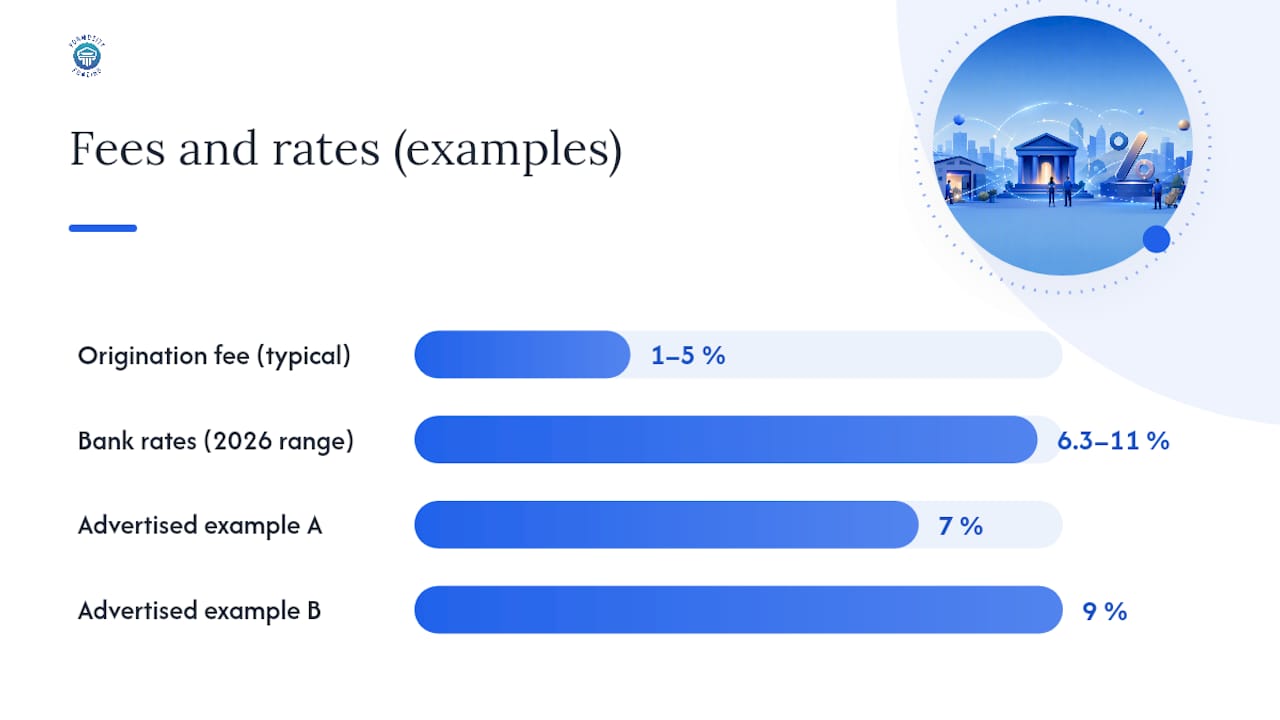
A 7% interest rate sounds better than a 9% rate, until you factor in what's bolted onto each offer. Origination fees typically run 1% to 5% of the loan amount. SBA loans add a guarantee fee scaled to loan size. Some products, especially bank term loans, include prepayment penalties if you pay off the balance early.
Take a $100,000 loan over five years.
- Bank rates in 2026 generally run 6.3% to 11%.
- Online and short-term products routinely land far above that range once fees are included.
Compare the APR and total repayment amount side by side, not the advertised rate alone. That single habit catches most bad deals before you sign.
What 2026 Lending Data Actually Shows
New small-business lending rose year-over-year through Q1 2026, driven largely by growth in lines of credit, according to the Kansas City Fed survey. At the same time, lenders reported tighter credit standards, a combination that explains why approvals feel more available while pricing hasn't necessarily loosened.
- Rural banks saw rate decreases on some products; urban banks often charged more for comparable loans.
- Respondents flagged technology adoption as a likely positive driver of loan demand over the next 12 months, and inflation as a likely drag, per the same Q1 2026 survey.
Expect continued variation by region and lender type over the coming year, not a single national number moving in one direction.
Why Rate Shopping Matters More Than Ever
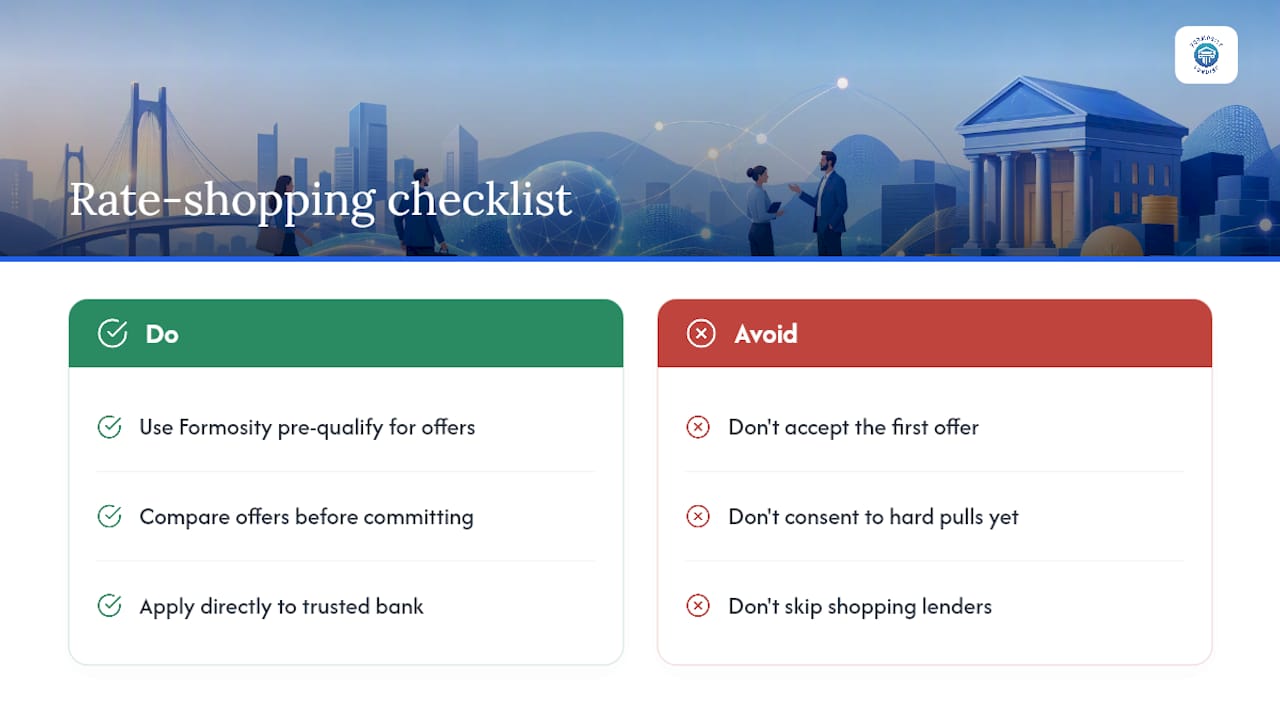
Rate spreads between lenders on the exact same borrower profile can run several points wide, and that gap has only grown as underwriting standards tighten unevenly across bank sizes and regions. I've seen enough loan files to know most business owners accept the first real offer they get, mostly out of fatigue rather than strategy. That's the costliest habit in this entire process.
Formosity Funding's pre-qualification process exists precisely for this problem: it surfaces multiple offers from a lender network without a hard credit pull, so you see your actual range before committing to one path. Use it when you want options fast. Apply directly to a bank or SBA lender when you already have a strong relationship and know exactly which product you want.
— Alvin
Compare 2026 Loan Offers Before You Commit to One
Some platforms get you real offers from multiple lenders at once, instead of the slow, one-at-a-time process of applying to banks separately and waiting on each response. That's the practical edge over shopping solo: one pre-qualification, several offers, no impact to your credit score while you compare.
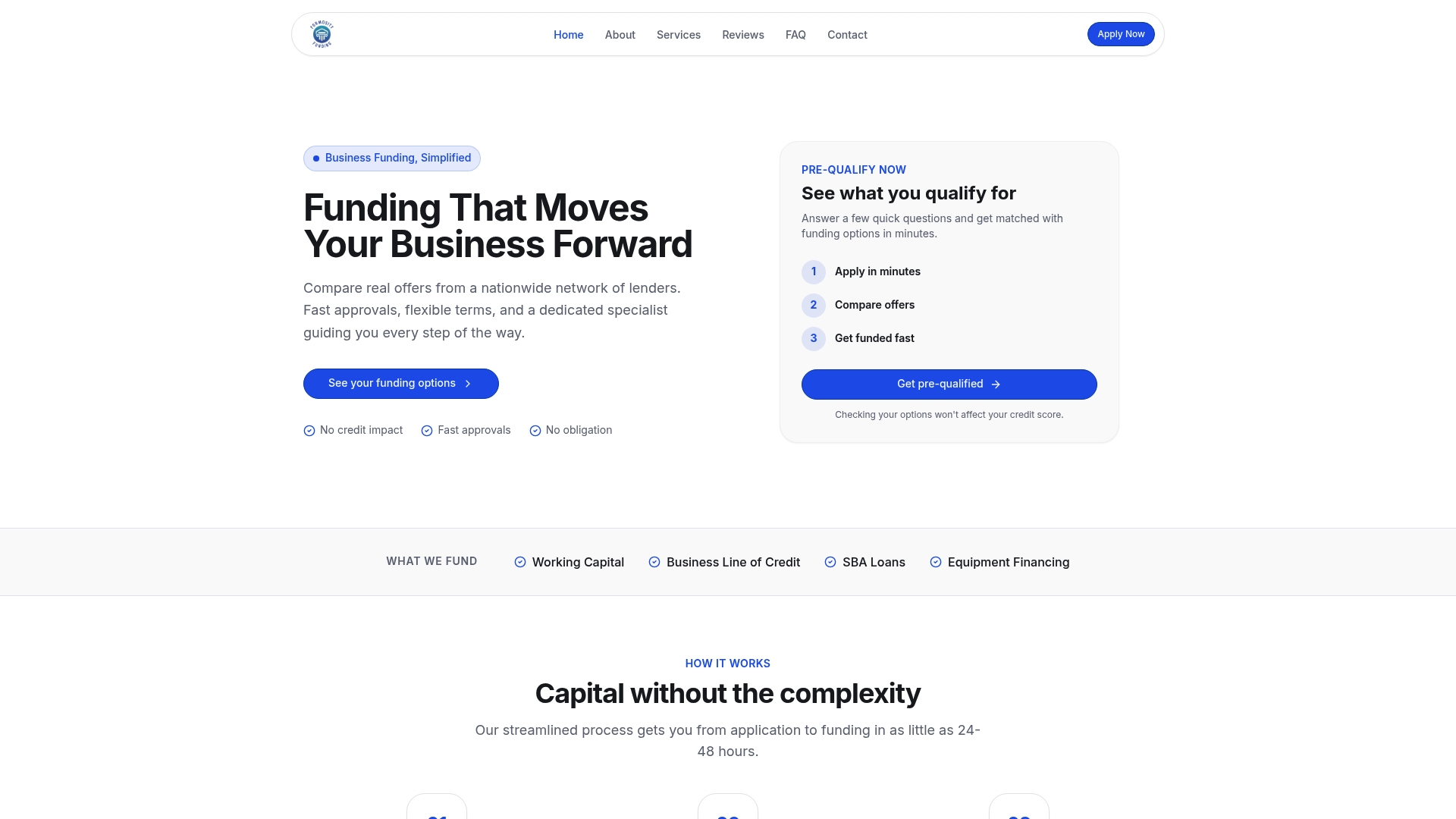
Getting started takes minutes. Have your last two years of tax returns, recent bank statements, and a rough sense of how much you need and what it's for. Formosity Funding's funding specialists walk you through matching to working capital, SBA loans, equipment financing, or a line of credit based on what actually fits your numbers, not a generic product pitch. If you're within a few weeks of needing capital, start your pre-qualification now and see your real offers before you commit to anything.
This article is general information, not a substitute for advice from a qualified financial advisor. Consult a qualified financial professional about your own circumstances before acting on anything here.
Sources
- Small-Business Lending Survey — Kansas City Fed (Q1 2026)
- Loans - Small Business Administration
- Average Business Loan Interest Rates: September 2026 - NerdWallet