

Nondilutive startup funding is capital you raise without handing over ownership. The SEC's funding roadmap defines it as money from a source that takes no ownership interest, such as grants or loans, while angel, friends-and-family and venture money shrinks your share. For most owners the real question is which nondilutive source fits their stage and timeline. Research grants suit a narrow set of technical companies and run on agency calendars. Loans, lines of credit, equipment financing and similar products suit most other businesses, and they can be matched and approved in far less time. At Formosity Funding we match your business with lenders in our nationwide network, and pre-qualification does not affect your credit.
TL;DR
- Nondilutive means you keep your equity: grants and debt-type financing do not take a share of your company.
- Federal research awards (SBIR/STTR) are real money, but only for R&D-driven, for-profit U.S. companies, and review runs on a multi-month cycle.
- If you need cash for payroll, inventory, equipment, expansion or property, loan-type products are the practical nondilutive route.
- Match the product to the purpose: a line of credit for uneven cash flow, equipment financing for machines, SBA or commercial real estate loans for large, long-term needs.
- You can see matched offers with a pre-qualification that does not affect your credit.
Table of Contents
- What nondilutive funding means in practice
- Federal research awards: SBIR and STTR
- Loan-type nondilutive funding: where most owners land
- How to choose: stage, purpose, cash flow, repayment
- What lenders will ask for
- Getting matched with Formosity Funding
- Our perspective
- FAQ
- Sources
What nondilutive funding means in practice
When you sell equity, every dollar raised costs you a slice of the company and usually some control. When you use nondilutive capital, the cost is something else: a repayment schedule, a fee, or in the case of grants, compliance and reporting. Your cap table stays the same.
The SEC's roadmap lists friends and family, angel investors and venture capital funds as the common early dilutive sources. Everything on the list below sits on the other side of that line.
| Source | What you give up | Typical use | Speed |
|---|---|---|---|
| Federal R&D awards (SBIR/STTR) | Nothing, no repayment, but strict use rules | Research and development | Months |
| SBA-guaranteed loans | Repayment with interest and fees | Working capital, equipment, real estate, acquisitions | Weeks to months |
| Business line of credit | Interest on what you draw | Uneven cash flow | Often fastest |
| Equipment financing | Repayment, usually secured by the equipment | Machinery, vehicles, technology | Fast |
| Invoice factoring | A fee on each invoice | Unpaid B2B invoices | Fast |
| Commercial real estate loans | Repayment, secured by the property | Buying or improving property | Longer |
Federal research awards: SBIR and STTR
If your startup does technical research, the largest nondilutive source is the federal Small Business Innovation Research (SBIR) program and its partner, Small Business Technology Transfer (STTR). Several agencies run their own versions.
- National Science Foundation: up to $305,000 for Phase I over six to 18 months, then up to $1,250,000 for Phase II over 24 months, with no equity taken and nothing to pay back.
- SBIR.gov's general ranges: Phase I awards of $50,000 to $323,000 and Phase II awards of $650,000 to $2.2 million. Phase II is typically open only to Phase I awardees.
- NIH: its small business programs set aside over $1.4 billion in nondilutive funds every year for life sciences. NIH also allows Direct to Phase II when feasibility is already shown, and Fast Track applications that combine both phases.
Who qualifies
The rules are firm. SBIR.gov requires a for-profit U.S. entity with fewer than 500 employees, owned and controlled by U.S. citizens or permanent residents. You need a Unique Entity ID from SAM.gov, and you must read the full solicitation before you submit. NIH's application webinar adds that applicants also need Grants.gov, eRA Commons and SBIR.gov registrations, with two-factor authentication through login.gov.
There is an ownership wrinkle for venture-backed companies. NSF says companies majority owned by VC operating companies, hedge funds or private equity firms are ineligible. NIH guidance explains that multiple such firms can together own more than 50%, provided no single one does. Check this before you take a priced round if you plan to apply.
What the money can and cannot pay for
NSF awards cover salaries and wages, fringe benefits, materials and supplies and other R&D costs, but not intellectual property, marketing or business development. So a grant will not pay for your launch campaign or your legal filings. If you are protecting a brand while you build, plan that cost separately, for instance by reviewing the intent-to-use trademark steps and fees.
Timeline and effort
Plan in quarters, not days. NIH's slides describe about three months for scientific review, then about four more for the institute to assign funding. Each application gets three assigned reviewers and five scored criteria, and about half are not discussed, though all receive comments. Standard NIH due dates are September 5, January 5 and April 5. A competitive proposal itself typically takes two to three months to prepare, according to a state technology organization that helps applicants.

That makes SBIR/STTR an excellent fit for a research roadmap and a poor fit for next month's payroll. For expenses on a shorter clock, read on.
Loan-type nondilutive funding: where most owners land
Most small businesses are not building a research prototype. They need working capital, a delivery truck, a second location or a building. For them, debt-type financing is the nondilutive path, and it is where our marketplace works.
SBA-guaranteed loans
The SBA does not lend directly in most cases. It guarantees loans made by participating lenders. Its three main programs are 7(a), 504 and microloans of $50,000 or less. Most 7(a) loans have a maximum amount of $5 million, and the loan can fund working capital, equipment, real estate, a business acquisition or a startup.
Two points matter to a new company. First, the SBA says eligibility rests on what the business does to earn income, its ownership, its location, its size and its ability to repay, and that even businesses with bad credit may qualify for startup funding. Second, the SBA states that rates and fees on guaranteed loans are generally comparable to non-guaranteed loans.
Fees are published. Under SBA's standard operating procedure, the upfront 7(a) guaranty fee is 2% of the guaranteed portion for loans of $150,000 or less and 3% for $150,001 to $700,000, with higher tiers above that. Eligibility rules were updated again in SOP 50 10 version 8, effective June 1, 2025. Our guides on SBA loan rates, SBA credit score expectations and the SBA loan timeline walk through what to expect.
Working capital and lines of credit
A business line of credit gives you a limit to draw from and interest only on what you use. It suits seasonal swings, delayed customer payments and opportunistic inventory buys. Working capital financing is the broader category for covering day-to-day operating costs. Both avoid equity entirely. See our breakdown of business line of credit rates for what to compare.
Equipment financing
When the purchase is a machine, a vehicle or a technology system, equipment financing lets you spread the cost over time and keep cash for operations. We offer it through our lender network, and it is a natural fit for companies that would otherwise spend their runway on hardware.
Invoice factoring
If you invoice other businesses and wait on payment, factoring converts those invoices to cash. One published overview describes an advance of around 85% of the invoice value, with rates often ranging from 1% to 5% of invoice value per month. Terms vary by invoice size, volume and your customer's creditworthiness, which is why comparing offers matters.
Commercial real estate financing
For investors and owners buying or improving property, commercial real estate loans and SBA 504 financing (long-term, fixed-rate financing delivered through Certified Development Companies) keep ownership of the business untouched. These are larger and slower than a line of credit, so start early.
Venture debt
Venture-backed companies sometimes add venture debt alongside equity rounds. It is a loan with its own cost structure, covered in our comparison of venture debt versus a bank loan.
How to choose: stage, purpose, cash flow, repayment
Start with what the money is for, then test it against your ability to repay.
- Is it research? If you are a for-profit U.S. company doing R&D with a technical risk to retire, SBIR/STTR is worth a serious look, with a long runway and a registration checklist to complete.
- Is it a purchase with a tangible asset? Equipment financing or a commercial real estate loan ties the debt to the asset.
- Is it a timing gap? Receivables outstanding or seasonal dips call for a line of credit or factoring.
- Is it growth with predictable returns? An SBA loan offers longer terms for expansion, an acquisition or a build-out.
- Can monthly payments fit your cash flow? Lay your revenue against the payment schedule before you accept any offer, and count fees as well as the rate. Our note on origination fees shows how much they can add.
A worked example
Say a four-person fabrication shop wants a $60,000 CNC machine and also needs a cushion for slow-paying customers. The machine goes on equipment financing, so the debt is secured by the machine and payments are spread over its working life. The cushion goes on a line of credit, drawn only in the weeks invoices run late. No equity changes hands, and each product matches how the money will be used and repaid.

What lenders will ask for
The paperwork for loan-type funding is lighter than a grant proposal but still needs preparation. Expect to show time in business, revenue, bank statements and ownership details. Our guides on loan requirements and time-in-business rules list what to gather, and the typical funding timeline helps you decide when to apply. Bank term loan pricing is covered in our interest rate guide.
Getting matched with Formosity Funding
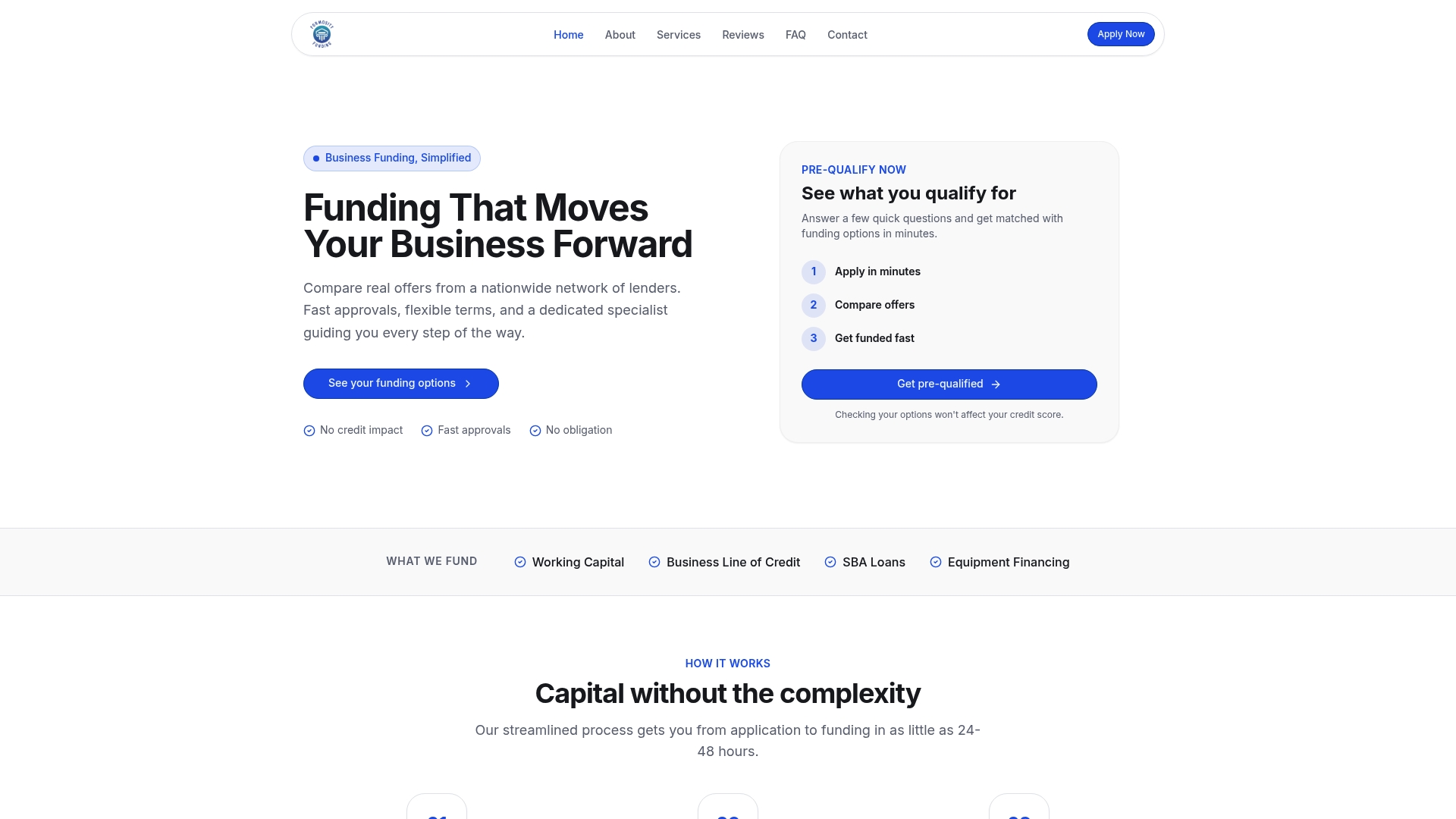
The hard part of loan-type nondilutive funding is not knowing which products you qualify for or what each lender will offer. Formosity Funding is a marketplace that connects small and midsize businesses with a nationwide network of lenders. You get quick pre-qualification with no credit impact, real loan and credit offers, and a dedicated funding specialist who guides you from application to funding. Products include working capital, business lines of credit, SBA loans, equipment financing, commercial real estate loans and invoice factoring.
See the full range on our funding services page, and pre-qualify to see which offers fit your business.
Owners who hold real estate equity can also look at our Business HELOC, and we offer a payment acceptance consultation for businesses reviewing how they take payments.
Our perspective
Founders often treat "nondilutive" as shorthand for grants. Grants are valuable for the companies they fit, but most owners we talk about are solving something more immediate: a payroll gap, a machine, a second location.
Our view is that the best nondilutive funding is the one matched to the purpose and the repayment schedule. That is why we built a single platform that spans working capital, lines of credit, SBA loans, equipment financing and commercial real estate, so one pre-qualification with no credit impact opens several options at once.
A dedicated funding specialist walks you through the process, so you compare real offers side by side and keep 100% of your company.
Alvin
FAQ
Is a business loan really nondilutive?
Yes. A lender gets repaid with interest and fees but takes no ownership in your company. The SEC's roadmap explicitly gives loans as an example of nondilutive capital. Your cost is the repayment, so check that the payment fits your cash flow.
Can a brand-new startup get nondilutive funding?
Often, yes. The SBA says a business with a sound purpose and the ability to repay can qualify, and even businesses with bad credit may qualify for startup funding. Federal research awards are open to new for-profit companies that meet the ownership and size rules.
Do I have to repay SBIR or STTR awards?
No. NSF states that its SBIR/STTR funding involves 0% equity and nothing to pay back. Awards must be spent on allowed research costs, so read the solicitation closely.
Does checking my options hurt my credit?
Pre-qualification with Formosity Funding has no credit impact. You can see matched offers before deciding to move ahead.
Sources
- Roadmap to Funding a Small Business, SEC
- Apply, SBIR.gov
- About NSF SBIR/STTR
- Small Business Funding, NIH Seed
- Understanding SBIR and STTR, NIH Seed
- NIH America's Seed Fund application webinar slides, November 13, 2024
- Small Business Eligibility Requirements, NIA
- R43/R44 SBIR Grant, NIDDK
- Technical Assistance Program, Maine Technology Institute
- SBA loans
- SBA SOP 50 10 7.1 (effective November 15, 2023)
- SBA SOP 50 10 8 technical updates (effective June 1, 2025)
- Invoice Factoring: What It Is and How It Works, NerdWallet
- Intent-to-use trademark steps and fees