

If you qualify at a bank and can wait two to eight weeks, a bank loan almost always costs less over the life of the loan. If you need cash in days, have less than two years in business, or your credit score sits below 680, an online lender will likely say yes faster, at a higher price. Formosityfunding exists for exactly this fork in the road, matching businesses to whichever path actually clears fastest or is cheapest.
TL;DR:
- Borrowers needing cash within days or with less than two years in business should prioritize online lenders, despite higher interest rates.
- Online loans often fund within one to three days with APRs ranging from 10% to over 40%, whereas banks typically take two to six weeks with 6% to 12% APR.
- Qualifying for bank loans generally requires at least two years in business and credit scores above 680, while online lenders accept shorter histories and scores as low as 500.
- Using a factor rate for online loans can hide the true cost, sometimes translating to an APR near 50% for a 6-month loan; always compare offers with the actual APR.
- A marketplace matching approach helps find the best fit by comparing pre-qualified offers side by side, saving time and ensuring the right balance of cost and speed.
Table of Contents
- Online Lenders vs Banks: A Side-by-Side Comparison
- How Do APR and Factor Rates Actually Compare?
- What Do Lenders Look For Before Approving You?
- Will Daily Repayments Wreck Your Cash Flow?
- Bank or Online Lender: A Decision Checklist
- Why a Marketplace Approach Beats Guessing Alone
- Start Comparing Real Offers Instead of Guessing
- Sources
Online Lenders vs Banks: A Side-by-Side Comparison
The two channels split cleanly on five variables: speed, cost, qualification bar, loan size, and paperwork.
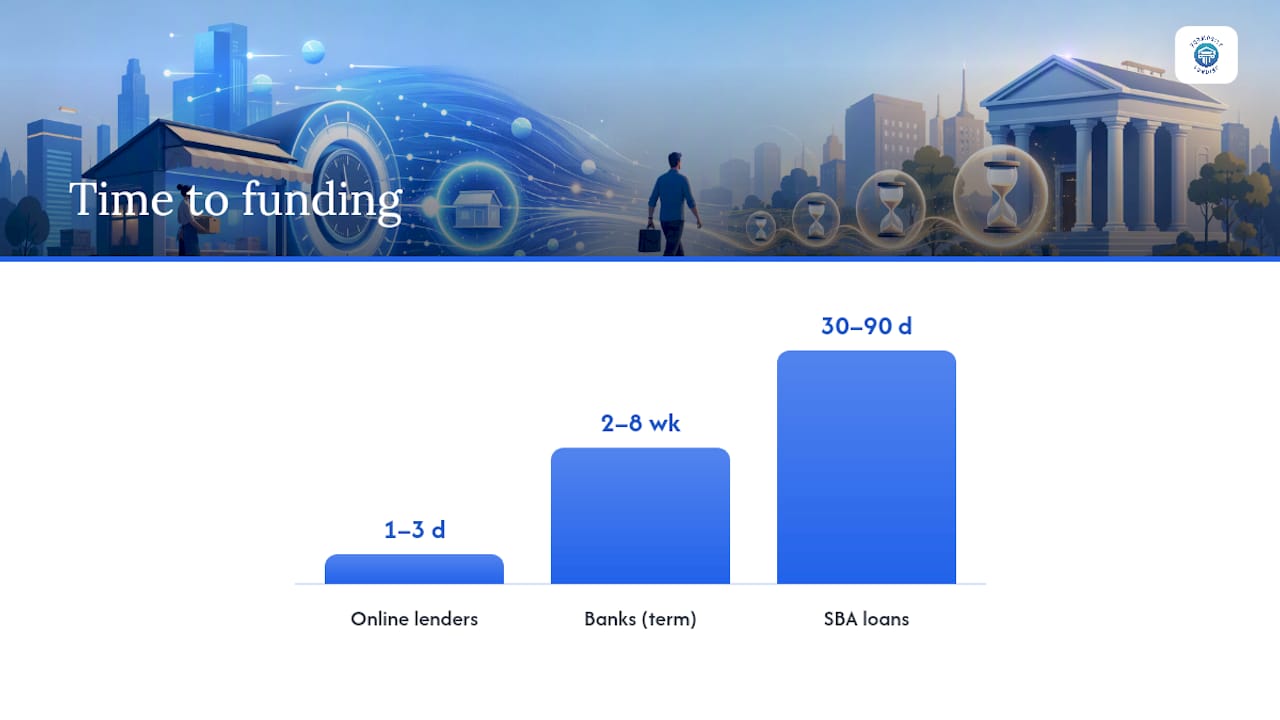
Banks generally take two to six weeks to fund a standard term loan, and SBA loans can run 30 to 90 days. Online lenders, by contrast, often issue a decision within 24 hours and fund within one to three business days, because underwriting runs on automated bank-statement analysis instead of a loan committee.
Cost moves in the opposite direction. Banks typically land in the 6% to 12% APR range for qualified borrowers, while online products can run 10% to 40% or higher depending on risk and structure.
Here's how the two stack up at a glance:
- Time to funding: online, same day to 3 days; banks, 2 to 8 weeks; SBA, up to 90 days.
- Typical APR: banks around 6% to 12%; online lenders 10% to 40%+, often quoted as a factor rate instead.
- Qualification bar: banks want 2+ years in business and credit scores near 680 to 720; many online lenders accept 6 to 12 months and scores in the 500 to 600 range.
- Loan size: banks generally support larger amounts once approved; online lenders skew toward smaller, shorter-term advances.
- Documentation: banks want full financial statements and tax returns; online applications frequently run on bank statements alone.
None of this makes one channel objectively better. It means the right choice depends on how urgently you need the money and how your business looks on paper today.
How Do APR and Factor Rates Actually Compare?
A factor rate is not an interest rate, and treating it like one is how business owners get blindsided by the true cost of a loan.
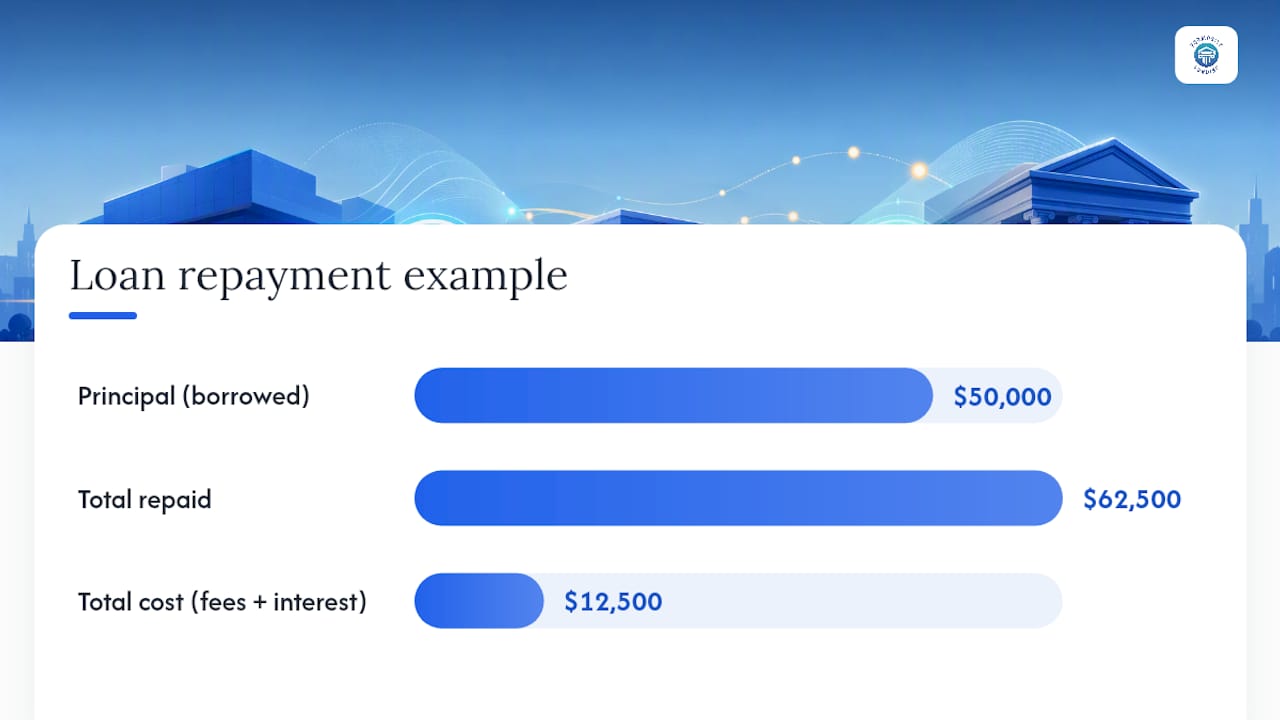
A factor rate multiplies your borrowed amount by a fixed number, say 1.25, to determine total repayment, regardless of how fast you pay it back. Converting that figure to an annualized rate requires factoring in the repayment term and payment cadence, and the results often surprise people.
Worked example: Borrow $50,000 at a 1.25 factor rate, repaid daily over 6 months. Total repayment is $62,500, meaning $12,500 in cost.
Quick math: A 1.25 factor rate on a 6-month term can translate to an APR near 50%, even though the "1.25" sounds modest on its face.
To compare offers honestly:
- Ask every online lender for the equivalent APR, not just the factor rate.
- Add origination fees, draw fees, and prepayment penalties into the total cost, not just the headline rate.
- Calculate total dollars repaid, not just the monthly payment size.
- Weigh cost against opportunity: if the borrowed capital generates returns that clear the effective APR with room to spare, a pricier loan can still be the right call.
What Do Lenders Look For Before Approving You?
Banks and online lenders draw the line in different places, and knowing where you fall saves you from wasting weeks on an application that was never going to clear.
Banks typically want two or more years in business and a credit score in the 680 to 720+ range, backed by full financial statements, tax returns, and often collateral or a personal guarantee. Online lenders frequently accept 6 to 12 months of operating history and scores as low as 500 to 600, leaning on bank statements and recent revenue instead of a full financial picture.
A quick self-audit before you apply anywhere:
- Pull your personal and business credit scores. Know the exact numbers, not a rough guess.
- Gather 3 to 6 months of bank statements and your last two years of business tax returns.
- List any equipment, real estate, or receivables you could offer as collateral.
- Check your time in business against both thresholds above.
- Review common reasons applications get denied before you submit.
Pro Tip: Pull your own credit report before applying anywhere. A hard inquiry from a bank application you were never going to qualify for can shave points off your score right when you need it intact.
If your file looks thin on paper, start with the documents that actually decide working capital approval rather than guessing at what a lender wants.
Will Daily Repayments Wreck Your Cash Flow?
They can, and this is the part borrowers underestimate most when they focus only on the interest rate.
Bank loans typically bill monthly. Many online products, especially merchant cash advances and short-term working capital loans, pull payments daily or weekly directly from your business bank account, which changes your liquidity picture even when the total principal is identical.
Example 1: A $30,000 bank loan at monthly payments of roughly $2,700 leaves your daily cash position untouched between due dates.
Example 2: The same $30,000 as an online advance with daily debits of around $180 pulls money out of your account before you've even collected on the invoices that were supposed to cover it.
Watch for these signals that a repayment schedule is straining your business:
- You're checking your bank balance daily to make sure the automatic debit will clear.
- You've delayed paying suppliers or payroll to cover a loan payment.
- Your revenue is seasonal, but your repayment schedule is flat.
Where possible, negotiate the cadence, request a smaller advance, or ask about a structure with weekly rather than daily debits. Lenders will sometimes flex on this more than they advertise.
Bank or Online Lender: A Decision Checklist
Run through these questions in order, and the right lender usually becomes obvious within a few minutes.
- How fast do you actually need the money? Days, not weeks, points you toward online financing almost by default.
- Do you clear the bank thresholds today? Two years in business, a credit score near 700, clean financials. If yes, get a bank quote before anything else.
- How much do you need, and for how long? Larger, longer-term needs generally favor bank or SBA financing once you qualify.
- Does the return outweigh the cost? If the capital funds a job, contract, or inventory purchase that clears the effective APR with margin left over, a costlier loan can still be the smarter move.
A common practitioner move: take faster online financing now to cover the immediate need, then refinance into bank debt once your financials season, typically after 12 to 18 months of on-time payments. When you take the online loan, ask the lender directly about prepayment penalties and get any early-payoff terms in writing. That protects your ability to refinance later without an unexpected fee eating the savings.
Before you apply anywhere:
- Convert every offer to its true APR, not the headline rate.
- Run a 12-week cash-flow projection against the proposed repayment schedule.
- Start pre-qualification with more than one source so you can compare real offers side by side, not theoretical rate ranges.
Why a Marketplace Approach Beats Guessing Alone
Matching businesses to the right lender isn't about finding the cheapest headline rate. It's about matching a business's actual profile, time in business, credit score, revenue pattern, urgency, to the lender that will actually say yes on workable terms.
A marketplace fills this gap. A business with 8 months of operating history and a 590 credit score doesn't need to waste three weeks applying at a bank that requires 700+. A business that qualifies for both should see the bank offer alongside the faster online options, so the cost difference is visible before committing. Fast pre-qualification with no credit impact lets an owner see multiple real offers and make that call with actual numbers instead of assumptions. Support staff then walk through which offer fits, given the urgency and the math, rather than just handing over a list. If you're weighing your own next move, the loan requirements guide is a solid place to check your standing first.
— Alvin
Start Comparing Real Offers Instead of Guessing
You don't have to choose blind between a bank's slow, cheaper path and an online lender's fast, pricier one. This kind of platform is built for exactly this decision. It matches your business against a nationwide network of lenders and surfaces the offers you actually qualify for, various loan types included, side by side.
Pre-qualification runs with no impact to your credit score, so checking your options costs nothing but a few minutes. Submit your basic business details and you'll typically see multiple offers back, each with real rates and terms, not estimates. A funding specialist then helps you weigh the tradeoffs covered above: speed against cost, repayment cadence against your cash flow, bank thresholds against what you qualify for right now. Explore the full range of funding options Formosityfunding matches you to and start pre-qualification today to see what's actually available for your business.
Sources
Rate and qualification benchmarks in this guide draw from NerdWallet's comparison of online and bank business loans and BestMoney's analysis of online lenders versus traditional banks. For funding timelines specific to your situation, see how long a business loan typically takes to fund.
- Should You Get an Online Business Loan or a Bank Loan? - NerdWallet
- Online Business Loans: Pros, Cons, and Top Lenders to Consider - USDNG