

A loan broker is a person or firm that works your deal one-to-one, shops it to lenders and negotiates on your behalf. A lending marketplace is a platform that matches your business profile with many lenders at once, usually online, and shows you real offers side by side. Both sit between you and the lender, and neither lends its own money in the usual case. The real difference is how much human negotiation you get, how fast you see offers, and how you are charged. This guide walks through each, so you can pick the route that fits the funding you need.
TL;DR
- A broker is a hands-on intermediary who packages and negotiates your deal. A marketplace is a platform that matches you with many lenders and shows offers side by side.
- Neither is the lender. Your loan is funded and underwritten by a lender, so approval is never guaranteed by the intermediary.
- Always ask how the intermediary is paid, whether you owe anything upfront, and whether pre-qualification touches your credit.
- Marketplaces tend to suit owners who want speed and a broad comparison. Brokers can suit complex, high-dollar deals that need custom structuring.
- A marketplace with dedicated funding specialists gives you both: broad lender access and a person to guide you.
Table of Contents
- What each one actually is
- Does either one lend you money?
- Side-by-side comparison
- How fees and compensation work
- Speed, lender choice and guidance
- What a match does and does not promise
- Which one should you choose?
- Our perspective
- See your options with Formosity Funding
- A quick way to sanity-check any provider
- FAQ
- Sources
What each one actually is
The loan broker
A business loan broker acts as a go-between. You describe what you need, the broker reviews your financials, and then approaches lenders they already work with. Good brokers know which lenders like which industries, which ones are strict on time in business, and how to present a file so it clears underwriting without back-and-forth.
The quality varies widely. One practical tip from a business loan broker guide is to choose a broker who understands your industry and can explain the pros and cons of your options and answer questions about terms and obligations. If a broker cannot explain why one offer beats another in plain language, keep looking.

The lending marketplace
A marketplace is built around technology first. You enter your business details once, the platform checks them against the criteria of many lenders, and you see which products you may qualify for. You then compare offers, choose one and finish the application with that lender.
The federal government runs a version of this idea for SBA loans. The SBA's Lender Match tool helps businesses find lenders, where borrowers can talk with lenders, compare rates, terms and fees, and submit applications. The SBA is also clear that it does not guarantee a match, a loan offer or eligibility. That caveat applies to every intermediary: matching is not approval.

Where the labels blur
In practice the lines overlap. Some brokers run online intake forms. Some marketplaces assign a human specialist to each applicant. When you evaluate a provider, ignore the label and look at three things: how many lenders it can reach, who talks to you, and how it gets paid.
Does either one lend you money?
Usually not. A broker or a marketplace matches you with a funding source, and the lender decides. The Congressional Research Service describes marketplace lending as separating the matching and origination step from the ultimate funding and credit risk. Some platforms use partner banks to originate loans and may pass them to investors, unlike traditional lenders that keep most loans on their own books.
For you as a borrower, this means two things:
- Your loan terms, credit decision and repayment schedule come from the lender named in your agreement.
- The intermediary's job is to get you in front of the right lenders and help you finish a clean application.
If you want a closer look at the broker versus direct lender question, our walkthrough on choosing a business loan broker or direct lender covers it step by step.
Side-by-side comparison
| Factor | Loan broker | Lending marketplace |
|---|---|---|
| How you start | Phone call, meeting or intake form | Online form, often with quick pre-qualification |
| Lender reach | The lenders that broker has relationships with | A network of lenders, often broader and more varied |
| Personal guidance | One person, usually from start to finish | Varies: self-serve, or paired with a funding specialist |
| Speed to see offers | Depends on the broker's workload and lender responses | Often much faster, since matching is automated |
| Best for | Complex deals, large amounts, custom structuring | Comparing several products quickly, standard small business needs |
| How it is paid | Commonly a commission or fee tied to the funded deal | Commonly a referral fee from the lender when a loan closes |
| Risk to watch | Narrow lender list, unclear fees | Thin support if no human help is offered |
The compensation row is the one to verify with any provider. Compensation models differ, and you should see them in writing before you sign anything.
How fees and compensation work
Most borrowers worry about this first, and they are right to. There are two broad models:
- Lender-paid. The lender pays the intermediary when your loan closes. You do not write a separate check, though the lender may price its overall offer with that cost in mind.
- Borrower-paid. You pay the intermediary directly, as a flat fee, a percentage of the loan amount, or both. This is more common on large commercial deals where the broker does substantial packaging work.
For commercial deals, the amounts can be significant. Our breakdown of commercial loan broker fees and SBA rules shows how those fees are typically structured and what rules apply to SBA loans.
Before you apply anywhere, ask these questions:
- Who pays you, and how much, if my loan closes?
- Do I owe anything if I do not take an offer?
- Is there any upfront fee, and what does it cover?
- Will pre-qualification involve a hard credit pull?
- Are you showing me every product I qualify for, or only the ones you are paid most on?
A trustworthy provider answers all five without hesitation. If you get vague answers on fees, treat that as your answer.
Speed, lender choice and guidance
Speed
Marketplaces compress the early steps. Because your information is checked against many lenders at once, you can see likely matches in a short time instead of waiting on one broker to call around. Online lenders in general move faster than banks, a gap we explore in online lenders vs. banks. Brokers can be fast too, particularly if they already know your industry, but their pace depends on one person's capacity.
Lender choice
More lenders means more chances that one fits your profile, whether you are a two-year-old restaurant, a trucking company needing equipment, or an investor buying a building. Ask any provider what product types they cover. A marketplace that spans working capital, lines of credit, SBA loans, equipment financing and commercial real estate lets you compare across categories rather than being nudged toward one.
Guidance
This is where brokers have traditionally won. A person who knows your file can catch problems early, such as missing documents or a debt-service ratio that needs work. Marketplaces that pair you with a funding specialist close that gap. If you are going the fully self-serve route, get your paperwork ready first. Our lists of small business loan requirements and business loan documents show what underwriters ask for, and common loan denial reasons show what to fix before you apply.
What a match does and does not promise
Whether you use a broker or a platform, a match is a starting point. It tells you which lenders may be a fit. It does not lock in a rate, an amount or an approval. Lenders still review financials, credit, time in business and collateral. For a plain-language explainer on this, see what lender-matching services can and cannot guarantee.
SBA loans add another layer. Credit expectations have shifted, and our guide to SBA loan credit scores explains what lenders look for under the current rules.
Which one should you choose?
Use this as a decision guide.
Choose a broker if:
- Your deal is unusual, such as a multi-part commercial real estate purchase or a heavily structured acquisition.
- You want one person to run point and negotiate terms directly.
- You have time to let the process run at the broker's pace.
Choose a marketplace if:
- You want to see real offers from several lenders without repeating your story.
- You need working capital, a line of credit or equipment financing and speed matters.
- You want to pre-qualify without hurting your credit while you compare.
Choose a marketplace with dedicated specialists if:
- You want both breadth and a human guide.
- You are not sure which product fits and want help sorting it out.
Neither route is automatically cheaper. The cost depends on the offer you accept, so compare the full terms: rate or factor, fees, repayment length and any prepayment rules. Our guide to choosing a business lender offers a checklist for doing that.
Our perspective
We built Formosity Funding as a marketplace because most small business owners do not have time to call ten lenders, and most do not know which products they should even be asking about.
Our approach is to put the breadth of a lender network and the guidance of a person in the same place. You pre-qualify with no credit impact, you see real loan and credit offers, and a dedicated funding specialist stays with you from application to funding. That matters when the question is not just "who will lend to me" but "which product is right for this stage of my business."
A single broker's lender list is only as wide as their personal relationships. A single platform with no human help can leave you alone at the hardest step. We designed our service so you get a wide range of options, working capital, lines of credit, SBA loans, equipment financing and commercial real estate, through one streamlined process, with someone to answer questions along the way.
Our advice: compare offers, ask how everyone is paid, and take the one that fits your cash flow, not just the one that arrives first.
Alvin
See your options with Formosity Funding
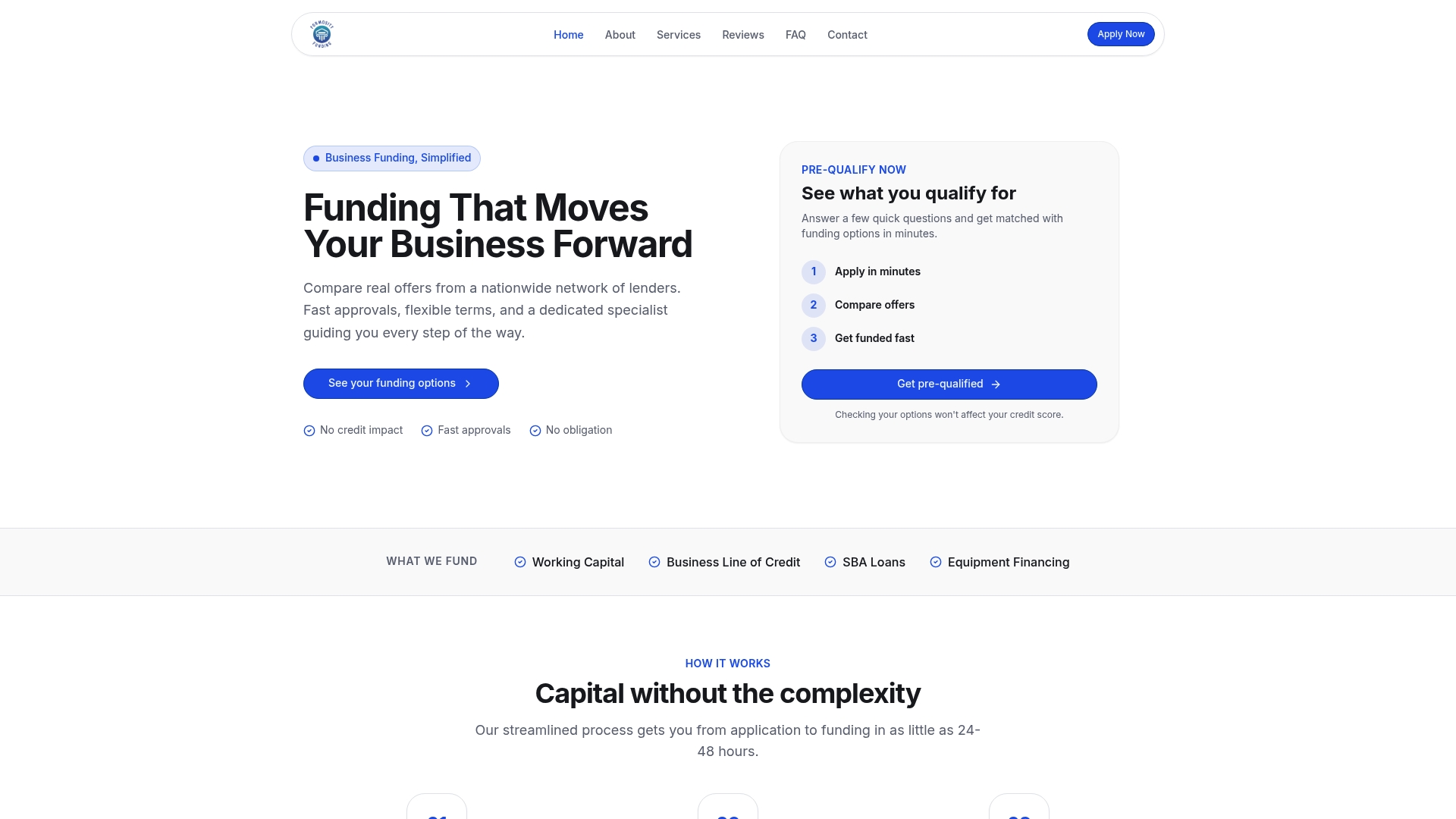
If you want to compare offers rather than guess, Formosity Funding connects your business with a nationwide network of lenders. You can pre-qualify with no credit impact, review loan and credit offers, and work with a dedicated funding specialist. Products include working capital, business lines of credit, SBA loans, equipment financing and commercial real estate financing. Explore our funding options to see what may fit.
If you own property and want to borrow against it, take a look at our Business HELOC page. If you are also reviewing how you accept customer payments, we offer a payment acceptance consultation. For a faster path to documents, our guide to loan matching platforms lists the six that speed things up most.
A quick way to sanity-check any provider
Before you hand over financial documents to anyone, run through this short test:
- Transparency. Can they tell you in one sentence how they are paid?
- Scope. Do they cover the product you need, or only one type?
- Clarity on credit. Do they say plainly whether the first step is a soft or hard inquiry?
- No promises. Anyone who guarantees approval before a lender has reviewed your file is overselling.
- A real contact. You should know who to call when something stalls.
These five points apply equally to brokers and platforms. A provider that clears all five is worth a conversation, whatever it calls itself.
FAQ
Is a loan broker the same as a lender?
No. A broker connects you with lenders and does not usually fund the loan itself. The lender sets the rate, terms and approval decision, so read the lender's agreement, not just the broker's pitch.
Can I borrow money directly from a marketplace?
It depends on the platform's structure. Some platforms only match you and send you to a lender. Others use partner banks to originate loans, as the Congressional Research Service describes. Check the name of the lender on your agreement before you sign.
Does using a marketplace hurt my credit?
That depends on the provider. At Formosity Funding, pre-qualification has no credit impact. A lender may run a hard inquiry later, when you formally apply for a specific offer, so ask each lender before you submit.
Which is faster, a broker or a marketplace?
Marketplaces are often faster at the start, because matching is automated and you can see likely offers quickly. Final funding time still depends on the lender, the product and how complete your documents are.
Do I have to pay to use a broker or marketplace?
Often the lender pays the intermediary when a loan closes, but some brokers charge borrowers directly. Ask for the compensation terms in writing before you apply, and compare them with our overview of broker fees.
Sources
- Lender Match, U.S. Small Business Administration
- Marketplace Lending: Fintech in Consumer and Small Business Lending, Congressional Research Service
- Business Loan Broker: What It Is and How to Choose One, Shopify