

Choose a business lender by working backward from what the money is for. Name the goal, pick the product that fits it, collect three to five offers, and compare them on total cost and repayment terms rather than the headline rate or the monthly payment. Then check that the lender is legitimate before you sign anything. The rest of this guide shows how to do each step and what to watch for.
TL;DR
- Start with the purpose of the funding (cash flow, equipment, expansion, property). The purpose narrows the product, and the product narrows the lender.
- Compare three to five offers on APR, fees, term, repayment frequency, net funding amount and speed, using the same product type each time.
- Banks and credit unions tend to cost less but approve slowly. Online lenders tend to fund faster and cost more.
- Never pay an upfront fee to "secure" a loan, and read the personal guarantee clause before you sign.
- Have your documents ready before you apply. Missing paperwork is a common cause of delay.
Table of Contents
- Start with the goal, not the lender
- Match the product to the need
- Banks, credit unions or online lenders
- What to compare when offers arrive
- How lenders decide: what they look at
- Prepare your documents before you apply
- Check that the lender is legitimate
- Perspective: what we see from the marketplace side
- Comparing marketplaces and direct lenders
- See real offers with no credit impact
- A step-by-step way to decide
- FAQ
- Sources
Start with the goal, not the lender
Most owners begin by asking who has the best rate. A better first question is what the money has to do and how fast it will pay for itself. A lender that is perfect for a $40,000 equipment purchase may be the wrong choice for a seasonal cash gap.
Write down four things before you talk to anyone:
- The purpose. Payroll cushion, inventory, a truck, a second location, a building.
- The amount. Be exact, and add a margin for fees that are deducted from the proceeds.
- The timeline. Do you need funds in days, or can you wait weeks for a lower cost?
- The repayment source. Which revenue will cover the payments, and on what cycle (daily, weekly, monthly)?
The fourth point matters most. WSJ's guide to choosing a small business lender advises matching your funding goal to the lenders that serve it and checking that the repayment cycle fits your cash flow. A weekly payment on a business that gets paid monthly is a mismatch that no rate can fix.
Match the product to the need
The same sources point to a simple rule: use flexible, short-cycle products for working capital and longer-term products for assets and growth.
| Your need | Product that usually fits | Why |
|---|---|---|
| Cover payroll or inventory gaps | Business line of credit, invoice financing | You borrow only what you use and repay as cash arrives |
| Buy a vehicle or machinery | Equipment financing | The asset itself often serves as collateral |
| Fund long-term growth | Term loan, SBA loan | Longer repayment spreads the cost |
| Buy or refinance property | Commercial real estate loan | Terms and amounts are built around property value |
| Quick short-term cash | Working capital loan | Fast funding, but compare the total cost carefully |
This mapping follows WSJ's guidance, which also notes that SBA loans are often considered for long-term expansion when conventional sources have been exhausted.
If you are leaning toward an SBA loan, the SBA runs a free Lender Match tool that connects you with interested SBA lenders after you answer a few questions about your business. It states that registering is no guarantee that lenders will find you eligible, so treat it as an introduction rather than an approval.
Banks, credit unions or online lenders
This is the choice that shapes everything else. According to WSJ, banks and credit unions may offer lower interest rates but often have stricter eligibility requirements and longer approval times than online lenders.
| Banks and credit unions | Online lenders | |
|---|---|---|
| Typical cost | Often lower | Often higher |
| Eligibility | Stricter | More flexible |
| Speed | Longer approval | Faster approval |
| Best when | You have strong credit and time | You need cash quickly or have a thinner history |
Neither is "better." A business with two years of clean financials and no deadline may save real money at a bank. A business that must buy discounted inventory this week may find the faster option worth a higher cost. We break down the timing trade-off in more detail in online lenders vs banks for small businesses.
What to compare when offers arrive
Get three to five offers if you can. WSJ recommends this range so you can balance rate, fees and repayment flexibility against your cash flow. Then line them up on the same set of measures.
The measures that matter
- Total cost in dollars. Interest plus every fee, over the whole term.
- APR. It folds interest and fees into one yearly figure, so it is a better basis for comparison than the interest rate alone.
- Term length. A longer term lowers the payment but usually raises the total cost.
- Repayment frequency. Daily or weekly debits behave very differently from a monthly payment.
- Net funding amount. What actually lands in your account after origination fees and deductions.
- Speed of disbursement. Days, or weeks.
Compare like with like. A line of credit should be measured against other lines of credit, and a term loan against other term loans, or the numbers will mislead you.
Watch for factor rates
Some short-term products quote a factor rate, a multiplier such as 1.25 applied to the full amount up front. A factor rate looks small, but converted to an annual rate it can be far higher, especially on short terms. Ask every lender for the APR equivalent in writing, or work it out yourself.
Here is a simple worked example with invented numbers. Say you borrow $50,000 at a factor rate of 1.20, repaid over six months. You repay $60,000, so the cost is $10,000. That is 20% of the amount in half a year, which is far above what "1.20" suggests at a glance. If the same $50,000 had a 12% APR over twelve months with equal payments, the interest would be only a few thousand dollars. The monthly payment on the first product might even look manageable, which is why you should compare total cost, not the payment.

Fees that hide in the fine print
Two fees change the math more than most borrowers expect:
- Origination fees, deducted from the proceeds. Our piece on business loan origination fees shows how they reduce the money you actually receive.
- Prepayment penalties, which can punish you for paying early. See prepayment penalties on business loans before you assume that paying off a loan early will save you money.
Fees also show up on the payments side of your business. If you pass card processing costs on to customers, check the rules first; this overview of credit card surcharge rules explains what small businesses face, and it is worth knowing before you build a repayment plan on surcharge revenue.
How lenders decide: what they look at
Underwriters assess your capacity to repay. The FDIC's small business financing guide says this means reviewing financial statements and tax returns to judge whether the business can handle new debt. In practice, expect them to look at revenue consistency, existing debts, credit history and, for larger loans, collateral.
If you want to know where applications fail, read our breakdown of loan denial reasons. Knowing the usual deal killers lets you fix them before you apply, or steer toward a lender whose criteria you meet.
Prepare your documents before you apply
Slow paperwork is one of the easiest delays to avoid. The Minority Business Development Agency's loan documentation checklist lists what lenders commonly ask for:
- A completed loan application
- Personal and business credit reports
- Personal and business tax returns for the previous three years
- A business plan with projected profit-and-loss, cash-flow and balance-sheet statements
- Bank statements
- Where required, signed personal financial statements for owners with more than 20% ownership, accounts receivable and payable details, and collateral information
- Résumés, licenses, incorporation documents, contracts, franchise agreements and commercial leases, as applicable
The agency notes that requirements vary by lender and program, so treat this as a starting point and ask each lender for its own list.
Be ready to explain why you need the loan, how you will use the proceeds, which assets you will buy and from whom, what other business debt you carry, and who is on your management team. Clear answers shorten the process.
For more depth, we have guides on the nine documents that prevent underwriting delays, general loan requirements and documents for prequalification. If you do not have tax returns, there are options without tax returns that some lenders accept.
Check that the lender is legitimate
Compare the lender's paper trail as carefully as its price. A few checks take minutes.
Refuse upfront fees
The clearest red flag is a demand for money before the loan is funded. Connecticut's Department of Banking describes the advance-fee loan scam: someone guarantees you credit, but you must pay before you apply, and then the money is gone. It notes that small businesses have been charged as much as several thousand dollars. Real lenders may deduct fees from proceeds at closing, which is different from asking you to wire money first.
The pattern is not limited to ordinary operating loans. Investors reading about creative financing, such as buying a rental property with no money down, will see the same rule apply: legitimate deals are documented, and nobody should ask you to pay a stranger a fee in advance for a guaranteed approval.
Read the personal guarantee
Some lenders require a personal guarantee, which means they may seek repayment from your personal assets if the business defaults, as WSJ notes. Ask before you sign whether one is required and what it covers. For SBA loans specifically, read SBA personal guarantee risks.
Read the covenants
Loan agreements can include conditions on how you run the business while the debt is outstanding. Our guide to loan covenants covers what to check.
A quick legitimacy checklist
- The lender gives you written terms with the APR or total repayment amount.
- No one asks for payment before approval and funding.
- You can verify the company's licensing and physical or registered business details.
- The contract matches what was said on the phone.
- You have time to read and compare, without pressure to sign today.
Perspective: what we see from the marketplace side
We built Formosity Funding because owners rarely have one clean need. A restaurant might want working capital this month and equipment financing next quarter. A real estate investor might want a commercial property loan and a cheaper way to keep cash available. Going to one lender at a time means you see one set of terms and tend to accept it.

Our view is simple. The best lender is the one whose product matches your purpose, whose cost you can verify, and whose repayment schedule your revenue can carry. Seeing several real offers side by side is the fastest way to find that. It is also the best protection, because a high-cost or oddly structured offer stands out when it sits next to a plain one.
Two habits separate owners who are happy with their financing from those who are not. They read total cost instead of the payment, and they ask about fees and prepayment before they sign instead of after. Neither takes expertise, only patience for a day or two.
— Alvin
Comparing marketplaces and direct lenders
A marketplace connects you with several lenders through one application. A direct lender gives you its own terms only. Each has a place:
- Go direct when you already have a relationship with a bank and your financials are strong.
- Use a marketplace when you want to compare options quickly, are unsure which product fits, or have a profile that some lenders decline and others accept.
A marketplace is paid by lenders when a loan closes, so ask any platform you use how it is compensated, and look at the actual offers instead of relying on promises of approval.
See real offers with no credit impact
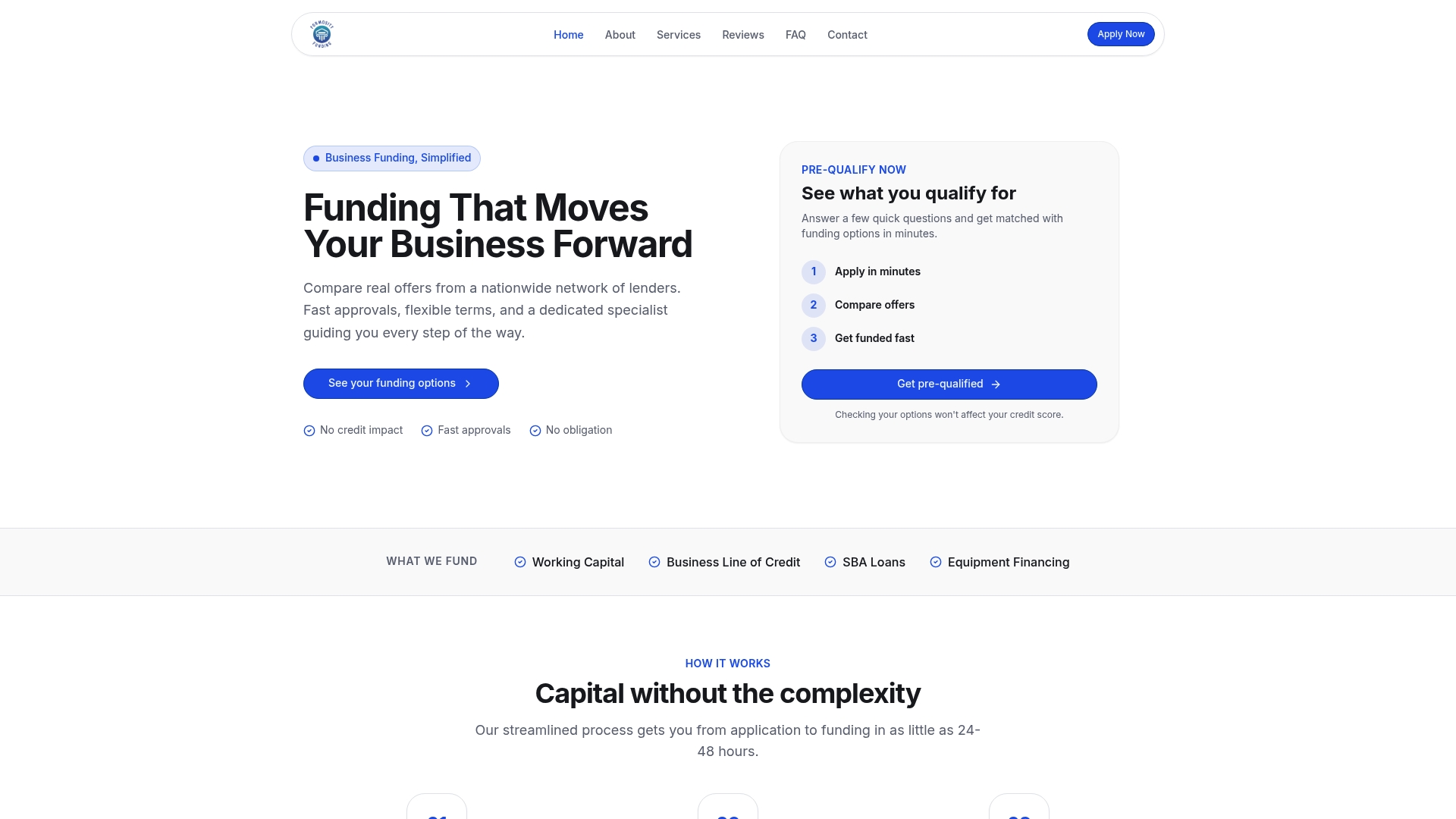
If you are ready to compare, Formosity Funding matches your business with lenders in a nationwide network and shows you real loan and credit offers. Pre-qualification does not affect your credit, and a dedicated funding specialist can walk you through the process from application to funding. Our funding options include working capital, business lines of credit, SBA loans, equipment financing and commercial real estate financing. We also offer a Business HELOC for owners who want to tap home equity for business needs.
If card acceptance costs are part of your cash flow picture, our payment acceptance consultation can help you look at that side too.
A step-by-step way to decide
- Define the purpose, amount and timeline. Put them on one page.
- Pick the product type that fits the purpose.
- Gather documents so you can apply the same week you choose.
- Request three to five offers, mixing at least two lender types if your credit allows.
- Build a comparison sheet with APR, total repayment, term, payment frequency, net funding and funding speed.
- Check each lender for upfront-fee requests, guarantees and covenants.
- Ask about prepayment and origination fees in writing.
- Choose the offer with the lowest total cost that your cash flow can carry, not the lowest payment.
FAQ
How many lenders should I compare?
Three to five is a sensible range. It gives you enough contrast to see what is normal without turning the process into a month-long project. Make sure you compare the same kind of product each time.
Is an online lender or a bank better for a small business?
It depends on your priorities. Banks and credit unions may offer lower rates but typically have stricter requirements and slower approvals. Online lenders usually decide faster, often at a higher cost.
Is it normal to pay a fee before a loan is approved?
No. Asking you to pay a fee in advance to guarantee or secure a loan is a recognized scam pattern. Legitimate costs, such as origination fees, are disclosed in writing and typically come out of the proceeds at funding.
What documents do I need to apply for a business loan?
Expect to provide a loan application, credit reports, tax returns, bank statements and a business plan or financial projections, plus items such as licenses and leases where relevant. Requirements vary by lender and program, so ask each one for its list before you apply.
Does pre-qualification hurt my credit?
That depends on the lender. With Formosity Funding, pre-qualification has no credit impact. Ask any other lender whether it uses a soft or hard credit pull before you share your information.
Sources
- How to Choose a Small Business Lender That's Right for You
- Lender Match, U.S. Small Business Administration
- Module 5 Small Business Financing, FDIC
- Loan Documentation, Minority Business Development Agency
- Advance Fee Loan Scams, Connecticut Department of Banking