

The SBA does not lend you money directly. It guarantees part of a loan made by a bank or other participating lender, and for working capital that usually means the 7(a) program, which allows up to $5 million. The hard part is not the program name. It is finding a lender that will say yes, and knowing which version fits how you actually spend cash. We built Formosity Funding around that problem: one pre-qualification with no credit impact, then real offers from a nationwide lender network.
TL;DR
- SBA working capital comes mainly through 7(a) loans, up to $5 million, for short- and long-term working capital needs.
- A revolving SBA line of credit exists, but only through specific 7(a) variants, such as SBA Express, Export Express and CAPLines, or the Working Capital Pilot.
- The Working Capital Pilot offers monitored lines up to $5 million with a maximum maturity of 60 months and capped interest rates.
- Lenders look at whether you are an operating, for-profit U.S. business, small under SBA standards, and able to repay.
- Formosity Funding offers pre-qualification with no credit impact and dedicated funding specialists, so you can compare offers before you commit.
Table of Contents
- What an SBA working capital loan actually is
- The SBA programs that can fund working capital
- How an SBA line of credit works
- Rates, guarantees and fees
- Who qualifies
- What the money can cover
- How to apply, step by step
- Get matched through Formosity Funding
- Our perspective
- FAQ
- Sources
What an SBA working capital loan actually is
"SBA working capital loan" is a search phrase, not a single product. Working capital is the money that pays for the everyday running of a business: payroll, inventory, rent, supplier invoices, the gap between billing a customer and getting paid. The SBA has no product with that exact name. Instead, several of its programs allow working capital as a use of proceeds.
The main one is the 7(a) program. The SBA describes it as its flagship program for small businesses that cannot get capital from conventional sources, and states that 7(a) loans can fund short- and long-term working capital with a maximum loan amount of $5 million.
The guarantee is the key mechanic. The SBA backs a share of the loan, which reduces the lender's risk. That is why a business that a bank might decline on a conventional loan can sometimes be approved with an SBA guarantee behind it.
The SBA programs that can fund working capital
7(a) loans
The 7(a) is the broadest option. Beyond working capital it can pay for equipment, expansion and debt refinancing. Maximum loan size is $5 million. Rates are negotiated between you and the lender, within SBA caps. Repayment terms for working capital are typically shorter than for real estate: one of the top-ranking guides cites up to 10 years for working capital and 25 for real estate.
SBA Express
SBA Express lets lenders use more of their own processes in exchange for a smaller SBA guarantee. The SBA lists a 50% guaranty on Express loans, which is one reason a lender can often move faster than on a standard 7(a).
Working Capital Pilot (WCP)
This is the closest thing the SBA has to a purpose-built working capital line. According to the SBA's 7(a) page, the WCP provides monitored lines of credit up to $5 million, with an 85% guarantee on amounts of $150,000 or less, 75% above that, and a maximum maturity of 60 months. The SBA says it was designed to combine the best features of existing 7(a) line-of-credit methods, and it includes one-on-one counseling with SBA experts for borrowers and lenders.

Microloans
For smaller needs, SBA microloans go up to $50,000, with an average of about $13,000. They can cover working capital, inventory, supplies, furniture, fixtures and equipment, but not existing debt or real estate. Maximum repayment is seven years, and rates generally run 8% to 13%, set by the intermediary lender.
MARC for manufacturers
Manufacturers have one more route. In a May 14, 2026 presentation, the SBA Office of Manufacturing and Trade explained that MARC proceeds may only be used for working capital. It is structured like an expanded SBA Express loan with revolving and term options, but underwritten like a standard 7(a), with a lien on all business assets as the minimum collateral.
| Program | Maximum amount | Working capital use | Notable feature |
|---|---|---|---|
| 7(a) | $5 million | Short- and long-term | Broadest use of proceeds |
| SBA Express | Lender-dependent within 7(a) limits | Yes | 50% SBA guaranty, faster lender process |
| Working Capital Pilot | $5 million | Revolving, monitored line | Up to 60-month maturity, capped rates |
| Microloan | $50,000 | Yes | Average about $13,000, up to 7 years |
| MARC (manufacturers) | See SBA program page | Working capital only | Revolving or term |
How an SBA line of credit works
People search for "SBA line of credit" as if it were one product. It is not, but the idea is simple. A term loan gives you a lump sum that you repay on a schedule. A line of credit gives you a limit you draw from as needed, and you pay interest on what you use, then borrow again as you repay.
The SBA is specific about where this is allowed. On a standard 7(a), revolving lines of credit are permitted only under SBA Express, Export Express or CAPLines. The Working Capital Pilot is the other revolving path, and it adds monitoring: the lender tracks how the line is used, which is the trade-off for the SBA guarantee.
A line suits uneven cash flow: seasonal inventory, slow-paying customers, a payroll that lands before the invoices do. A term loan suits a one-time, defined need. If you are weighing these against each other, our guide to cash flow financing walks through how the options differ. For ideas on tightening the cash cycle itself, this working capital improvement plan covers the operational side.
Rates, guarantees and fees
The published caps give you a ceiling to check any quote against. For the Working Capital Pilot, the SBA states maximum interest rates as the base rate plus a spread that shrinks as the loan grows:
| Loan size | Maximum spread over base rate |
|---|---|
| $50,000 or less | +6.5% |
| $50,001 to $250,000 | +6.0% |
| $250,001 to $350,000 | +4.5% |
| $350,001 and greater | +3.0% |
These caps come from the SBA's 7(a) page. The base rate moves, so the actual rate on your loan depends on the base rate in force when you borrow and on your lender's pricing. Use the spread, not a headline percentage from an article, to test an offer.
On fees, ask every lender for a written list before you accept. Line-of-credit costs can include more than interest, for example origination, closing and guarantee-related charges, and some lines carry charges for servicing or monitoring. Comparing the total annual cost, not just the interest rate, is what makes two offers comparable.

Who qualifies
The SBA's 7(a) eligibility rules ask that your business:
- operates for profit and is located in the U.S.
- is small under SBA size requirements
- is not an ineligible business type
- cannot get the credit on reasonable terms from non-government sources
- is creditworthy, with a reasonable ability to repay
Size is measured under 13 CFR Part 121, either by industry standards or by an alternative test. Under SBA SOP 50 10 8.1, effective October 1, 2026, the alternative standard is no more than $20 million in tangible net worth and $6.5 million in average after-tax net income over the prior two fiscal years. Most small businesses pass on the industry standard long before this matters.
"Reasonable ability to repay" is where most files are won or lost. For the MARC program, the SBA says lenders underwrite with a 1:1 debt service coverage ratio on the fully advanced loan and require a current debt schedule. That is a useful mental model for any SBA working capital request: show that your cash flow covers the payments, with your existing debts listed.
To prepare before you apply, read what lenders ask for on small business loans and which document decides working capital approval. If you have been declined before, common denial reasons show what to fix first.
What the money can cover
Working capital under 7(a) is flexible: payroll, inventory, supplies, operating expenses and similar day-to-day costs. Microloan proceeds are narrower and cannot repay existing debt. MARC allows debt refinancing only for working capital purposes. Match the program to the use before you apply, because use of proceeds is written into the loan paperwork. Our breakdown of what working capital loans can cover gives examples.
If the purchase is a machine or vehicle rather than general operating cash, compare it with an equipment loan, which can fit better.
How to apply, step by step
- Define the need. Write down the amount, what it pays for and when you will repay it from revenue. A one-time need points to a term loan; recurring swings point to a line.
- Gather your documents. Expect to provide financial statements, tax returns, a debt schedule and business details. Lenders vary, so your list should be complete before you start. Missing items cause most delays.
- Find a participating lender. The SBA offers Lender Match, which it describes as a tool to find lenders in your community, not a loan application. Using it does not guarantee a match or an offer. For the Working Capital Pilot, the SBA directs businesses to use it to find a participating lender.
- Compare offers. Look at the rate against the SBA cap, the term, the fee list, collateral requirements and whether the line is revolving. Choosing a business lender explains how to weigh these.
- Submit and close. The lender submits the file, and for qualified lenders can decide under delegated authority. Closing involves signing guarantees and collateral documents.
This is where a marketplace saves time. Instead of approaching lenders one by one, you complete one pre-qualification and receive matched offers, and a dedicated funding specialist guides you through the process. If you want to understand the difference between a broker and a direct lender first, see how to choose between them.
Get matched through Formosity Funding
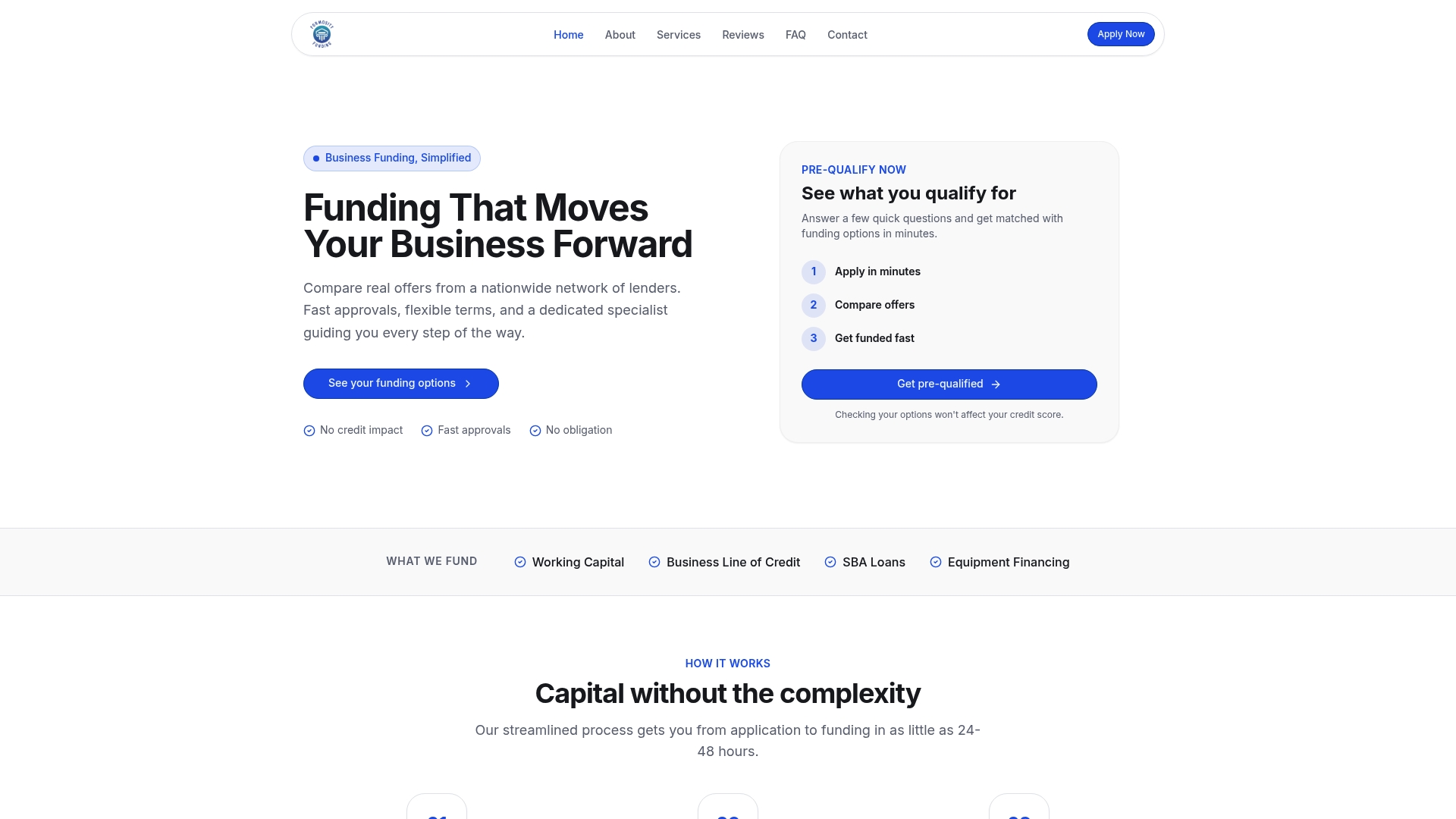
Formosity Funding is an online marketplace that connects small and medium-sized businesses with a nationwide network of lenders. You can pre-qualify with no credit impact, review multiple real loan and credit offers, and work with a dedicated funding specialist from application to funding. We cover working capital, business lines of credit, SBA loans, equipment financing and commercial real estate financing in one place.
See the full range on our business funding options page, or start from formosityfunding.com.
Our perspective
Most owners who search for SBA working capital are really asking one question: which product gets cash into my business with the least friction? The SBA programs are strong tools, but the program names hide a practical problem. A guarantee is only useful if a lender will use it for your file.
That is why we built Formosity Funding as a marketplace. One pre-qualification with no credit impact lets you see where you stand before any lender pulls your credit. Matched offers from a nationwide lender network let you compare real terms side by side, rather than guessing from advertised ranges.
We also think the guidance matters as much as the access. A dedicated funding specialist who walks you through the process helps you pick the right structure, whether that is SBA financing, a line of credit or working capital, and avoid applying for the wrong product.
Alvin
FAQ
Is there an SBA line of credit?
Yes, through specific programs. Revolving lines are permitted under SBA Express, Export Express and CAPLines, and the Working Capital Pilot offers monitored lines up to $5 million. The SBA guarantees the line, but a participating lender makes it.
How much can I borrow for working capital with the SBA?
The maximum for 7(a) working capital is $5 million, and the same ceiling applies to the Working Capital Pilot. Microloans for smaller needs go up to $50,000. What you are approved for depends on your cash flow and the lender's underwriting.
Does the SBA lend me the money directly?
No. The SBA guarantees a portion of a loan made by a participating lender. Its Lender Match tool helps you find lenders, but it is not an application and does not promise an offer.
Can a startup get SBA working capital?
Eligibility focuses on being an operating, for-profit U.S. business that is small under SBA standards and able to repay. A very new business has less history to show a lender, so prepare projections and a clear repayment plan. Formosity Funding also lists startup funding among its products, and a specialist can help you find the right fit.
Sources
- 7(a) loans, U.S. Small Business Administration
- Microloans, U.S. Small Business Administration
- Lender Match, U.S. Small Business Administration
- Small Business Loan Symposium slides, SBA Office of Manufacturing and Trade
- SBA SOP 50 10 8.1, Lender and Development Company Loan Programs
- Working capital improvement plan for owners