

Yes, you can apply to more than one lender for business funding, and for most owners it is the smart move. Lenders differ in what they fund, what they charge and how they underwrite, so a single quote tells you very little. The trick is to do it in the right order: start with soft-pull pre-qualification, narrow the field, then submit full applications close together so the offers stay comparable.
TL;DR
- Applying to several lenders is normal and sensible. Compare real offers instead of accepting the first one.
- Pre-qualification usually uses a soft inquiry, which does not lower your score. Formal applications usually trigger hard inquiries, which can.
- Rank lenders by fit for your loan type and deal size first, then apply to a short list inside a tight window.
- Compare offers on total cost over the term (APR, fees, prepayment terms), not on the monthly payment alone.
- Keep a backup option alive until you hold a written commitment from the lender you choose.
Table of Contents
- Is it okay to apply to more than one lender?
- How multiple applications affect your credit
- How many lenders should you approach?
- A step-by-step way to apply to several lenders
- What to compare in each offer
- Pitfalls to avoid
- How we can help you compare offers
- Our perspective
- FAQ
- Sources
Is it okay to apply to more than one lender?
It is okay, and it is how experienced borrowers work. The FDIC points out that lenders vary widely in priorities and underwriting models, depending on their size, the type of business they serve and the credit products they offer. A lender that declines you may simply not like your industry or deal size, while another would be glad to fund it.
The search results for this topic are full of mortgage advice, and some of it does carry over. Shopping around gives you leverage and a real benchmark. But business lending has its own quirks: personal credit often matters alongside business credit, there is no standard "rate-shopping window" you can count on, and many products (working capital, lines of credit, equipment financing) are priced with fees and factor rates that are hard to compare at a glance. That is why the process matters more than the number of applications.
A practical rule we give owners: two or three serious contenders beat ten casual applications. More than that and you spend weeks juggling paperwork, and your credit file collects pulls without adding insight.

How multiple applications affect your credit
The difference between a soft and a hard inquiry is the whole game.
- Soft inquiry: A lender looks at your file without a formal credit application. The FDIC notes that soft inquiries, often used for prequalification, do not impact scores.
- Hard inquiry: This happens when you formally apply for credit. The same FDIC guide says hard inquiries can temporarily lower credit scores.
How much a cluster of hard inquiries hurts depends on several things. Experian says multiple hard inquiries from loan applications can hurt credit scores, though the effect depends on the loan type, the timing of creditor checks and the scoring model in use. In plain terms: do not assume that grouping applications will collapse them into one pull. Some scoring models treat similar inquiries made close together more kindly than others, and many business lenders also review your personal credit as a matter of course.
The safe approach is to minimize the number of hard pulls you invite. Use soft-pull pre-qualification to find out who is likely to say yes, and only submit full applications where you have a realistic shot. If you want to go deeper on this, our guide on limiting hard pulls and avoiding loan stacking covers the pitfalls of taking on several financing products at once.
If you have a thin or damaged credit profile, be extra selective. A string of declines, each with a hard pull behind it, is the worst outcome. Our breakdown of why small business applications get rejected is a good check before you submit anything.
How many lenders should you approach?
There is no official magic number for business loans. Our working answer is two or three lenders you have good reason to believe in, plus one fallback.
The way you build that list matters more than its length. BankingLens, a commercial lending resource, suggests ranking lenders by relevance to your specific loan need and deal size before you contact anyone. That means asking yourself:
- What product fits? A short-term cash flow gap points to working capital or a line of credit. A truck or machine points to equipment financing. A building points to commercial real estate financing. A larger, longer-term need may suit an SBA loan.
- What size of deal? Some lenders will not look at small amounts, and others are not built for large ones.
- How fast do you need the money? Online lenders and banks run on very different clocks. Our comparison of online lenders versus banks lays out the trade-offs.
- Who is the lender? The FDIC research notes that smaller banks may rely on relationship-based lending with local knowledge, while larger banks often favor automated, transactional lending built on hard data such as credit scores. A business with a strong story but a modest score may do better with the first type. A business with clean numbers may sail through the second.
If you would rather not research dozens of lenders yourself, a marketplace can do the first pass. Our guide on choosing between a broker and a direct lender explains what to look for either way.
A step-by-step way to apply to several lenders
1. Get your package ready first
Offers are only comparable if every lender sees the same facts. The FDIC describes a strong loan package as typically including a business plan, two years of tax returns, recent financial statements, a debt schedule and clear documentation of how the funds will be used. Assemble these before you contact anyone. Our lists of loan documents owners need and small business loan requirements walk through each item, and a ready package is the best defense against underwriting delays.
Also know what you might pledge. Banks commonly weigh personal credit scores and collateral availability heavily, according to the FDIC's Small Business Lending Survey. Decide in advance what you can offer; see what small businesses can pledge as collateral.
2. Pre-qualify with soft pulls
Pre-qualification is where you find out which doors are open without paying for it in credit points. The SBA's Lender Match tool is one route: it connects businesses with potential lenders, and you can then talk to the matched lenders, compare rates, terms and fees, and submit applications. The SBA is clear that Lender Match is not a loan application and does not guarantee an offer, so treat it as an introduction.
A lending marketplace works on the same principle at wider scale. You complete one form, and lenders in the network respond with the products you may qualify for.
3. Narrow to two or three
Look at what came back. Drop any option with a structure that does not fit your cash flow, such as a short-term product to fund a long-term asset. Keep the ones that are clearly priced and clearly explained.
4. Apply inside a short window
BankingLens advises sequencing applications within a short, overlapping window, so that the offers you receive remain comparable and reflect your current financial information. If one lender sees your books from this month and another sees last quarter's, you are comparing apples to oranges. Aim to submit your full applications within days of each other, not months.
5. Keep a backup warm
An approval email is not a commitment. The same source recommends keeping an alternative option alive until you hold a formal commitment letter, because terms can change late in underwriting. Do not tell your second-choice lender no until the first one has put it in writing.
6. Compare, negotiate, then sign
Put the offers side by side (see the next section), ask each lender to clarify anything unclear, and use a competing offer as leverage. Lenders can often adjust fees or terms when they know you are comparing.
What to compare in each offer
The SBA says borrowers should ask lenders about interest rates, minimum credit score, cash-flow requirements, qualifying factors, prepayment penalties, grace periods and whether the lender can demand full repayment of principal. Use that list as a base, then add the cost lines below so every offer lands in the same grid.
| What to check | Why it matters | What to ask |
|---|---|---|
| Total cost over the term | A low monthly payment can hide a long term or heavy fees | What is the total I repay, and what is the APR? |
| Origination and other fees | They reduce what you actually receive | Are fees deducted from the funds? See origination fees |
| Prepayment terms | Paying early may not save you money | Is there a penalty if I repay early? See prepayment penalties |
| Repayment schedule | Daily or weekly payments hit cash flow differently than monthly | How often and how is it collected? |
| Collateral and guarantees | Determines what you could lose | What is pledged, and is a personal guarantee required? |
| Speed to funding | Time-sensitive needs may rule out slower products | How long from signed offer to funds? |
| Repayment demand rights | Some agreements let the lender call the loan | Under what conditions can the lender demand full repayment? |
The most common mistake is ranking offers by monthly payment. Convert each one to the total you will repay across the term, then divide by what you actually receive after fees. That single comparison usually changes the order.
A worked example of the method
Suppose you need equipment and receive two offers. The first has a lower payment but a longer term and an origination fee taken from the proceeds. The second has a higher payment, a shorter term and no prepayment penalty. Add up all payments and fees for each, subtract the net proceeds, and you see the true cost of borrowing. If the second is cheaper overall and your cash flow can carry the payment, it wins, even though it looks worse on a monthly basis. The numbers here are illustrative only, but the method is the same for any offer.
Pitfalls to avoid
- Applying everywhere at once. More hard pulls, more paperwork and no extra insight. Stick to the short list.
- Inconsistent information. Give every lender the same figures. Mismatches slow underwriting and can read as a red flag.
- Stacking financing by accident. Taking several products at once can strain cash flow and trigger problems with later lenders. Our piece on loan stacking explains how to avoid it.
- Ignoring product type. Comparing a line of credit with an equipment loan on rate alone is meaningless. Compare like with like, or compare the total cost of solving the same problem.
- Skipping the fine print. Prepayment penalties and fee structures can erase an apparent savings.
- Burning your fallback. Keep your second choice open until you have a written commitment.
How we can help you compare offers
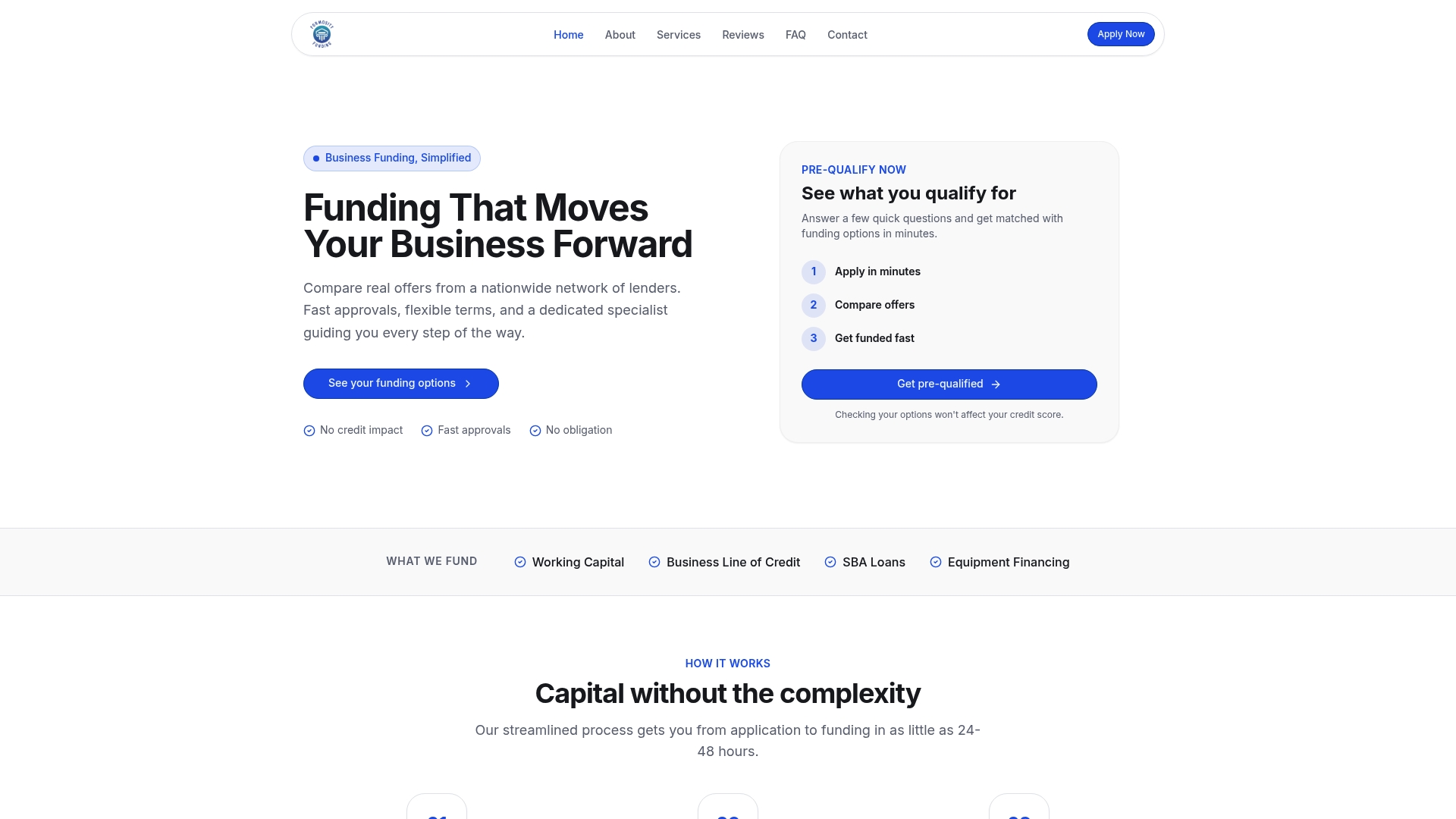
We built Formosity Funding so you do not have to repeat this process lender by lender. Our marketplace connects you with a nationwide network of lenders, and pre-qualification does not impact your credit. You can look at multiple real offers for products such as working capital, business lines of credit, SBA loans, equipment financing and commercial real estate financing, with a dedicated funding specialist to guide you from application to funding.
See the products and start pre-qualifying on our funding options page.
If you own property and want to explore tapping its equity for your business, take a look at our Business HELOC page too.
Our perspective
Most owners we talk to think of "applying to multiple lenders" as a risk to their credit. We think the bigger risk is the opposite: accepting one offer because it was the first one that arrived, and never learning that a better structure existed.
The way to have both safety and choice is to separate discovery from commitment. Discovery should be soft-pull and cheap: one form, several lender responses, no damage to your score. Commitment should be deliberate: two or three formal applications, submitted close together, with matching documents.
That is the reason we designed Formosity Funding as a single streamlined platform with a wide lender network. You see real loan and credit offers side by side, and a dedicated funding specialist helps you read them, so the cheapest monthly payment does not trick you into the most expensive loan.
Whatever route you take, hold on to one habit: compare total cost, keep a backup until the commitment letter arrives, and ask questions until every fee makes sense.
Alvin
FAQ
Will applying to multiple business lenders hurt my credit score?
It can, if the applications are formal. Hard inquiries from full applications can temporarily lower scores, while soft inquiries used for pre-qualification do not, according to the FDIC. Experian adds that the impact depends on the loan type, timing and scoring model. Pre-qualify first and apply formally only to your short list.
How many lenders should I apply to?
Two or three well-matched lenders is a practical target, plus a backup. Rank lenders by how well they fit your loan type and deal size before you contact them. Fewer, better-chosen applications give you real comparison without a pile of hard pulls.
Is pre-qualification the same as an application?
No. The SBA states that Lender Match is not a loan application and does not guarantee an offer. Pre-qualification shows you likely options, and a formal application, which usually involves a hard credit check and full documents, comes after you choose.
When should I submit applications?
Within a short, overlapping window. That keeps each lender working from the same current financial information, so the offers you receive are directly comparable. Spreading applications over months can leave you comparing stale terms.
What if one lender approves me and another is still reviewing?
Do not close the door on the second one until you hold a written commitment from the first. Terms can change late in underwriting, and a warm alternative protects you if they do.
Sources
- Lender Match, U.S. Small Business Administration
- Building Strong Credit for Your Business, FDIC
- Do Multiple Loan Inquiries Affect Your Credit Score?, Experian
- How to Shop a Commercial Loan Without Burning Every Bank, BankingLens
- Small Business Lending Survey 2024, Loan Underwriting and Approval, FDIC
- Can Banks Lend Like Fintechs?, FDIC Center for Financial Research