
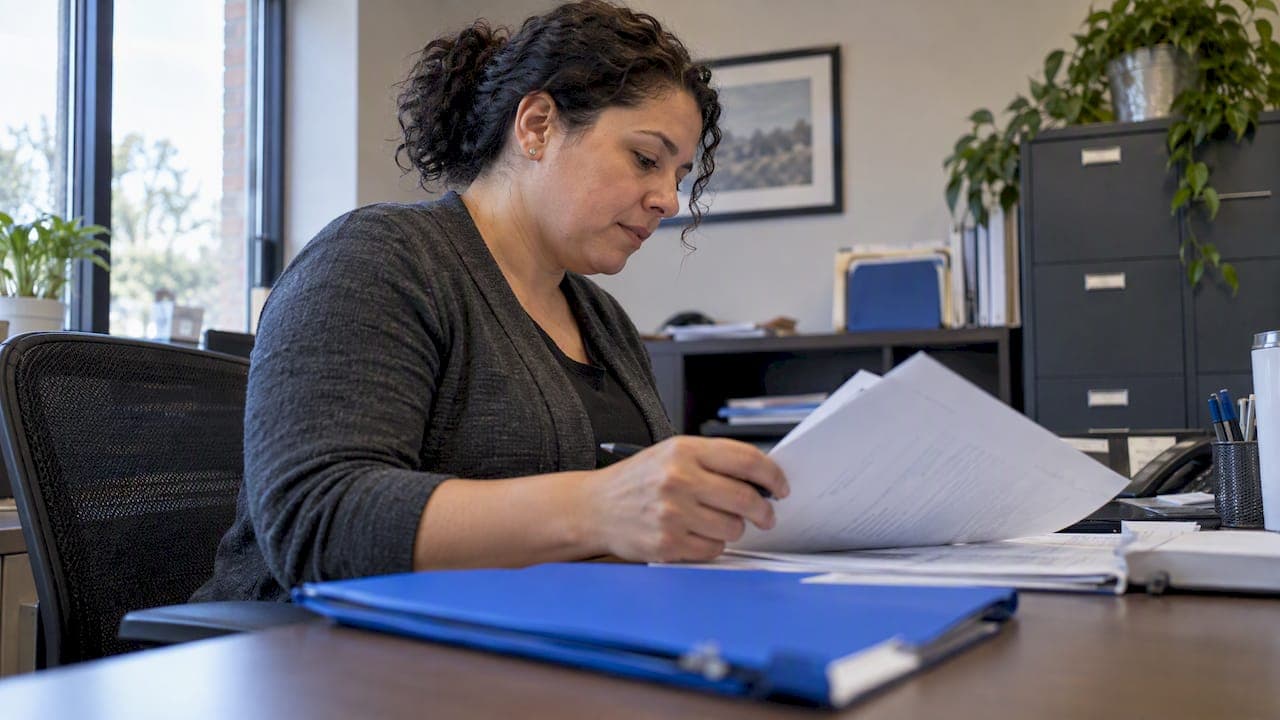
Underwriting is the stage where a lender decides whether your business can repay the money you asked for. An underwriter verifies your documents, analyzes your cash flow and credit, weighs collateral and risk, then approves, counters or declines. Timing ranges from a few business days for some online products to 45 to 90 days for an SBA loan. Being in underwriting does not mean you are approved. It means a person or a system is now testing every claim in your application.
Below is what happens in that stage, what the underwriter is looking for, and what you can do to keep the file moving.
TL;DR
- Underwriting is a verification and risk-assessment stage. Landing in it is not an approval.
- Lenders focus on repayment ability: cash flow, debt service coverage, credit history, collateral and the strength of the owners.
- Timelines vary by lender type and product. Bank and SBA files take longer than most online products, and slow responses from you add the most delay.
- Standards move with the economy, so a profile that was approved easily a few years ago may now face tighter collateral or covenants.
- Complete, consistent documents submitted up front are the most controllable part of the process.
Table of Contents
- What underwriting actually is
- The underwriting process, step by step
- How long does underwriting take?
- What underwriters weigh most
- Why a good profile can still hit tighter standards
- Our perspective
- How to move through underwriting faster
- Match your file to the right lender
- FAQ
- Sources
What underwriting actually is
A loan officer or funding specialist collects your application. The underwriter is the person (or, for small, simple loans, the automated model) who makes the credit decision. The two roles are often confused, but the officer advocates for you while the underwriter tests the file against the lender's credit policy.
The question is always the same: is there reasonable assurance the loan will be repaid? For SBA-guaranteed loans, SBA guidance sets minimum credit-analysis expectations. For conventional bank loans and online products, each lender sets its own policy. Banks surveyed by the FDIC were asked whether they assign a grade or numeric score to small business applications and how many levels of approval a loan needs, which shows how much the process differs from one institution to the next.

The underwriting process, step by step
1. Intake and completeness check
Before anyone analyzes anything, the file is checked for gaps: missing signatures, unreadable statements, a tax return that does not match the application. Incomplete files wait in a queue. This is where most avoidable delay happens. Our guide to the nine documents that prevent underwriting delays lists what to have ready.
2. Verification of identity, eligibility and ownership
The lender confirms who owns the business, that it is legally registered, and that it is eligible for the product. On SBA loans, SBA has said it checks eligibility and fraud upfront so lenders have timely assurance the borrower qualifies.
3. Credit review
The underwriter pulls personal credit for the owners and, where available, business credit. They look at payment history, utilization, recent inquiries, liens and past delinquencies. Minimum scores differ by lender and product. For SBA specifics, see what lenders want from SBA credit scores.
4. Financial and cash flow analysis
This is the core of the process. Expect the underwriter to read:
- Business bank statements, usually several months
- Profit and loss statements and balance sheets
- Business and personal tax returns
- A schedule of existing debts
They are testing whether operating cash flow covers all debt payments, including the new one. That test is the debt service coverage ratio (DSCR): cash available for debt service divided by total debt payments. For SBA 7(a) loans above $500,000, SBA's rule calls for a comprehensive credit analysis showing repayment ability from historical or projected cash flow, with a ratio of at least 1.15. Below that amount, 7(a) Small loans let lenders use their own processes, such as credit scoring or cash flow analysis.
A 1.15 ratio means that for every $1.00 of debt payments, the business generates $1.15 of cash to pay it. Many lenders set their own bar higher for conventional loans.
5. Global cash flow
Lenders often look beyond the business entity. If you own other companies or carry personal debt such as a mortgage or auto loans, the underwriter may combine them into a single picture. A business can look profitable alone and still fall short once the owner's personal obligations are counted. If you have affiliates, give the lender that information early rather than letting them find it.
6. Collateral and structure
The underwriter decides what secures the loan and whether the structure fits the need: term, payment schedule, amount, and any personal guarantee. Equipment loans are usually secured by the equipment itself, while real estate loans by the property. Read what small businesses can pledge as collateral and, if you already have other loans, the risk of cross-collateralization, where one default can reach every asset pledged.
7. Management and business-plan review
Underwriting is not only math. Lenders look at the owners' experience and how the business would run without them. For expansion or startup funding, projections need documented assumptions, such as a signed contract or a new sales channel, not an optimistic growth curve. Expect questions about industry conditions too.
8. Credit committee or final decision
Small, simple loans may be decided by one underwriter or fully automated. Larger files may go to a committee. The outcome is one of four: approval, approval with conditions, a counteroffer for a different amount or terms, or a decline.
9. Conditions, commitment and closing
Approval often arrives with conditions: an updated bank statement, proof of insurance, a lien search, a signed lease. Once you satisfy them, the lender issues a commitment and moves to closing documents. Do not make large purchases or open new credit lines in the meantime, because lenders can re-check credit and balances right before funding.
How long does underwriting take?
It depends on the product and how quickly you respond.
| Funding type | Typical underwriting pace | What drives the time |
|---|---|---|
| Working capital or short-term online products | Often days, depending on the lender | Bank statement review, often automated |
| Business line of credit | Days to a few weeks | Financials, credit and any collateral |
| Equipment financing | Days to a few weeks | Equipment quote and valuation |
| SBA loans | Industry sources cite roughly 45 to 90 days | Full credit analysis, SBA requirements, borrower responsiveness |
| Commercial real estate | Often longer | Appraisal, environmental and title work |
These ranges are general patterns, not guarantees from any lender. One industry overview of the SBA lending timeline says underwriting itself can take up to a few weeks, with the overall SBA process taking longer. For a deeper comparison of speed and cost, see our piece on online lenders versus banks.
What underwriters weigh most
Lenders use different formulas, but the same factors appear repeatedly:
- Cash flow stability. Steady deposits beat one strong quarter.
- Debt service coverage. Can the business pay every obligation with room to spare?
- Credit history. Owners' personal credit and the business's payment record.
- Time in business. Many products require a minimum operating history.
- Collateral. What the lender can recover if repayment fails.
- Industry and concentration risk. Reliance on one customer or a volatile sector raises questions.
- Character and management. Experience, transparency and consistency across documents.
For a fuller checklist, see small business loan requirements.
Why a good profile can still hit tighter standards
Underwriting rules are not fixed. In the Federal Reserve's October 2024 Senior Loan Officer survey, moderate net shares of banks reported tighter standards on commercial and industrial loans to small firms. The April 2024 survey reported tightening on terms as well. Practically, that can mean larger collateral requests, added covenants or higher premiums for riskier borrowers, even if your numbers haven't changed.
Approval rates also vary by lender type. A Federal Reserve publication reports that small banks approved 75% of applicants while online lenders approved 70%, and it advises small businesses to review the cost and terms of every offer carefully. Speed and approval odds are separate questions, so compare the full terms, not only the timeline. Our look at bank term loan rates helps you judge an offer.
Our perspective
We see underwriting from the borrower's side of the table. Owners tend to treat it as a black box and then are surprised by a request for one more statement. We think of it as a conversation you can prepare for.

Three habits make the biggest difference. First, decide which product fits before applying. A short-term cash flow gap and a ten-year property purchase need different structures, and a mismatch is a common reason for a decline. Second, put everything on the table early: other businesses, personal debts, a tax lien you are paying down. Underwriters can forgive a known weakness with a documented plan far more easily than one they discover. Third, apply to the right type of lender for your profile. Because our marketplace connects businesses with a nationwide network of lenders, we can pre-qualify you without a credit impact and show you real offers, so you are not collecting hard inquiries across lenders that were never going to say yes.
The point of all of it is to make the underwriter's job easy: a complete file, consistent numbers, a clear use of funds.
— Alvin
How to move through underwriting faster
- Pre-qualify first. A soft-pull check shows which products you are likely to fit. Our prequalification document list covers what to gather.
- Reconcile your numbers. Tax returns, statements and the application should tell the same story. Explain any gaps in a short note.
- Respond the same day. On SBA files especially, slow replies are among the main causes of delay.
- Keep your bank balances and credit stable. Avoid new debt until funding.
- Fix known weaknesses. Pay down cards, resolve errors on your credit reports, and document one-time dips. More ideas are in how to increase approval odds fast.
- Learn from a decline. The common denial reasons usually point to a specific fix.
Match your file to the right lender
Formosity Funding is a marketplace for small and mid-sized businesses. We offer working capital, business lines of credit, SBA loans, equipment financing, commercial real estate financing and more, with pre-qualification that does not affect your credit and dedicated funding specialists who guide you through the process. See our funding options or start from our home page.
FAQ
If my loan is in underwriting, does that mean it's approved?
No. Underwriting is the stage where the lender verifies your information and decides. It can end in approval, approval with conditions, a counteroffer or a decline. You are approved when you receive a written approval or commitment.
What should I avoid doing while in underwriting?
Avoid opening new credit, making large unexplained deposits or withdrawals, and changing your business structure. Do not ignore document requests. Lenders can re-check credit and balances before funding, so changes can hurt the file.
How likely is a loan to be denied in underwriting?
It depends on the lender type and your profile. The Federal Reserve publication cited above reports approval rates of 75% at small banks and 70% at online lenders, though those figures cover applications broadly, not only files that reach underwriting. Our guide to loan denial reasons covers the usual causes.
What documents do underwriters usually ask for?
Expect business bank statements, tax returns, profit and loss statements, a balance sheet, a debt schedule, ID and ownership documents, and for some products a business plan or collateral details. Requirements vary by lender and loan type.
Sources
- SBA: Business Loan Program Improvements
- Federal Reserve: October 2024 Senior Loan Officer Opinion Survey
- Federal Reserve: April 2024 Senior Loan Officer Opinion Survey
- Federal Reserve Board publication on small business credit
- FDIC 2022 Small Business Lending Survey, Part 3: Underwriting
- First Internet Bank: Step-by-step guide to SBA 7(a) loans