

The online business loan process has six stages: choose the funding type, pre-qualify, gather documents, compare real offers, complete underwriting and sign, then receive funds. Most of the delay in that sequence comes from missing paperwork and from comparing offers on the wrong number, not from the lender. At Formosity Funding, we connect small and medium-sized businesses with a nationwide network of lenders, and pre-qualification does not affect your credit, so you can see real offers before you commit to anything.
TL;DR
- Start by naming the amount and the purpose. Every lender and every application asks for both, and they decide which product fits (working capital, line of credit, equipment, SBA or commercial real estate).
- Pre-qualification is a first look, not a loan. With us it has no credit impact, and it shows you offers before a full application.
- Have your documents ready before you apply: financial statements, tax returns, a business plan or loan purpose summary, and collateral details if the loan is secured.
- Compare offers by APR, fees taken from proceeds, term and payment schedule, not by the monthly payment alone.
- Approval is a lender decision based on cash flow, financial position and business history. Funding follows signing.
Table of Contents
- The online business loan process at a glance
- Step 1: Decide what you are borrowing for
- Step 2: Pre-qualify before you apply
- Step 3: Gather your documents
- Step 4: Know how lenders decide
- Step 5: Compare offers the right way
- Step 6: Underwriting, signing and funding
- What to know by funding type
- Mistakes that slow the process
- Where Formosity Funding fits
- Our perspective
- FAQ
- Sources
The online business loan process at a glance
An online business loan is a loan you apply for and manage through a web platform instead of a branch visit. The steps below are the same whether you borrow $20,000 for inventory or several million for property. Only the paperwork gets heavier as the amount grows.
| Step | What you do | What can go wrong |
|---|---|---|
| 1. Define the need | Set the amount, purpose and how fast you need the money | Borrowing for the wrong product, such as a term loan for a recurring cash gap |
| 2. Pre-qualify | Answer a short set of questions about the business | Treating a match as an approval |
| 3. Gather documents | Pull financials, tax returns and ownership details | Missing or inconsistent figures slow underwriting |
| 4. Compare offers | Line up APR, fees, term and payment schedule | Choosing on payment size alone |
| 5. Underwriting and signing | The lender verifies your file and issues final terms | Late document requests, changes in the business |
| 6. Funding | Funds are disbursed after signing | Not accounting for fees deducted from proceeds |
Step 1: Decide what you are borrowing for
Lenders structure products around purpose, so the purpose comes first. A loan application generally states the amount you want and what it is for, according to the FDIC's small business financing guide, and lenders may ask for documents tied to that purpose.
A rough map of the common choices:
- Working capital: covers payroll, inventory and short-term gaps between paying bills and getting paid.
- Business line of credit: revolving access you draw on and repay as needed, suited to uneven cash flow.
- Equipment financing: funds a specific machine or vehicle, which usually serves as the collateral.
- SBA loans: loans partly guaranteed by the U.S. Small Business Administration, typically for larger or longer-term needs.
- Commercial real estate financing: purchase or refinance of owner-occupied or investment property.
If you cannot say which of these fits, that is a good reason to talk to a funding specialist before applying anywhere. Our platform covers all of these, so the question "which product" gets answered with real options in front of you.
Step 2: Pre-qualify before you apply
Pre-qualification is a short questionnaire that gives lenders a snapshot of your business so they can tell you whether they are interested. It is not an application, and it should not be confused with an approval.
The SBA's own matching tool shows the pattern. Its Lender Match page describes four steps: describe your financing needs, receive matches from interested lenders, talk with those lenders to compare terms, then apply and submit paperwork. The questionnaire can take as little as five minutes, a summary of interested lenders arrives two business days after the request, and it does not guarantee a match or a loan offer.

Our pre-qualification works on the same logic with one feature owners care about: it has no impact on your credit. You get multiple real loan and credit offers from lenders in our network, and a dedicated funding specialist guides you from there through application to funding.
Step 3: Gather your documents
Most delays at the underwriting stage are documentation delays. According to the FDIC, lenders may request:
- a business plan
- financial statements, sometimes for multiple years
- recent business tax returns
- owner personal tax returns or credit information, depending on company size, structure and maturity
- collateral details if the loan is secured
- documents related to the purpose of the loan, such as an equipment quote or a purchase contract
The same FDIC guide notes that what is requested depends on the size, structure and age of the company. A one-owner LLC borrowing a small amount will be asked for less than a company seeking a seven-figure facility.
A practical way to prepare: put the last two to three years of tax returns, current profit and loss statement, balance sheet, and a list of existing debts in one folder. We have written a detailed checklist in 9 business loan documents U.S. owners need, and a shorter list for the first stage in 10 documents for prequalification. For the full list of what lenders look for, see small business loan requirements.
If the loan will be secured, decide early what you can pledge. Our guide to business loan collateral covers the usual options.
Step 4: Know how lenders decide
You do not need to see a lender's scorecard to understand what drives the decision. The FDIC's Small Business Lending Survey 2024 reports that 80 percent of banks said loan size was the most common factor shaping how many approval levels a loan goes through, and 67 percent cited an insufficient debt service coverage ratio. Among small banks, 74 to 82 percent ranked the business's financial position (balance sheet, debt-service coverage and liquidity) as the most important factor. These are survey results from banks, but they show what any underwriter checks: can the business cover the payment from its own earnings?
Debt service coverage ratio simply compares your income available for debt payments with the payments themselves. If you want to get comfortable with that and similar measures before you apply, this walkthrough on how to interpret financial ratios is a good start.
What SBA loans add
SBA loans carry a government guarantee to the lender, which makes them workable for some borrowers who cannot get reasonable conventional credit. They still require full underwriting. The OCC's SBA lending bulletin attachment states that 7(a) loans require a "credit not available elsewhere" certification, that lenders consider industry, operating history, collateral and a reasonable term based on actual or projected cash flow, and that the maximum guaranty is generally 85 percent on loans up to $150,000 and 75 percent above that.
Under 13 CFR § 120.172, the SBA looks at nine factors for loan soundness, including character and credit history, management experience, business strength, past earnings and projected cash flow, ability to repay from business earnings, invested equity and the value of collateral. The regulation also says inadequate collateral alone cannot be the sole reason for denial. The same section sets the maximum 7(a) loan at $2,000,000 with a $1,000,000 aggregate SBA guaranty limit per borrower. That is why a $1,000,000 request is not out of reach for a strong borrower, but it does mean a full underwriting file and a lender that handles SBA loans. Check the current regulation text on govinfo or SBA.gov, because limits can change.

New LLCs
A new LLC can apply, but the file looks different. With little operating history, lenders lean on the owner's personal credit, projected cash flow, collateral and the strength of your plan. Prepare a clear plan with realistic projections and be ready to explain how the money will generate revenue. If a denial would sting, read why SMB applications get rejected first, and use how to increase approval odds before you submit.
Step 5: Compare offers the right way
Once offers arrive, the temptation is to pick the lowest monthly payment. That number hides the real cost. Federal law helps: the Truth in Lending Act requires lenders to give written disclosures stating loan terms in a clear, uniform way before you sign, and the FDIC's Money Smart module tells borrowers to use them, especially the Annual Percentage Rate (APR), to compare offers. The sample disclosure shows APR, finance charge, amount financed and total of payments. Line those four items up side by side for every offer. Whether a particular business product comes with that exact disclosure depends on the product and the lender, so ask each lender what disclosure they provide.
Two traps are worth knowing:
- Fees come out of the proceeds. The FDIC's instructor guide gives the example that borrowing $1,000 with a $100 fee means you receive $900.
- Balloon payments. The same guide warns that some installment offers end with a larger-than-usual one-time payment, so read the payment schedule rather than the headline payment.
Worked example: a $50,000 loan
Readers often ask what the monthly payment on a $50,000 loan is. It depends on rate and term. This is an illustration with made-up terms, not an offer: $50,000 at a 12% annual rate over 36 months with equal monthly payments comes to about $1,661 a month, or roughly $59,786 in total, so about $9,786 in interest. Multiplying the monthly payment by the number of months is the same method the CFPB's loan comparison worksheet uses, and that worksheet also notes a longer term raises the total cost.
Now add a hypothetical 3% origination fee taken from proceeds: $1,500 comes off the top, so you receive $48,500 while still repaying on $50,000. If you needed the full $50,000 for an equipment purchase, you would have to borrow more. That is the gap between the loan amount and the usable amount, and it is why the amount financed line matters.
For definitions of the terms you will see on an offer sheet, our plain-English guide to business loan terms is a quick reference.
Step 6: Underwriting, signing and funding
After you pick an offer, the lender verifies what you submitted. Expect requests for clarification, updated bank statements or a signed authorization. Respond the same day when you can. A lender who has to chase you is a lender whose timeline slips.
Can you get a business loan instantly online? Pre-qualification can be quick, and some products move faster than others, but a match is not a funded loan. The SBA says its own matching questionnaire is not a loan application and does not guarantee an offer. Funding follows underwriting and signing, and speed varies by product, amount and how complete your file is. Our guide to how long a business loan takes to fund breaks down the stages, and online lenders versus banks compares typical timelines.
What to know by funding type
Working capital and lines of credit. The question is how often you will need the money. A recurring seasonal gap points to a line of credit you can draw on repeatedly. A one-time need fits a lump sum. Lenders will focus on your recent revenue and cash flow.
Equipment financing. The equipment usually backs the loan, so have the vendor quote ready. This is the stage at which the loan purpose documents the FDIC mentions matter most.
Commercial real estate. Property deals bring appraisals, entity documents and larger down payments, and the underwriting is slower. If you invest in multi-unit property, this overview of multifamily financing options explains how financing differs between 2 to 4 units and 5 or more units. Plan for the property's income as well as your own.
Business acquisition. Buying an existing company is often funded through SBA programs. See our guide to SBA business acquisition financing.
Mistakes that slow the process
- Applying to many lenders one at a time with different numbers each time. Use one set of figures everywhere.
- Submitting incomplete or out-of-date financial statements.
- Asking for the wrong amount, too little to finish the project or too much for your cash flow to support.
- Comparing monthly payments instead of APR, fees and total payments.
- Ignoring the payment schedule, where a balloon payment can hide.
Where Formosity Funding fits
We are an online marketplace that matches your business with lenders across the country, covering working capital, business lines of credit, SBA loans, equipment financing and commercial real estate loans, along with invoice factoring, startup funding and business credit improvement. Pre-qualification is instant with no credit impact, you see multiple real offers, and a dedicated funding specialist stays with you from application to funding.
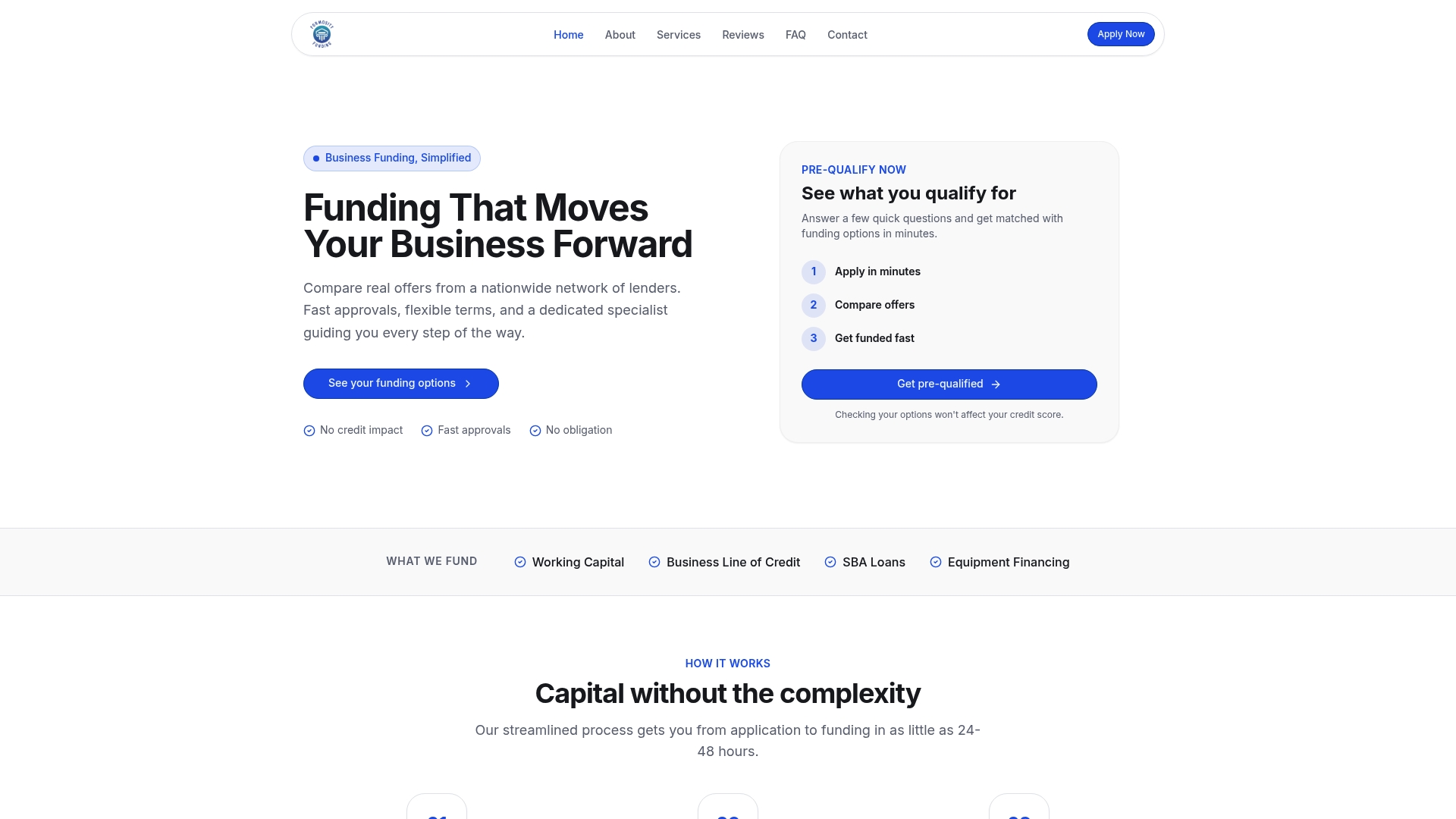
To see which products fit your business, start from our funding options page. If you own property or equity and want a different structure, take a look at the Business HELOC, and if card payments are part of your cash flow, our payment acceptance consultation is available.
Our perspective
Most owners treat a business loan as a single decision: yes or no. It is really a sequence, and the owners who move through it fastest are the ones who prepared before the first question was asked.
We built Formosity Funding around that sequence. One pre-qualification, no credit impact, and several real offers from a wide lender network means you compare actual terms instead of guessing. A dedicated funding specialist stays with you through application to funding, so the paperwork, the questions and the choice between a line of credit, an SBA loan or equipment financing are never yours to untangle alone.
Our advice is simple: know your purpose, gather your documents, compare by APR and total cost, and let the lenders compete for your business.
Alvin
FAQ
Can I get a business loan instantly online?
Pre-qualification can take minutes, and you can see offers quickly. Funding is a separate stage that follows underwriting and signing, and it depends on the product, the amount and how complete your documents are. A match or pre-qualification is not a guarantee of a loan.
Can a new LLC get a business loan?
Yes, though lenders will weigh the owner's personal credit, projected cash flow, collateral and your plan more heavily because there is little operating history. Prepare a clear plan and financial projections before you apply.
What is the monthly payment on a $50,000 business loan?
It depends on the rate, term and fees. As an illustration, $50,000 at 12% over 36 months is about $1,661 a month. Always compare offers by APR and total of payments rather than the monthly figure alone.
How hard is it to get a $1,000,000 business loan?
It requires a full underwriting file showing the business can repay from its earnings. SBA 7(a) loans can go up to $2,000,000 under 13 CFR § 120.172, and lenders review cash flow, equity, management experience and collateral. Strong financials and complete documents make the biggest difference.
Sources
- Lender Match, U.S. Small Business Administration
- Module 5 Small Business Financing Participant Guide, FDIC
- Small Business Lending Survey 2024, Section 3, FDIC
- Bulletin 2021-34 Attachment: SBA Lending Risk Management, OCC
- 13 CFR § 120.172, govinfo.gov
- Money Smart for Adults Module 7 Participant Guide, FDIC
- Money Smart for Adults Module 7 Instructor Guide, FDIC
- Comparing auto loans worksheet, CFPB