

Yes, you can get a business loan after bankruptcy. A prior filing does not create a federal ban on borrowing. Approval is mainly a lender's underwriting decision, and there is no universal federal waiting period, so timing, price and requirements depend on the lender and the product. What changes after a filing is the amount of proof you need: why it happened, what you fixed, and how the business pays the loan back today.
This guide walks through how each bankruptcy chapter affects the timeline, what lenders weigh, which types of financing tend to be open to you, and what to prepare before you apply.
TL;DR
- A bankruptcy does not legally bar you from a business loan, but you will face closer scrutiny and often higher costs.
- The chapter matters: Chapter 7 discharge usually comes fast, while Chapter 13 discharge comes only after the plan is fully paid.
- Bankruptcy can stay on a credit report for up to 10 years, so lenders weigh recent performance more than the filing alone.
- Flexible lenders (online, credit union, SBA intermediaries, asset-based) are often the first door that opens, usually at a higher cost than a bank.
- Disclose the filing, explain it, and document how finances have improved before you apply.
Table of Contents
- Why a past bankruptcy does not end your borrowing options
- How the bankruptcy chapter affects your timeline
- What lenders look at after a bankruptcy
- Financing types to consider after bankruptcy
- Our perspective
- How to improve your chances before you apply
- Find out what you qualify for
- FAQ
- Sources
Why a past bankruptcy does not end your borrowing options
No federal law says a person or company that went through bankruptcy cannot borrow again. What you meet instead is risk pricing. A lender looks at a discharged bankruptcy as evidence that debts once went unpaid, then asks whether anything has changed since.
The factors that come up again and again are credit history, repayment ability, collateral, current business performance and the circumstances of the filing. A bankruptcy caused by a one-time event, such as a medical emergency, a lost major customer or a disaster, reads very differently from one that followed years of overspending. Be ready to tell that story plainly and with documents behind it.
It also helps to know who is actually deciding. A bank may have a hard internal rule. A different lender may have none. When one lender says no, that tells you about that lender's policy, not about your whole market. If you want a broader picture of the gap between lender types, see our comparison of online lenders and banks for small businesses.
How the bankruptcy chapter affects your timeline
The chapter you filed under shapes when the case ends, and the end of the case is when most lenders start to take a serious look.
| Chapter | What it does | Discharge timing |
|---|---|---|
| Chapter 7 | Liquidation of non-exempt assets | A typical discharge may come about 90 days after filing when no objection is filed |
| Chapter 11 | Lets a debtor, usually a business, keep operating while a reorganization plan is confirmed | Follows plan confirmation, so it varies by case |
| Chapter 13 | Lets an eligible individual with regular income repay debts through a plan | After all plan payments are made, usually three to five years |
The descriptions and the Chapter 7 and 13 timing come from the U.S. Bankruptcy Court for the District of Hawaii's FAQ, and the court's Chapter 13 overview describes the same three-to-five-year repayment period.
Chapter 7
Because a Chapter 7 case is short, you can reach a discharge quickly. But a fast discharge does not mean fast lender acceptance. Many lenders want a stretch of clean payment history after discharge, and they care about what you did with that time: new accounts opened, paid on time, balances kept low.
Chapter 11
Chapter 11 is built for reorganization, so the business typically keeps operating. If you are in the middle of a case, borrowing generally needs court approval, and the specialized financing used during a case is a separate category from a regular term loan. Once the plan is confirmed and you have performed under it for a while, you look more like any other borrower with a recovery story.
Chapter 13
Chapter 13 is a personal filing, so it matters most for sole proprietors and for owners whose personal credit supports the business. While you are paying under the plan, lenders see an active repayment obligation. Completing the plan is a strong signal, because it shows several years of consistent payments. If the chapter choice is still ahead of you, this plain-language comparison of Chapter 7 and Chapter 13 explains how each affects what you can do afterward, including financing. Talk to a bankruptcy attorney before filing, since the right chapter depends on your entity type and your debts.
What lenders look at after a bankruptcy
Lenders do not use one checklist, but the SBA's 7(a) program is a useful model of the questions underwriters ask. According to the Congressional Research Service, lenders consider character, reputation, credit history, management experience, past earnings, projected cash flow, repayment ability, invested equity, long-term prospects and collateral. Notice that bankruptcy is only one input among many.
Credit reports and the 10-year window
The CFPB says bankruptcy information can remain on a credit report for up to 10 years from the date of entry of the order. That does not mean you wait 10 years. It means the filing stays visible while your newer, positive history builds on top of it. Lenders weigh the age of the filing and the quality of what has happened since.
Pull your reports before applying. If something is wrong, you can dispute it: the CFPB's summary of rights under the Fair Credit Reporting Act says consumers may dispute inaccurate or incomplete information, and a lender that denies you based on a consumer report must give an adverse-action notice naming the reporting agency. That notice is a useful clue about why you were declined.
Disclosure is not optional
Do not try to hide a filing. The SBA's 504 application form asks applicants and relevant owners whether they have ever declared bankruptcy and requires supporting documents. The same logic runs through private lending. A bankruptcy you explain is an underwriting question. A bankruptcy you omit is a credibility problem.
Current cash flow and collateral
The strongest counterweight to a past filing is present performance: steady deposits, profit or a clear path to it, and a debt load the business can carry. Collateral also helps. Nolo notes that most SBA loans require collateral, so think about which business or personal assets you could pledge. Our guide to SBA loan collateral covers what lenders usually look for.
Financing types to consider after bankruptcy
Nolo lists several routes that may be available after bankruptcy: SBA loans and Microloans, credit-union loans, online or alternative lenders, asset-based financing, invoice factoring, merchant cash advances, peer-to-peer lending and grants. It also reports that traditional banks generally set the strictest requirements, while online, credit-union, SBA-participating and alternative lenders may use more flexible underwriting, and that the flexible options commonly cost more.
Here is how to think about the main categories.
| Option | Why it can work after a filing | Watch out for |
|---|---|---|
| SBA Microloan | Smaller amounts, decisions by nonprofit intermediaries | Capped at $50,000; cannot refinance existing debt or buy real estate |
| SBA 7(a) or 504 | Long terms, government-backed | Heavy documentation, collateral, close review of the filing |
| Working capital or online term loans | Faster decisions, cash flow focus | Higher cost, short terms |
| Business line of credit | Flexible access to funds as needed | Limits may start low after a filing |
| Equipment financing | The equipment itself secures the loan | Down payment may be required |
| Invoice factoring or asset-based lending | Based on receivables or inventory rather than only credit | Fees; reporting requirements |
SBA programs
The SBA's lender page lists 7(a) loans up to $5 million, CDC/504 loans from $25,000 to $5.5 million and Microloans up to $50,000, and says 7(a) terms are negotiated with participating lenders. That last point matters here: because there is no single SBA bankruptcy rule you can cite to a lender, results vary by lender.

The Microloan route deserves a close look if your needs are modest. The SBA says eligible for-profit small businesses can borrow up to $50,000 through nonprofit intermediary lenders for working capital, inventory, supplies, machinery or equipment, but not for existing debt or real estate. Those intermediaries make all credit decisions and set the terms, so a small community lender may weigh your story differently than a large bank.
For 7(a) specifically, the CRS says applicants must be U.S.-located, for-profit operating small businesses that show a credit need and cannot get comparable nonfederal credit on reasonable terms. Credit score expectations have also shifted; see our breakdown of SBA loan credit scores. If the loan requires owner cash in, read how to document the SBA equity injection.
Online and alternative lenders
These lenders often decide on recent revenue and bank activity more than on a years-old filing. The tradeoff is price. Compare the true annual cost, not just the factor rate or monthly payment, and check how often payments are collected. For context on what ordinary pricing looks like, see our guide to business loan interest rates and line of credit rates.
Asset-based options
If you hold receivables, inventory or equipment, lenders can lend against them. That shifts the decision from your credit history to the quality of the assets. Our explainer on the borrowing base in asset-based lending shows how advance rates work.
Be careful with merchant cash advances
A merchant cash advance is one of the options Nolo lists, and it is often the easiest to get and the most expensive to carry. Before you sign anything, calculate the total repayment against the amount you receive, and ask what happens if sales dip. If the numbers only work in your best month, walk away.
Our perspective
We see the same pattern with owners who have a bankruptcy in their past: the filing is rarely the whole reason for a decline. More often the application is missing context. The owner did not explain it, the paperwork was thin, or the request did not match the lender. A business asking a bank for an unsecured term loan one year after discharge is in a different position from the same business asking a working capital lender to look at six months of deposits.

That is why we built our process around matching rather than guessing. Our marketplace connects small and medium-sized businesses with a nationwide network of lenders, and pre-qualification does not impact your credit. You can see which products and offers are realistic before you submit a full application and before more hard inquiries pile up on a report that is already under a microscope.
Our advice is to start with the smallest, cleanest request that solves your real problem. Take a modest line of credit or equipment loan, pay it exactly on time, and let that new record become the first thing a lender sees. A funding specialist can help you decide the order, because each approval strengthens the next one.
— Alvin
How to improve your chances before you apply
Nolo advises rebuilding credit, explaining the bankruptcy and providing proof that your finances have improved. Here is how that looks in practice.
- Confirm your discharge and get the paperwork. Keep the discharge order, schedule and, if you filed Chapter 11 or 13, the confirmed plan and proof of completed payments.
- Check all three of your credit reports. Fix errors, and make sure discharged debts show the correct status.
- Rebuild with small, on-time accounts. A secured card, a small vendor account or a modest loan, all paid on time and kept at low balances, shows the pattern lenders want.
- Separate business and personal finances. A dedicated business account with clean monthly statements gives an underwriter something to read.
- Write a one-page explanation. State what happened, what you changed, and how the business now covers its obligations. Keep it factual and short.
- Prepare recent financials. Bank statements, profit and loss statements, tax returns and a cash flow projection show repayment ability.
- Ask for an amount you can support. A smaller request that fits your cash flow is easier to approve than a large one that stretches it.
- Choose lenders deliberately. Fewer, better-matched applications beat many scattershot ones.
Our guides on raising your approval odds and the most common loan denial reasons go deeper on the application itself.
If old debts are still weighing on cash flow
If some debts survived the filing, such as a personally guaranteed loan or secured debt, they may be squeezing your monthly cash flow. In some cases a restructure helps, and our guide to business debt consolidation shows when it makes sense and when it does not. Check with your bankruptcy attorney or a CPA first, since debts that were part of your case may be treated differently.
Find out what you qualify for
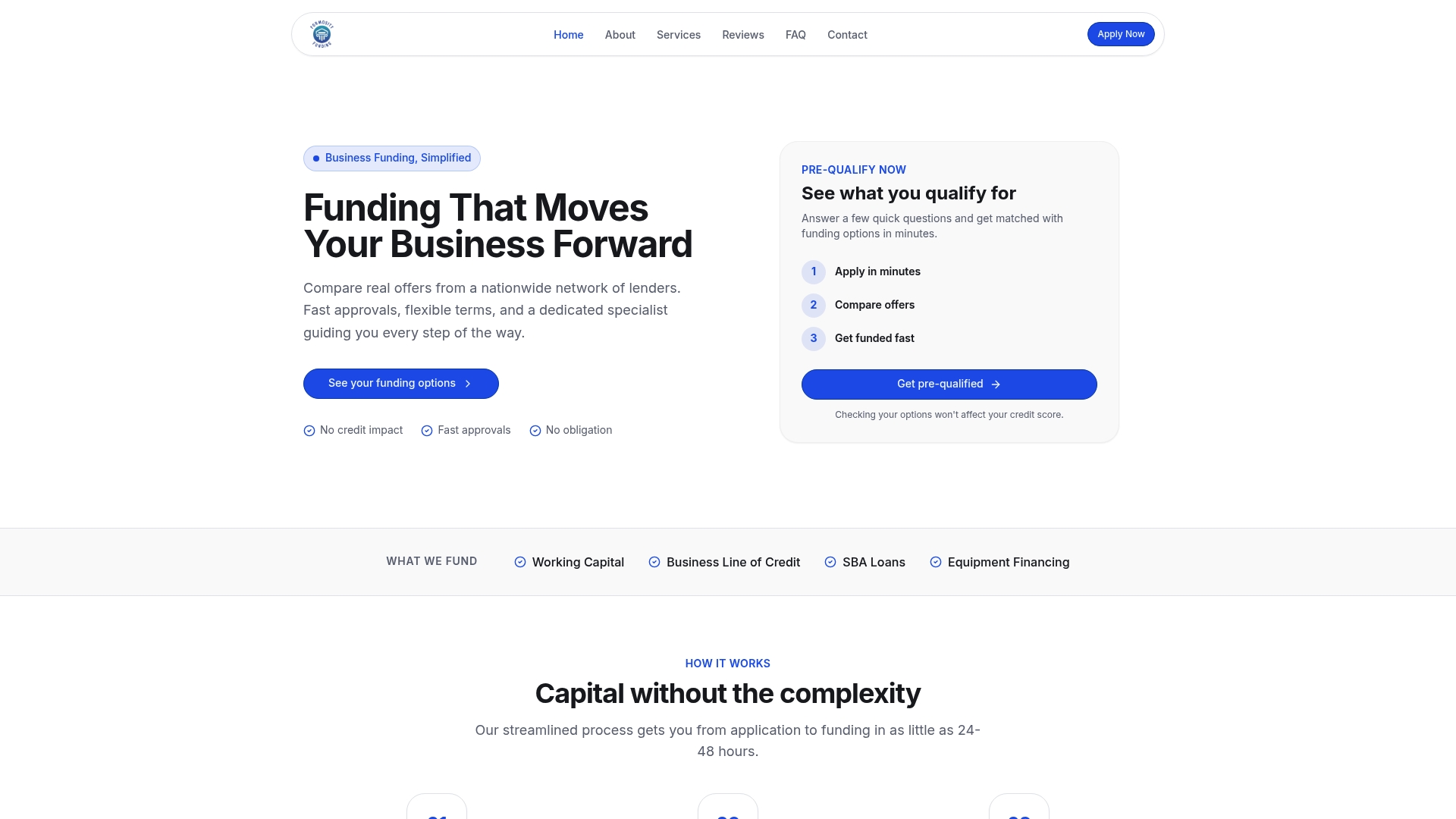
If you are past your discharge and want to see realistic options, we can help. Formosity Funding is a marketplace that matches businesses with lenders across the country, with offers for working capital, business lines of credit, SBA loans, equipment financing and commercial real estate. Pre-qualification has no credit impact, and a dedicated funding specialist guides you from application to funding. You can see the funding products we offer and start there.
If you own a home and want to understand whether it could back a business borrowing need, look at our Business HELOC page, and talk to your attorney about how your bankruptcy status affects that choice.
FAQ
How soon after bankruptcy can I apply for a business loan?
There is no universal federal waiting period. Each lender sets its own policy, and some will look at you soon after discharge if cash flow is strong, while others want a longer record. A Chapter 7 discharge typically comes about 90 days after filing, while Chapter 13 discharge comes after all plan payments are made.
Will bankruptcy stop me from getting an SBA loan?
Not automatically. The SBA's 7(a) program is delivered by participating lenders who consider character, credit history, cash flow and collateral, and terms are negotiated with them. Expect to disclose the filing and provide supporting documents.
How long does a bankruptcy stay on my credit report?
The CFPB says bankruptcy information can remain on a credit report for up to 10 years from the date of the order. Its weight in a lender's decision usually fades as you build a record of on-time payments.
What is the easiest type of financing to get after bankruptcy?
Online and alternative lenders, credit unions and asset-based or invoice financing tend to be more flexible than banks. They commonly cost more, so compare total repayment before you accept an offer.
Should I tell a lender about my bankruptcy?
Yes. Application forms often ask directly, and the SBA's 504 form requires disclosure and documents. Explaining the filing yourself, with proof of recovery, is far better than having it discovered in a credit pull.
Sources
- Can I Get a Business Loan After Bankruptcy? (LegalClarity)
- FAQs, District of Hawaii, United States Bankruptcy Court
- Chapter 13 Bankruptcy Basics, U.S. Courts
- Small Business Administration 7(a) Loan Guaranty Program, Congressional Research Service
- How long does a bankruptcy appear on credit reports? (CFPB)
- A Summary of Your Rights Under the Fair Credit Reporting Act (CFPB)
- SBA Application for Section 504 Loan (Form 1244)
- Getting Small Business Loans After Bankruptcy (Nolo)
- Microloans, Small Business Administration
- SBA lender resources
- Chapter 7 vs 13 Bankruptcy: Which One Fits You?